Day 338 of 365 · Week 46
Pulling up and cruising, month twelve
Last reviewed · 4 min read · 10 sources · Plain-text version
Pulling up to stand and walking while holding furniture are 1-year milestones, with standing alone anywhere from 6.9 to 16.9 months. A box to push, with you spotting. Push-and-carry walks.
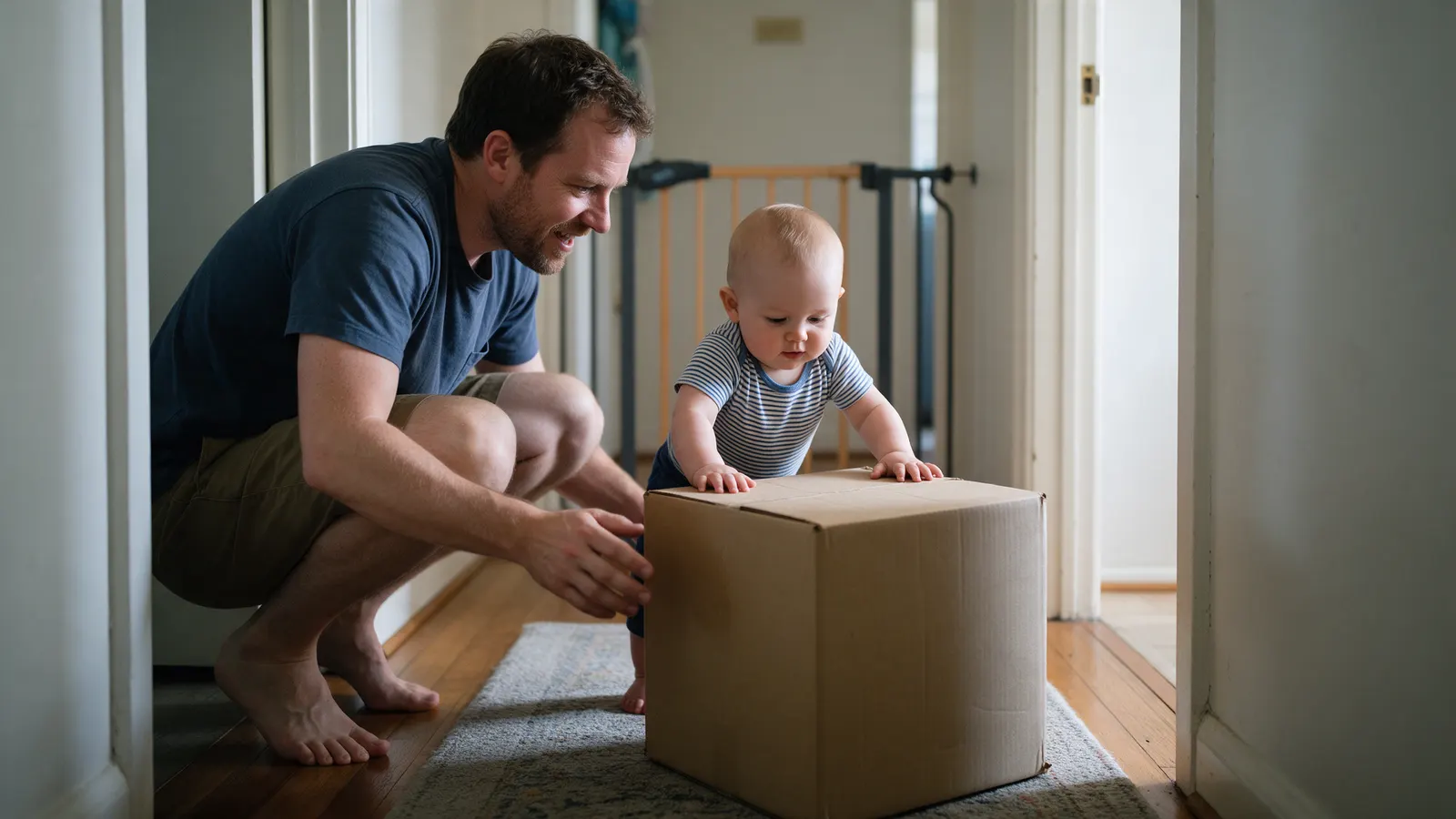
The furniture tour is the main event of the eleventh month for many babies: up at the sofa, sideways along it, across the gap to the chair, down with a thump. Today is where that's heading, how wide the range is, and the push toy that's a safe version of the next step.
Heart
By 1 year, most babies pull up to stand and walk while holding on to furniture (CDC). The AAP's order of events: pulling up to stand, often before they know how to get back down, then cruising sideways along furniture, then wobbly first steps, which many babies take around their first birthday (AAP). "Around" is doing a lot of work in that sentence. In the WHO's study of 816 healthy children, standing alone started anywhere from 6.9 to 16.9 months, and walking alone from 8.2 to 17.6 (WHO Multicentre Growth Reference Study Group, 2006). Your baby is 11 months old and inside both windows, whatever they're doing today.
Head
What helps is practice, and practice means floor and furniture, not gadgets. Filmed during free play, 12- to 19-month-olds averaged 2,368 steps and 17 falls per hour (Adolph et al., 2012). Baby walkers don't help; they can delay walking and cause injuries (AAP), and CDC says instead to let babies push things around, such as empty boxes (CDC). The 1-year guide's Push-and-carry walks is that idea, grown up: a sturdy push toy, a laundry basket, or a small chair to push across the floor, and once they walk, something light to carry. Today is the push half only.
Body
A cruising baby has reached everything at table height, so the room gets another pass. CDC's advice is to place your baby near furniture they can safely pull up on (CDC; CDC); anchor bookcases, dressers, and TV stands to the wall, and put gates at the top and bottom of stairs, mounted to the wall studs (AAP). The crib mattress goes to its lowest position before your baby learns to stand (AAP). And if they get stuck standing, show them how to bend their knees to sit down; the AAP suggests it to save you many trips to a crib where a baby is standing and crying (AAP).
Try today
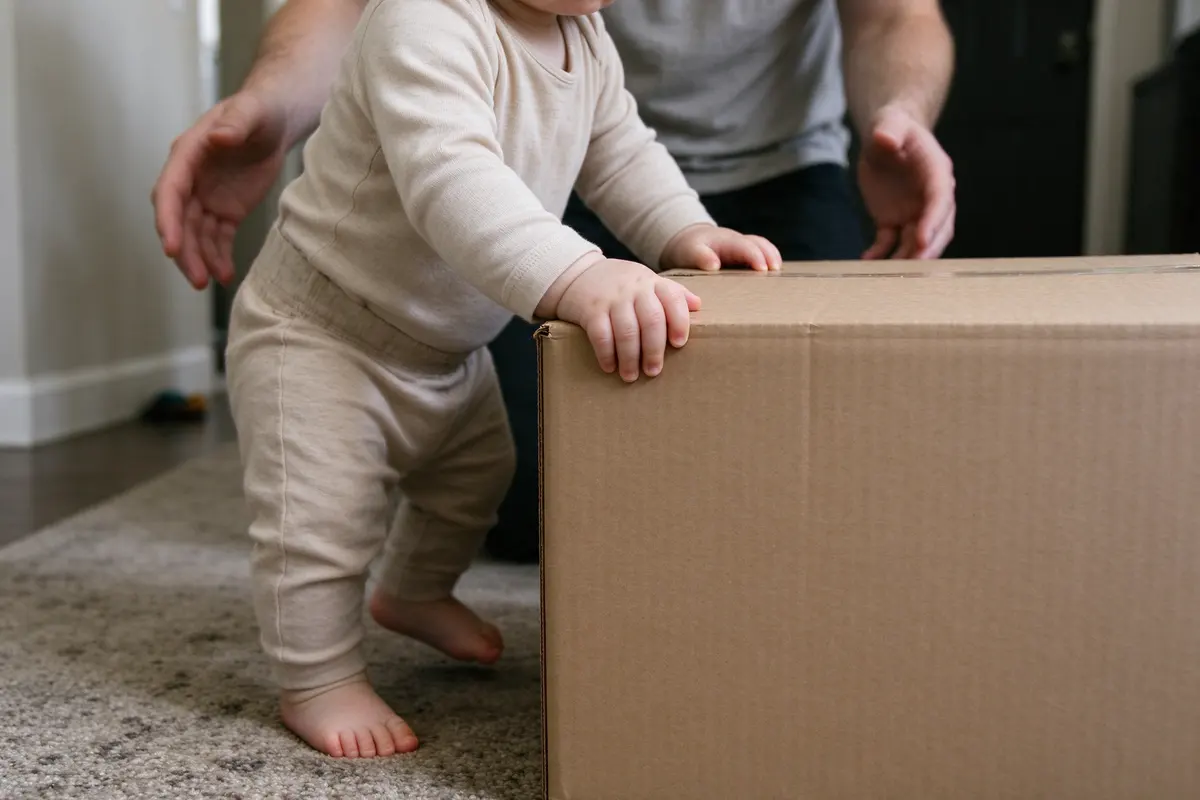
Push-and-carry walks
Time: 5 minutes, a few times today · Push-and-carry walks in the guide
Find a sturdy box with some weight in it, a diaper box with a few books inside, or a laundry basket with the laundry still in it. It should slide, not skid.
Stand your baby behind it with both hands on the edge, on a rug, pointed away from the stairs (CDC).
Walk beside them with your hands a few inches from their back, and let them push. Cheer the trip, not the arrival.
When they sit down, the walk is over. The carrying half of this activity waits until they walk (Adolph et al., 2012).
Watch for
Normal
a baby found standing in the crib at dawn, holding the rail, unsure how to get down; the mattress at its lowest is the answer (AAP).
Call your pediatrician now
for any head injury in a baby under 1 year, even if your baby seems fine (AAP).
Normal
a box that outruns the baby and a sit-down onto a diapered bottom; 17 falls an hour is what the walkers in the study managed (Adolph et al., 2012).
Call 911
if, after a fall, your baby has a seizure, was knocked out for more than a minute, or is confused or unsteady (AAP).
Normal
both hands on the sofa all month and no interest in letting go; standing alone has until 16.9 months in the WHO's range (WHO Multicentre Growth Reference Study Group, 2006).
Ask about a developmental screening
if your baby isn't pulling to stand by 12 months (CDC).
For you
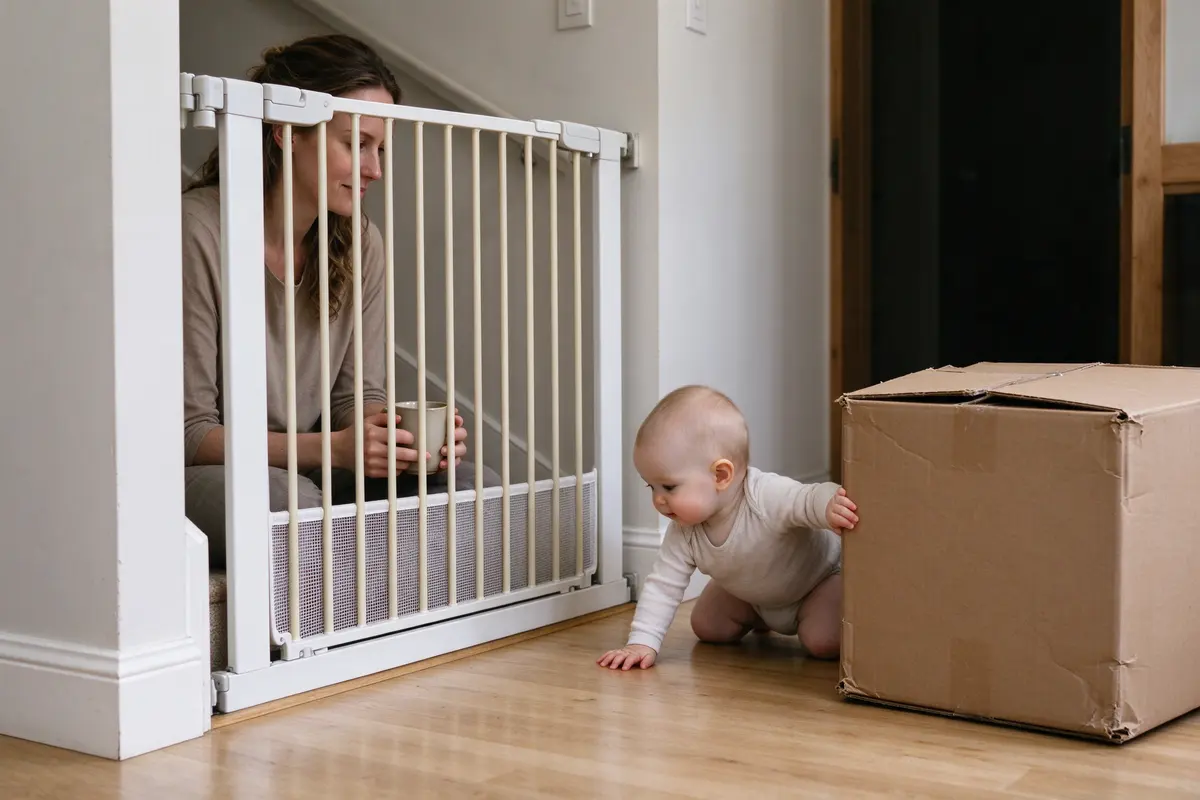
The pace is theirs. The hard part of this week isn't the box; it's the cousin who walked at ten months, and the question that comes with it. The WHO's windows are the answer: nearly all healthy children started walking alone between 8.2 and 17.6 months (WHO Multicentre Growth Reference Study Group, 2006), a span of more than nine months, and your baby is in the early middle of it. The only thing in the window that's yours to supply is floor, furniture that won't tip, and time (AAP). Walking is learned a fall at a time, thousands of steps a day (Adolph et al., 2012), and none of those steps can be yours.
If you're the partner: the push box is the toy you make, not buy. Weight it, test it on the rug, and be the hands behind the back tonight.
Sources
- Centers for Disease Control and Prevention. "Milestones by 1 Year." Learn the Signs. Act Early. program, updated 2026. https://www.cdc.gov/act-early/milestones/1-year.html
- American Academy of Pediatrics. "Movement Milestones in Babies 8 to 12 Months Old." HealthyChildren.org, updated 2021. https://www.healthychildren.org/English/ages-stages/baby/Pages/Movement-8-to-12-Months.aspx
- WHO Multicentre Growth Reference Study Group. "WHO Motor Development Study: windows of achievement for six gross motor development milestones." Acta Paediatrica Supplement, 2006. https://pubmed.ncbi.nlm.nih.gov/16817682/
- Adolph KE, Cole WG, Komati M, et al. "How do you learn to walk? Thousands of steps and dozens of falls per day." Psychological Science, 2012. https://pubmed.ncbi.nlm.nih.gov/23085640/
- American Academy of Pediatrics. "Baby Walkers: A Dangerous Choice." HealthyChildren.org, updated 2022. https://www.healthychildren.org/English/safety-prevention/at-home/Pages/Baby-Walkers-A-Dangerous-Choice.aspx
- Centers for Disease Control and Prevention. "Milestones by 9 Months." Learn the Signs. Act Early. program, updated 2026. https://www.cdc.gov/act-early/milestones/9-months.html
- American Academy of Pediatrics. "Home Safety: Tips for Families With Young Children." HealthyChildren.org, updated 2022. https://www.healthychildren.org/English/safety-prevention/at-home/Pages/Home-Safety-Heres-How.aspx
- American Academy of Pediatrics. "Make Baby's Room Safe: Parent Checklist." HealthyChildren.org, updated 2020. https://www.healthychildren.org/English/safety-prevention/at-home/Pages/Make-Babys-Room-Safe.aspx
- American Academy of Pediatrics. "Safety for Your Child: 1 to 2 Years." HealthyChildren.org, updated 2022. https://www.healthychildren.org/English/ages-stages/toddler/Pages/safety-for-your-child-1-to-2-years.aspx
- American Academy of Pediatrics. "Head Injury" (symptom checker). HealthyChildren.org, accessed 2026. https://www.healthychildren.org/English/tips-tools/symptom-checker/Pages/symptomviewer.aspx?symptom=Head+Injury
This guide is general education that summarizes published research and guidance from groups like the American Academy of Pediatrics, the CDC, and the WHO. It isn’t medical advice, and every child develops on their own timeline. Your pediatrician knows your child; if something feels wrong, call them. In an emergency, call 911.
Get each day’s note the morning it applies
Add your baby to a free Chorevia household with their date of birth, and every morning for 365 days the day’s note arrives in the app and by email: what’s developing, one thing to try, what to watch for, and a word for you.
Create your household