Day 353 of 365 · Week 48
Napkins to the table
Last reviewed · 4 min read · 15 sources · Plain-text version
Carrying napkins or spoons to the table is on CDC's list of jobs for toddlers. Make it a game, find the safe version of every job, and say thank you. The napkin carrier: one napkin, one trip.

The sock went in the basket, the blocks went in the bin, and tonight something goes to the table. Twelve days from the birthday, this is the job on CDC's list that fits a baby who can't walk yet, if you carry the baby.
Heart
CDC suggests including your child in everyday tasks, like fetching shoes, putting snacks in a bag, or carrying napkins to the table (CDC; CDC). The AAP's advice: even if it takes longer, make it a game, and if a job is unsafe, find another one they can do; don't discourage the urge to help (AAP). Those lists are written for toddlers who walk, and taking a few steps alone is a 15-month milestone (CDC). An 11-month-old who cruises (CDC) needs the safe version: the napkin travels in their hand while they travel in yours.
Head
What makes it a job rather than a toy is the handover. Passing a toy back and forth is a CDC turn-taking game from 9 months (CDC), and in experiments, 12-month-olds pointed to show an adult where a lost object was, more often when the adult hadn't seen where it went (Liszkowski et al., 2008). A napkin asked for, carried, and handed over to someone who needed it is that same wish to be useful, with a table at the end of it. The thank-you describes the effort, "You carried the napkin!", which is the praise the small Gunderson study tracked (Gunderson et al., 2013).
Body
The safe version of every job has the same shape: nowhere near the stove, hot drinks, cleaning products, or buckets of water (AAP). Hot liquids in cups and mugs cause 27% to 60% of scald burns in children under 5, and the rule is never to carry a hot drink while holding your baby and to keep mugs away from table edges (AAP). So the napkin trip happens before the pot comes to the table, and the baby's job ends in the high chair with the harness on. The guide's section is Family jobs for helpers in diapers.
Try today
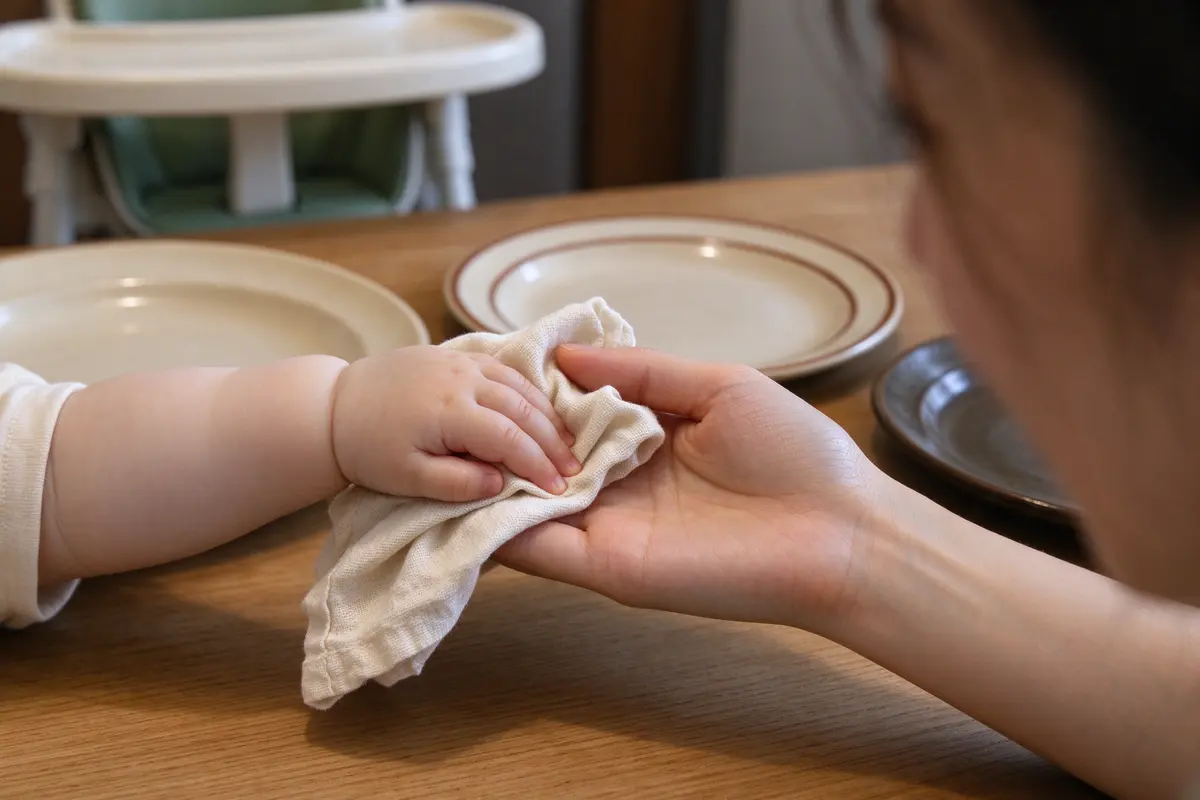
The napkin carrier
Time: 1 minute, before dinner · Family jobs for helpers in diapers in the guide
With the table set except for one napkin and the stove still off, pick your baby up and hand them a cloth napkin: "Napkin for Mama."
Walk to the table together and stop at the chair that needs it. Hold out the other adult's hand, or your own, and wait (CDC).
However it arrives, dropped, thrown, or pressed into the palm, say thank you and say what they did: "You carried the napkin to the table!" (AAP)
Into the high chair, harness buckled, and dinner. One napkin, one trip; tomorrow, maybe two.
Make it work:Nothing hot is on the table until the baby is strapped in (AAP).
Watch for
Normal
a napkin chewed the whole way there and delivered damp; everything still goes in the mouth (AAP).
Call your pediatrician right away
if your baby has great trouble swallowing fluids or spit (AAP).
Normal
a napkin that won't be given up at the table and is eaten over, like a blanket.
Go to the ER now
if your baby might have swallowed a button battery or a magnet, or can't swallow, drools, or gags after swallowing something (AAP).
Normal
a job that takes four minutes instead of ten seconds; the AAP's line is even if it takes longer (AAP).
Call your pediatrician now
for any head injury in a baby under 1, even if your baby seems fine (AAP).
Normal
knowing, from the way the napkin is held out, that the baby understood the job.
Call anyway
if your baby just doesn't seem right to you. Trust your instincts; three hundred and fifty-three days have built them (Lurie Children's).
For you
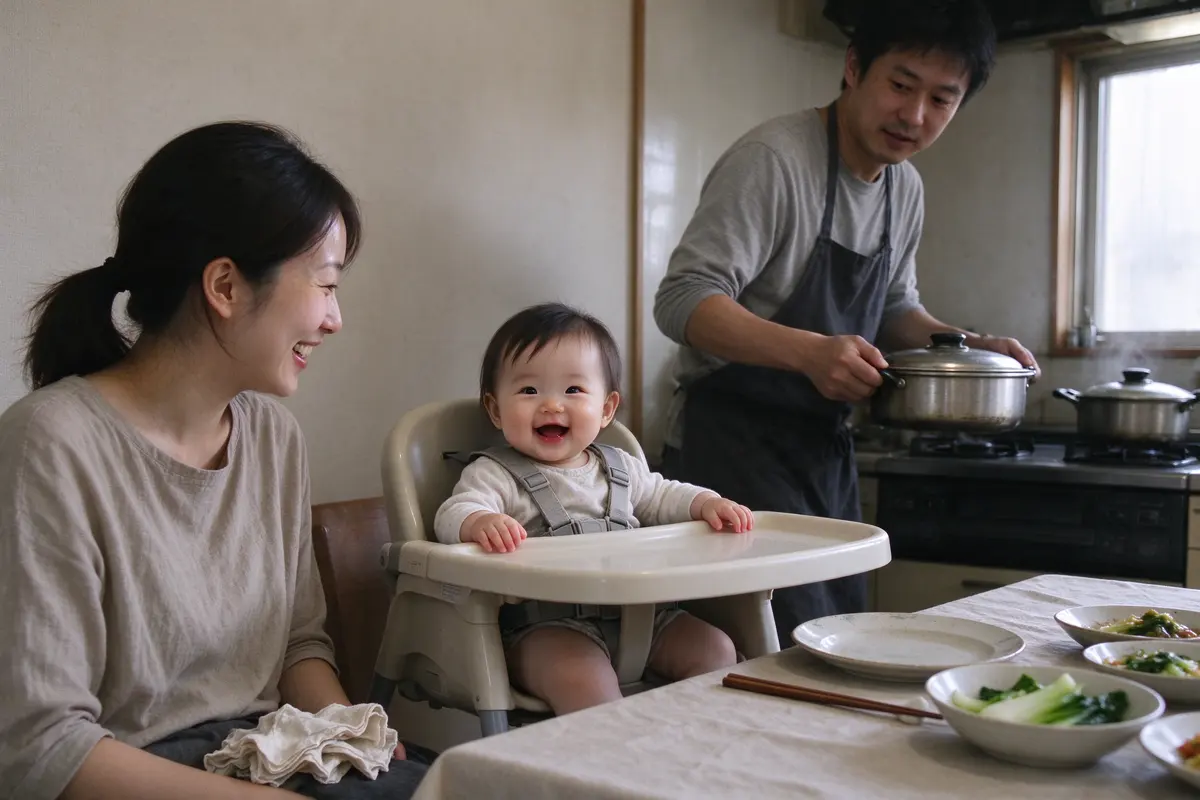
The job that takes longer is still the job. The AAP wrote that line for parents who could set the table in nine seconds and are now watching it take four minutes with a detour to the dog (AAP). Those four minutes are the price of a child who, years from now, sets the table without being asked. In a survey of more than 500 families, most parents said their toddler's help was sometimes unhelpful (Hammond & Brownell, 2018); they kept letting them help anyway, which is the whole trick.
If you're the partner: your napkin tonight is the one that arrives damp. Receive it like it's clean.
Sources
- Centers for Disease Control and Prevention. "Milestones by 15 Months." Learn the Signs. Act Early. program, updated 2026. https://www.cdc.gov/act-early/milestones/15-months.html
- Centers for Disease Control and Prevention. "Milestones by 2 Years." Learn the Signs. Act Early. program, updated 2026. https://www.cdc.gov/act-early/milestones/2-years.html
- American Academy of Pediatrics. "Social Development: 1 Year Olds." HealthyChildren.org, updated 2009. https://www.healthychildren.org/English/ages-stages/toddler/Pages/Social-Development-1-Year-Olds.aspx
- Centers for Disease Control and Prevention. "Milestones by 1 Year." Learn the Signs. Act Early. program, updated 2026. https://www.cdc.gov/act-early/milestones/1-year.html
- Centers for Disease Control and Prevention. "Milestones by 9 Months." Learn the Signs. Act Early. program, updated 2026. https://www.cdc.gov/act-early/milestones/9-months.html
- Liszkowski U, Carpenter M, Tomasello M. "Twelve-month-olds communicate helpfully and appropriately for knowledgeable and ignorant partners." Cognition, 2008. https://pubmed.ncbi.nlm.nih.gov/18721918/
- Gunderson EA, Gripshover SJ, Romero C, et al. "Parent praise to 1- to 3-year-olds predicts children's motivational frameworks 5 years later." Child Development, 2013. https://pubmed.ncbi.nlm.nih.gov/23397904/
- American Academy of Pediatrics. "Safety for Your Child: 1 to 2 Years." HealthyChildren.org, updated 2022. https://www.healthychildren.org/English/ages-stages/toddler/Pages/safety-for-your-child-1-to-2-years.aspx
- American Academy of Pediatrics. "Infant Drowning Prevention & Water Safety: How to Protect Your Baby." HealthyChildren.org, updated 2026. https://www.healthychildren.org/English/safety-prevention/at-play/Pages/Infant-Water-Safety.aspx
- American Academy of Pediatrics. "Cognitive Development in Infants: 8 to 12 Months." HealthyChildren.org, updated 2023. https://www.healthychildren.org/English/ages-stages/baby/Pages/Cognitive-Development-8-to-12-Months.aspx
- American Academy of Pediatrics. "Fever" (symptom checker). HealthyChildren.org, accessed 2026. https://www.healthychildren.org/English/tips-tools/symptom-checker/Pages/symptomviewer.aspx?symptom=Fever
- American Academy of Pediatrics. "Swallowed Foreign Object" (symptom checker). HealthyChildren.org, accessed 2026. https://www.healthychildren.org/English/tips-tools/symptom-checker/Pages/symptomviewer.aspx?symptom=Swallowed+Foreign+Object
- American Academy of Pediatrics. "Head Injury" (symptom checker). HealthyChildren.org, accessed 2026. https://www.healthychildren.org/English/tips-tools/symptom-checker/Pages/symptomviewer.aspx?symptom=Head+Injury
- Latimer T. "When to Call the Pediatrician for Your Newborn." Lurie Children's Hospital of Chicago, 2022. https://www.luriechildrens.org/en/blog/when-to-call-the-pediatrician-for-your-newborn/
- Hammond SI, Brownell CA. "Happily Unhelpful: Infants' Everyday Helping and its Connections to Early Prosocial Development." Frontiers in Psychology, 2018. https://pubmed.ncbi.nlm.nih.gov/30298039/
This guide is general education that summarizes published research and guidance from groups like the American Academy of Pediatrics, the CDC, and the WHO. It isn’t medical advice, and every child develops on their own timeline. Your pediatrician knows your child; if something feels wrong, call them. In an emergency, call 911.
Get each day’s note the morning it applies
Add your baby to a free Chorevia household with their date of birth, and every morning for 365 days the day’s note arrives in the app and by email: what’s developing, one thing to try, what to watch for, and a word for you.
Create your household