Day 333 of 365 · Week 45
Bye-bye, hello
Last reviewed · 4 min read · 9 sources · Plain-text version
Waving bye-bye is on the 1-year list, and a wave is a word before words. Every arrival and departure in the house gets a wave with a name on it today. The doorway wave.
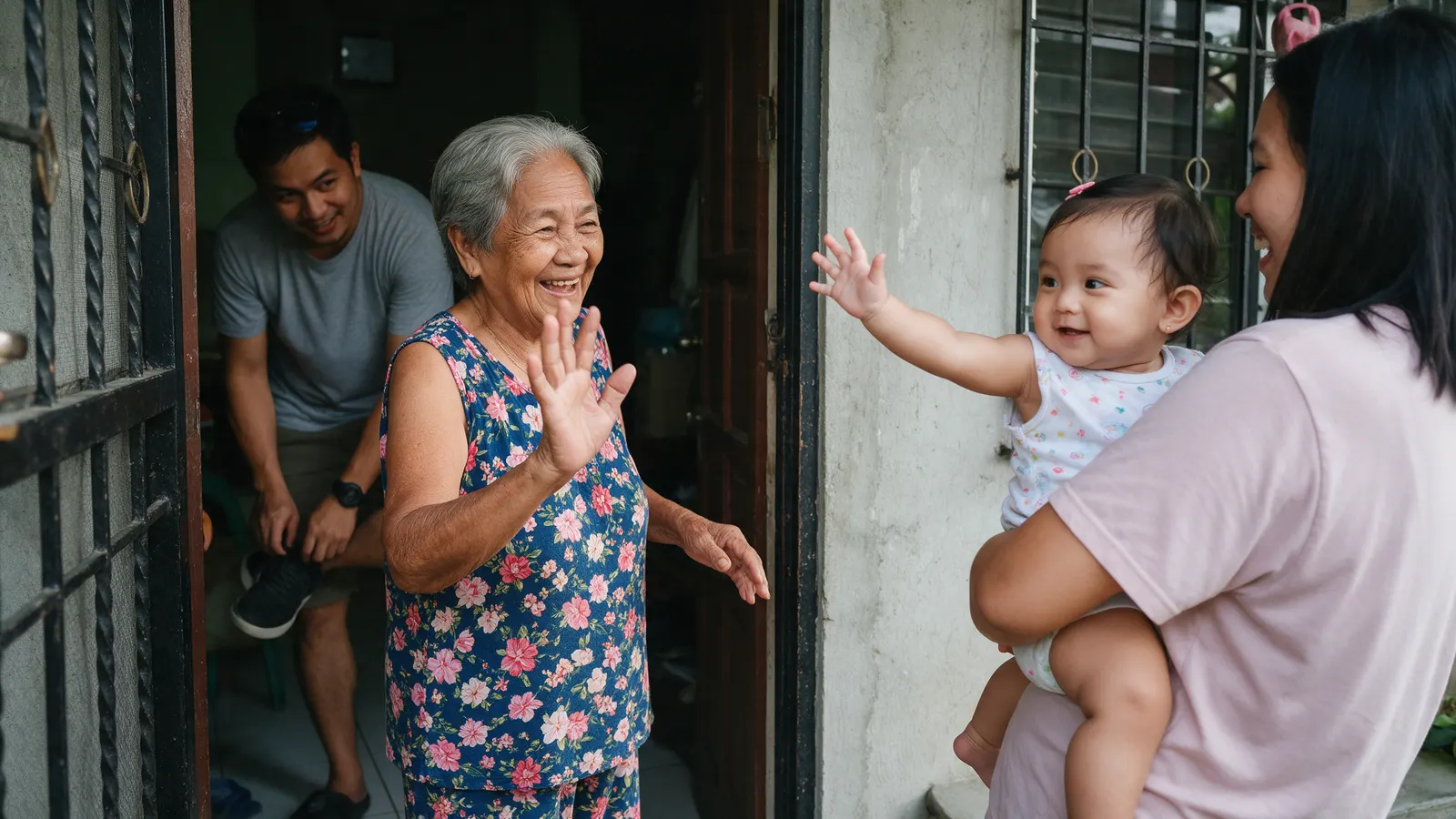
"Bye-bye" may be the first word your baby says with a hand instead of a mouth. Today is every coming and going in the house, named and waved, because the wave is a word, and words get learned by being used.
Heart
By 1 year, most babies wave "bye-bye" (CDC). Most point to ask for something or get help by 15 months (CDC), so the wave usually comes first among the gestures. Toward the end of the first year, babies start using pointing and gestures to say what they want, and they copy the gestures they see you use (AAP). A wave is the easiest gesture to copy because it comes with a sound and a moment: someone is leaving, everyone says it, everyone does it.
Head
The guide's instruction is to teach gestures on purpose: wave bye-bye, shake your head for "no," and lift your arms to say "up" (CDC). Gestures aren't a detour around talking; they're the road. In a study of 10 toddlers, many of the things children first pointed at later became words (Iverson & Goldin-Meadow, 2005). And the CDC's don't-wait list has the wave on it: bring it up if by 12 months your baby doesn't wave bye-bye (CDC). That date is five weeks off. A baby who hasn't waved at eleven months is inside the normal spread, and a baby who waves at the bus and never at a person is still waving.
Body
A wave from a standing baby is a balance test: one hand leaves the sofa. Standing alone ran from 6.9 to 16.9 months in the WHO's study of 816 healthy children (WHO Multicentre Growth Reference Study Group, 2006), so the hand that comes off to wave may be the first second of standing alone, or it may bring the whole baby down onto a diapered bottom. Either is fine on a cleared floor. The other place the wave happens is the high chair, harness on, where both arms are free to flap.
Try today
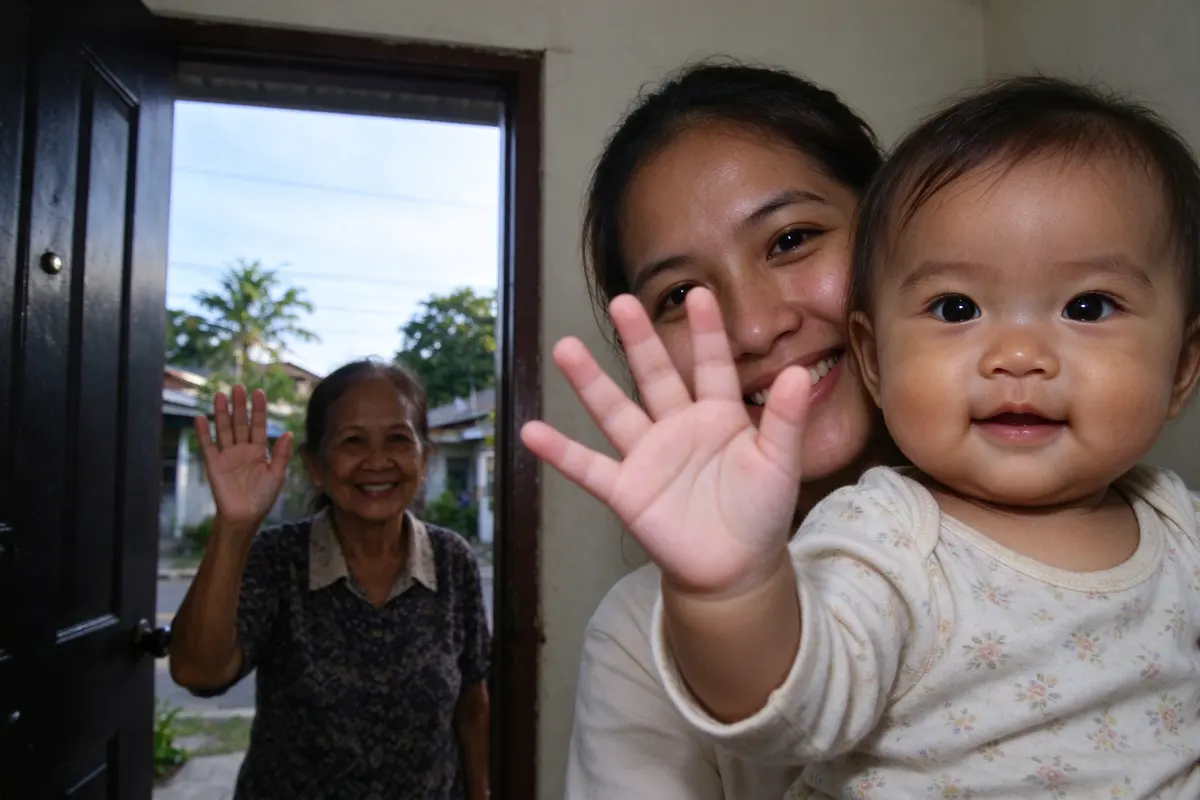
The doorway wave
Time: 10 seconds, at every doorway today · Bye-bye and pat-a-cake in the guide
Every time anyone leaves a room or the house, stop at the doorway, wave, and name it: "Bye-bye, Daddy." Help your baby's hand wave too, if they want it (CDC).
Every arrival gets the same: "Hello, Grandma," and a wave, so the gesture has two meanings and twice the practice.
Wave at things that leave too: the bus, the dog going out, the water going down the drain.
Once today, leave the room with the wave and a "back soon," and come back when you said you would (Swanson, AAP).
Make it work:Say the words every time. The gesture gets copied, and the word rides along with it (AAP).
Watch for
Normal
a wave that's a whole-arm flap, or a hand opening and closing at the wrist, aimed at the door after it has shut.
Bring it up
if by 12 months your baby doesn't wave bye-bye (CDC).
Normal
tears at the doorway even with the wave; separation anxiety peaks between 10 and 18 months and is a sign of attachment (AAP).
Call your pediatrician right away
if your baby has a fever over 104°F (40°C) (AAP).
Normal
a wave offered to the grandmother only from your arms; even favorite relatives can make a baby cry if they swoop in fast (AAP).
Go to the ER now
if your baby is hard to wake, isn't alert when awake, or seems confused (AAP).
For you

The wave is a word, and it's also your goodbye ritual, which is why today's game does double duty. The AAP's advice for goodbyes is a quick, cheerful one, the same short ritual every time, and a return when you said you would (Swanson, AAP); never sneak away, even if your baby cries (CDC). A wave at every doorway, all day, means the wave at the real goodbye isn't a new thing happening at a hard moment. It's the ordinary thing. That makes it easier on the baby, since tears usually stop within minutes of your leaving (AAP), and easier on you, because the ritual gives your hands something to do on the way out.
If you're the partner: the hello matters as much as the bye-bye. Walk in, stop, wave, and say your own name for yourself, "Hi, it's Dada," before you pick up the baby.
Sources
- Centers for Disease Control and Prevention. "Milestones by 1 Year." Learn the Signs. Act Early. program, updated 2026. https://www.cdc.gov/act-early/milestones/1-year.html
- Centers for Disease Control and Prevention. "Milestones by 15 Months." Learn the Signs. Act Early. program, accessed 2026. https://www.cdc.gov/act-early/milestones/15-months.html
- American Academy of Pediatrics. "Language Development: 8 to 12 Months." HealthyChildren.org, updated 2009. https://www.healthychildren.org/English/ages-stages/baby/Pages/Language-Development-8-to-12-Months.aspx
- Centers for Disease Control and Prevention. "Milestones by 9 Months." Learn the Signs. Act Early. program, updated 2026. https://www.cdc.gov/act-early/milestones/9-months.html
- Iverson JM, Goldin-Meadow S. "Gesture paves the way for language development." Psychological Science, 2005. https://pubmed.ncbi.nlm.nih.gov/15869695/
- WHO Multicentre Growth Reference Study Group. "WHO Motor Development Study: windows of achievement for six gross motor development milestones." Acta Paediatrica Supplement, 2006. https://pubmed.ncbi.nlm.nih.gov/16817682/
- Swanson WS. "How to Ease Your Child's Separation Anxiety." HealthyChildren.org, updated 2026. https://www.healthychildren.org/English/ages-stages/toddler/Pages/Soothing-Your-Childs-Separation-Anxiety.aspx
- American Academy of Pediatrics. "Emotional and Social Development: 8 to 12 Months." HealthyChildren.org, updated 2009. https://www.healthychildren.org/English/ages-stages/baby/Pages/Emotional-and-Social-Development-8-12-Months.aspx
- American Academy of Pediatrics. "Fever" (symptom checker). HealthyChildren.org, accessed 2026. https://www.healthychildren.org/English/tips-tools/symptom-checker/Pages/symptomviewer.aspx?symptom=Fever
This guide is general education that summarizes published research and guidance from groups like the American Academy of Pediatrics, the CDC, and the WHO. It isn’t medical advice, and every child develops on their own timeline. Your pediatrician knows your child; if something feels wrong, call them. In an emergency, call 911.
Get each day’s note the morning it applies
Add your baby to a free Chorevia household with their date of birth, and every morning for 365 days the day’s note arrives in the app and by email: what’s developing, one thing to try, what to watch for, and a word for you.
Create your household