Day 341 of 365 · Week 46
Shoes for the first steps
Last reviewed · 4 min read · 8 sources · Plain-text version
No shoes until walking outside, and then closed-toe, flexible, nonskid, with room to grow and no special arches. Barefoot inside, shoes for out. The barefoot-inside rule.
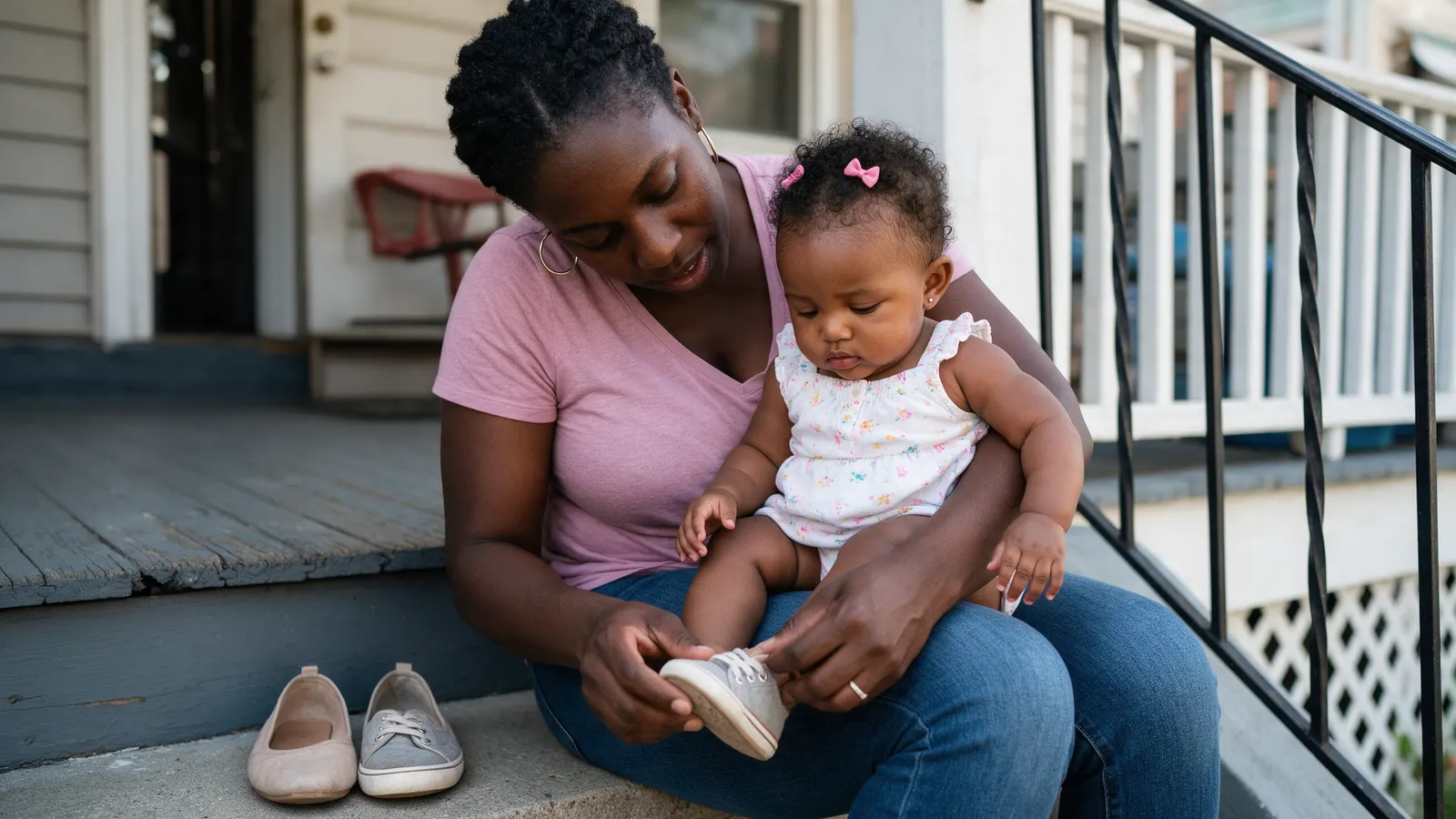
Someone has given you shoes, or will. Today is what the AAP actually says about them, which is less than the shoe aisle does, and a house rule that costs nothing.
Heart
Your baby doesn't need shoes until they start walking outside, and special "supportive" shoes have no proven benefit (AAP). When the time comes, choose closed-toe, comfortable, flexible shoes with nonskid soles and room to grow; sneakers are a great choice. Skip wedges, inserts, high backs, and special arches: they have no proven benefit for most children and may make walking harder. A first pair usually lasts 2 to 3 months, so check the fit monthly (AAP). The guide's question is Does my baby need shoes to learn to walk?
Head
The one indoor note in the guides is about floors, not feet: on slippery floors, nonskid shoes like sneakers help toddlers stay steady (AAP). That's a line for a walking toddler on a polished floor, not a reason to put shoes on a cruising baby on a rug. For an 11-month-old who stands at the sofa and pushes a box down the hall, the AAP's answer is bare feet until the walking moves outdoors (AAP).
Body
Feet grow fast enough that the check matters more than the shoe: monthly, because a pair lasts 2 to 3 months (AAP). The rest of the body is the actual first-steps equipment. Standing alone ran from 6.9 to 16.9 months and walking alone from 8.2 to 17.6 in the WHO's study (WHO Multicentre Growth Reference Study Group, 2006), and once walking starts it's learned through thousands of steps and dozens of falls a day (Adolph et al., 2012). None of that needs a shoe. The one thing sold as walking equipment that does get bought, the walker, doesn't help and can delay walking (AAP).
Try today
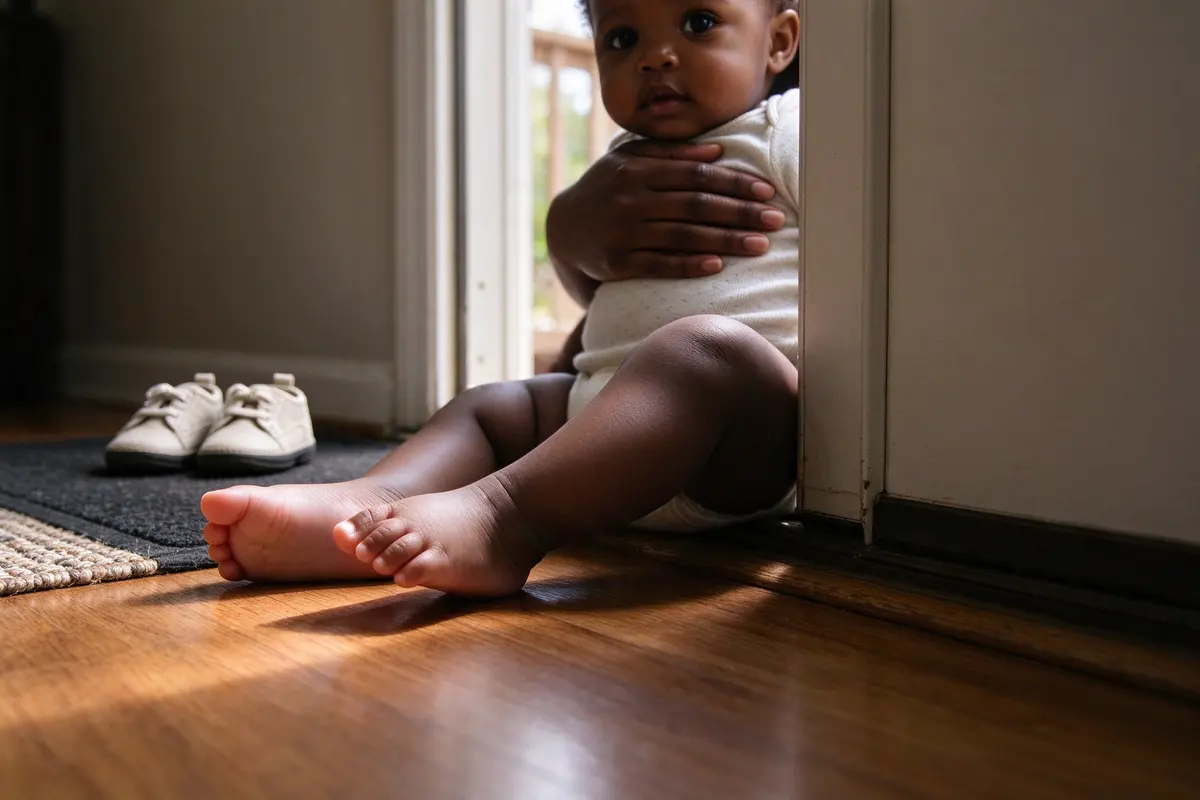
The barefoot-inside rule
Time: 2 minutes to agree, then it's the rule · Does my baby need shoes to learn to walk? in the guide
Shoes live by the door, on the outside of the rule. Inside, the baby goes barefoot, or in socks on carpet; on a slick floor, bare feet rather than socks, since nonskid is the point (AAP).
If shoes have been given, check them against the list: closed toe, a sole you can bend in your hand, nonskid, room to grow at the toe, and no wedge, insert, high back, or built-up arch (AAP).
Shoes go on for walking outside, when that starts, and for nothing else (AAP).
Write the date on the box. Once they're in use, the fit check is monthly, because a pair lasts 2 to 3 months (AAP).
Make it work:Tell the grandparents the rule once, kindly, so the shoes they bought are for the park, not the kitchen.
Watch for
Normal
feet that turn out, toes that curl on cold tile, and a shoe pulled off and chewed within a minute; none of it is a shoe problem.
Talk with your pediatrician
if your baby favors one side or doesn't seem to be moving normally (AAP).
Normal
a slide on the kitchen floor in socks and a sit-down.
Call your pediatrician now
for any head injury in a baby under 1 year, even if your baby seems fine (AAP).
Normal
outrage at shoes going on at all.
Call your pediatrician right away
if your baby has a fever over 104°F (40°C) (AAP).
For you
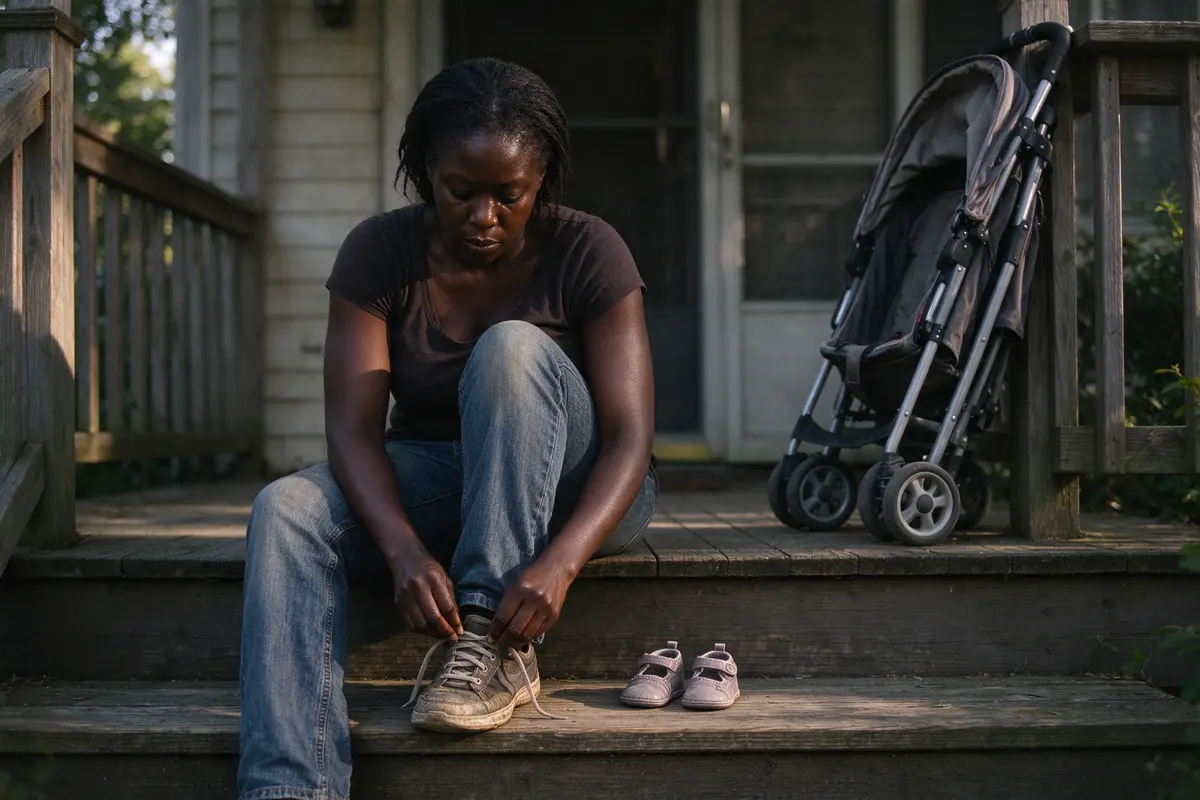
Your own flat shoes, because the list is the same, comfortable, flexible, nonskid, room to move (AAP), and because the next year has stairs with a bigger child on your hip. One line that isn't about shoes: dizziness or fainting is on the CDC's list of urgent maternal warning signs for the full year after birth (CDC). A wobble on the stairs with the baby in your arms isn't the shoes, and it isn't tiredness to push through. It's a call, and the person you call needs to know you were pregnant within the last year (CDC).
If you're the partner: the barefoot rule is yours to keep too. Shoes off at the door, yours included, so the floor the baby crawls on is a floor you'd eat off.
Sources
- American Academy of Pediatrics. "Movement Milestones in Babies 8 to 12 Months Old." HealthyChildren.org, updated 2021. https://www.healthychildren.org/English/ages-stages/baby/Pages/Movement-8-to-12-Months.aspx
- American Academy of Pediatrics. "Shoes for Active Toddlers." HealthyChildren.org, accessed 2026. https://www.healthychildren.org/English/ages-stages/toddler/Pages/Shoes-for-Active-Toddlers.aspx
- WHO Multicentre Growth Reference Study Group. "WHO Motor Development Study: windows of achievement for six gross motor development milestones." Acta Paediatrica Supplement, 2006. https://pubmed.ncbi.nlm.nih.gov/16817682/
- Adolph KE, Cole WG, Komati M, et al. "How do you learn to walk? Thousands of steps and dozens of falls per day." Psychological Science, 2012. https://pubmed.ncbi.nlm.nih.gov/23085640/
- American Academy of Pediatrics. "Baby Walkers: A Dangerous Choice." HealthyChildren.org, updated 2022. https://www.healthychildren.org/English/safety-prevention/at-home/Pages/Baby-Walkers-A-Dangerous-Choice.aspx
- American Academy of Pediatrics. "Head Injury" (symptom checker). HealthyChildren.org, accessed 2026. https://www.healthychildren.org/English/tips-tools/symptom-checker/Pages/symptomviewer.aspx?symptom=Head+Injury
- American Academy of Pediatrics. "Fever" (symptom checker). HealthyChildren.org, accessed 2026. https://www.healthychildren.org/English/tips-tools/symptom-checker/Pages/symptomviewer.aspx?symptom=Fever
- Centers for Disease Control and Prevention. "Urgent Maternal Warning Signs and Symptoms." HEAR HER campaign, accessed 2026. https://www.cdc.gov/hearher/maternal-warning-signs/index.html
This guide is general education that summarizes published research and guidance from groups like the American Academy of Pediatrics, the CDC, and the WHO. It isn’t medical advice, and every child develops on their own timeline. Your pediatrician knows your child; if something feels wrong, call them. In an emergency, call 911.
Get each day’s note the morning it applies
Add your baby to a free Chorevia household with their date of birth, and every morning for 365 days the day’s note arrives in the app and by email: what’s developing, one thing to try, what to watch for, and a word for you.
Create your household