Day 357 of 365 · Week 48
Balls and bubbles
Last reviewed · 4 min read · 12 sources · Plain-text version
A ball rolled back and forth, bubbles to pop, and a teddy fed with a spoon: three games about taking turns, and the first pretend. What the research does and doesn't say about them.
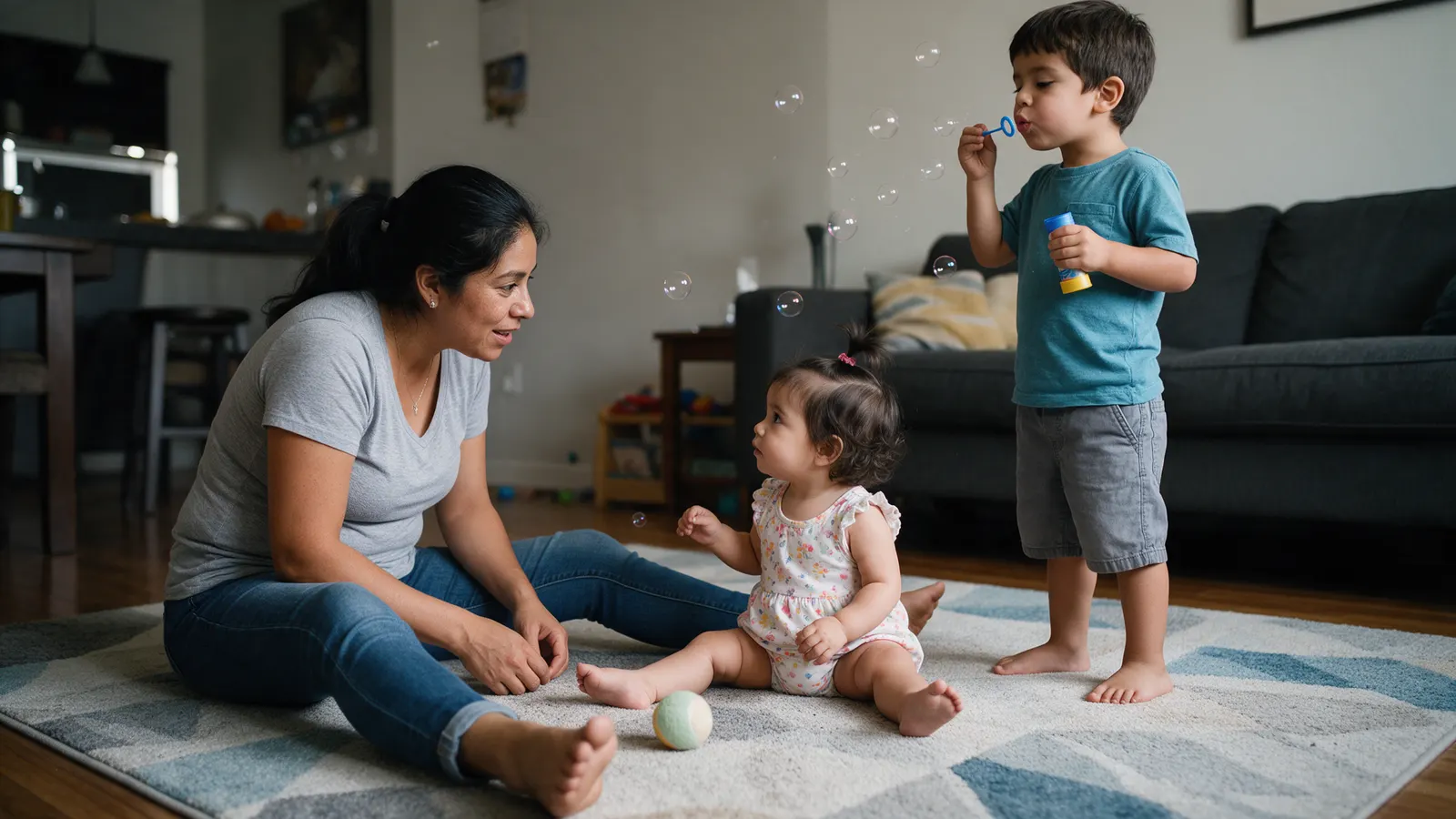
Every game today has the same shape: your turn, their turn, your turn. A ball, a bubble, and a teddy with a spoon are how an 11-month-old learns that other people take turns, and how you find out what makes yours laugh.
Heart
Ball first. The 1-year guide's Ball roll and kick is for a toddler who walks; today's version is the first step of it, sitting and rolling only. CDC suggests rolling balls together (CDC), and the WHO recommends at least 180 minutes of varied physical activity a day for 1- and 2-year-olds (WHO); this game itself hasn't been studied. Kicking waits: by 2, most toddlers kick a ball (CDC). The hand skill underneath rolling is the same one that made the drop game: once babies can let go on purpose, dropping and throwing become favorite games (AAP).
Head
Bubbles are the same lesson with a built-in request. The guide's Bubble turn-taking comes from CDC's suggestion to blow bubbles for your toddler to pop while you name the action (CDC): blow, say "Pop!", stop, and wait for them to ask for more, by word, sign, or point. Pointing to ask for something or get help is a 15-month milestone (CDC), so at 11 months the ask may be a shriek, a reach, or a stare at the wand. Any of those counts. Blow again right away, so the request gets answered. Passing a toy back and forth is the oldest version of the game, from the 9-month list (CDC).
Body
And the teddy. CDC suggests pretend play like feeding a stuffed animal with a spoon (CDC), and hugging a stuffed toy is a 15-month milestone (CDC). The honest evidence, from the guide's Feed the teddy: a major review found little proof that pretend play itself causes gains in language, thinking, or social skills (Lillard et al., 2013). What an 11-month-old brings to it is the "things have uses" skill: hand over a cup, a spoon, or a hairbrush and be an audience when they copy you (AAP). A spoon aimed at a teddy's ear is pretend enough.
Try today

Ball roll and kick
Time: 5 to 10 minutes · Ball roll and kick in the guide
Sit on the floor facing each other, legs apart, a soft ball between you. Push it slowly into their lap and say "Your turn."
Hold out both hands and wait. A shove, a drop, or a throw in your direction all count as the ball coming back (AAP).
Roll it back and say "My turn." Ten rounds, or until they crawl off with it.
Skip the kick for now; the ball stays on the floor and so does the baby (CDC).
Make it work:A ball too big to fit entirely in the mouth, and nothing smaller than that on the rug (AAP).
Watch for
Normal
a ball thrown at you instead of rolled, with delight; letting go on purpose is new (AAP).
Talk with your pediatrician
if your baby uses one arm or leg much more than the other (AAP).
Normal
tears when the ball rolls under the sofa; name it, "You're sad. The ball rolled away" (CDC).
Call your pediatrician right away
if your baby cries nonstop, or cries when touched or moved (AAP).
Normal
a bubble popped on the cheek and a baby who blinks and asks for more.
Call 911
if your baby has purple or blood-colored spots or dots on the skin (AAP).
For you
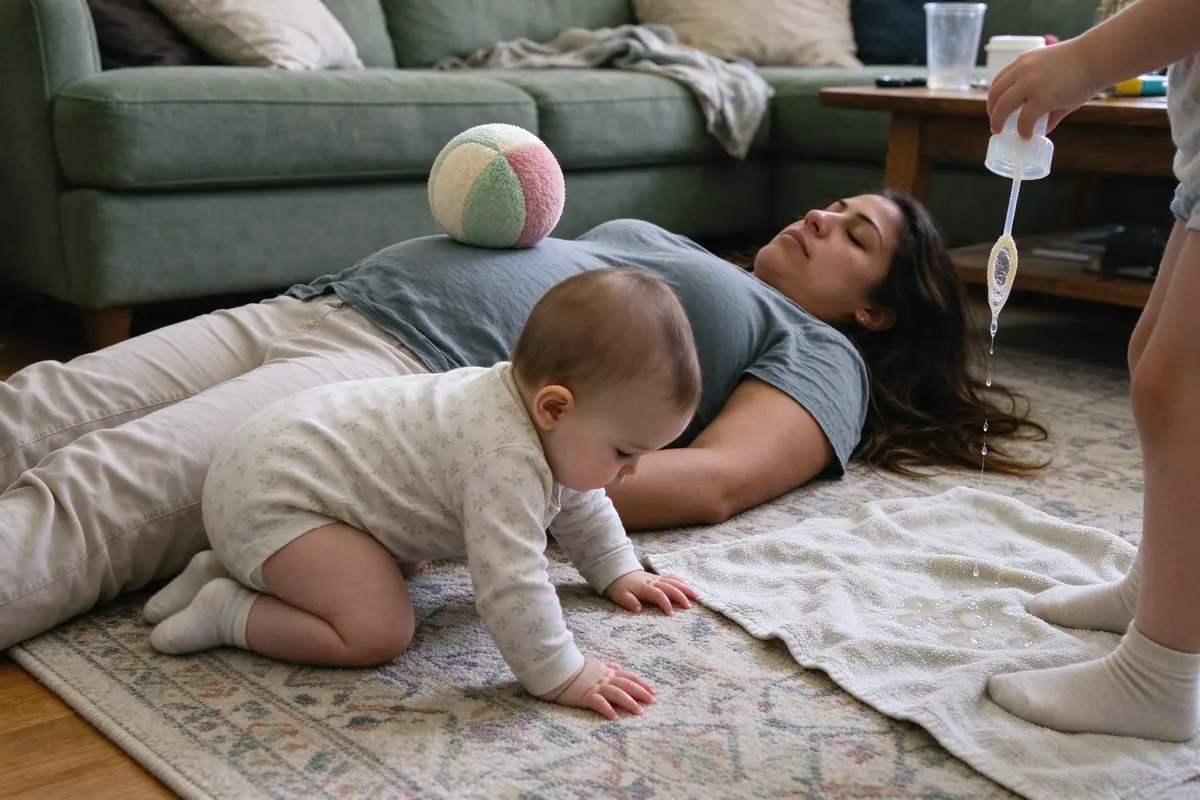
The game of catch starts here, and it's one you'll still be playing in a driveway in ten years. Today it's played lying on a rug, which is where the week's other advice lands too: a floor you can get down to and up from without pain. If getting up is the hard part, that's a question for your own provider, and the CDC's rule for the whole first year is the one to use: if something just isn't right, or you aren't sure if it's serious, talk to your health care provider, and tell them you were pregnant within the last year (CDC).
If you're the partner: you're the other end of the ball tonight, and the bubble blower, because the baby asks the person holding the wand. Hand it to her for the last round so the asking goes both ways.
Sources
- Centers for Disease Control and Prevention. "Milestones by 18 Months." Learn the Signs. Act Early. program, updated 2026. https://www.cdc.gov/act-early/milestones/18-months.html
- World Health Organization. "To grow up healthy, children need to sit less and play more." 2019. https://www.who.int/news/item/24-04-2019-to-grow-up-healthy-children-need-to-sit-less-and-play-more
- Centers for Disease Control and Prevention. "Milestones by 2 Years." Learn the Signs. Act Early. program, updated 2026. https://www.cdc.gov/act-early/milestones/2-years.html
- American Academy of Pediatrics. "Hand and Finger Skills." HealthyChildren.org, updated 2009. https://www.healthychildren.org/English/ages-stages/baby/Pages/Hand-and-Finger-Skills.aspx
- Centers for Disease Control and Prevention. "Milestones by 15 Months." Learn the Signs. Act Early. program, updated 2026. https://www.cdc.gov/act-early/milestones/15-months.html
- Centers for Disease Control and Prevention. "Milestones by 9 Months." Learn the Signs. Act Early. program, updated 2026. https://www.cdc.gov/act-early/milestones/9-months.html
- Lillard AS, Lerner MD, Hopkins EJ, et al. "The impact of pretend play on children's development: a review of the evidence." Psychological Bulletin, 2013. https://pubmed.ncbi.nlm.nih.gov/22905949/
- American Academy of Pediatrics. "Cognitive Development in Infants: 8 to 12 Months." HealthyChildren.org, updated 2023. https://www.healthychildren.org/English/ages-stages/baby/Pages/Cognitive-Development-8-to-12-Months.aspx
- Bradin S. "Choking Prevention for Babies & Children: What Every Parent Needs to Know." HealthyChildren.org, updated 2026. https://www.healthychildren.org/English/health-issues/injuries-emergencies/Pages/Choking-Prevention.aspx
- American Academy of Pediatrics. "Movement Milestones in Babies 8 to 12 Months Old." HealthyChildren.org, updated 2021. https://www.healthychildren.org/English/ages-stages/baby/Pages/Movement-8-to-12-Months.aspx
- American Academy of Pediatrics. "Fever" (symptom checker). HealthyChildren.org, accessed 2026. https://www.healthychildren.org/English/tips-tools/symptom-checker/Pages/symptomviewer.aspx?symptom=Fever
- Centers for Disease Control and Prevention. "Urgent Maternal Warning Signs and Symptoms." HEAR HER, 2024. https://www.cdc.gov/hearher/maternal-warning-signs/index.html
This guide is general education that summarizes published research and guidance from groups like the American Academy of Pediatrics, the CDC, and the WHO. It isn’t medical advice, and every child develops on their own timeline. Your pediatrician knows your child; if something feels wrong, call them. In an emergency, call 911.
Get each day’s note the morning it applies
Add your baby to a free Chorevia household with their date of birth, and every morning for 365 days the day’s note arrives in the app and by email: what’s developing, one thing to try, what to watch for, and a word for you.
Create your household