Day 360 of 365 · Week 49
Car seat at one
Last reviewed · 4 min read · 6 sources · Plain-text version
Rear-facing until the seat's own rear-facing limit, not until a birthday; most convertible seats allow it to 2 or later, and bent legs are fine. The rear-facing promise, and a sentence for relatives.

Five days from the birthday, the question arrives from somewhere: "So you'll turn the seat around at one?" No. Today is why the seat stays rear-facing well past the birthday, how to check the fit on a baby who has grown, and the sentence to say to whoever asks.
Heart
The rule is about the seat's limit, not a birthday. Keep your baby rear-facing until they reach the top weight or height their seat allows; when they outgrow an infant-only seat, switch to a convertible or all-in-one seat installed rear-facing (AAP). The AAP says to keep toddlers rear-facing as long as possible, and most convertible seats allow it until 2 or later (AAP). The 1-year guide's answer to When can my toddler ride forward-facing? is the same: not until they outgrow the highest weight or height their seat allows for rear-facing.
Head
The legs are the thing relatives worry about. Bent legs are fine: children are flexible, and leg injuries in rear-facing seats are very rare (AAP). A one-year-old with feet pressed against the seat back and knees up is riding the way the seat was designed to be used. The other rules haven't changed either: never put a rear-facing seat in front of an active airbag (AAP); the back seat is safest; never leave your toddler alone in a car, and walk behind the car before backing out (AAP).
Body
The fit, on a baby who has grown since the last check. Harness snug, chest clip at armpit level, and no bulky coat under the straps (AAP). If the seat is still the infant one, its label is what ends it: rear-facing-only infant seats typically fit babies up to 22 to 35 pounds and 26 to 35 inches, depending on the model (AAP), and the 12-month visit will give you an exact weight and length to compare against it. The guide's section is Car seats; the next guide's is the same section a year on.
Try today
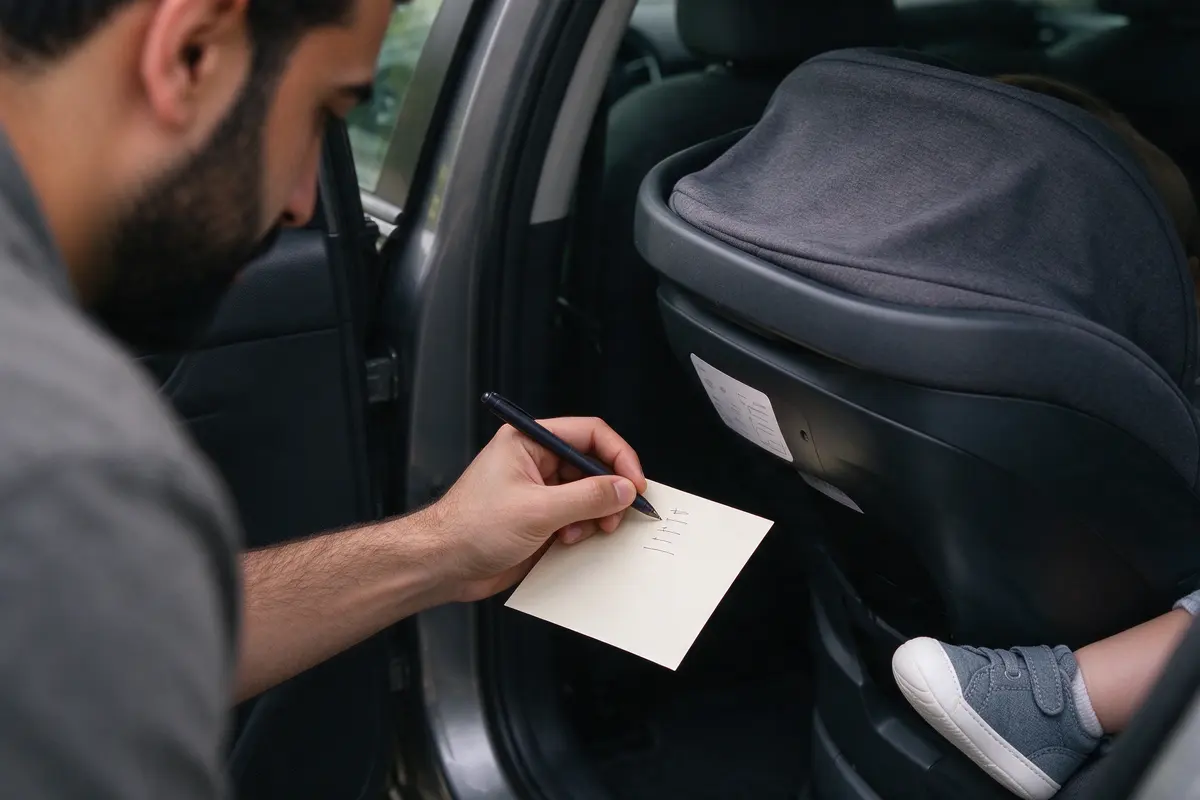
The rear-facing promise
Time: 15 minutes, at the car · Car seats in the guide
Find the seat's label and read its rear-facing limits out loud: the top weight and the top height. Those two numbers are the only ones that end rear-facing (AAP).
Write them on a card with today's date, and the date you'll re-check: after the 12-month visit, when you have the measurements.
Redo the fit with the baby in the seat: harness snug, chest clip at the armpits, coat off under the straps (AAP).
Write the sentence for relatives under the numbers: "The seat stays rear-facing until it says otherwise, and that's at least a year away."
Make it work:Tape the card inside the glove box, next to the seat's manual, so the next person who installs it reads both.
Watch for
Normal
a baby who arches, howls, and goes rigid at the buckle now that they'd rather be standing; the seat is still for every ride (AAP).
Call your pediatrician right away
if your baby won't move an arm or leg normally (AAP).
Normal
feet flat against the seat back and knees folded for the whole drive (AAP).
Call 911
after any crash if your baby has a seizure, was knocked out for more than a minute, or is confused or unsteady afterward (AAP).
Normal
a nap that starts in the car and ends, as always, flat on the back in a bare crib once home (AAP).
Go to the ER now
if your baby vomits 2 or more times after a head injury, or cries nonstop after one (AAP).
For you
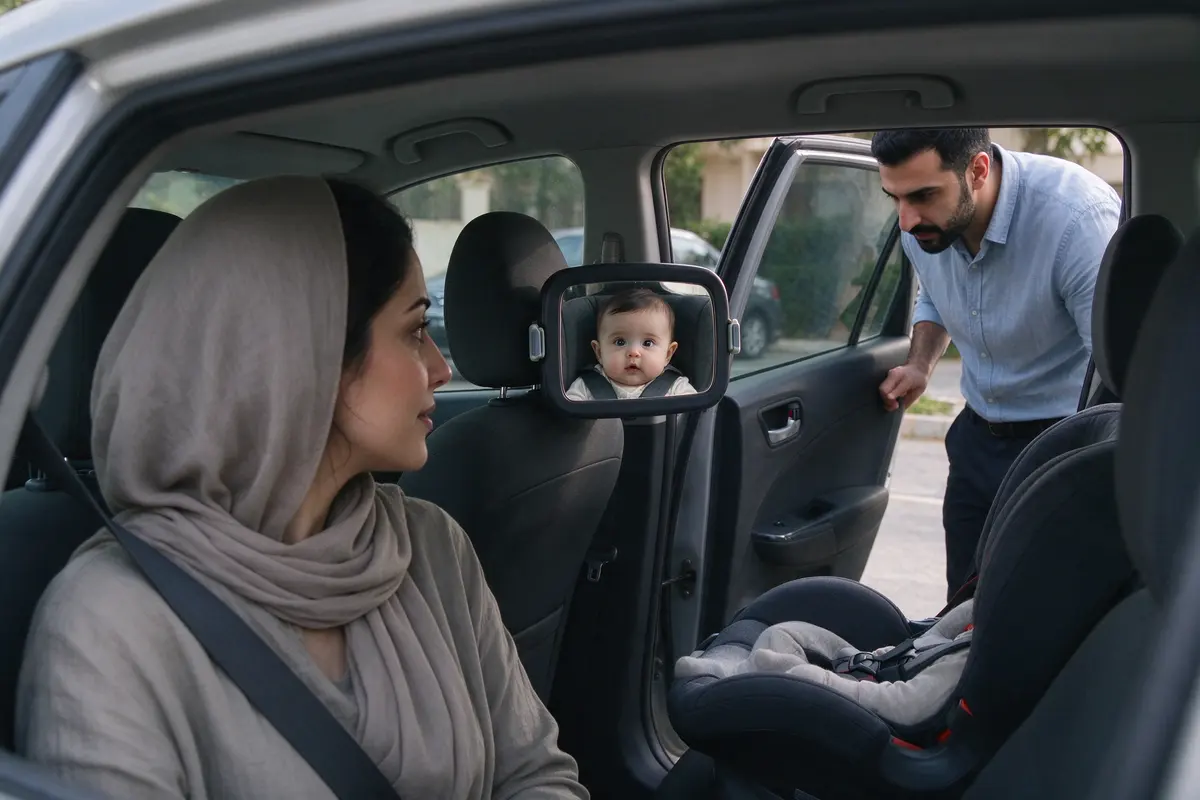
The seat stays rear-facing past the birthday, and so does the conversation you'll have about it. The sentence for relatives is on the card, and it's allowed to be short: the AAP says as long as possible, most convertible seats allow it until 2 or later (AAP), and that's the end of the discussion. You don't owe anyone a longer version. The year's other sentence belongs to you in the front seat: tell any provider you see this year that you were pregnant within the last year, including after a crash, however minor (CDC).
If you're the partner: when the question comes at the party, you answer it before she has to. One sentence, warm, final. Then change the subject to the cake.
Sources
- American Academy of Pediatrics. "Car Seats: Information for Families." HealthyChildren.org, updated 2026. https://www.healthychildren.org/English/safety-prevention/on-the-go/Pages/Car-Safety-Seats-Information-for-Families.aspx
- American Academy of Pediatrics. "Safety for Your Child: 1 to 2 Years." HealthyChildren.org, updated 2022. https://www.healthychildren.org/English/ages-stages/toddler/Pages/safety-for-your-child-1-to-2-years.aspx
- American Academy of Pediatrics. "Fever" (symptom checker). HealthyChildren.org, accessed 2026. https://www.healthychildren.org/English/tips-tools/symptom-checker/Pages/symptomviewer.aspx?symptom=Fever
- American Academy of Pediatrics. "Head Injury" (symptom checker). HealthyChildren.org, accessed 2026. https://www.healthychildren.org/English/tips-tools/symptom-checker/Pages/symptomviewer.aspx?symptom=Head+Injury
- American Academy of Pediatrics. "Getting Your Baby to Sleep." HealthyChildren.org, updated 2024. https://www.healthychildren.org/English/ages-stages/baby/sleep/Pages/getting-your-baby-to-sleep.aspx
- Centers for Disease Control and Prevention. "Urgent Maternal Warning Signs and Symptoms." HEAR HER, 2024. https://www.cdc.gov/hearher/maternal-warning-signs/index.html
This guide is general education that summarizes published research and guidance from groups like the American Academy of Pediatrics, the CDC, and the WHO. It isn’t medical advice, and every child develops on their own timeline. Your pediatrician knows your child; if something feels wrong, call them. In an emergency, call 911.
Get each day’s note the morning it applies
Add your baby to a free Chorevia household with their date of birth, and every morning for 365 days the day’s note arrives in the app and by email: what’s developing, one thing to try, what to watch for, and a word for you.
Create your household