Day 362 of 365 · Week 49
Before the 12-month visit
Last reviewed · 4 min read · 18 sources · Plain-text version
Vaccines around the birthday on a schedule that differed in 2026, an anemia check, lead by risk, and five things to confirm in writing: milk, bottles, walking, words, and the dentist.

The 12-month visit falls around the birthday, and this is the eve of the month it belongs to. Today is what the visit does, which shots come with it, and the list of things it's the place to confirm, written tonight so the appointment isn't the first time you think of them.
Heart
What the visit does. The AAP schedule puts a well visit at 12 months with vaccines, an anemia check, and lead screening based on risk or local rules (AAP, 2025); the timing of iron screening also depends on diet (AAP). Expect measurements, and expect the numbers to tell a new story: near 12 months, growth slows and appetite often levels off (AAP). The 1-year guide's section is The 12-, 15-, 18-, and 24-month checkups; the one you've been reading is The 9-month and 12-month checkups.
Head
The shots. The AAP recommends vaccines for measles, mumps, and rubella (MMR), chickenpox (varicella), and hepatitis A, starting around the first birthday, plus later doses of vaccines started in the first year, such as DTaP, Hib, pneumococcal, polio, and hepatitis B, along with a yearly flu shot and COVID-19 vaccination for children 6 to 23 months (Bracho-Sánchez, AAP). US guidance has been changing: the AAP and CDC schedules have differed in 2026 (AAP), and in March 2026 a federal judge paused many of the federal changes, a ruling the government has appealed (STAT, 2026). So the first line on the list is which schedule your pediatrician follows and what's due at this visit.
Body
The things to confirm. Milk: from 12 months to 2 years, 2 to 3 cups (16 to 24 ounces) of plain whole milk a day (AAP), and no more than 24, because milk is low in iron and fills toddlers up (AAP). Bottles: finish the move to a cup between 12 and 18 months (Shu, AAP). Walking: 8.2 to 17.6 months for walking alone (WHO Multicentre Growth Reference Study Group, 2006), a few steps by 15 (CDC). Words: few or no clear words at the first birthday is normal (CDC). Teeth: a dentist by the first birthday or within 6 months of the first tooth, and fluoride varnish every 6 months (Krol & Whelan, AAP).
Try today
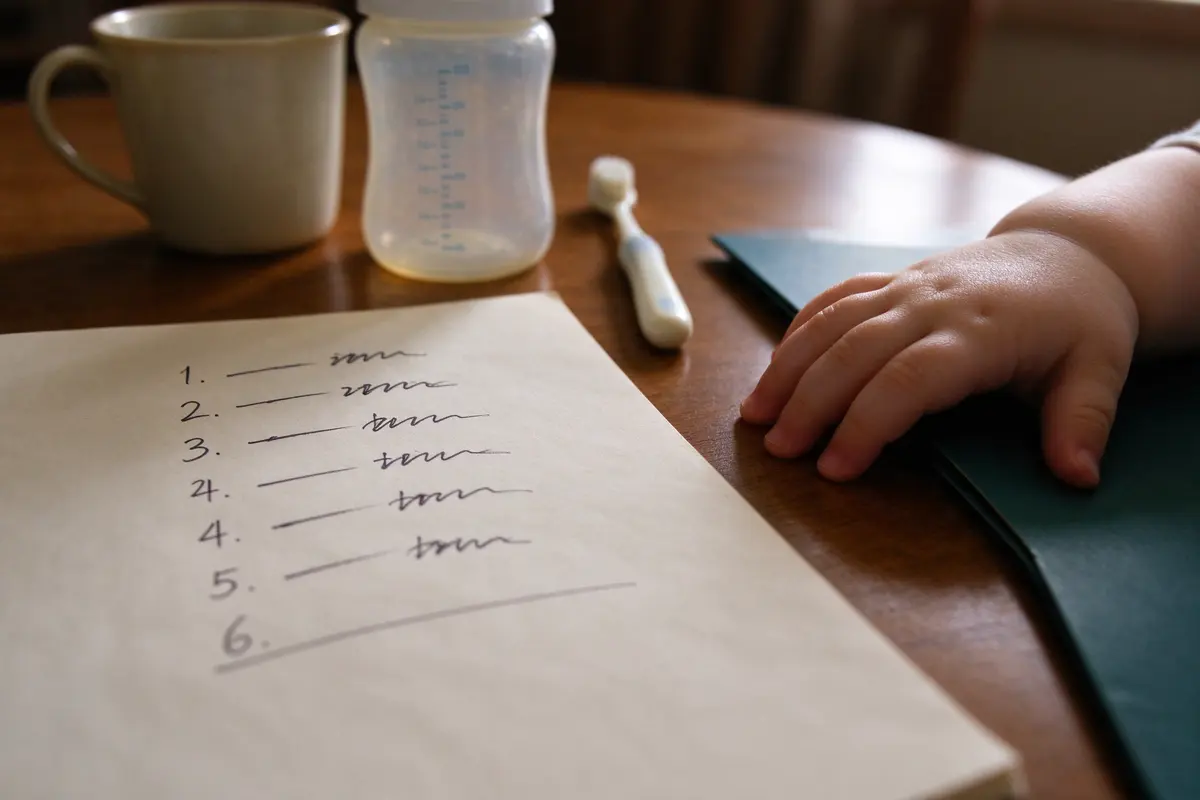
The twelve-month list
Time: 15 minutes, both adults · The 12-, 15-, 18-, and 24-month checkups in the guide
Line one: "Which schedule do you follow, and what's due today?" (AAP)
Line three: "How many ounces of whole milk for this baby, and is 2% right for them?" (AAP)
Line four: "Which bottle goes first, and can night feeds stop?" (Shu, AAP)
Line five: "Who do you recommend for the first dental visit?" Then, under a drawn line, the sixth one, about you (Krol & Whelan, AAP).
Make it work:Bring the word log, the food diary, and the car seat's limit numbers; the visit's weight and length answer that card too.
Watch for
Normal
smaller meals in the last few weeks with no change in energy; appetite often levels off near 12 months (AAP).
Call your pediatrician right away
for signs of dehydration: no urine in more than 8 hours, dark urine, a very dry mouth, and no tears (AAP).
Normal
a baby who cruises everything and walks nowhere.
Ask about a developmental screening
at this visit if your baby isn't pulling to stand by 12 months or has lost skills (CDC).
Normal
tears at the sight of the exam table and a baby who buries their face in your shoulder; wariness of strangers is expected at this age (AAP).
Bring it up
if your baby seems not to see or hear well (AAP).
For you

The visit asks about you, if you make it. The AAP recommends screening the birthing parent for depression at the 1-, 2-, 4-, and 6-month visits (Earls et al., 2019); at 12 months there's no form, which is why the sixth line is on your list in your own handwriting. Answer it honestly to yourself before anyone else: if sadness has lasted more than two weeks, that's a reason to go to your own doctor, not to wait for a visit about the baby (Office on Women's Health). A pediatrician who's told "I've been low for a month" will know where to send you.
If you're the partner: the sixth line is yours to ask her on the drive in, and yours to answer too. About 10% of fathers have depression around a birth, with higher rates reported at 3 to 6 months after (Paulson & Bazemore, 2010); a year in, the question still applies.
Sources
- American Academy of Pediatrics and Bright Futures. "Recommendations for Preventive Pediatric Health Care" (Periodicity Schedule). 2025. https://downloads.aap.org/AAP/PDF/periodicity_schedule.pdf
- American Academy of Pediatrics. "Iron Deficiency and Anemia in Babies, Children & Teens." HealthyChildren.org, updated 2026. https://www.healthychildren.org/English/health-issues/conditions/chronic/Pages/Anemia-and-Your-Child.aspx
- American Academy of Pediatrics. "Checkup Checklist: First Birthday (12 Months Old)." HealthyChildren.org, updated 2021. https://www.healthychildren.org/English/ages-stages/Your-Childs-Checkups/Pages/Your-Checkup-Checklist-12-Months-Old.aspx
- Bracho-Sánchez E. "AAP Guide: Vaccines Your Child Needs by Age 6." HealthyChildren.org, updated 2026. https://www.healthychildren.org/English/safety-prevention/immunizations/Pages/Your-Babys-First-Vaccines.aspx
- American Academy of Pediatrics. "AAP Releases Recommended Childhood and Adolescent Immunization Schedule for 2026." HealthyChildren.org, 2026. https://www.healthychildren.org/English/news/Pages/AAPs-recommended-childhood-and-adolescent-immunization-schedule-for-2026.aspx
- STAT. "HHS appeals ruling that stalled many of Kennedy's vaccine policy changes." 2026. https://www.statnews.com/2026/04/29/hhs-appealing-acip-vaccine-policy-lawsuit-ruling/
- American Academy of Pediatrics Institute for Healthy Childhood Weight. "Healthy Beverage Quick Reference Guide." 2021. https://downloads.aap.org/AAP/PDF/HealthyBeverageQuickReferenceGuideDownload.pdf
- Shu J. "From Bottle to Cup: Helping Your Child Make a Healthy Transition." HealthyChildren.org, updated 2023. https://www.healthychildren.org/English/ages-stages/baby/feeding-nutrition/Pages/Discontinuing-the-Bottle.aspx
- WHO Multicentre Growth Reference Study Group. "WHO Motor Development Study: windows of achievement for six gross motor development milestones." Acta Paediatrica Supplement, 2006. https://pubmed.ncbi.nlm.nih.gov/16817682/
- Centers for Disease Control and Prevention. "Milestones by 15 Months." Learn the Signs. Act Early. program, updated 2026. https://www.cdc.gov/act-early/milestones/15-months.html
- Centers for Disease Control and Prevention. "Milestones by 1 Year." Learn the Signs. Act Early. program, updated 2026. https://www.cdc.gov/act-early/milestones/1-year.html
- Krol D, Whelan K. "Good Oral Health Starts Early: AAP Policy Explained." HealthyChildren.org, updated 2026. https://www.healthychildren.org/English/healthy-living/oral-health/Pages/Brushing-Up-on-Oral-Health-Never-Too-Early-to-Start.aspx
- American Academy of Pediatrics. "Fever" (symptom checker). HealthyChildren.org, accessed 2026. https://www.healthychildren.org/English/tips-tools/symptom-checker/Pages/symptomviewer.aspx?symptom=Fever
- American Academy of Pediatrics. "Emotional and Social Development: 8 to 12 Months." HealthyChildren.org, updated 2009. https://www.healthychildren.org/English/ages-stages/baby/Pages/Emotional-and-Social-Development-8-12-Months.aspx
- American Academy of Pediatrics. "Checkup Checklist: 9 Months Old." HealthyChildren.org, updated 2021. https://www.healthychildren.org/English/ages-stages/Your-Childs-Checkups/Pages/Your-Checkup-Checklist-9-Months-Old.aspx
- Earls MF, Yogman MW, Mattson G, Rafferty J; AAP Committee on Psychosocial Aspects of Child and Family Health. "Incorporating Recognition and Management of Perinatal Depression Into Pediatric Practice." Pediatrics, 2019. https://pubmed.ncbi.nlm.nih.gov/30559120/
- Office on Women's Health. "Recovering from birth." US Department of Health and Human Services, 2021. https://womenshealth.gov/pregnancy/childbirth-and-beyond/recovering-birth
- Paulson JF, Bazemore SD. "Prenatal and postpartum depression in fathers and its association with maternal depression: a meta-analysis." JAMA, 2010. https://pubmed.ncbi.nlm.nih.gov/20483973/
This guide is general education that summarizes published research and guidance from groups like the American Academy of Pediatrics, the CDC, and the WHO. It isn’t medical advice, and every child develops on their own timeline. Your pediatrician knows your child; if something feels wrong, call them. In an emergency, call 911.
Get each day’s note the morning it applies
Add your baby to a free Chorevia household with their date of birth, and every morning for 365 days the day’s note arrives in the app and by email: what’s developing, one thing to try, what to watch for, and a word for you.
Create your household