Day 351 of 365 · Week 47
Forty-eight weeks: the first family jobs
Last reviewed · 4 min read · 18 sources · Plain-text version
Toddlers want to help, and most start around the first birthday. Show, then do it together; expect unhelpful help; thank them; keep it unpaid. Laundry basket helper, for an 11-month-old: one sock.
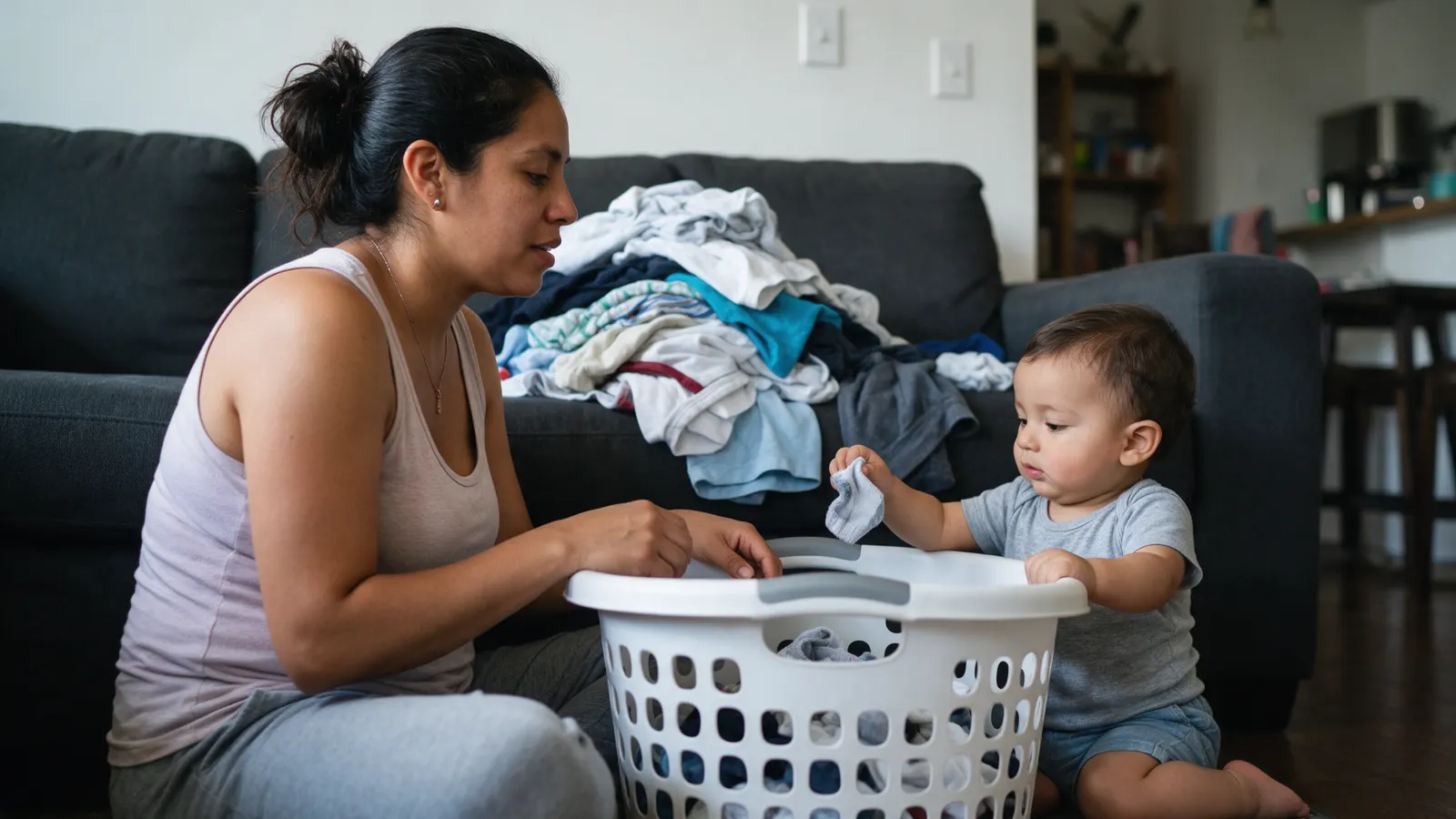
Two weeks to the birthday, and the thing this whole series has been walking toward arrives a little early. Today is the first family job: what the research found about toddlers who help, the method in four lines, and one sock.
Heart
The urge is real and it starts about now. At home, most children start helping around their first birthday (Dahl, 2015). In lab studies, 18-month-olds helped an unfamiliar adult without being asked, picking up a marker he dropped or opening a cabinet he couldn't (Warneken & Tomasello, 2006); when he dropped a clothespin, they usually helped within 10 seconds, with no thanks or reward (Max Planck Society, 2006). Even 14-month-olds handed over objects an adult was reaching for (Warneken & Tomasello, 2007). CDC's own list of everyday tasks to include a child in: fetching shoes, putting snacks in a bag, carrying napkins to the table (CDC; CDC).
Head
The 1-year guide's method, in four lines. Show, then do it together; your toddler copies what you do. Expect unhelpful help: in a survey of more than 500 families, most parents of 1- to 4-year-olds said their child's help was sometimes unhelpful (Hammond & Brownell, 2018). Thank them and describe the effort: in a small study of 53 families, parents' praise of effort at 14 to 38 months predicted children's belief at 7 and 8 that ability can grow (Gunderson et al., 2013), though across studies the link between mindset and school achievement is weak (Sisk et al., 2018). And keep it unpaid: among 36 toddlers about 20 months old, those given a toy for helping later helped less than those who got praise or nothing (Warneken & Tomasello, 2008). The AAP's line is the one to keep: even if it takes longer, make it a game, and don't discourage the urge to help (AAP).
Body
The safe jobs are the ones nowhere near the stove. Keep helping away from the stove, hot drinks, cleaning products, and buckets of water (AAP). Laundry has its own rule: keep laundry packets locked away and out of sight, and consider traditional detergent while young children live in or visit your home (AAP). The guide's section is Family jobs for helpers in diapers.
Try today
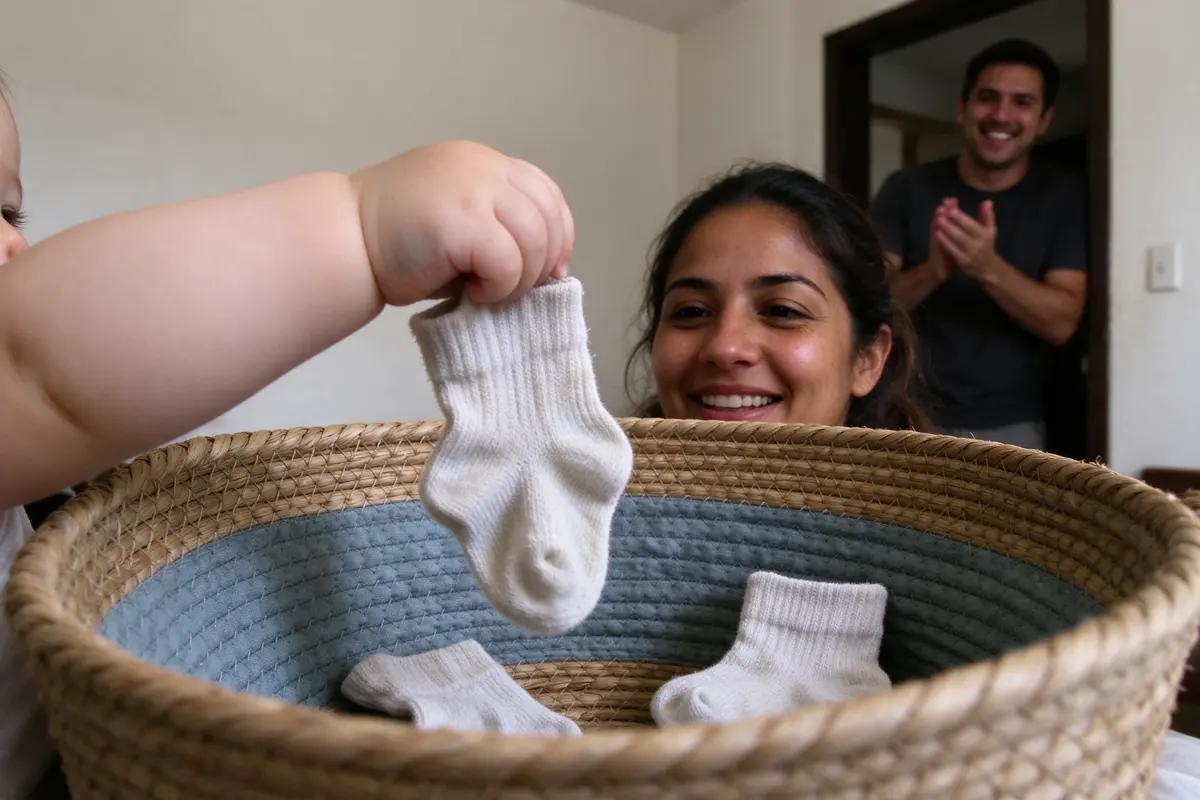
Laundry basket helper
Time: 5 minutes, during your own laundry · Laundry basket helper in the guide
Basket on the floor, baby sitting beside it, the clean pile within your reach and not theirs. Drop one sock in yourself, slowly: "Sock. In the basket."
Hand your baby one sock and ask for it to go in. Wait. However it lands, in, on the rim, or in the mouth, that was the job (Hammond & Brownell, 2018).
Say thank you and say what they did: "You put the sock in!" Nothing else: no treat, no sticker (Warneken & Tomasello, 2008).
One sock is the whole job today. If they want more, name things as they go: "Your sock. Daddy's shirt."
Make it work:Detergent and packets are locked away before the basket comes down (AAP). A basket tipped over and climbed into is still a basket.
Watch for
Normal
the sock delivered to the basket and immediately retrieved and chewed; letting go on purpose is new, and dropping is the favorite half (AAP).
Bring it up
if by 12 months your baby doesn't pull up to stand, wave bye-bye, or look for a toy they saw you hide (CDC).
Normal
no interest in the sock and great interest in the basket's handle.
Call your pediatrician right away
if your baby won't move an arm or leg normally, or cries when touched or moved (AAP).
Normal
a sock handed to you instead of the basket, which is the "hand it to me" game and counts (CDC).
Go to the ER now
if your baby might have swallowed something and can't swallow, drools, or gags (AAP).
For you
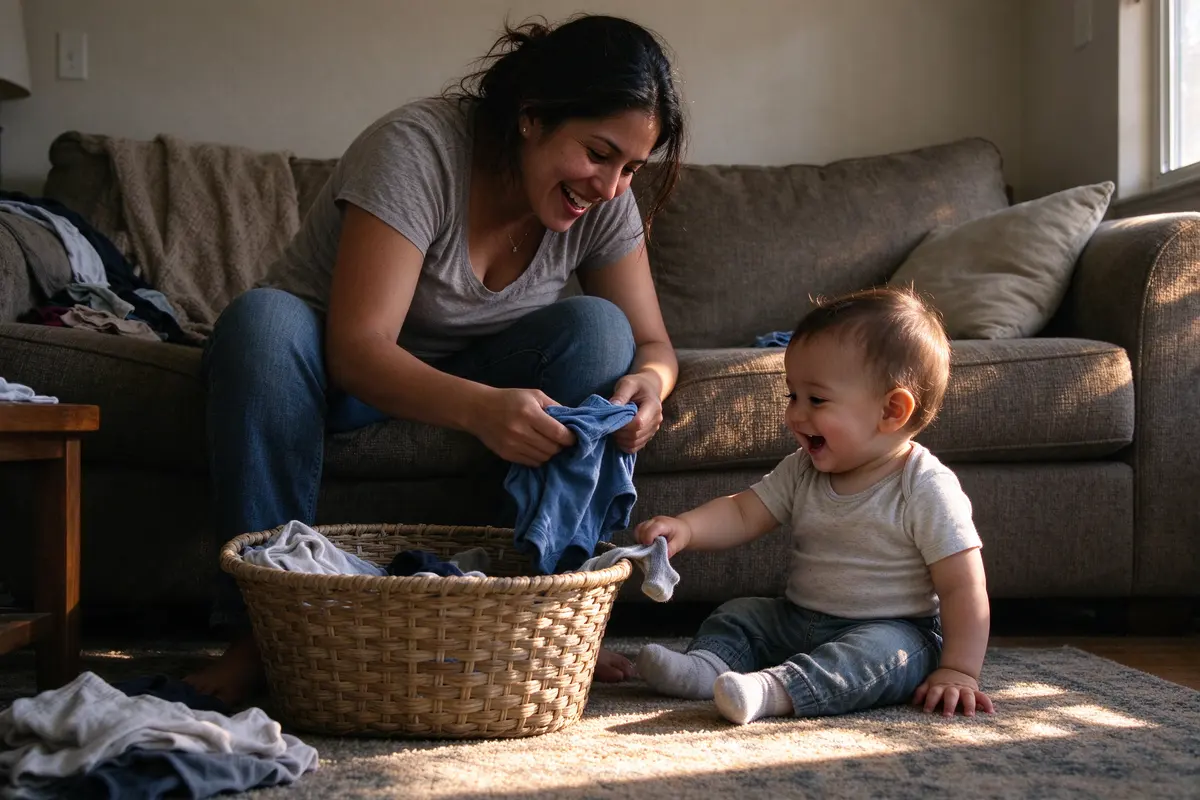
Chorevia's family jobs begin here, and this is the whole method. Everything the app will ever do with chores rests on four lines you did on the floor today: show, do it together, thank them for the effort, keep it unpaid (AAP; Warneken & Tomasello, 2008). The paid extras and the money lessons come years from now, and they never touch the jobs that are simply part of belonging to this house. What you're building isn't a helper. It's a person who already was one, and found out it was welcome.
If you're the partner: tomorrow the basket is yours. The thank-you has to come from both of you, or it's a trick one parent does.
Sources
- Dahl A. "The Developing Social Context of Infant Helping in Two U.S. Samples." Child Development, 2015. https://pubmed.ncbi.nlm.nih.gov/25800068/
- Warneken F, Tomasello M. "Altruistic helping in human infants and young chimpanzees." Science, 2006. https://pubmed.ncbi.nlm.nih.gov/16513986/
- Max Planck Society. "Baby's helping hands." Press release, 2006. https://www.mpg.de/532681/pressRelease20060302
- Warneken F, Tomasello M. "Helping and Cooperation at 14 Months of Age." Infancy, 2007. https://pubmed.ncbi.nlm.nih.gov/33412734/
- Centers for Disease Control and Prevention. "Milestones by 15 Months." Learn the Signs. Act Early. program, updated 2026. https://www.cdc.gov/act-early/milestones/15-months.html
- Centers for Disease Control and Prevention. "Milestones by 2 Years." Learn the Signs. Act Early. program, updated 2026. https://www.cdc.gov/act-early/milestones/2-years.html
- Hammond SI, Brownell CA. "Happily Unhelpful: Infants' Everyday Helping and its Connections to Early Prosocial Development." Frontiers in Psychology, 2018. https://pubmed.ncbi.nlm.nih.gov/30298039/
- Gunderson EA, Gripshover SJ, Romero C, et al. "Parent praise to 1- to 3-year-olds predicts children's motivational frameworks 5 years later." Child Development, 2013. https://pubmed.ncbi.nlm.nih.gov/23397904/
- Sisk VF, Burgoyne AP, Sun J, et al. "To What Extent and Under Which Circumstances Are Growth Mind-Sets Important to Academic Achievement? Two Meta-Analyses." Psychological Science, 2018. https://pubmed.ncbi.nlm.nih.gov/29505339/
- Warneken F, Tomasello M. "Extrinsic rewards undermine altruistic tendencies in 20-month-olds." Developmental Psychology, 2008. https://pubmed.ncbi.nlm.nih.gov/18999339/
- American Academy of Pediatrics. "Social Development: 1 Year Olds." HealthyChildren.org, updated 2009. https://www.healthychildren.org/English/ages-stages/toddler/Pages/Social-Development-1-Year-Olds.aspx
- American Academy of Pediatrics. "Safety for Your Child: 1 to 2 Years." HealthyChildren.org, updated 2022. https://www.healthychildren.org/English/ages-stages/toddler/Pages/safety-for-your-child-1-to-2-years.aspx
- American Academy of Pediatrics. "Laundry Room and Detergent Safety." HealthyChildren.org, updated 2024. https://www.healthychildren.org/English/safety-prevention/at-home/Pages/Laundry-Room-and-Detergent-Safety.aspx
- American Academy of Pediatrics. "Hand and Finger Skills." HealthyChildren.org, updated 2009. https://www.healthychildren.org/English/ages-stages/baby/Pages/Hand-and-Finger-Skills.aspx
- Centers for Disease Control and Prevention. "Milestones by 1 Year." Learn the Signs. Act Early. program, updated 2026. https://www.cdc.gov/act-early/milestones/1-year.html
- American Academy of Pediatrics. "Fever" (symptom checker). HealthyChildren.org, accessed 2026. https://www.healthychildren.org/English/tips-tools/symptom-checker/Pages/symptomviewer.aspx?symptom=Fever
- Centers for Disease Control and Prevention. "Milestones by 9 Months." Learn the Signs. Act Early. program, updated 2026. https://www.cdc.gov/act-early/milestones/9-months.html
- American Academy of Pediatrics. "Swallowed Foreign Object" (symptom checker). HealthyChildren.org, accessed 2026. https://www.healthychildren.org/English/tips-tools/symptom-checker/Pages/symptomviewer.aspx?symptom=Swallowed+Foreign+Object
This guide is general education that summarizes published research and guidance from groups like the American Academy of Pediatrics, the CDC, and the WHO. It isn’t medical advice, and every child develops on their own timeline. Your pediatrician knows your child; if something feels wrong, call them. In an emergency, call 911.
Get each day’s note the morning it applies
Add your baby to a free Chorevia household with their date of birth, and every morning for 365 days the day’s note arrives in the app and by email: what’s developing, one thing to try, what to watch for, and a word for you.
Create your household