Day 356 of 365 · Week 48
Books at one
Last reviewed · 4 min read · 14 sources · Plain-text version
Five to ten minutes once or twice a day, a thick page they turn themselves, and "Where's the dog?" with a wait. What the trials found about shared reading, and the free building down the road.
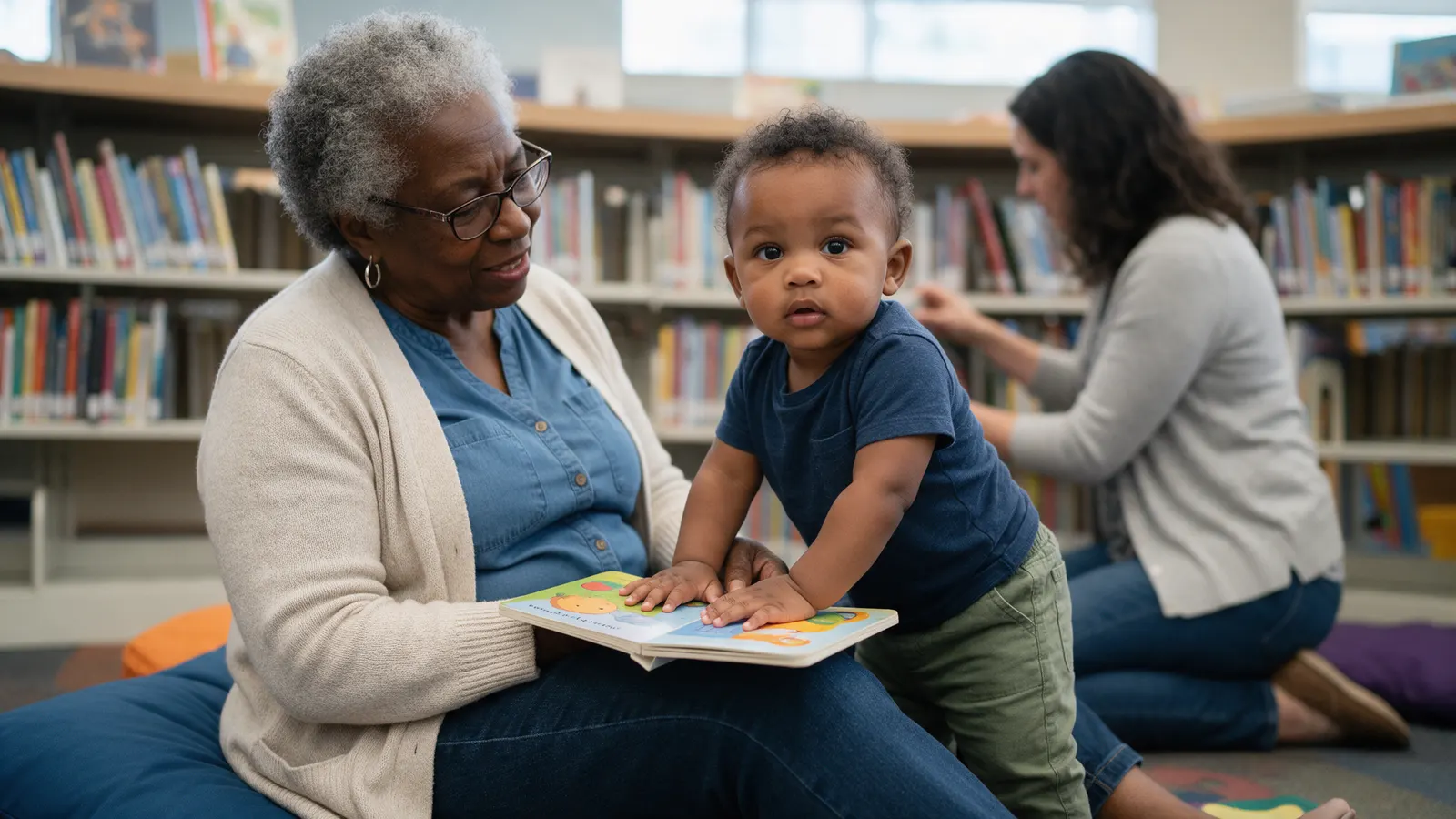
A baby who points, turns pages, and chews corners is ready for the version of reading that lasts the rest of childhood: you point and name, they point back. Today is what the research found, what to let them do with the book, and the free building down the road.
Heart
The 1-year guide's version is Point-and-name book time: 5 to 10 minutes, once or twice a day. The evidence is the strongest in the guide: a meta-analysis of 19 randomized trials found that training parents in shared book reading had small but consistent benefits for children's language, with more effect at higher doses (Dowdall et al., 2020), and the AAP recommends shared reading from birth (Klass et al., 2024). Your baby is 11 months old; the dose is the same. Choose board, cloth, or vinyl books with simple pictures of familiar things (AAP).
Head
What to let them do. Point and name: "Ball. Dog. Baby." Then let your baby turn the pages, chew the corners, and decide when you're done (CDC). Ask "Where's the dog?" and wait; when they point or say a word, repeat it and add one more: "Yes, a big dog" (CDC). Keep the milestone honesty: looking at a familiar object when you name it and pointing to ask are 15-month milestones, and looking at a few pages of a book with you is an 18-month one (CDC; CDC). A baby who slaps the page shut after one picture has done book time.
Body
Why the pointing matters. In 24 babies followed monthly from 9 to 15 months, time spent sharing attention with their mothers, and mothers' talk about what the baby was already looking at, predicted the earliest gestures and words (Carpenter et al., 1998). In a study of 10 toddlers, many things children first pointed at later became words (Iverson & Goldin-Meadow, 2005). These show links, not cause, but a page is the easiest place in the house to look at the same thing at the same time. Ask whether your pediatrician's office takes part in Reach Out and Read, which gives families books at checkups and says it reaches 4.8 million children (Reach Out and Read).
Try today
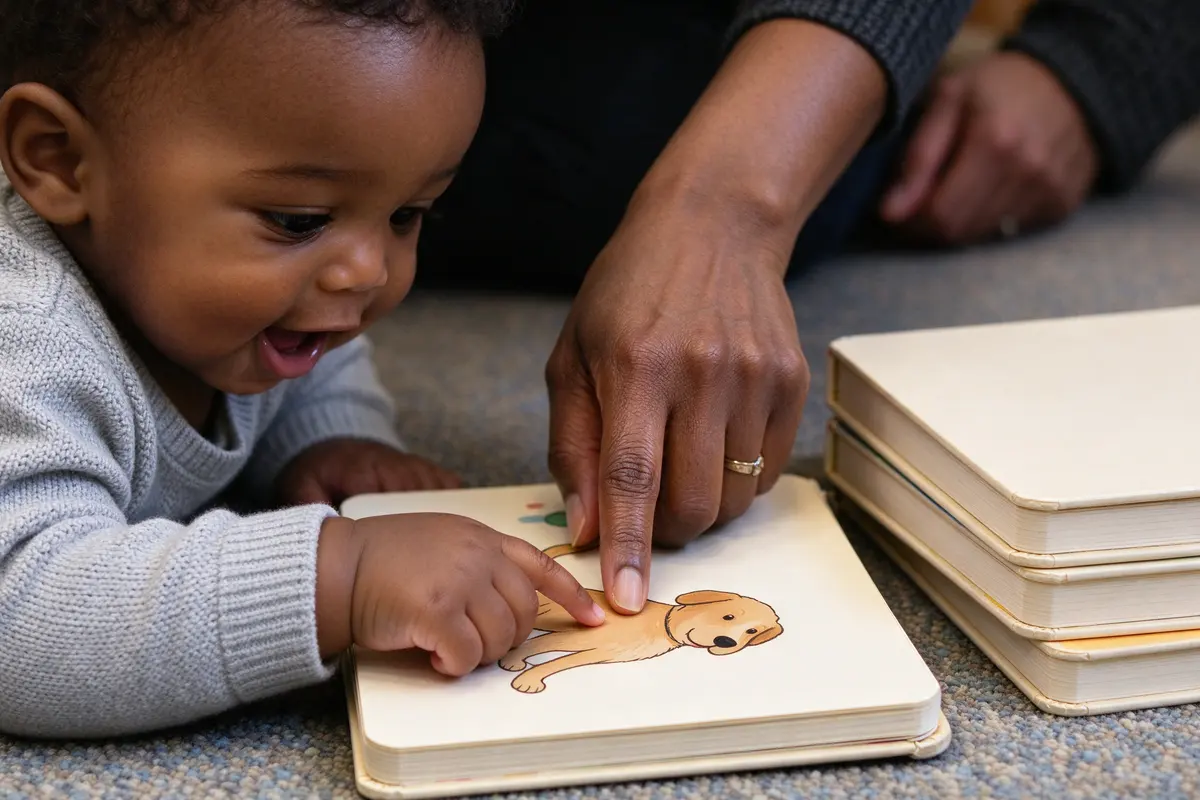
Point-and-name book time
Time: 5 to 10 minutes, once or twice a day · Point-and-name book time in the guide
Pick one sturdy book with clear pictures and sit so your baby can see your face and the page.
Point to a picture and name it. Then ask, "Where's the dog?" and wait, five seconds, for a point, a look, or a slap on the page (CDC).
Whatever they do, say the word again and add one: "Yes, a big dog."
Hand them the page corner and let them turn it, however badly, and stop while it's still fun (CDC).
Make it work:Reading the same favorite again and again is fine. The chewed corner is part of the reading.
Watch for
Normal
a book carried to you spine-first and dropped in your lap, then taken away before page two.
Bring it up
if by 12 months your baby doesn't pull up to stand, wave bye-bye, or look for a toy they saw you hide (CDC).
Normal
a baby who stares at your mouth instead of the page.
Bring it up
if your baby seems not to see or hear well (AAP).
Normal
a cardboard corner gummed soft.
Call 911
if your baby is choking and can't breathe, cry, or make noise, turns bluish, or goes limp, and start back blows and chest thrusts while someone calls (AAP).
Normal
a low fever with a cold that eases in a couple of days.
Call within 24 hours
if a fever with no other symptoms lasts more than 2 days, or any fever lasts more than 3 days (AAP).
For you
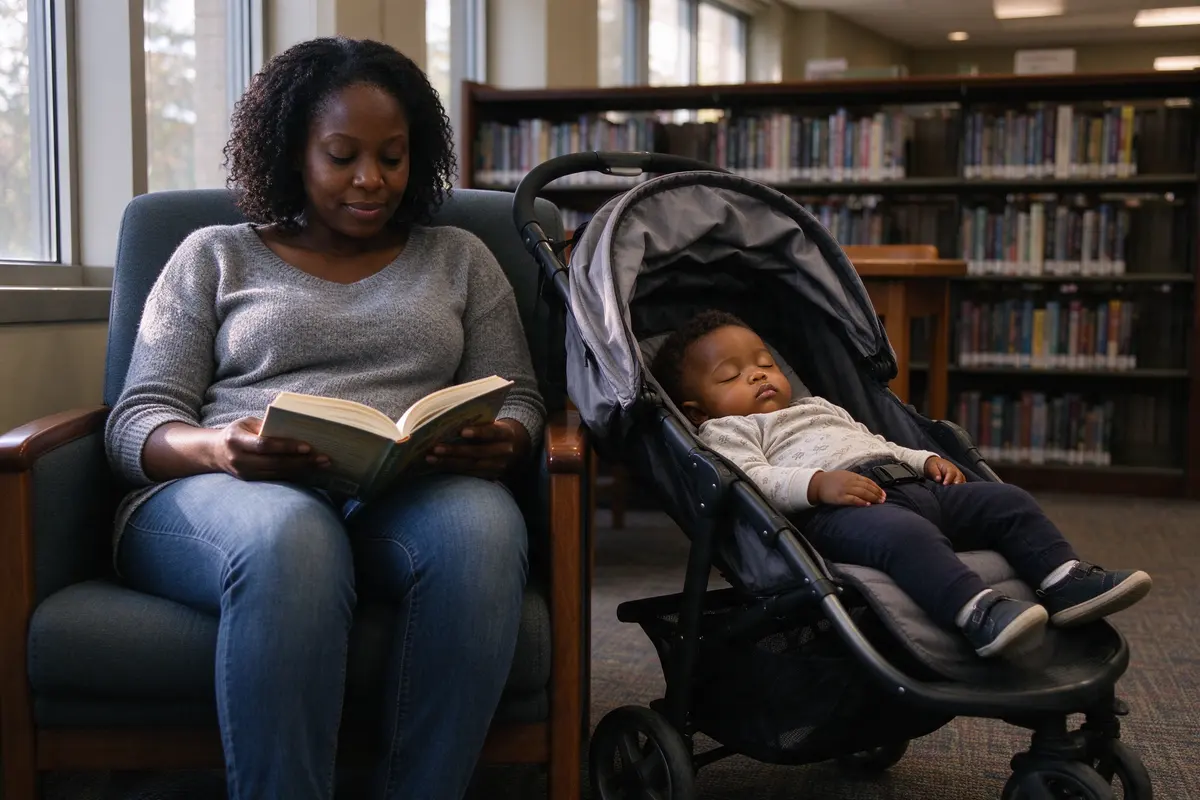
Your own ten pages. A library is warm, free, has a floor the baby can crawl on, and will hand you a book you didn't have to think about; ten pages of it in the armchair while the baby sleeps in the stroller is reading, and it counts for you the way the board book counts for them. The CDC lists overwhelming tiredness among the maternal warning signs to act on, for a full year after birth (CDC). Ordinary tiredness isn't on the list, and ten pages of a book you chose is one way to find out which kind you have.
If you're the partner: your job is the library card, and the Saturday morning trip that gets the two of them out of the house and gives her the armchair. Bring back three board books and one paperback that isn't about babies.
Sources
- Dowdall N, Melendez-Torres GJ, Murray L, et al. "Shared Picture Book Reading Interventions for Child Language Development: A Systematic Review and Meta-Analysis." Child Development, 2020. https://pubmed.ncbi.nlm.nih.gov/30737957/
- Klass P, Miller-Fitzwater A, High PC; AAP Council on Early Childhood. "Literacy Promotion: An Essential Component of Primary Care Pediatric Practice: Policy Statement." Pediatrics, 2024. https://pubmed.ncbi.nlm.nih.gov/39342414/
- American Academy of Pediatrics. "Language Development: 8 to 12 Months." HealthyChildren.org, updated 2009. https://www.healthychildren.org/English/ages-stages/baby/Pages/Language-Development-8-to-12-Months.aspx
- Centers for Disease Control and Prevention. "Milestones by 9 Months." Learn the Signs. Act Early. program, updated 2026. https://www.cdc.gov/act-early/milestones/9-months.html
- Centers for Disease Control and Prevention. "Milestones by 18 Months." Learn the Signs. Act Early. program, updated 2026. https://www.cdc.gov/act-early/milestones/18-months.html
- Centers for Disease Control and Prevention. "Milestones by 15 Months." Learn the Signs. Act Early. program, updated 2026. https://www.cdc.gov/act-early/milestones/15-months.html
- Carpenter M, Nagell K, Tomasello M. "Social cognition, joint attention, and communicative competence from 9 to 15 months of age." Monographs of the Society for Research in Child Development, 1998. https://pubmed.ncbi.nlm.nih.gov/9835078/
- Iverson JM, Goldin-Meadow S. "Gesture paves the way for language development." Psychological Science, 2005. https://pubmed.ncbi.nlm.nih.gov/15869695/
- Reach Out and Read. "About." Accessed 2026. https://reachoutandread.org/about/
- Centers for Disease Control and Prevention. "Milestones by 1 Year." Learn the Signs. Act Early. program, updated 2026. https://www.cdc.gov/act-early/milestones/1-year.html
- American Academy of Pediatrics. "Checkup Checklist: 9 Months Old." HealthyChildren.org, updated 2021. https://www.healthychildren.org/English/ages-stages/Your-Childs-Checkups/Pages/Your-Checkup-Checklist-9-Months-Old.aspx
- Bradin S. "Choking Prevention for Babies & Children: What Every Parent Needs to Know." HealthyChildren.org, updated 2026. https://www.healthychildren.org/English/health-issues/injuries-emergencies/Pages/Choking-Prevention.aspx
- American Academy of Pediatrics. "Fever" (symptom checker). HealthyChildren.org, accessed 2026. https://www.healthychildren.org/English/tips-tools/symptom-checker/Pages/symptomviewer.aspx?symptom=Fever
- Centers for Disease Control and Prevention. "Urgent Maternal Warning Signs and Symptoms." HEAR HER, 2024. https://www.cdc.gov/hearher/maternal-warning-signs/index.html
This guide is general education that summarizes published research and guidance from groups like the American Academy of Pediatrics, the CDC, and the WHO. It isn’t medical advice, and every child develops on their own timeline. Your pediatrician knows your child; if something feels wrong, call them. In an emergency, call 911.
Get each day’s note the morning it applies
Add your baby to a free Chorevia household with their date of birth, and every morning for 365 days the day’s note arrives in the app and by email: what’s developing, one thing to try, what to watch for, and a word for you.
Create your household