Day 337 of 365 · Week 45
Forty-five weeks: hidden, found
Last reviewed · 4 min read · 8 sources · Plain-text version
Looking for things they saw you hide is on the 1-year list. Hide-and-find from the 1-year guide, written for an eleven-month-old: one hiding place, in sight. The memory game, again.

Forty-five weeks. The toy goes under the blanket and the baby goes after it, which means a baby who knows things keep existing when they can't be seen. Today is that idea, the game that uses it, and why it's also the reason goodbyes are hard right now.
Heart
By 1 year, most babies look for things they saw you hide (CDC). By 10 months they keep searching, because they now know objects exist out of sight (AAP). In a classic lab study, babies 7.5 to 9 months old searched in the old hiding spot after delays of just 2 to 5 seconds, while 12-month-olds made the same mistake only after delays of more than 10 seconds (Diamond & Goldman-Rakic, 1989). The memory is getting longer week by week, and a baby who goes to the right place after a short wait is showing you exactly how long it is today.
Head
The 1-year guide's version is Hide-and-find, in three steps: a toy under a blanket while they watch ("Where did it go?"), then under one of two cups, then you behind a door, calling their name. Finding a toy they saw you hide is a 12-month milestone, and CDC suggests simple hide-and-seek games (CDC; CDC). For an 11-month-old, today is step one only: one hiding place, in plain sight, the toy going under while they watch. The two cups and the door are for the months after the birthday.
Body
The same memory that finds the giraffe is the one that misses you. Your baby now knows you exist when you're gone but has little sense of time, so they don't know when you'll be back; separation anxiety usually peaks between 10 and 18 months, and the AAP calls it a sign of attachment, not of spoiling (AAP; Swanson, AAP). It can bring back night waking too, and the advice there is to reassure quietly, then leave (Nemours KidsHealth). A baby who shouts for the hidden toy and shouts for you from the crib is running the same program.
Try today

Hide-and-find
Time: 5 minutes · Hide-and-find in the guide
Sit on the floor with a favorite toy and a small blanket. Let your baby watch you slide the toy under, leaving a corner showing, and ask, "Where did it go?" (CDC)
Wait. If they pull the blanket off, cheer like it was lost for a week. If they stare, lift the corner and ask again.
Next round, cover the toy completely while they watch, and count to three before helping (Diamond & Goldman-Rakic, 1989).
Stop after a few finds, while it's still funny. The two cups and the door come later (CDC).
Make it work:One hiding place today, in plain sight. The blanket goes over the toy, never over the baby's face.
Watch for
Normal
a baby who lifts the blanket, finds the toy, and hides it again under their own leg.
Bring it up
if by 12 months your baby doesn't look for a toy they saw you hide (CDC).
Normal
a week of night waking that lines up with a clingy week in the day; separation anxiety can bring back night waking, and the advice is to reassure quietly, then leave (Nemours KidsHealth).
Call within 24 hours
if your baby has a fever with no other symptoms for more than 2 days, any fever that lasts more than 3 days, or a fever that comes back after a day without one (AAP).
Normal
the toy forgotten the moment the dog walks in.
Call your pediatrician right away
if your baby has a fever over 104°F (40°C), or shaking chills lasting more than 30 minutes (AAP).
For you
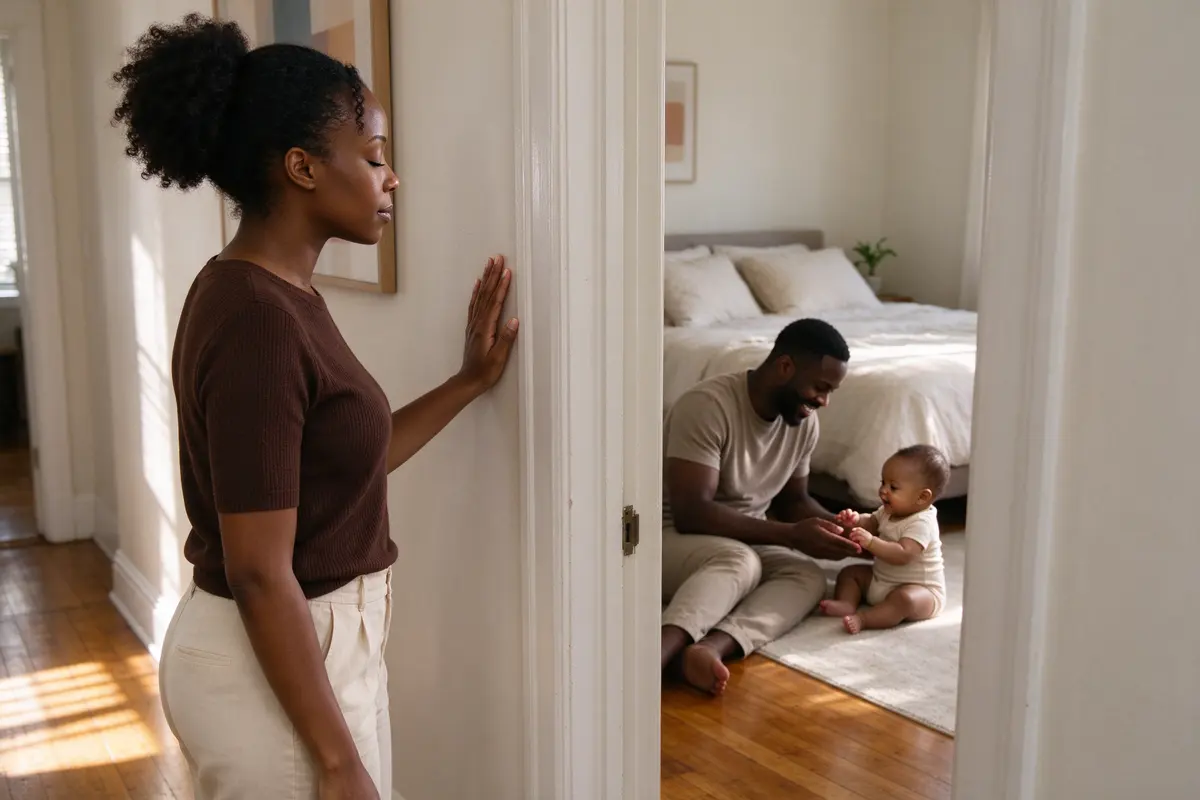
The memory game, again. You've played versions of it since the fourth month, and it keeps mattering because the thing it proves keeps getting bigger: a baby who can hold a giraffe in mind for three seconds under a blanket is a baby who holds you in mind the whole time you're in the other room. That's the attachment the AAP is talking about (AAP), and it's why the guide's goodbye advice is a quick, cheerful one, the same ritual every time, and a return when you said you would (Swanson, AAP). You are the toy under the blanket. The finding is the point, and so is the wait.
If you're the partner: be the one behind the blanket this evening, and then the one who leaves the room with a wave and comes back on time. Both halves are the game.
Sources
- Centers for Disease Control and Prevention. "Milestones by 1 Year." Learn the Signs. Act Early. program, updated 2026. https://www.cdc.gov/act-early/milestones/1-year.html
- American Academy of Pediatrics. "Cognitive Development in Infants: 8 to 12 Months." HealthyChildren.org, updated 2023. https://www.healthychildren.org/English/ages-stages/baby/Pages/Cognitive-Development-8-to-12-Months.aspx
- Diamond A, Goldman-Rakic PS. "Comparison of human infants and rhesus monkeys on Piaget's AB task: evidence for dependence on dorsolateral prefrontal cortex." Experimental Brain Research, 1989. https://pubmed.ncbi.nlm.nih.gov/2924839/
- Centers for Disease Control and Prevention. "Milestones by 15 Months." Learn the Signs. Act Early. program, accessed 2026. https://www.cdc.gov/act-early/milestones/15-months.html
- American Academy of Pediatrics. "Emotional and Social Development: 8 to 12 Months." HealthyChildren.org, updated 2009. https://www.healthychildren.org/English/ages-stages/baby/Pages/Emotional-and-Social-Development-8-12-Months.aspx
- Swanson WS. "How to Ease Your Child's Separation Anxiety." HealthyChildren.org, updated 2026. https://www.healthychildren.org/English/ages-stages/toddler/Pages/Soothing-Your-Childs-Separation-Anxiety.aspx
- Nemours KidsHealth. "Baby Sleep: 8- to 12-Month-Olds." Reviewed 2025. https://kidshealth.org/en/parents/sleep812m.html
- American Academy of Pediatrics. "Fever" (symptom checker). HealthyChildren.org, accessed 2026. https://www.healthychildren.org/English/tips-tools/symptom-checker/Pages/symptomviewer.aspx?symptom=Fever
This guide is general education that summarizes published research and guidance from groups like the American Academy of Pediatrics, the CDC, and the WHO. It isn’t medical advice, and every child develops on their own timeline. Your pediatrician knows your child; if something feels wrong, call them. In an emergency, call 911.
Get each day’s note the morning it applies
Add your baby to a free Chorevia household with their date of birth, and every morning for 365 days the day’s note arrives in the app and by email: what’s developing, one thing to try, what to watch for, and a word for you.
Create your household