Day 328 of 365 · Week 44
Forty-fourth week: the 12-month visit ahead
Last reviewed · 4 min read · 15 sources · Plain-text version
An anemia check and, depending on risk, lead; MMR, chickenpox, and hepatitis A at or soon after the birthday, on a schedule that differed in 2026, so ask which. The birthday-visit list, in writing.

The forty-fourth week ends with the first birthday about five weeks away and the 12-month visit just past it. Today is what that visit checks, which shots come with it, and the five questions that go in writing before you walk in.
Heart
At 12 months, your baby will be checked for anemia and, depending on risk, lead; near 12 months, growth slows and appetite often levels off (AAP). The AAP's schedule puts the visit at 12 months, with vaccines, the anemia check, and lead screening based on risk or local rules (AAP, 2025). The guide's section is The 9-month and 12-month checkups. A visit with a blood check in it is a visit to arrive at rested and fed, with the questions already written, because the baby's opinion of it will take up the rest of your attention.
Head
At or soon after the first birthday come MMR, chickenpox, and hepatitis A, plus boosters; the AAP also recommends a flu shot every year from 6 months and COVID vaccine for babies 6 through 23 months (Bracho-Sánchez, AAP). US guidance is in flux: the AAP and CDC schedules differ in 2026 (AAP), and a federal judge paused many of the federal changes in March 2026, a ruling the government has appealed (STAT, 2026). So the first question on the list is which schedule your pediatrician follows; the guide's question is What vaccines does my baby get between 7 and 12 months?
Body
The rest of the list is this month's plans, which the visit is the place to confirm. Around 12 months, most babies can switch to whole cow's milk; after the first birthday, keep milk to about 16 ounces (2 cups) a day or less (AAP). The move off bottles finishes sometime between 12 and 18 months (Shu, AAP). Night feeds get asked about before they're cut (AAP). And walking: healthy children in the WHO's study started walking alone anywhere from 8.2 to 17.6 months (WHO Multicentre Growth Reference Study Group, 2006), so a baby who isn't is inside the range, not a question.
Try today
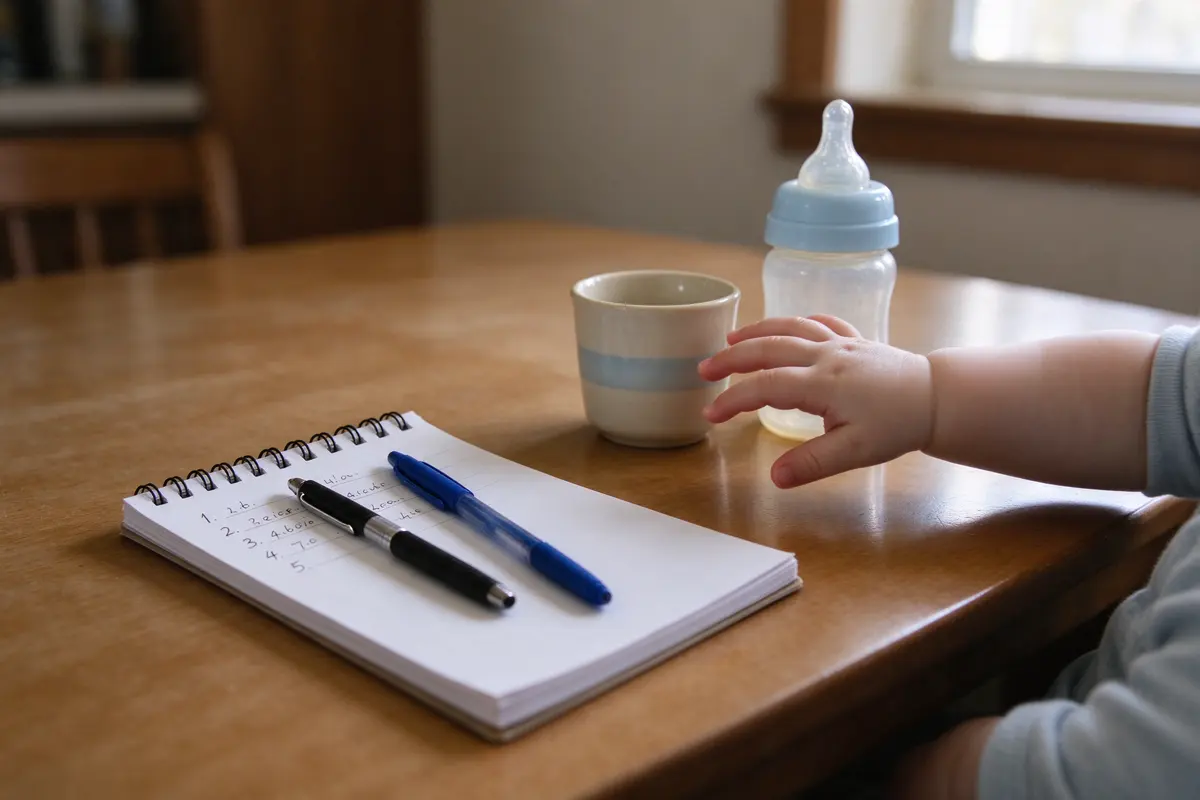
The birthday-visit list
Time: 15 minutes, both adults · The 9-month and 12-month checkups in the guide
Question one: "Which vaccine schedule do you follow, and what's due today?" (AAP)
Question two: "Does my baby need the lead test, and what will you check for anemia?" (AAP)
Question three, the milk plan: whole milk, how much, and whether 2% is right for this baby (AAP).
Question five is yours: the one thing you've wondered about this month that no list covers. Write it even if it sounds small.
Make it work:Bring the food diary and the word log if you've kept them; the visit goes faster with the answers already written.
Watch for
Normal
a baby who lets go of the sofa, stands alone for a second, and sits down fast; standing alone ran from 6.9 to 16.9 months in the WHO's study (WHO Multicentre Growth Reference Study Group, 2006).
Don't wait
if you're worried about development: ask about screening, or call your state's early intervention program for a free evaluation; you don't need a referral (CDC).
Normal
an appetite that has leveled off in the last few weeks, with smaller meals and no change in energy (AAP).
Call your pediatrician right away
for signs of dehydration: no urine in more than 8 hours, dark urine, a very dry mouth, and no tears (AAP).
Normal
bruised shins from cruising the coffee table's corner.
Call your pediatrician now
for any head injury in a baby under 1, even if your baby seems fine (AAP).
For you
The visit asks about you, if you make it. The 6-month visit was the last of the checkups at which the AAP recommends screening the birthing parent for depression (Earls et al., 2019), so at 12 months nobody hands you a form. Write a sixth line on the list anyway, for yourself: if sadness has lasted more than two weeks, that's a reason to go to your own doctor, without waiting for any visit (Office on Women's Health). A pediatrician who's asked how you're sleeping will answer; the question just has to be on the page.
If you're the partner: question five is yours to write, and the sixth line is yours to ask her about on the drive there. About 10% of fathers have depression around a birth, with higher rates reported at 3 to 6 months after (Paulson & Bazemore, 2010); answer the sixth line yourself, too.
Sources
- American Academy of Pediatrics. "Checkup Checklist: First Birthday (12 Months Old)." HealthyChildren.org, updated 2021. https://www.healthychildren.org/English/ages-stages/Your-Childs-Checkups/Pages/Your-Checkup-Checklist-12-Months-Old.aspx
- American Academy of Pediatrics and Bright Futures. "Recommendations for Preventive Pediatric Health Care" (Periodicity Schedule). 2025. https://downloads.aap.org/AAP/PDF/periodicity_schedule.pdf
- Bracho-Sánchez E. "AAP Guide: Vaccines Your Child Needs by Age 6." HealthyChildren.org, updated 2026. https://www.healthychildren.org/English/safety-prevention/immunizations/Pages/Your-Babys-First-Vaccines.aspx
- American Academy of Pediatrics. "AAP Releases Recommended Childhood and Adolescent Immunization Schedule for 2026." HealthyChildren.org, 2026. https://www.healthychildren.org/English/news/Pages/AAPs-recommended-childhood-and-adolescent-immunization-schedule-for-2026.aspx
- STAT. "HHS appeals ruling that stalled many of Kennedy's vaccine policy changes." 2026. https://www.statnews.com/2026/04/29/hhs-appealing-acip-vaccine-policy-lawsuit-ruling/
- American Academy of Pediatrics. "Why Do Infants Need Baby Formula Instead of Cow's Milk?" HealthyChildren.org, updated 2024. https://www.healthychildren.org/English/ages-stages/baby/formula-feeding/Pages/Why-Formula-Instead-of-Cows-Milk.aspx
- Shu J. "From Bottle to Cup: Helping Your Child Make a Healthy Transition." HealthyChildren.org, updated 2023. https://www.healthychildren.org/English/ages-stages/baby/feeding-nutrition/Pages/Discontinuing-the-Bottle.aspx
- American Academy of Pediatrics. "Sleeping Through the Night." HealthyChildren.org, updated 2013. https://www.healthychildren.org/English/ages-stages/baby/sleep/Pages/Sleeping-Through-the-Night.aspx
- WHO Multicentre Growth Reference Study Group. "WHO Motor Development Study: windows of achievement for six gross motor development milestones." Acta Paediatrica Supplement, 2006. https://pubmed.ncbi.nlm.nih.gov/16817682/
- Centers for Disease Control and Prevention. "Concerned About Your Child's Development?" Updated 2026. https://www.cdc.gov/act-early/families/concerned.html
- American Academy of Pediatrics. "Fever" (symptom checker). HealthyChildren.org, accessed 2026. https://www.healthychildren.org/English/tips-tools/symptom-checker/Pages/symptomviewer.aspx?symptom=Fever
- American Academy of Pediatrics. "Head Injury" (symptom checker). HealthyChildren.org, accessed 2026. https://www.healthychildren.org/English/tips-tools/symptom-checker/Pages/symptomviewer.aspx?symptom=Head+Injury
- Earls MF, Yogman MW, Mattson G, Rafferty J; AAP Committee on Psychosocial Aspects of Child and Family Health. "Incorporating Recognition and Management of Perinatal Depression Into Pediatric Practice." Pediatrics, 2019. https://pubmed.ncbi.nlm.nih.gov/30559120/
- Office on Women's Health. "Recovering from birth." US Department of Health and Human Services, 2021. https://womenshealth.gov/pregnancy/childbirth-and-beyond/recovering-birth
- Paulson JF, Bazemore SD. "Prenatal and postpartum depression in fathers and its association with maternal depression: a meta-analysis." JAMA, 2010. https://pubmed.ncbi.nlm.nih.gov/20483973/
This guide is general education that summarizes published research and guidance from groups like the American Academy of Pediatrics, the CDC, and the WHO. It isn’t medical advice, and every child develops on their own timeline. Your pediatrician knows your child; if something feels wrong, call them. In an emergency, call 911.
Get each day’s note the morning it applies
Add your baby to a free Chorevia household with their date of birth, and every morning for 365 days the day’s note arrives in the app and by email: what’s developing, one thing to try, what to watch for, and a word for you.
Create your household