Day 317 of 365 · Week 43
Night feeds at ten months
Last reviewed · 4 min read · 8 sources · Plain-text version
Many babies this age don't need to eat at night; some still do. Attention at every waking can teach waking. Growth first; the pediatrician decides with you. The water-not-milk night, or the question.
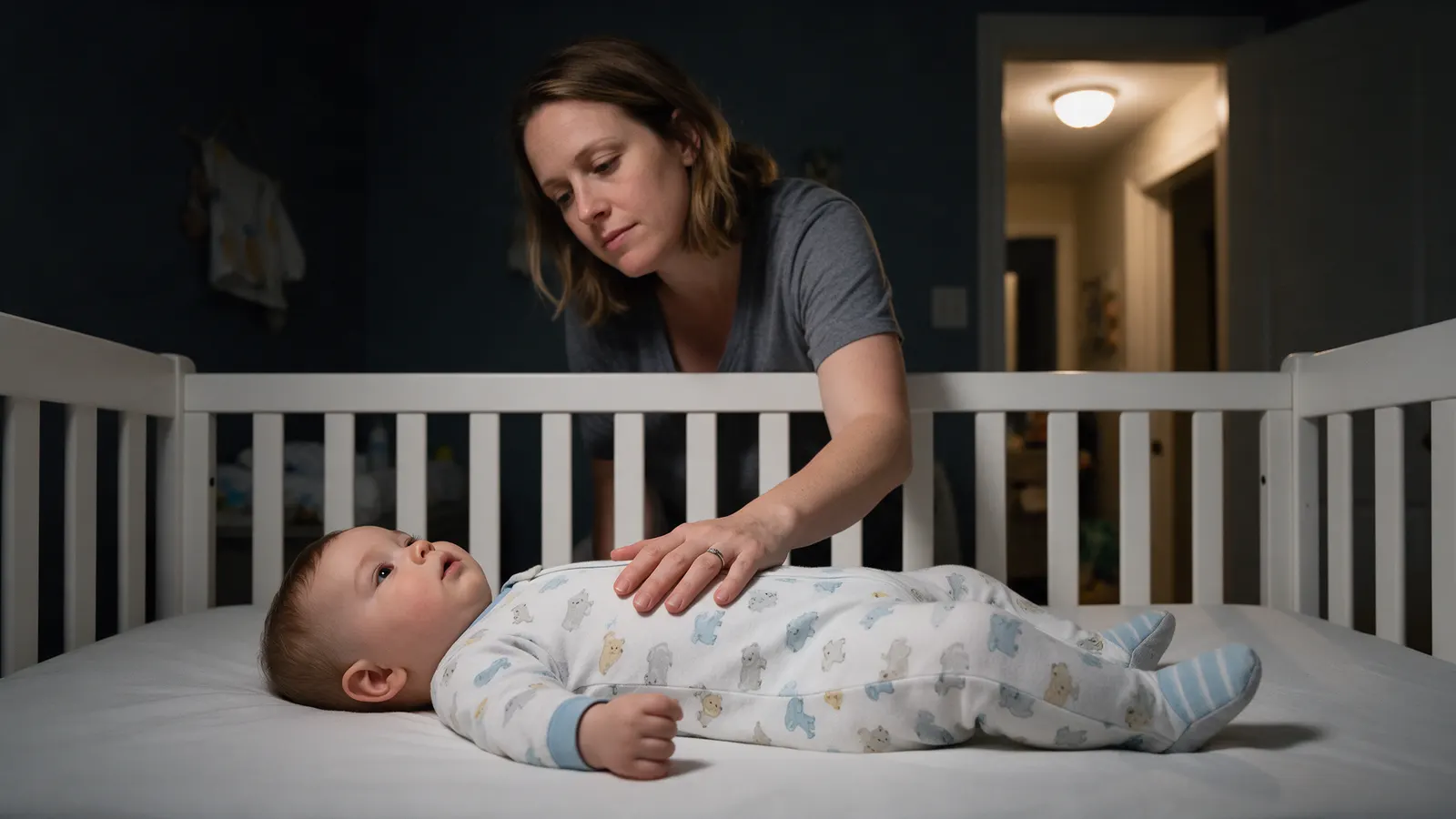
If your baby still eats at night, this isn't a note telling you to stop. It's the AAP's reasons it might be time to ask, the one way to find out, and what a waking looks like once feeding isn't the answer.
Heart
Many babies this age don't need to eat at night, but some still do, so the guide's rule is to ask your pediatrician before cutting night feeds (AAP). The AAP says most formula-fed babies no longer need a middle-of-the-night feeding after 2 to 4 months (AAP), which puts a ten-month-old well past the average, and nowhere near every baby. Growth comes first: check with your pediatrician before anything changes if your baby isn't growing and gaining weight steadily (AAP).
Head
Why the feed and the waking get tangled: night waking at this age is often caused by separation anxiety, and cuddling, feeding, or talking at every waking can prompt your baby to wake for that attention (Nemours KidsHealth). A feed is the warmest attention there is. That doesn't make it wrong; it makes it worth knowing which of the two your baby is waking for, and only the pediatrician's answer on growth tells you whether the feed can go. KidsHealth's advice for the wakings that aren't hunger is to reassure your baby quietly, then leave (Nemours KidsHealth).
Body
Two things stay fixed whichever way the answer goes. Never put your baby to bed with a bottle; sugary residue left in the mouth overnight promotes tooth decay (AAP). And your baby still goes down on their back in a bare crib, with the mattress at its lowest setting now that standing is here or close (AAP). The guide's answer is Should my 9-month-old still wake up to eat at night?, and the question is the activity if you haven't asked it yet.
Try today
The water-not-milk night
Time: One night, or one sticky note · Naps, nights, and night feeds in the guide
If you haven't asked, stop here and write the question for the pediatrician: "Does this baby still need to eat at night, given their growth?" (AAP). That's today's whole activity.
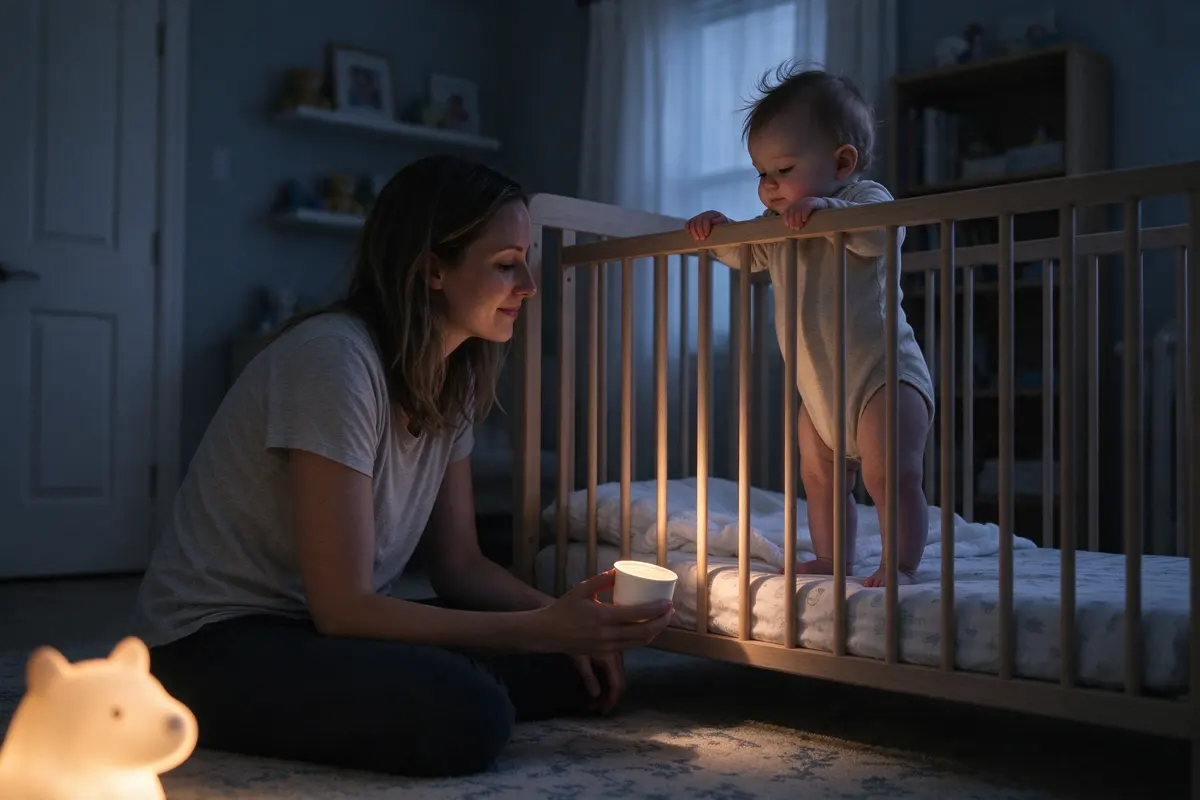
If the pediatrician has agreed the feed can go: at the waking, go in, keep the lights off, one calm sentence and a hand on the back (Nemours KidsHealth).
If they seem thirsty, a sip or two of water from a small cup you hold, counted into the day's 4 to 8 ounces; no bottle (Muth, AAP).
Back on the back, the same sentence, out. Note the time and how long it took, so you can see it shorten.
Make it work:Pick a week with no cold, no new tooth, and no new sitter. Separations are harder when babies are tired, hungry, or sick (AAP).
Watch for
Normal
a 3 a.m. waking that ends with a hand on the back and no feed, and a baby who eats a big breakfast.
Talk with your pediatrician
before dropping a night feed if your baby isn't growing and gaining weight steadily (AAP).
Normal
a week of extra wakings with a cold, since separations are harder when babies are sick (AAP).
Call within 24 hours
if a fever lasts more than 3 days, or comes back after a day without one (AAP).
Normal
a baby found standing at the rail, cords nowhere near the crib (AAP).
Call 911
if your baby is struggling for each breath or can barely cry (AAP).
For you
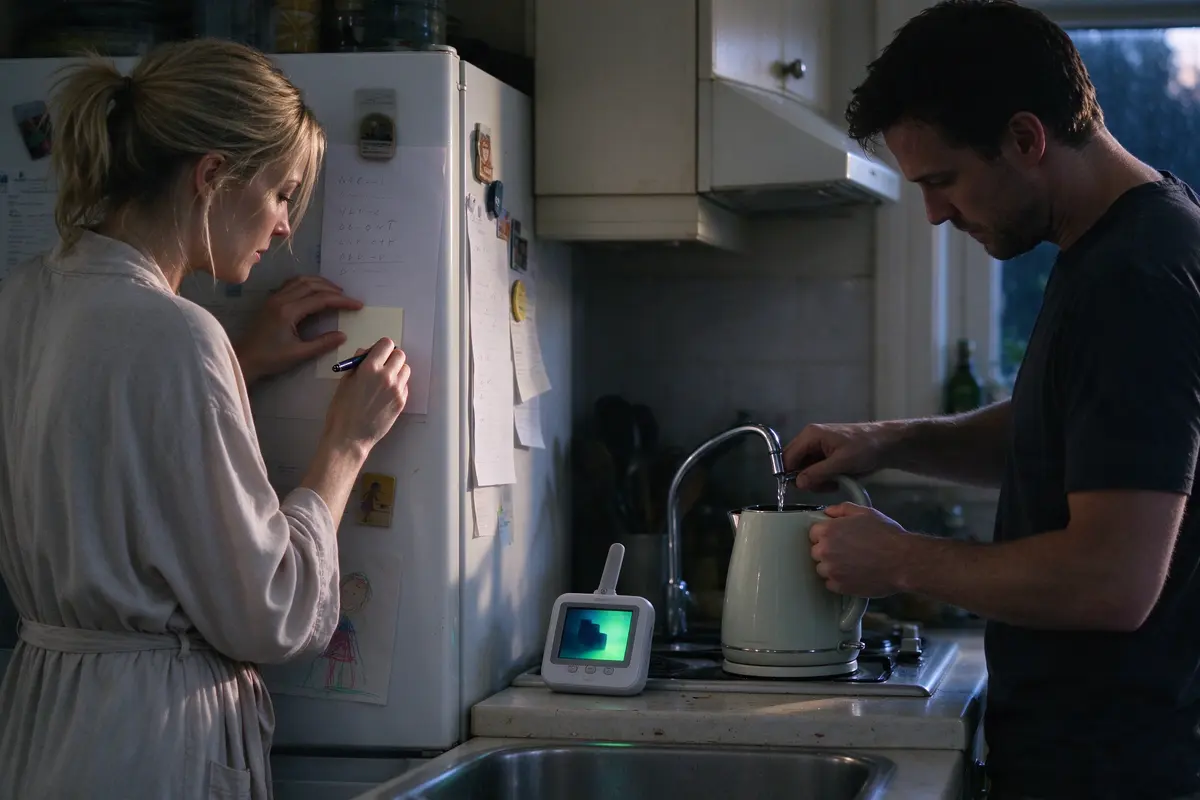
The question, asked, is progress. Whatever the answer, you'll have traded a guess for a decision made with someone who has the growth chart in front of them (AAP), and a night feed you choose to keep is a different night from one you're not sure you should be doing. If you're breastfeeding, the question is the same, and so is the answer's source. And if the nights have stopped being tired and become something you dread, that's a different question, with a number: call or text the National Maternal Mental Health Hotline at 1-833-TLC-MAMA (1-833-852-6262), or call or text 988; in an emergency, call 911 (CDC).
If you're the partner: once the feed is gone, the wakings don't need the person with the milk. Take the first week of them. Same sentence, same cup, lights off.
Sources
- American Academy of Pediatrics. "Sleeping Through the Night." HealthyChildren.org, updated 2013. https://www.healthychildren.org/English/ages-stages/baby/sleep/Pages/Sleeping-Through-the-Night.aspx
- American Academy of Pediatrics. "Amount and Schedule of Baby Formula Feedings." HealthyChildren.org, updated 2022. https://www.healthychildren.org/English/ages-stages/baby/formula-feeding/Pages/amount-and-schedule-of-formula-feedings.aspx
- Nemours KidsHealth. "Baby Sleep: 8- to 12-Month-Olds." Reviewed 2025. https://kidshealth.org/en/parents/sleep812m.html
- American Academy of Pediatrics. "Make Baby's Room Safe: Parent Checklist." HealthyChildren.org, updated 2020. https://www.healthychildren.org/English/safety-prevention/at-home/Pages/Make-Babys-Room-Safe.aspx
- Muth ND. "Recommended Drinks for Children Age 5 & Younger." HealthyChildren.org, updated 2023. https://www.healthychildren.org/English/healthy-living/nutrition/Pages/Recommended-Drinks-for-Young-Children-Ages-0-5.aspx
- American Academy of Pediatrics. "Emotional and Social Development: 8 to 12 Months." HealthyChildren.org, updated 2009. https://www.healthychildren.org/English/ages-stages/baby/Pages/Emotional-and-Social-Development-8-12-Months.aspx
- American Academy of Pediatrics. "Fever" (symptom checker). HealthyChildren.org, accessed 2026. https://www.healthychildren.org/English/tips-tools/symptom-checker/Pages/symptomviewer.aspx?symptom=Fever
- Centers for Disease Control and Prevention. "Symptoms of Depression Among Women." 2024. https://www.cdc.gov/reproductive-health/depression/index.html
This guide is general education that summarizes published research and guidance from groups like the American Academy of Pediatrics, the CDC, and the WHO. It isn’t medical advice, and every child develops on their own timeline. Your pediatrician knows your child; if something feels wrong, call them. In an emergency, call 911.
Get each day’s note the morning it applies
Add your baby to a free Chorevia household with their date of birth, and every morning for 365 days the day’s note arrives in the app and by email: what’s developing, one thing to try, what to watch for, and a word for you.
Create your household