Day 301 of 365 · Week 41
Month eleven
Last reviewed · 4 min read · 14 sources · Plain-text version
Ten months old today. The 12-month list read as what most babies do by a year, the two skills that aren't on it, corrected age, and the first birthday eight weeks off.
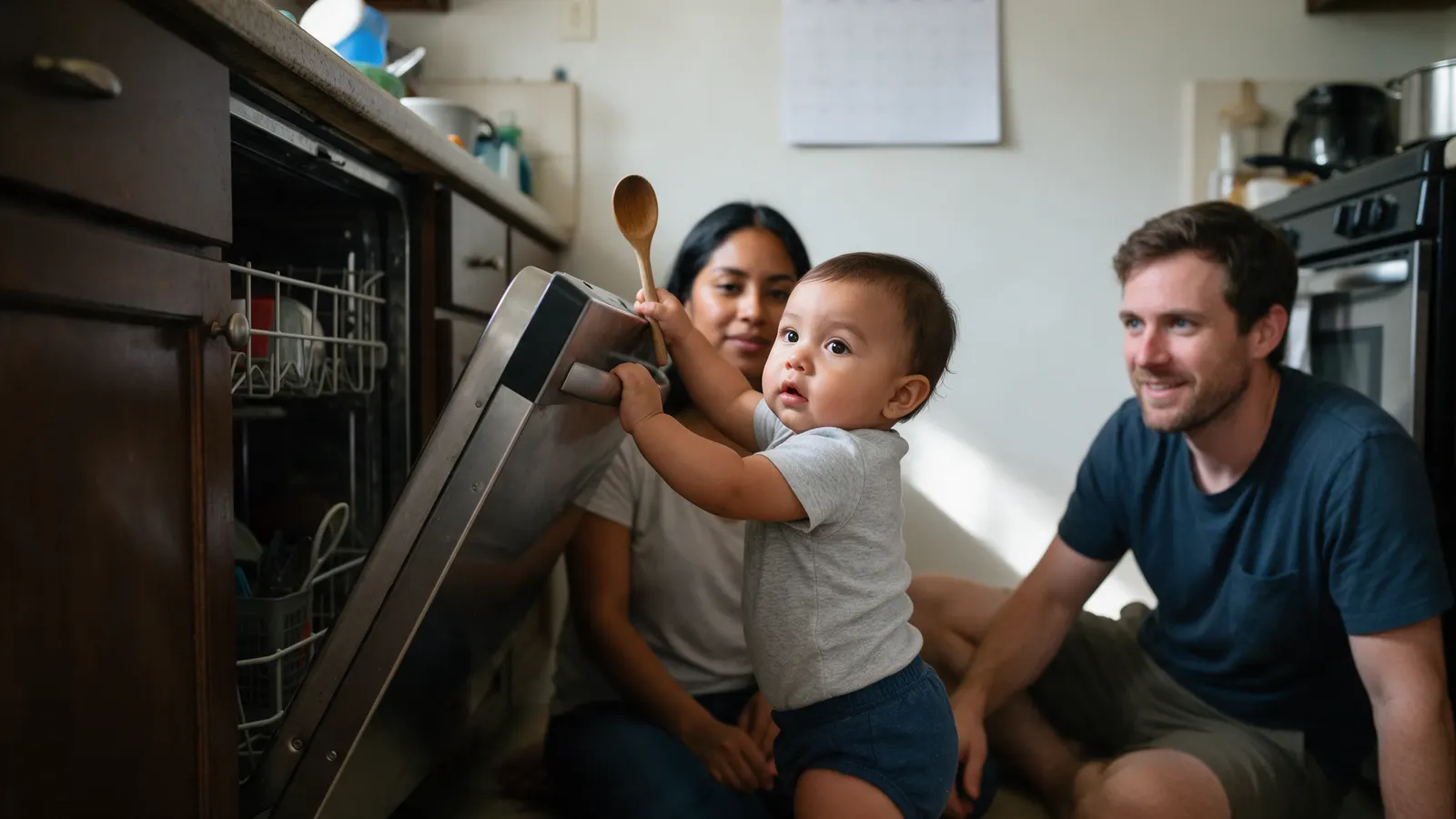
Ten months old today. Last month's notes are at your tenth month. This month the first birthday stops being an idea and becomes a date on the calendar, so the list for this month is the same one as last month, read with eight weeks left on the clock.
Heart
By 1 year, most babies play games with you, like pat-a-cake; wave "bye-bye"; call a parent "mama," "dada," or another special name; understand "no"; put something in a container; look for things they saw you hide; pull up to stand; walk while holding on to furniture; drink from a cup without a lid as you hold it; and pick up small bits of food between thumb and pointer finger (CDC). "Most" means at least 75% of babies by that age, so a missed one is a reason to check in, not to wait and see (Zubler et al., 2022). Your baby is 10 months old. Some of that list is here and some is still coming, and both are what a 10-month-old looks like. Born early? Use corrected age for milestones during the first 2 years (AAP).
Head
Two things people will ask about this month that aren't on the list. Taking a few steps alone and pointing to ask for things are 15-month milestones (CDC), and crawling isn't on any CDC checklist at all (Kretch et al., 2022). The line that does have a job: if by 12 months your baby doesn't pull up to stand, wave bye-bye, or look for a toy they saw you hide, bring it up (CDC). And if you're worried before then, your state's early intervention program does a free evaluation; you don't need a referral (CDC).
Body
The birthday brings a visit and two changes. At the 12-month checkup your baby will be checked for anemia and, depending on risk, lead, and near 12 months growth slows and appetite often levels off (AAP). Around 12 months, most babies can switch from formula to whole cow's milk; before that, no cow's milk as a drink (AAP). And the move off bottles finishes sometime between 12 and 18 months (Shu, AAP). None of that happens today. This month is for planning it; the guide's section is Milestones by 12 months.
Try today

The almost-one list
Time: 10 minutes, with your partner if you can · Milestones by 12 months in the guide
Take the fridge page from last month, or print the CDC's 1-year list fresh (CDC).
Next to every skill you've seen, write what it looks like in this baby and roughly when it started: "waves at the dog, since the park." That's a record for the 12-month visit, not a score.
Next to every skill you haven't seen, write nothing. The list describes a baby two months older than yours (Zubler et al., 2022).
At the bottom, add two lines that aren't due: "steps alone, 15 months" and "points to ask, 15 months" (CDC), so nobody in the house counts them this month.
Make it work:If you were told to use corrected age, the two months left on the clock run from the due date, not the birthday (AAP).
Watch for
Normal
a list that's half "started" at 10 months and half blank (Zubler et al., 2022).
Talk with your pediatrician
if your baby has lost skills they used to have (CDC).
Normal
a smaller appetite some days as growth slows toward the first birthday (AAP).
Call your pediatrician right away
for signs of dehydration: no urine in more than 8 hours, dark urine, a very dry mouth, and no tears (AAP).
Normal
a new fear of the dark hallway or the vacuum this month (AAP).
Go to the ER now
if your baby had a seizure with a fever, has a stiff neck, or has a bulging soft spot (AAP).
For you
A new month, and the same short list for you, because it runs for a full year after birth. Get care now, not later, for a headache that won't go away or gets worse, dizziness or fainting, changes in vision, a fever of 100.4°F or higher, extreme swelling of the hands or face, trouble breathing, chest pain or a fast-beating heart, severe belly pain that doesn't go away, heavy bleeding, overwhelming tiredness, or thoughts about harming yourself or your baby, and tell whoever sees you that you were pregnant within the last year (CDC). The quieter line, still true at ten months: if sadness has lasted more than two weeks, go to your own doctor without waiting for a visit (Office on Women's Health).
If you're the partner: the birthday is eight weeks off and someone will start planning it. Before the guest list, ask her the two-week question, and answer it yourself.
Sources
- Centers for Disease Control and Prevention. "Milestones by 1 Year." Learn the Signs. Act Early. program, updated 2026. https://www.cdc.gov/act-early/milestones/1-year.html
- Zubler JM, Wiggins LD, Macias MM, et al. "Evidence-Informed Milestones for Developmental Surveillance Tools." Pediatrics, 2022. https://pubmed.ncbi.nlm.nih.gov/35132439/
- American Academy of Pediatrics. "Corrected Age For Preemies." HealthyChildren.org, updated 2018. https://www.healthychildren.org/English/ages-stages/baby/preemie/Pages/Corrected-Age-For-Preemies.aspx
- Centers for Disease Control and Prevention. "Milestones by 15 Months." Learn the Signs. Act Early. program, accessed 2026. https://www.cdc.gov/act-early/milestones/15-months.html
- Kretch KS, Willett SL, Hsu LY, et al. "'Learn the Signs. Act Early.': Updates and Implications for Physical Therapists." Pediatric Physical Therapy, 2022. https://pubmed.ncbi.nlm.nih.gov/35876833/
- Centers for Disease Control and Prevention. "Concerned About Your Child's Development?" Updated 2026. https://www.cdc.gov/act-early/families/concerned.html
- American Academy of Pediatrics. "Checkup Checklist: First Birthday (12 Months Old)." HealthyChildren.org, updated 2021. https://www.healthychildren.org/English/ages-stages/Your-Childs-Checkups/Pages/Your-Checkup-Checklist-12-Months-Old.aspx
- American Academy of Pediatrics. "Why Do Infants Need Baby Formula Instead of Cow's Milk?" HealthyChildren.org, updated 2024. https://www.healthychildren.org/English/ages-stages/baby/formula-feeding/Pages/Why-Formula-Instead-of-Cows-Milk.aspx
- Shu J. "From Bottle to Cup: Helping Your Child Make a Healthy Transition." HealthyChildren.org, updated 2023. https://www.healthychildren.org/English/ages-stages/baby/feeding-nutrition/Pages/Discontinuing-the-Bottle.aspx
- Centers for Disease Control and Prevention. "Milestones by 9 Months." Learn the Signs. Act Early. program, updated 2026. https://www.cdc.gov/act-early/milestones/9-months.html
- American Academy of Pediatrics. "Fever" (symptom checker). HealthyChildren.org, accessed 2026. https://www.healthychildren.org/English/tips-tools/symptom-checker/Pages/symptomviewer.aspx?symptom=Fever
- American Academy of Pediatrics. "Emotional and Social Development: 8 to 12 Months." HealthyChildren.org, updated 2009. https://www.healthychildren.org/English/ages-stages/baby/Pages/Emotional-and-Social-Development-8-12-Months.aspx
- Centers for Disease Control and Prevention. "Urgent Maternal Warning Signs and Symptoms." HEAR HER, 2024. https://www.cdc.gov/hearher/maternal-warning-signs/index.html
- Office on Women's Health. "Recovering from birth." US Department of Health and Human Services, 2021. https://womenshealth.gov/pregnancy/childbirth-and-beyond/recovering-birth
This guide is general education that summarizes published research and guidance from groups like the American Academy of Pediatrics, the CDC, and the WHO. It isn’t medical advice, and every child develops on their own timeline. Your pediatrician knows your child; if something feels wrong, call them. In an emergency, call 911.
Get each day’s note the morning it applies
Add your baby to a free Chorevia household with their date of birth, and every morning for 365 days the day’s note arrives in the app and by email: what’s developing, one thing to try, what to watch for, and a word for you.
Create your household