Day 300 of 300 · Ten months
Three hundred days
Last reviewed · 4 min read · 18 sources · Plain-text version
Ten months old. The 12-month list as what most babies do by a year, the guide for the stretch to the first birthday, hotlines once more, and where the notes go next. The standing video.

Three hundred days. Ten months old today. Here is the list once more, what you did with it, and where the notes go next.
Heart
By 1 year, most babies play games with you like pat-a-cake; wave bye-bye; call a parent "mama," "dada," or another special name; understand "no"; put something in a container; look for things they saw you hide; pull up to stand; walk while holding on to furniture; drink from a cup without a lid as you hold it; and pick up small bits of food between thumb and pointer finger (CDC). Ten months old means "by a year" is still eight weeks off, so some of that is here and some is coming, and the list is set at what at least 75% of babies do by each age (Zubler et al., 2022). Born early? Count from the due date (AAP).
Head
Two things that aren't on it, and one rule about it. Crawling isn't on any CDC checklist (Kretch et al., 2022), and taking a few steps alone and pointing to ask for things are 15-month milestones (CDC). The rule: if by 12 months your baby doesn't pull up to stand, wave bye-bye, or look for a toy they saw you hide, bring it up (CDC), and if you're worried before then, your state's early intervention program does a free evaluation and you don't need a referral (CDC).
Body
What you did in three hundred days, in the guide's own terms. You moved a baby to 3 meals and 2 to 3 snacks (AAP) and put a cup at every one of them (Shu, AAP). You answered the babble on time (Goldstein & Schwade, 2008). You lowered the mattress before the standing (AAP), anchored the furniture, and locked up the medicine (AAP). And you said goodbye out loud every time instead of sneaking away (CDC). None of it was a milestone. All of it was the work.
Try today
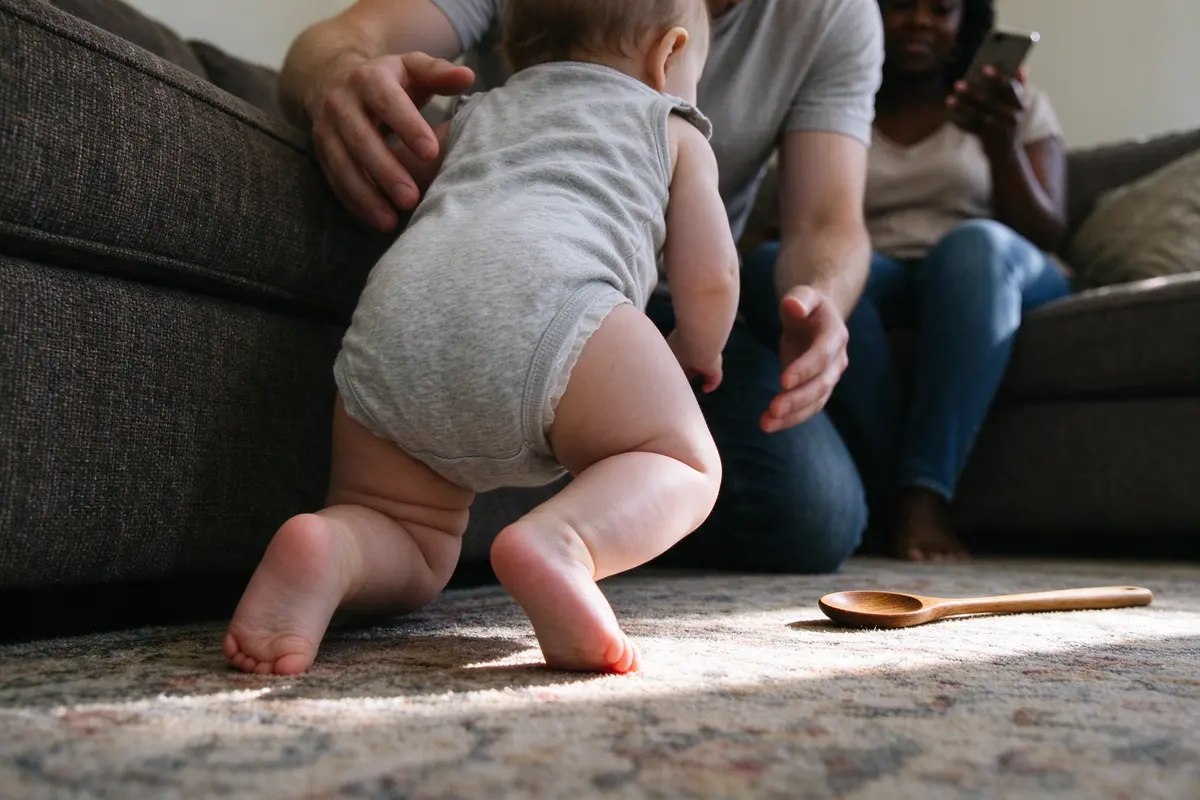
The standing video
Time: 2 minutes
Put the phone on the floor, propped against a book, so the baby is filmed from their own height and not from above.
Say the date out loud at the start, then let your baby pull up at the sofa or cruise toward a toy, your hands ready and out of the shot if you can.
If standing isn't here yet, film the crawl, the scoot, or the sit; the video is a keepsake, not evidence.
Save it next to the sitting video from month eight and send it to the person who most wants to see it.
Make it work:Keep it to two minutes. The baby who performed for the whole sofa yesterday will sit down and chew the remote the moment the phone comes out.
Watch for
Normal
a baby who pulls up on everything and comes down with a thump; by 1 year most babies pull up and cruise (CDC).
Call your pediatrician now
for any head injury in a baby under 1 year, even if your baby seems fine (AAP).
Normal
a week of waving at nothing in particular, and none at the person leaving.
Bring it up
if by 12 months your baby doesn't wave bye-bye (CDC).
Normal
a low fever with a runny nose that eases in a day.
Call within 24 hours
if your baby has a fever with no other symptoms for more than 2 days, any fever that lasts more than 3 days, or a fever that comes back after a day without one (AAP).
Normal
knowing this baby better than anyone alive, and better than any list.
Call anyway
if your baby just doesn't seem right to you. Trust your instincts; three hundred days have built them (Lurie Children's).
For you

Three hundred days of you. Once more, lightly: the National Maternal Mental Health Hotline is 1-833-TLC-MAMA (1-833-852-6262), call or text; 988 is for anyone; in an emergency, 911 (CDC). The 6-month visit was the last of the checkups at which the AAP recommends screening the birthing parent for depression (Earls et al., 2019), so the question is yours to ask each other on the step tonight, and the answer is allowed to be "not great." Partners count too: about 10% of fathers have depression around a birth, with higher rates reported at 3 to 6 months after (Paulson & Bazemore, 2010).
If you're the partner: say the one thing from this month you'll still remember in ten years, out loud, before the tea goes cold. Then keep going together: the 7-to-12-month guide covers the whole stretch to the first birthday, and the notes continue tomorrow at your eleventh month.
Sources
- Centers for Disease Control and Prevention. "Milestones by 1 Year." Learn the Signs. Act Early. program, updated 2026. https://www.cdc.gov/act-early/milestones/1-year.html
- Zubler JM, Wiggins LD, Macias MM, et al. "Evidence-Informed Milestones for Developmental Surveillance Tools." Pediatrics, 2022. https://pubmed.ncbi.nlm.nih.gov/35132439/
- American Academy of Pediatrics. "Corrected Age For Preemies." HealthyChildren.org, updated 2018. https://www.healthychildren.org/English/ages-stages/baby/preemie/Pages/Corrected-Age-For-Preemies.aspx
- Kretch KS, Willett SL, Hsu LY, et al. "'Learn the Signs. Act Early.': Updates and Implications for Physical Therapists." Pediatric Physical Therapy, 2022. https://pubmed.ncbi.nlm.nih.gov/35876833/
- Centers for Disease Control and Prevention. "Milestones by 15 Months." Learn the Signs. Act Early. program, accessed 2026. https://www.cdc.gov/act-early/milestones/15-months.html
- Centers for Disease Control and Prevention. "Concerned About Your Child's Development?" Updated 2026. https://www.cdc.gov/act-early/families/concerned.html
- American Academy of Pediatrics. "Checkup Checklist: 9 Months Old." HealthyChildren.org, updated 2021. https://www.healthychildren.org/English/ages-stages/Your-Childs-Checkups/Pages/Your-Checkup-Checklist-9-Months-Old.aspx
- Shu J. "From Bottle to Cup: Helping Your Child Make a Healthy Transition." HealthyChildren.org, updated 2023. https://www.healthychildren.org/English/ages-stages/baby/feeding-nutrition/Pages/Discontinuing-the-Bottle.aspx
- Goldstein MH, Schwade JA. "Social feedback to infants' babbling facilitates rapid phonological learning." Psychological Science, 2008. https://pubmed.ncbi.nlm.nih.gov/18466414/
- American Academy of Pediatrics. "Make Baby's Room Safe: Parent Checklist." HealthyChildren.org, updated 2020. https://www.healthychildren.org/English/safety-prevention/at-home/Pages/Make-Babys-Room-Safe.aspx
- American Academy of Pediatrics. "Home Safety: Tips for Families With Young Children." HealthyChildren.org, updated 2022. https://www.healthychildren.org/English/safety-prevention/at-home/Pages/Home-Safety-Heres-How.aspx
- Centers for Disease Control and Prevention. "Milestones by 9 Months." Learn the Signs. Act Early. program, updated 2026. https://www.cdc.gov/act-early/milestones/9-months.html
- American Academy of Pediatrics. "Head Injury" (symptom checker). HealthyChildren.org, accessed 2026. https://www.healthychildren.org/English/tips-tools/symptom-checker/Pages/symptomviewer.aspx?symptom=Head+Injury
- American Academy of Pediatrics. "Fever" (symptom checker). HealthyChildren.org, accessed 2026. https://www.healthychildren.org/English/tips-tools/symptom-checker/Pages/symptomviewer.aspx?symptom=Fever
- Latimer T. "When to Call the Pediatrician for Your Newborn." Lurie Children's Hospital of Chicago, 2022. https://www.luriechildrens.org/en/blog/when-to-call-the-pediatrician-for-your-newborn/
- Centers for Disease Control and Prevention. "Symptoms of Depression Among Women." 2024. https://www.cdc.gov/reproductive-health/depression/index.html
- Earls MF, Yogman MW, Mattson G, Rafferty J; AAP Committee on Psychosocial Aspects of Child and Family Health. "Incorporating Recognition and Management of Perinatal Depression Into Pediatric Practice." Pediatrics, 2019. https://pubmed.ncbi.nlm.nih.gov/30559120/
- Paulson JF, Bazemore SD. "Prenatal and postpartum depression in fathers and its association with maternal depression: a meta-analysis." JAMA, 2010. https://pubmed.ncbi.nlm.nih.gov/20483973/
This guide is general education that summarizes published research and guidance from groups like the American Academy of Pediatrics, the CDC, and the WHO. It isn’t medical advice, and every child develops on their own timeline. Your pediatrician knows your child; if something feels wrong, call them. In an emergency, call 911.
Get each day’s note the morning it applies
Add your baby to a free Chorevia household with their date of birth, and every morning for 300 days the day’s note arrives in the app and by email: what’s developing, one thing to try, what to watch for, and a word for you.
Create your household