Day 285 of 300 · Week 39
Answering, still
Last reviewed · 4 min read · 9 sources · Plain-text version
Your baby is now the age of the babies whose babble changed when it was answered right away. Talk with, not at: every babble gets three turns today, and the pause counts as one.
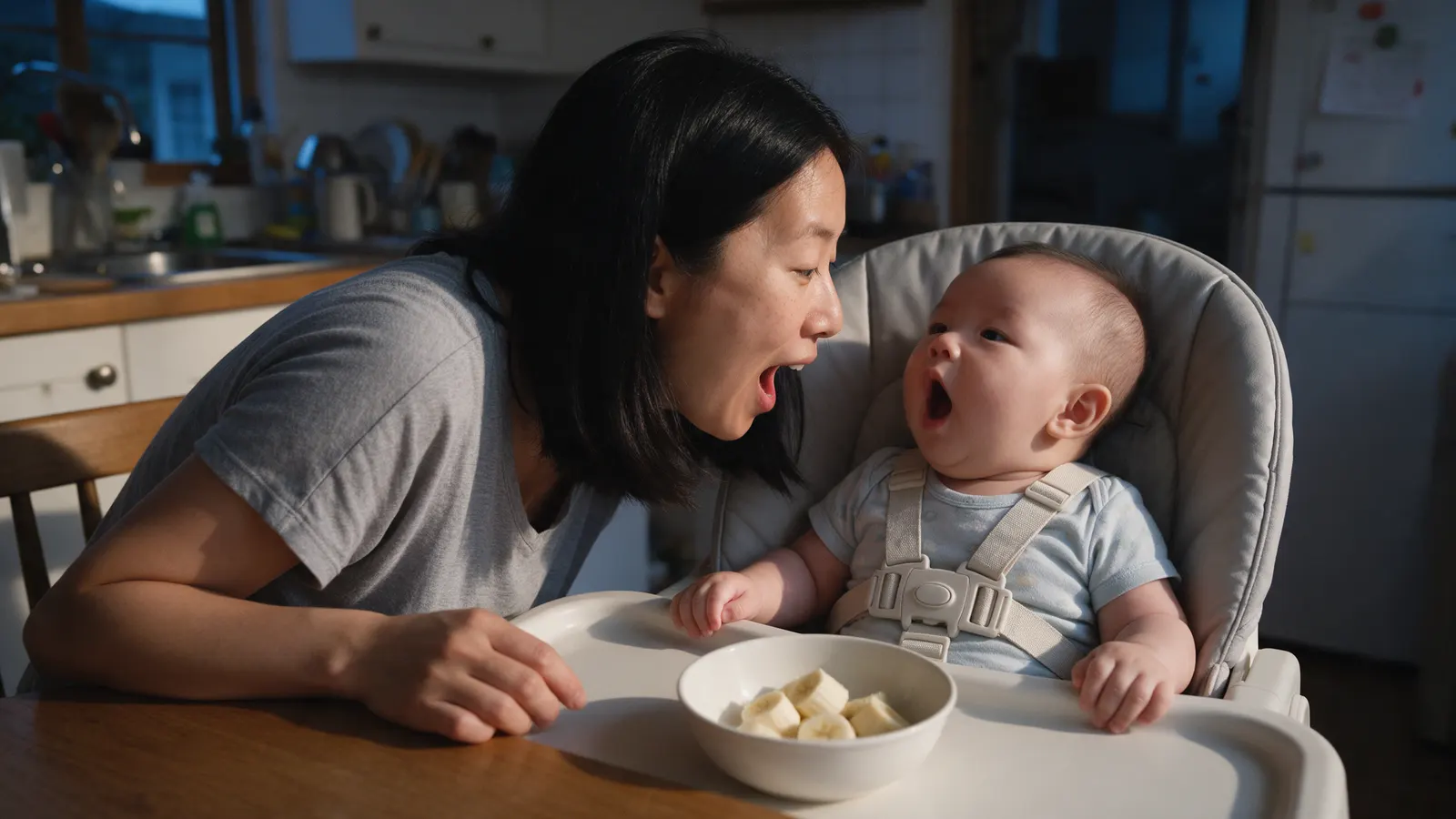
Last month you read that answering babble changes it. This month your baby is the age of the babies in that study. Today is the evidence once more, briefly, and a rule for the day that turns it into something you can count.
Heart
By 9 months, most babies make lots of different sounds like "mamamama" and "bababababa" (CDC), and by now the strings often rise and fall the way sentences do; the AAP describes most 12-month speech as babble with the ups and downs of real talk (AAP). Your baby is 9 months old. The sound coming from the high chair isn't aimed at nobody. It's the baby's half of a conversation, and it's waiting to see whether the other half shows up.
Head
In a lab experiment, 9.5-month-olds whose mothers answered their babble right away quickly reshaped it using sounds from their mothers' speech; babies answered at random times didn't (Goldstein & Schwade, 2008). In a randomized trial of 71 families, coaching parents at 6, 10, and 14 months increased parentese and back-and-forth turns (Ferjan Ramírez et al., 2020), and in a follow-up of 59 children, the coached group had larger vocabularies through 30 months (Huber et al., 2023). The trial and its follow-up are small and come from one lab group. The thing to hold onto is the word turns. Not the amount of talk, the number of exchanges.
Body
Talk with your baby, not at them. Repeat their sounds, add simple words, and describe what they see (CDC); ask questions, and wait for an answer (AAP). The waiting is a turn, even when nothing comes back. And clear the room for it: a TV on in the background cuts down how much parents talk (Hill, AAP), which means fewer turns without anyone deciding to have fewer. The guide's activity is Talk back with words; today adds a count.
Try today
The three-turn rule
Time: All day, counted at one meal
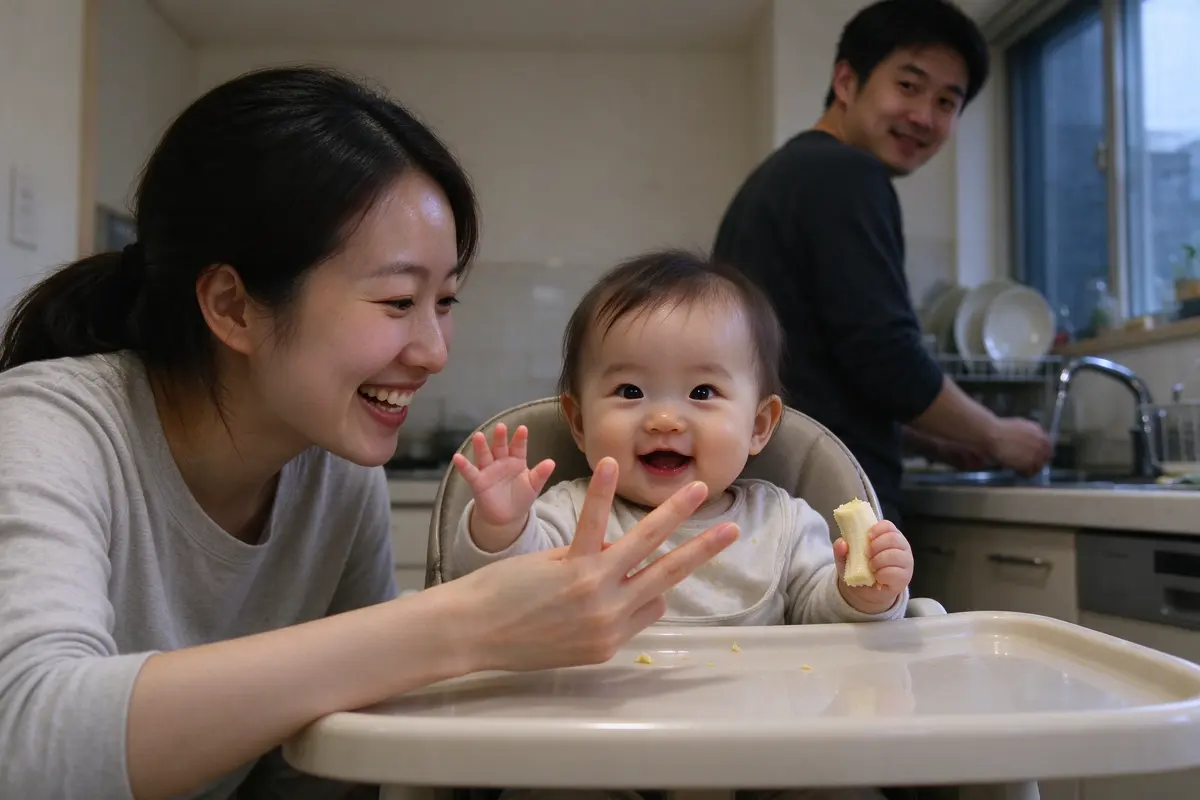
Every babble you notice today gets three turns: their sound, your answer, and your answer to whatever comes next, even if what comes next is silence.
Answer right away, not after you've finished the dishes. The babies answered off the beat didn't change their babble (Goldstein & Schwade, 2008).
Make your answer their sound plus one word: "Da-da? Dog. There's the dog" (CDC).
At one meal, count the turns on your fingers and hold up three when you get there. See how long the longest exchange runs before the baby turns to the banana.
Make it work:The pause is a turn. Count to five in your head before you fill it (AAP).
Watch for
Normal
more babble to the ceiling fan than to you some days, and a baby who stops dead the moment you answer, then starts again when you look away.
Don't wait
if you're worried about speech or hearing: ask your pediatrician about screening, or call your state's early intervention program for a free evaluation; you don't need a referral (CDC).
Normal
a long, happy shriek at full volume that clears the room.
Call 911
if your baby has purple or blood-colored spots or dots on the skin (AAP).
Normal
a hoarse voice the morning after the shrieking.
Go to the ER now
if your baby has any trouble breathing, including ribs pulling in with each breath or loud wheezing (AAP).
For you
The turns are the practice. What the coached parents learned wasn't a vocabulary list; it was to use the sing-song voice and to take turns (Ferjan Ramírez et al., 2020), and the babies in the lab changed their sounds because someone answered in time, not because someone talked a lot (Goldstein & Schwade, 2008). That's a relief if you're a quiet person. You don't have to narrate the day. You have to answer, and then let the baby answer back. Three turns, many times, is a language lesson with a lot of silence in it.
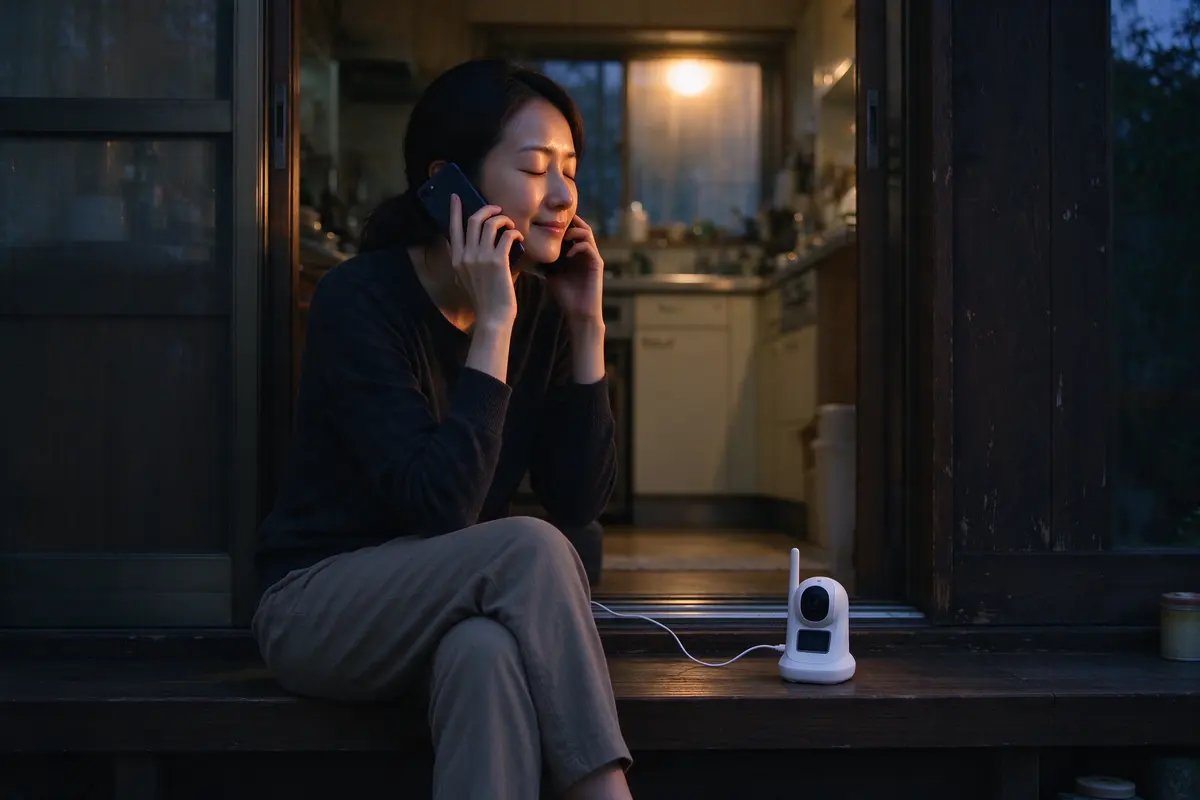
Then give yourself three turns with an adult. Call someone, say one true thing, wait for their answer, and answer that. Most of us stop at one.
If you're the partner: count the turns at bath time tonight and tell her the number. It'll be higher than you expect, and lower than it will be next week.
Sources
- Centers for Disease Control and Prevention. "Milestones by 9 Months." Learn the Signs. Act Early. program, updated 2026. https://www.cdc.gov/act-early/milestones/9-months.html
- American Academy of Pediatrics. "Language Development: 8 to 12 Months." HealthyChildren.org, updated 2009. https://www.healthychildren.org/English/ages-stages/baby/Pages/Language-Development-8-to-12-Months.aspx
- Goldstein MH, Schwade JA. "Social feedback to infants' babbling facilitates rapid phonological learning." Psychological Science, 2008. https://pubmed.ncbi.nlm.nih.gov/18466414/
- Ferjan Ramírez N, Lytle SR, Kuhl PK. "Parent coaching increases conversational turns and advances infant language development." Proceedings of the National Academy of Sciences, 2020. https://pubmed.ncbi.nlm.nih.gov/32015127/
- Huber E, Ferjan Ramírez N, Corrigan NM, Kuhl PK. "Parent coaching from 6 to 18 months improves child language outcomes through 30 months of age." Developmental Science, 2023. https://pubmed.ncbi.nlm.nih.gov/36999222/
- Hill DL. "Why to Avoid TV for Infants & Toddlers." HealthyChildren.org, updated 2016. https://www.healthychildren.org/English/family-life/Media/Pages/Why-to-Avoid-TV-Before-Age-2.aspx
- Centers for Disease Control and Prevention. "Concerned About Your Child's Development?" Updated 2026. https://www.cdc.gov/act-early/families/concerned.html
- American Academy of Pediatrics. "Fever" (symptom checker). HealthyChildren.org, accessed 2026. https://www.healthychildren.org/English/tips-tools/symptom-checker/Pages/symptomviewer.aspx?symptom=Fever
- American Academy of Pediatrics. "Breathing Trouble" (symptom checker). HealthyChildren.org, accessed 2026. https://www.healthychildren.org/English/tips-tools/symptom-checker/Pages/symptomviewer.aspx?symptom=Breathing+Trouble
This guide is general education that summarizes published research and guidance from groups like the American Academy of Pediatrics, the CDC, and the WHO. It isn’t medical advice, and every child develops on their own timeline. Your pediatrician knows your child; if something feels wrong, call them. In an emergency, call 911.
Get each day’s note the morning it applies
Add your baby to a free Chorevia household with their date of birth, and every morning for 300 days the day’s note arrives in the app and by email: what’s developing, one thing to try, what to watch for, and a word for you.
Create your household