Day 286 of 300 · Week 39
Reading, month ten
Last reviewed · 4 min read · 9 sources · Plain-text version
Board books with simple pictures, one word per page, and a baby who turns the pages now, however badly. The page turn is the activity, and the library is the field trip.

The book that was a thing to chew is becoming a thing to operate. Pages get grabbed, folded, pushed over two at a time. Today is why that's reading, and how to let the baby drive without losing the duck.
Heart
The AAP recommends shared reading from birth and reports that parents read more and children learn when pediatricians promote it (Klass et al., 2024). For this stage, choose board, cloth, or vinyl books with simple pictures of familiar things, and let your baby turn the pages, chew the corners, and decide when you're done (AAP). At 9 months old, the turning is the new part. By the end of this stage most babies pinch with thumb and finger and practice on anything small (AAP), and a cardboard page corner is a fine thing to practice on.
Head
What the book teaches is the same lesson as the walk and the fridge card: things have names. Name the pictures as you point to them (CDC), the same way each time (AAP). A picture of a duck is a duck that holds still, and it's the same duck tonight, which is why the same book every night is doing more than it looks like. One word per page lands; a paragraph is noise. The guide's activity is Board book time, 5 to 10 minutes a day, and today's version hands the pages over.
Body
Books cost nothing if you know where to look. Ask whether your pediatrician's office takes part in Reach Out and Read, which gives families books at checkups and says it reaches 4.8 million children (Reach Out and Read); the 12-month visit is a chance to ask. And the library's board-book bin is built for exactly this: thick pages, a few words, and nobody minds a chewed corner. Keep the choking rule in mind with any book that isn't board: check floors and between cushions for small things, and a torn-off corner of paper is a small thing (AAP).
Try today
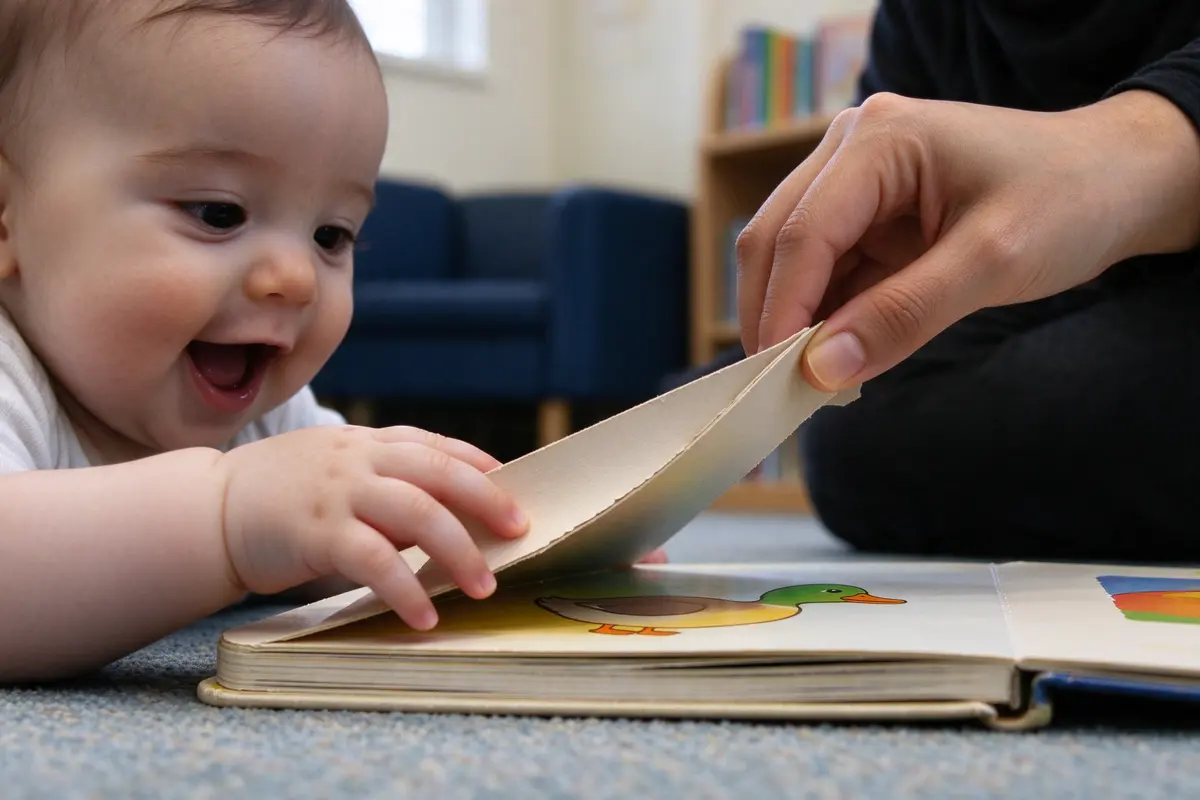
The page turn
Time: 5 to 10 minutes, a thick board book · Board book time in the guide
Sit your baby between your knees on the floor with the book on the rug, both of their hands free.
Lift the corner of the page an inch with your thumb and wait. Let them push it over, however badly; two pages at once still counts (AAP).
On whatever page opens, point to one picture and say its name once: "Duck" (CDC). Then wait.
Lift the next corner. If they turn back instead of forward, read the duck again.
Stop the moment they close the book, chew it, or crawl off. They decide when you're done (AAP).
Make it work:A short book with thick pages. Eight pages a baby can turn beats thirty they can't.
Watch for
Normal
a book turned back to front, upside down, and then flung; dropping and throwing are favorite games once letting go is on purpose (AAP).
Talk with your pediatrician
if your baby uses one arm or leg much more than the other (AAP).
Normal
a corner chewed soft and a baby who prefers the chewing to the pictures.
Call 911
if your baby is choking and can't breathe, cry, or make noise, turns bluish, or goes limp (AAP), and start back blows and chest thrusts while someone calls.
Normal
a shriek when the book closes, over the moment it opens again.
Call your pediatrician right away
if your baby screams and can't be consoled, or cries when you touch or move them (AAP).
For you
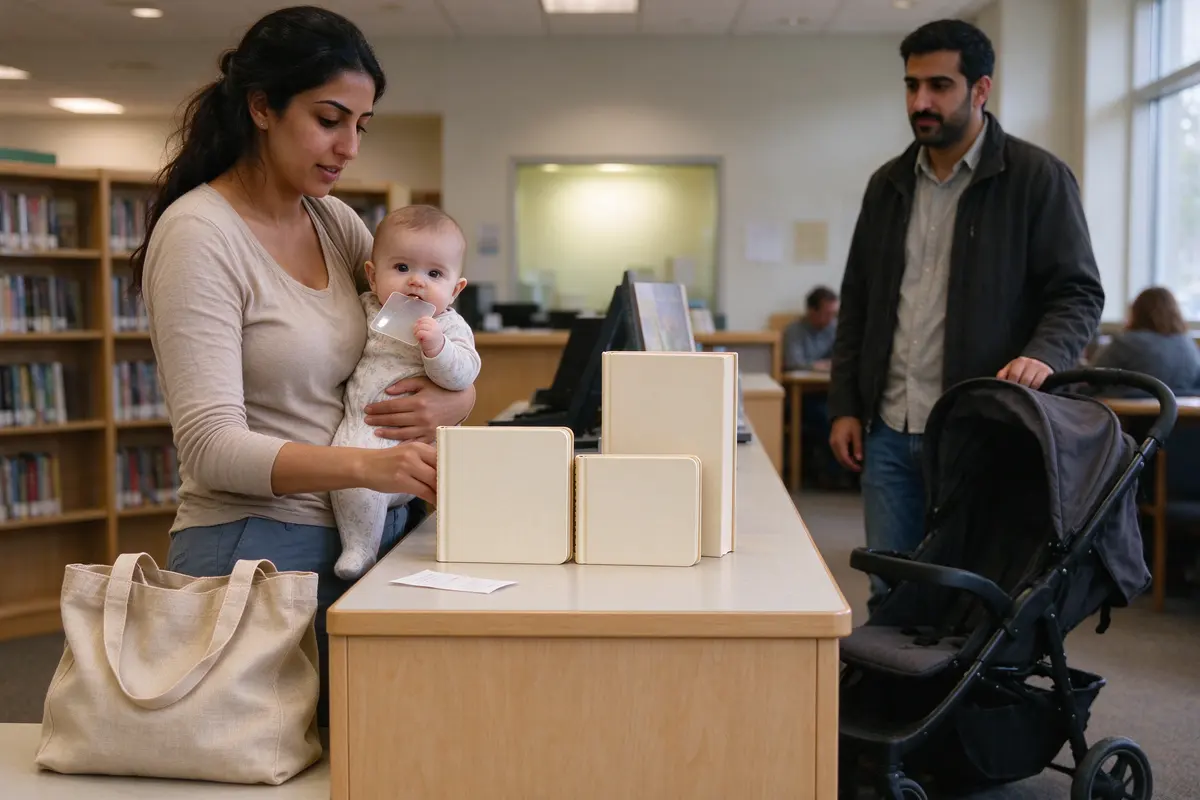
The library is the field trip. Take the baby this week: the children's floor has a rug, a bin of board books, and other adults who also haven't slept, and borrowing three books costs nothing. Then take ten pages of your own home with them, because the point of a reading house is that the adults read too. A TV on in the background cuts down how much parents talk (Hill, AAP); a paperback on the sofa arm doesn't. If you fall asleep on page two tonight, the book is still there tomorrow, which is more than you can say for the baby's nap.
If you're the partner: carry the tote, hold the stroller, and pick the one novel you'll actually open. Then read it in the same room as her, on the same night.
Sources
- Klass P, Miller-Fitzwater A, High PC; AAP Council on Early Childhood. "Literacy Promotion: An Essential Component of Primary Care Pediatric Practice: Policy Statement." Pediatrics, 2024. https://pubmed.ncbi.nlm.nih.gov/39342414/
- American Academy of Pediatrics. "Language Development: 8 to 12 Months." HealthyChildren.org, updated 2009. https://www.healthychildren.org/English/ages-stages/baby/Pages/Language-Development-8-to-12-Months.aspx
- American Academy of Pediatrics. "Hand and Finger Skills." HealthyChildren.org, updated 2009. https://www.healthychildren.org/English/ages-stages/baby/Pages/Hand-and-Finger-Skills.aspx
- Centers for Disease Control and Prevention. "Milestones by 9 Months." Learn the Signs. Act Early. program, updated 2026. https://www.cdc.gov/act-early/milestones/9-months.html
- Reach Out and Read. "About." Accessed 2026. https://reachoutandread.org/about/
- Bradin S. "Choking Prevention for Babies & Children: What Every Parent Needs to Know." HealthyChildren.org, updated 2026. https://www.healthychildren.org/English/health-issues/injuries-emergencies/Pages/Choking-Prevention.aspx
- American Academy of Pediatrics. "Movement Milestones in Babies 8 to 12 Months Old." HealthyChildren.org, updated 2021. https://www.healthychildren.org/English/ages-stages/baby/Pages/Movement-8-to-12-Months.aspx
- American Academy of Pediatrics. "Crying Child - 3 Months and Older" (symptom checker). HealthyChildren.org, accessed 2026. https://www.healthychildren.org/English/tips-tools/symptom-checker/Pages/symptomviewer.aspx?symptom=Crying+Child+-+3+Months+and+Older
- Hill DL. "Why to Avoid TV for Infants & Toddlers." HealthyChildren.org, updated 2016. https://www.healthychildren.org/English/family-life/Media/Pages/Why-to-Avoid-TV-Before-Age-2.aspx
This guide is general education that summarizes published research and guidance from groups like the American Academy of Pediatrics, the CDC, and the WHO. It isn’t medical advice, and every child develops on their own timeline. Your pediatrician knows your child; if something feels wrong, call them. In an emergency, call 911.
Get each day’s note the morning it applies
Add your baby to a free Chorevia household with their date of birth, and every morning for 300 days the day’s note arrives in the app and by email: what’s developing, one thing to try, what to watch for, and a word for you.
Create your household