Day 293 of 300 · Week 40
Finger foods, month ten
Last reviewed · 4 min read · 11 sources · Plain-text version
Finely chopped textures, half-inch pieces, the AAP's finger-food list, and the refused food offered again: tasting daily for 8 to 10 or more days raises acceptance. The refused-food return.
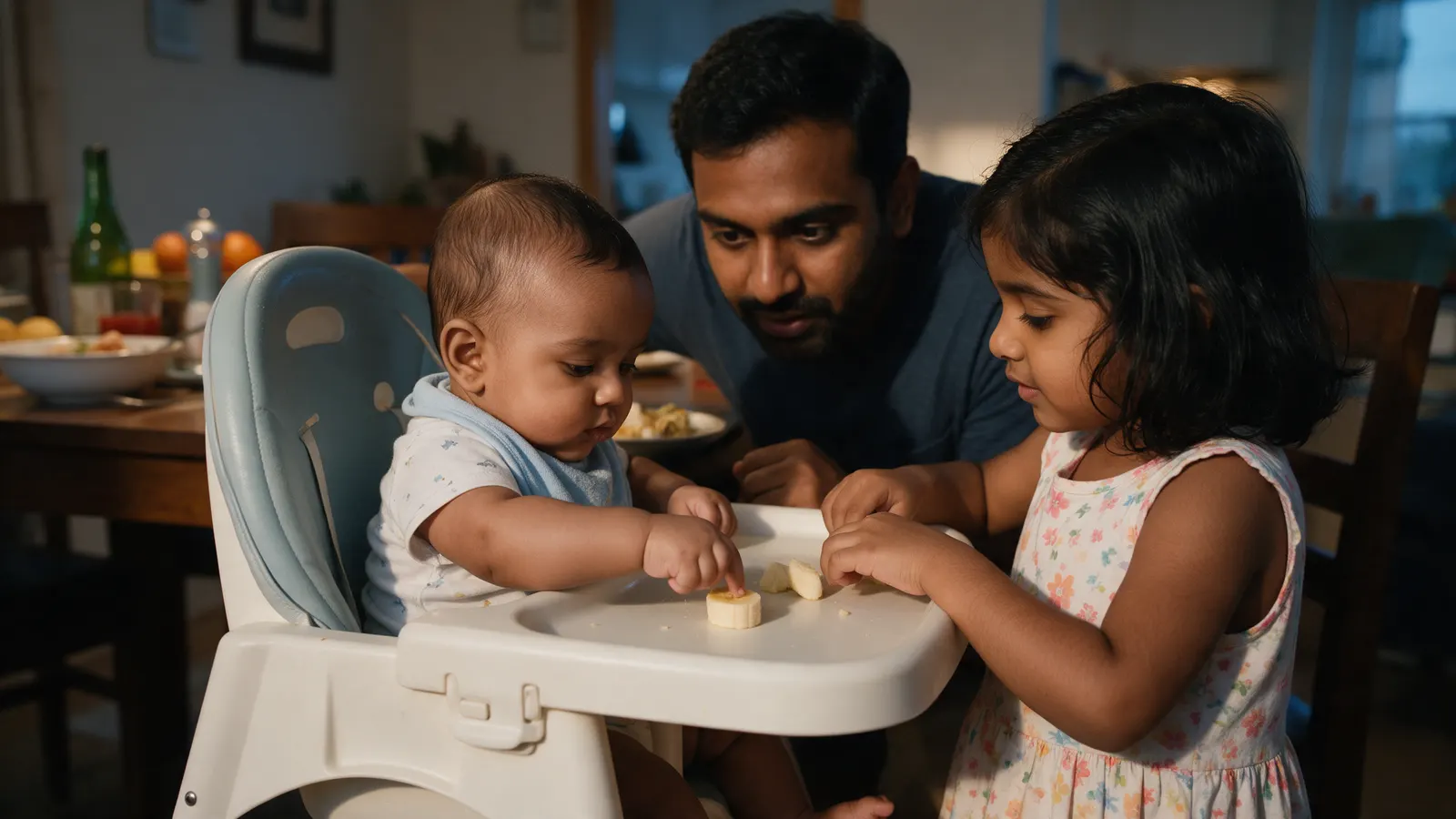
Three meals a day now, most of them with fingers. Today is the month-ten version of the tray, and the one food your baby has decided against, back for another try.
Heart
By 1 year, most babies pick up small bits of food between thumb and pointer finger (CDC), and the tray is where the practice happens. Textures move from smooth to mashed and lumpy, then finely chopped (CDC). Good first finger foods are soft, easy to swallow, and cut into small pieces, like bits of banana, scrambled eggs, well-cooked pasta, finely chopped cooked chicken, and cooked potatoes or peas (AAP). Cut pieces no larger than half an inch (AAP).
Head
A systematic review of 21 studies, mostly controlled trials, found moderate evidence that tasting a vegetable or fruit daily for 8 to 10 or more days makes babies and toddlers more willing to eat it (Spill et al., 2019). Keep offering foods your baby refused before (CDC). The egg pushed off the tray on Tuesday isn't a verdict on eggs. It's day one of ten, and most parents give up around day three.
Body
Eat together, and let your baby's fullness cues, not the plate, decide when the meal is over (AAP). The cues are pushing food away, closing the mouth, or turning the head; let your baby decide how much, and never make food a reward or punishment (CDC). The shape of the day is still 3 meals and 2 to 3 snacks (AAP), and before age 1 the list to avoid still stands: hot dogs, nuts and seeds, chunks of meat or cheese, whole grapes, popcorn, chunks of peanut butter, raw vegetables, raw fruit chunks like apple, and hard or sticky candy (AAP).
Try today
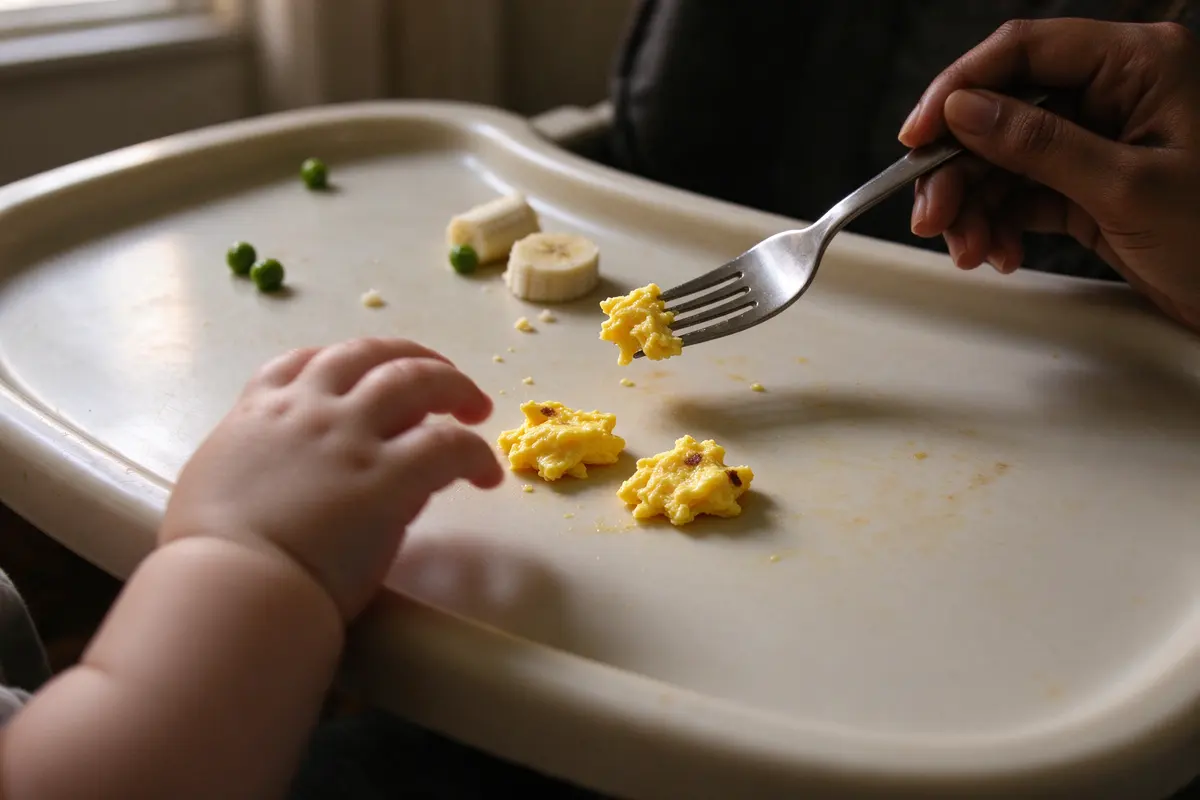
The refused-food return
Time: One meal, two minutes of it · Baby at the family table in the guide
Pick the food your baby pushed away most recently and cut it to half an inch or smaller (AAP).
Put two pieces on the tray beside foods they like, and eat the same food yourself where they can see.
Say its name once and leave it: no spoon chase, no "just one bite."
When the meal ends on their cues, the plate goes, the refused pieces with it (CDC).
Make a tick on the fridge. The review counted days of tasting, and 8 to 10 or more was the number (Spill et al., 2019).
Make it work:A piece touched, licked, or dropped on the floor counts as a day.
Watch for
Normal
the egg refused for the sixth day running; the review's number was 8 to 10 or more days (Spill et al., 2019).
Call 911
if your baby is choking and can't breathe, cry, or make noise, turns bluish, or goes limp (AAP).
Normal
a whole meal eaten with the left hand and the next with the right.
Talk with your pediatrician
if your baby uses one arm or leg much more than the other (AAP).
Normal
a head turned away at the fourth piece and a mouth that won't open; that's a fullness sign, and the meal is over (CDC).
Go to the ER now
if your baby is hard to wake, isn't alert when awake, or seems confused (AAP).
For you
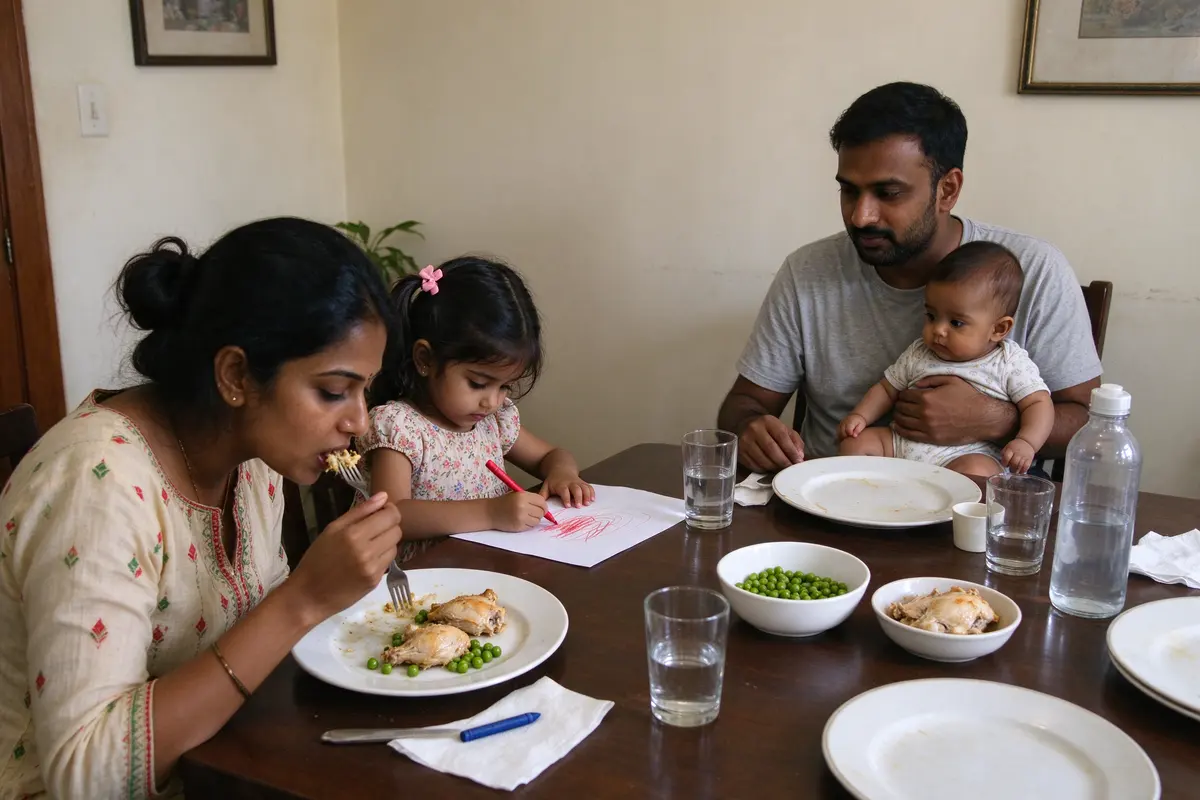
A refusal means not yet, for the baby and for the cook. The AAP's advice to eat the same foods yourself (AAP) is the easy half of the return: the meal where you both have chicken and peas is one of the 8 to 10 (Spill et al., 2019), and you don't have to clean your plate either. The vegetables on the tray are the same ones the recovery advice has been telling you to eat since the first week, with plenty of water (Office on Women's Health); cook once, serve twice.
If you're the partner: tomorrow night's return is yours. Same food, same two pieces, same tick on the fridge, so the count doesn't restart when the cook changes.
Sources
- Centers for Disease Control and Prevention. "Milestones by 1 Year." Learn the Signs. Act Early. program, updated 2026. https://www.cdc.gov/act-early/milestones/1-year.html
- Centers for Disease Control and Prevention. "Tastes and Textures." 2026. https://www.cdc.gov/infant-toddler-nutrition/foods-and-drinks/tastes-and-textures.html
- American Academy of Pediatrics. "When Can Babies Start Solid Foods? Readiness & Feeding Tips." HealthyChildren.org, updated 2026. https://www.healthychildren.org/English/ages-stages/baby/feeding-nutrition/Pages/Starting-Solid-Foods.aspx
- Bradin S. "Choking Prevention for Babies & Children: What Every Parent Needs to Know." HealthyChildren.org, updated 2026. https://www.healthychildren.org/English/health-issues/injuries-emergencies/Pages/Choking-Prevention.aspx
- Spill MK, Johns K, Callahan EH, et al. "Repeated exposure to food and food acceptability in infants and toddlers: a systematic review." American Journal of Clinical Nutrition, 2019. https://pubmed.ncbi.nlm.nih.gov/30982874/
- Centers for Disease Control and Prevention. "Milestones by 9 Months." Learn the Signs. Act Early. program, updated 2026. https://www.cdc.gov/act-early/milestones/9-months.html
- Centers for Disease Control and Prevention. "Signs Your Child Is Hungry or Full." 2026. https://www.cdc.gov/infant-toddler-nutrition/mealtime/signs-your-child-is-hungry-or-full.html
- American Academy of Pediatrics. "Checkup Checklist: 9 Months Old." HealthyChildren.org, updated 2021. https://www.healthychildren.org/English/ages-stages/Your-Childs-Checkups/Pages/Your-Checkup-Checklist-9-Months-Old.aspx
- American Academy of Pediatrics. "Movement Milestones in Babies 8 to 12 Months Old." HealthyChildren.org, updated 2021. https://www.healthychildren.org/English/ages-stages/baby/Pages/Movement-8-to-12-Months.aspx
- American Academy of Pediatrics. "Fever" (symptom checker). HealthyChildren.org, accessed 2026. https://www.healthychildren.org/English/tips-tools/symptom-checker/Pages/symptomviewer.aspx?symptom=Fever
- Office on Women's Health. "Recovering from birth." US Department of Health and Human Services, 2021. https://womenshealth.gov/pregnancy/childbirth-and-beyond/recovering-birth
This guide is general education that summarizes published research and guidance from groups like the American Academy of Pediatrics, the CDC, and the WHO. It isn’t medical advice, and every child develops on their own timeline. Your pediatrician knows your child; if something feels wrong, call them. In an emergency, call 911.
Get each day’s note the morning it applies
Add your baby to a free Chorevia household with their date of birth, and every morning for 300 days the day’s note arrives in the app and by email: what’s developing, one thing to try, what to watch for, and a word for you.
Create your household