Day 276 of 300 · Week 37
Walking: the honest range
Last reviewed · 4 min read · 9 sources · Plain-text version
Healthy babies walk alone anywhere from 8.2 to 17.6 months, steps alone is a 15-month milestone, and many aren't walking at 12. The standing count: seconds at the sofa, written down, no goal.

Someone's cousin walked at nine months; someone's cousin always did. Today is the actual numbers, wider than any family story, and a way to watch your own baby's practice without turning it into a race.
Heart
The WHO followed 816 healthy children in Ghana, India, Norway, Oman, and the US. Walking alone started anywhere from 8.2 to 17.6 months, and standing alone from 6.9 to 16.9 months, 1st to 99th percentiles (WHO Multicentre Growth Reference Study Group, 2006). So a 9-month-old at the very front of the range might already stand without hands, and a healthy child at the back won't walk for most of another year. Many babies aren't walking alone at 12 months, and taking a few steps alone is a 15-month milestone on CDC's checklist (CDC). By 12 months, what most babies do is pull up to stand and walk while holding on to furniture (CDC).
Head
The line that matters: if your baby isn't pulling to stand by 12 months or has lost skills, ask about a developmental screening (CDC). CDC's checklists are set at skills at least 75% of babies show by each age, so a missed milestone is a reason to check in, not to wait and see (Zubler et al., 2022), and if your baby was born early, the age to use is corrected age (AAP). The 9-month visit already asked about pulling to stand (AAP); whatever was said there is the current answer, and nothing the cousin did changes it.
Body
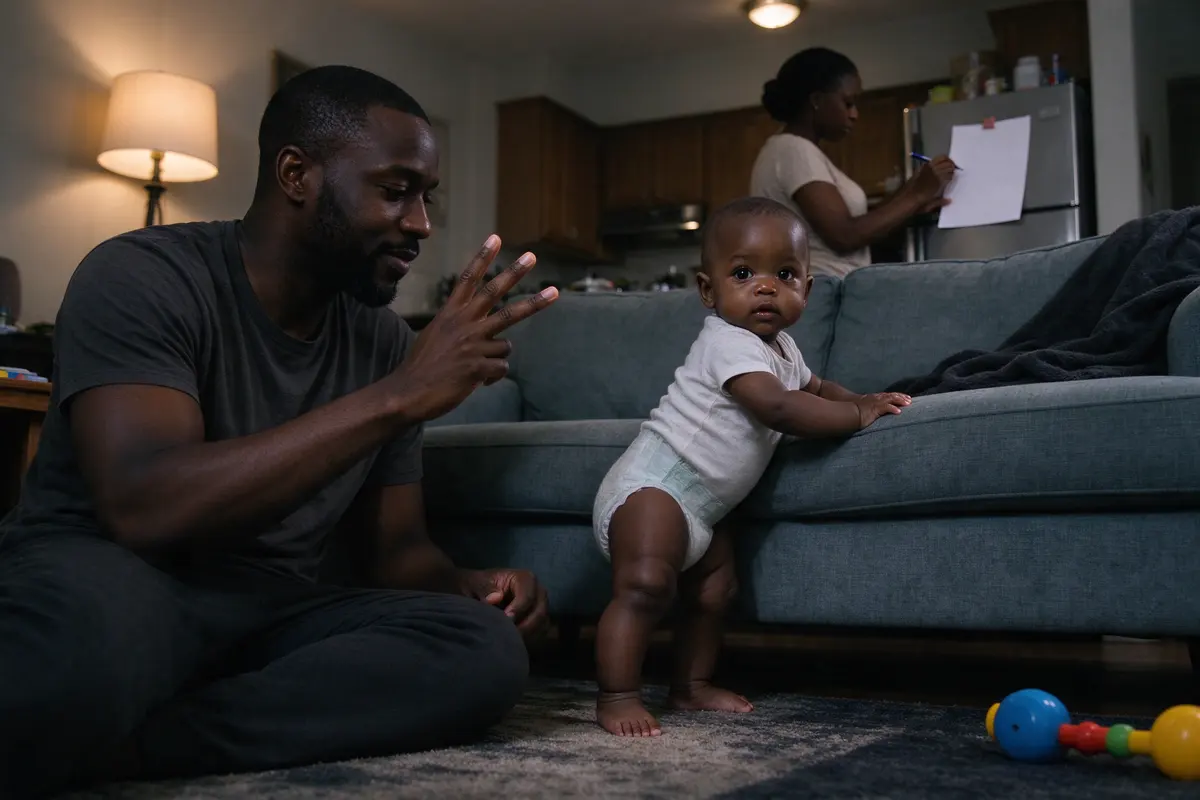
What moves the date is practice, and practice is what you can see. Filmed during free play, 12- to 19-month-olds averaged 2,368 steps and 17 falls per hour (Adolph et al., 2012). At 9 months the practice is standing: at the sofa, at the pull-up spot, at the crib rail at dawn. Today's activity is a log of it, not a test. The number will go up on its own and down on tired days; both are information about the day, not the baby.
Try today
The standing count
Time: 2 minutes, once a week · Is it normal if my baby isn't walking by their first birthday? in the guide
When your baby pulls up at the sofa, start counting out loud, slowly, from the moment both hands are on the cushion.
Count until they sit down or drop. Write the number and today's date on the fridge page.
Do it again in a week, not tomorrow. Once a week is a log; every day is a scoreboard.
Don't try to beat it, and don't hold them up to add seconds. The range for standing alone runs from 6.9 to 16.9 months (WHO Multicentre Growth Reference Study Group, 2006); your number is compared to nobody.
Make it work:Steps alone have until 15 months (CDC). If this week's count is zero because the knees are the stopping point, write "knees" and the date.
Watch for
Normal
no standing without hands at 9 months, or a sudden stand and a plop; standing alone starts anywhere from 6.9 to 16.9 months (WHO Multicentre Growth Reference Study Group, 2006).
Ask about a developmental screening
if your baby isn't pulling to stand by 12 months (CDC).
Normal
standing on tiptoe when held up, and bouncing instead of standing.
Talk with your pediatrician
if your baby uses one arm or leg much more than the other (AAP).
Normal
an off day with a cold where nothing gets practiced.
Call your pediatrician right away
if your baby looks or acts very sick, or you think they need to be seen urgently (AAP).
For you
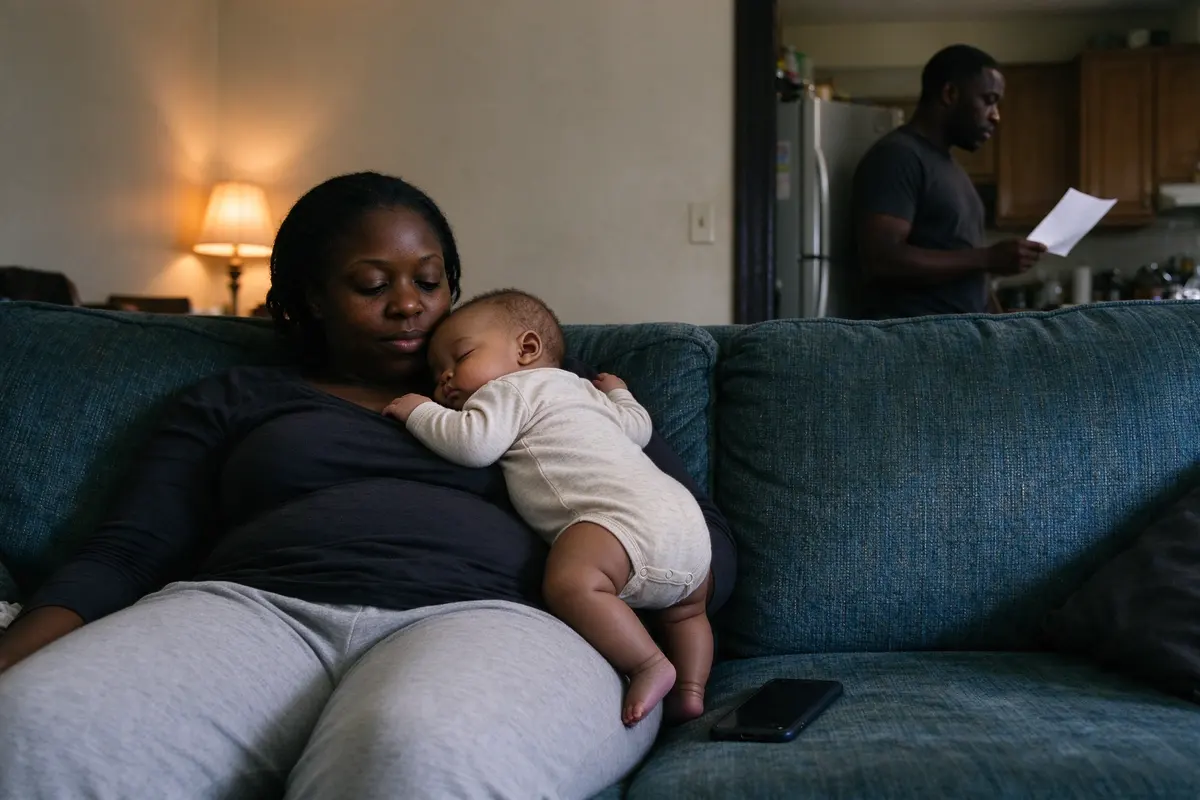
The range, not the cousin. The comparison arrives in a group chat or at a family dinner, and it lands because you've watched this baby so closely that any number sounds like a verdict. It isn't. Healthy children walked alone anywhere from 8.2 to 17.6 months (WHO Multicentre Growth Reference Study Group, 2006), a window more than nine months wide, and the only line inside it with a job is the 12-month one about pulling up (CDC). Everything else is a story someone tells about their own child. Let them.
If you're the partner: when a relative asks "walking yet?", the answer is "the range is wide, and we're in it," said warmly, and then a change of subject. Be the one who says it so she doesn't have to.
Sources
- WHO Multicentre Growth Reference Study Group. "WHO Motor Development Study: windows of achievement for six gross motor development milestones." Acta Paediatrica Supplement, 2006. https://pubmed.ncbi.nlm.nih.gov/16817682/
- Centers for Disease Control and Prevention. "Milestones by 15 Months." Learn the Signs. Act Early. program, accessed 2026. https://www.cdc.gov/act-early/milestones/15-months.html
- Centers for Disease Control and Prevention. "Milestones by 1 Year." Learn the Signs. Act Early. program, updated 2026. https://www.cdc.gov/act-early/milestones/1-year.html
- Zubler JM, Wiggins LD, Macias MM, et al. "Evidence-Informed Milestones for Developmental Surveillance Tools." Pediatrics, 2022. https://pubmed.ncbi.nlm.nih.gov/35132439/
- American Academy of Pediatrics. "Corrected Age For Preemies." HealthyChildren.org, updated 2018. https://www.healthychildren.org/English/ages-stages/baby/preemie/Pages/Corrected-Age-For-Preemies.aspx
- American Academy of Pediatrics. "Checkup Checklist: 9 Months Old." HealthyChildren.org, updated 2021. https://www.healthychildren.org/English/ages-stages/Your-Childs-Checkups/Pages/Your-Checkup-Checklist-9-Months-Old.aspx
- Adolph KE, Cole WG, Komati M, et al. "How do you learn to walk? Thousands of steps and dozens of falls per day." Psychological Science, 2012. https://pubmed.ncbi.nlm.nih.gov/23085640/
- American Academy of Pediatrics. "Movement Milestones in Babies 8 to 12 Months Old." HealthyChildren.org, updated 2021. https://www.healthychildren.org/English/ages-stages/baby/Pages/Movement-8-to-12-Months.aspx
- American Academy of Pediatrics. "Fever" (symptom checker). HealthyChildren.org, accessed 2026. https://www.healthychildren.org/English/tips-tools/symptom-checker/Pages/symptomviewer.aspx?symptom=Fever
This guide is general education that summarizes published research and guidance from groups like the American Academy of Pediatrics, the CDC, and the WHO. It isn’t medical advice, and every child develops on their own timeline. Your pediatrician knows your child; if something feels wrong, call them. In an emergency, call 911.
Get each day’s note the morning it applies
Add your baby to a free Chorevia household with their date of birth, and every morning for 300 days the day’s note arrives in the app and by email: what’s developing, one thing to try, what to watch for, and a word for you.
Create your household