Day 282 of 300 · Week 38
Hand it to me
Last reviewed · 4 min read · 8 sources · Plain-text version
Passing a toy back and forth is a 9-month turn-taking game, and the urge to help is starting: 12-month-olds point to show an adult where a lost object is. Hand it to me, with a thank-you.
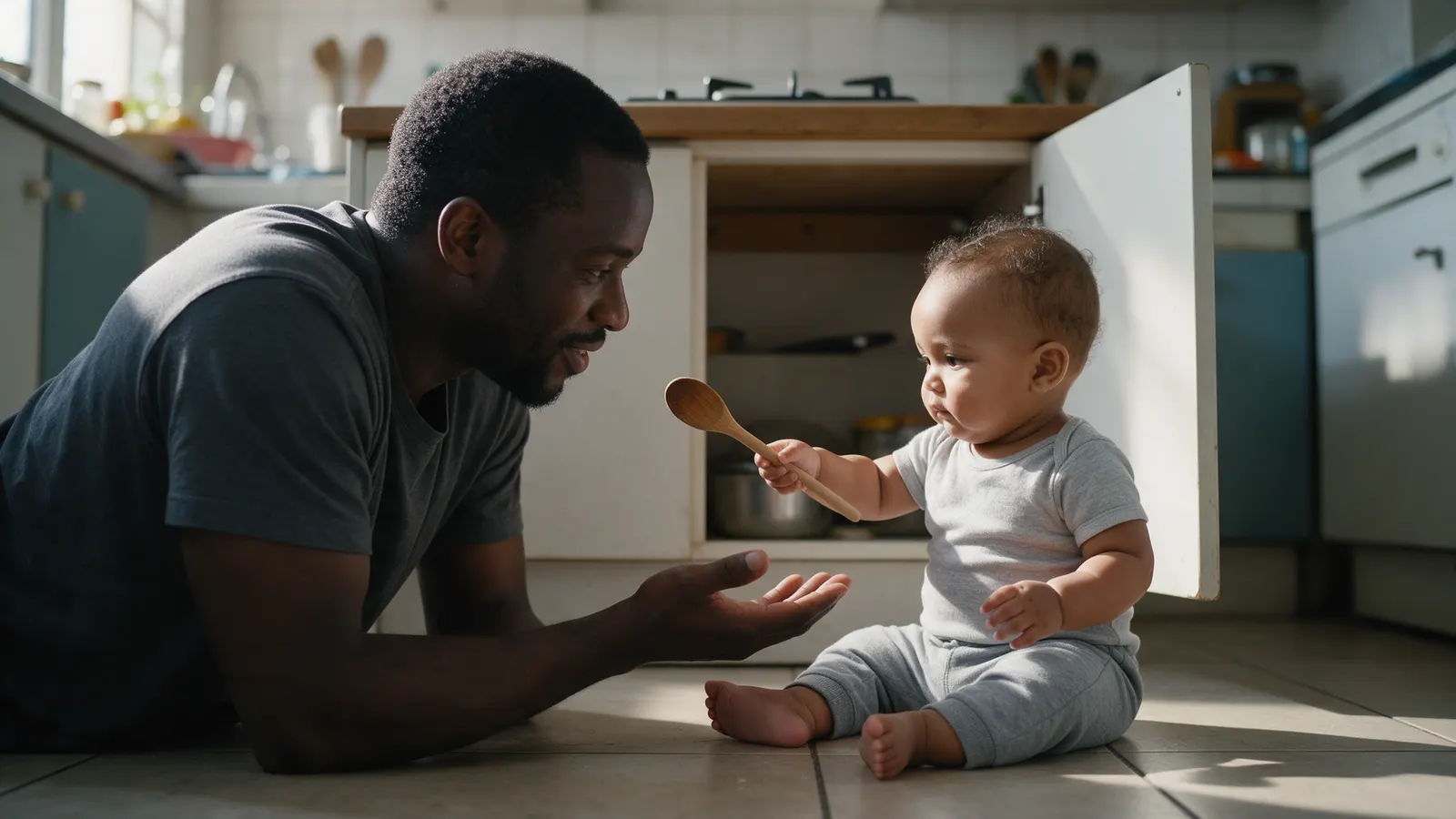
A spoon held out to you, taken back, held out again. It looks like a game, and it is, but it's also the first flicker of something you'll lean on for years: the urge to help. Today is the game, and where it goes.
Heart
By 9 months, most babies move things from one hand to the other (CDC), and once they can let go on purpose, dropping and throwing become favorite games (AAP). Letting go into your hand is the next move, and CDC suggests practicing it with turn-taking games like passing a toy back and forth (CDC). Your baby is 9 months old; some days the spoon comes to you and some days the fist clamps shut the moment you ask. Both are the skill being learned.
Head
It's too early for chores. But the helping impulse is older than you'd think. In experiments, 12-month-olds pointed to show an adult where a lost object was, more often when the adult hadn't seen where it went (Liszkowski et al., 2008), and by 18 months, toddlers readily help adults reach their goals, with nothing in it for them (Warneken & Tomasello, 2006). Those are lab findings about babies a few months older than yours. What they say is that nobody has to be bribed into helping at this age; the wish to be useful shows up on its own, and your job is to give it somewhere to go.
Body
Somewhere to go, this month, is your open hand. Hand over a cup, a spoon, or a hairbrush and be an enthusiastic audience when your baby copies you (AAP): things have uses, and giving is one of them. Pass a toy back and forth (CDC), and say a warm thank-you every time. The guide's section is First helping games; the sock-in-the-basket job is in there too, for a few months from now.
Try today
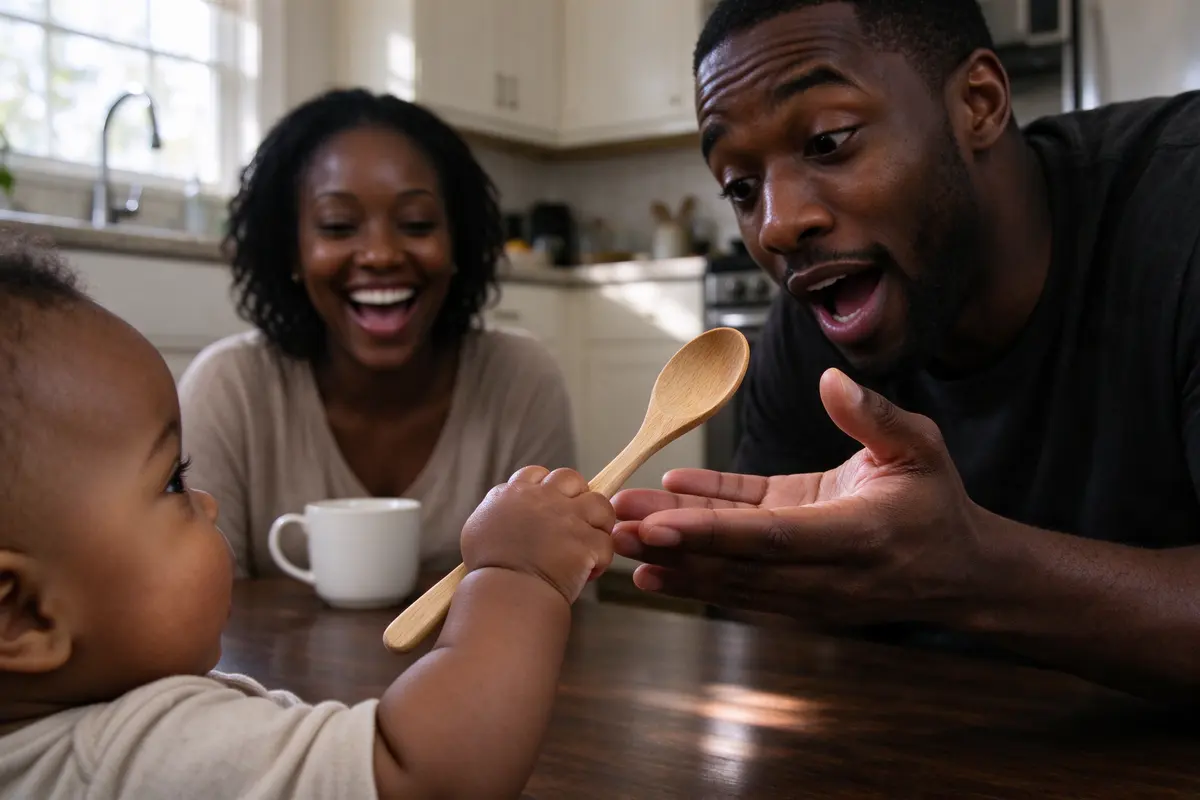
Hand it to me
Time: A few minutes, at a meal and once on the floor · Hand it to me in the guide
Hold out your open hand, palm up, close to the spoon or toy your baby is holding, and ask, "Can I have the spoon?"
Wait. If the spoon comes, say "Thank you!" like you mean it, and hand it straight back (CDC).
Ask again. Five rounds is a game; the giving back is what makes it one.
If the fist stays shut, say "Okay, you keep it," and try with a different object later. Letting go on purpose is new (AAP).
Make it work:Always give it back. A baby who learns that handing over means losing stops handing over.
Watch for
Normal
a baby who grips harder the moment you ask, then drops it on the floor instead of in your hand.
Talk with your pediatrician
if your baby uses one arm or leg much more than the other (AAP).
Normal
the spoon handed over, then screamed for the instant it's gone.
Call your pediatrician right away
if your baby screams and can't be consoled, or has cried nonstop for more than 2 hours (AAP).
Normal
the spoon in the mouth between every round, and a hairbrush bristles-first.
Call 911
if your baby is choking and can't breathe, cry, or make noise, turns bluish, or goes limp (AAP), and start back blows and chest thrusts while someone calls.
For you
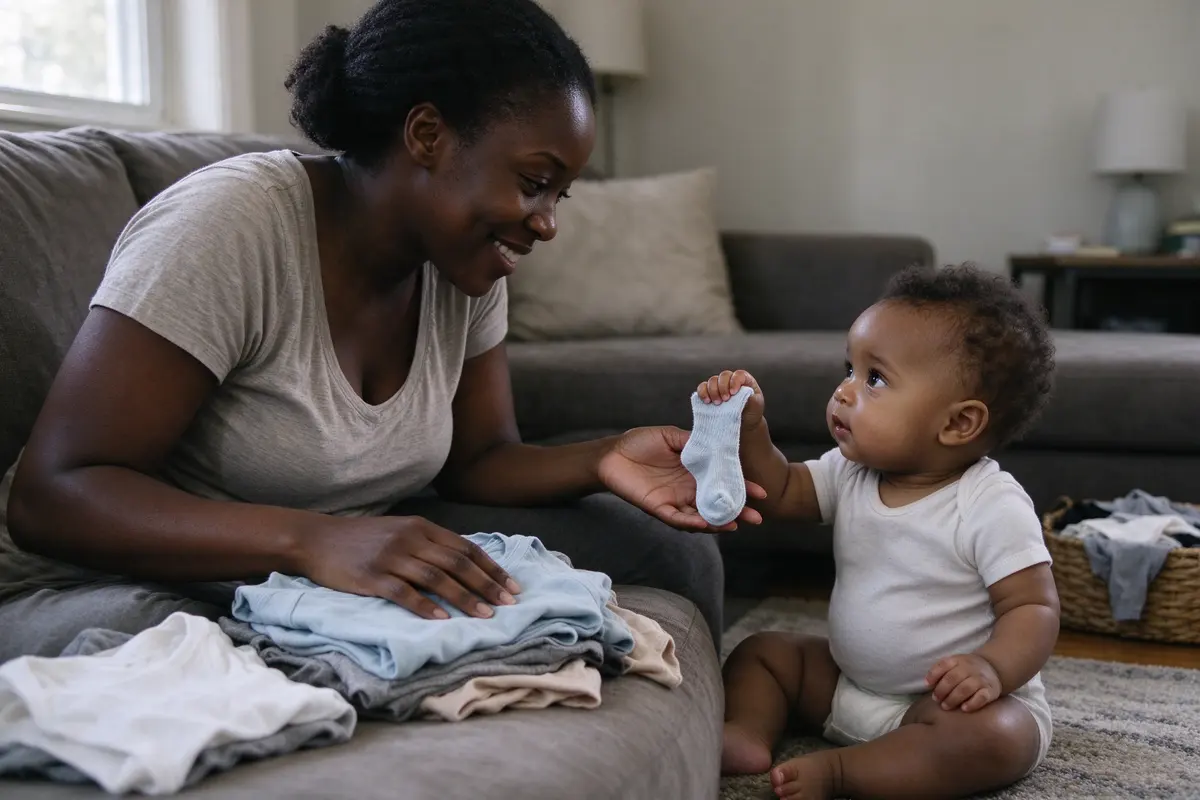
A warm thank-you is the whole reward system for now. No sticker, no chart, no "good job" in the voice you'd use for a dog. The toddlers in the lab helped with nothing in it for them (Warneken & Tomasello, 2006), and the game CDC suggests is just a toy going back and forth (CDC). What makes it work is your face when the spoon arrives. You're not training a habit. You're showing a person that being handed something by them is a pleasure, which it is.
If you're the partner: your hand, your "thank you," five rounds tonight. Then ask her to hand you something, and say it to her too. It lands the same way.
Sources
- Centers for Disease Control and Prevention. "Milestones by 9 Months." Learn the Signs. Act Early. program, updated 2026. https://www.cdc.gov/act-early/milestones/9-months.html
- American Academy of Pediatrics. "Hand and Finger Skills." HealthyChildren.org, updated 2009. https://www.healthychildren.org/English/ages-stages/baby/Pages/Hand-and-Finger-Skills.aspx
- Liszkowski U, Carpenter M, Tomasello M. "Twelve-month-olds communicate helpfully and appropriately for knowledgeable and ignorant partners." Cognition, 2008. https://pubmed.ncbi.nlm.nih.gov/18721918/
- Warneken F, Tomasello M. "Altruistic helping in human infants and young chimpanzees." Science, 2006. https://pubmed.ncbi.nlm.nih.gov/16513986/
- American Academy of Pediatrics. "Cognitive Development in Infants: 8 to 12 Months." HealthyChildren.org, updated 2023. https://www.healthychildren.org/English/ages-stages/baby/Pages/Cognitive-Development-8-to-12-Months.aspx
- American Academy of Pediatrics. "Movement Milestones in Babies 8 to 12 Months Old." HealthyChildren.org, updated 2021. https://www.healthychildren.org/English/ages-stages/baby/Pages/Movement-8-to-12-Months.aspx
- American Academy of Pediatrics. "Crying Child - 3 Months and Older" (symptom checker). HealthyChildren.org, accessed 2026. https://www.healthychildren.org/English/tips-tools/symptom-checker/Pages/symptomviewer.aspx?symptom=Crying+Child+-+3+Months+and+Older
- Bradin S. "Choking Prevention for Babies & Children: What Every Parent Needs to Know." HealthyChildren.org, updated 2026. https://www.healthychildren.org/English/health-issues/injuries-emergencies/Pages/Choking-Prevention.aspx
This guide is general education that summarizes published research and guidance from groups like the American Academy of Pediatrics, the CDC, and the WHO. It isn’t medical advice, and every child develops on their own timeline. Your pediatrician knows your child; if something feels wrong, call them. In an emergency, call 911.
Get each day’s note the morning it applies
Add your baby to a free Chorevia household with their date of birth, and every morning for 300 days the day’s note arrives in the app and by email: what’s developing, one thing to try, what to watch for, and a word for you.
Create your household