Day 279 of 300 · Week 38
Letting go on purpose
Last reviewed · 4 min read · 8 sources · Plain-text version
Once a baby can let go on purpose, dropping and throwing become favorite games, and the high-chair edge is the lab bench. Cause and effect, the drop zone, and when to stop picking it up.
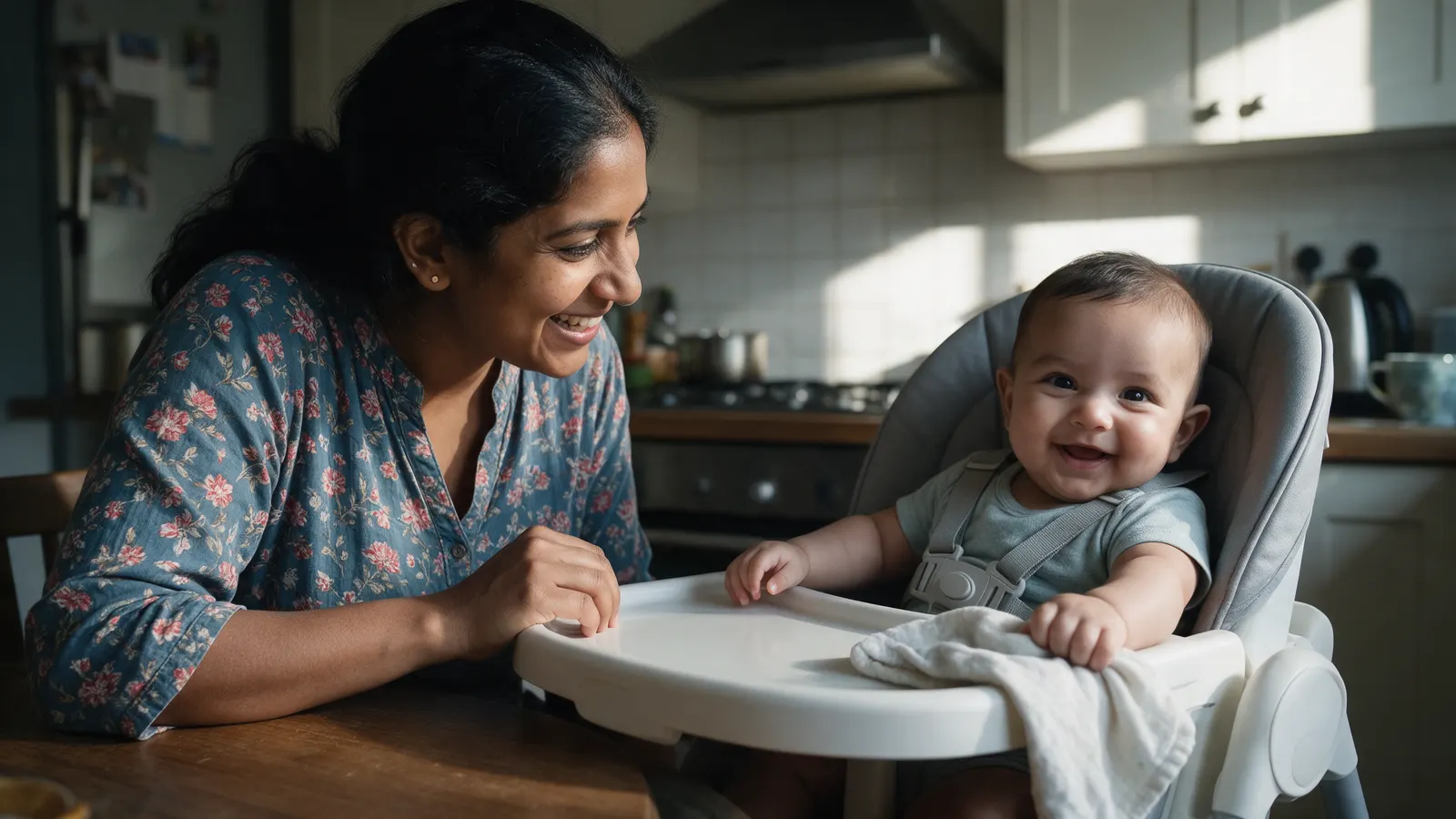
Every spoon that goes over the tray edge this week was let go of on purpose. Last month it was a new trick; this month it's a research program, and you're the equipment. Today is what's being learned, and how to take part without spending the meal on the floor.
Heart
Once they can let go on purpose, dropping and throwing become favorite games (AAP). Dropping and banging are experiments in how things work (AAP), and the experiment now has a result the baby can check: by 9 months, most babies look for objects dropped out of sight (CDC). Watch the sequence: hand opens, cup falls, head leans over the edge to see where it went, face comes up to find yours. That last look is the point. By 10 months they'll keep searching, because they now know objects exist out of sight (AAP).
Head
The lesson is cause and effect, with you as one of the effects: I open my hand, it falls, it makes a sound, a parent bends down. The AAP's advice is to hand over a cup, a spoon, or a hairbrush and be an enthusiastic audience when your baby copies you (AAP), and the drop copies something you do a hundred times a day: putting things down. The difference between science and a meal that's over is the count. Three drops with a look over the edge is an experiment; thirty, with food, is a fullness cue, and fullness cues, not the plate, end the meal (AAP).
Body
The lab bench is a high chair with the harness buckled every time (AAP), because a baby leaning over the edge to see where the spoon went is a baby leaning. Nothing gets tied to the chair; what gets dropped is too big to fit entirely in your baby's mouth (AAP), and the floor gets checked after, since everything still goes in the mouth (AAP). A basket on the floor catches most of it, which is today's whole trick.
Try today

The drop zone
Time: 5 minutes, before a meal · Out of sight, not out of mind in the guide
Buckle the harness (AAP) and set a laundry basket on the floor right under the edge of the tray.
Hand over one soft toy, too big for the mouth (AAP). When it goes over, say "drop!" and count out loud: "One."
Hand over the second and the third. "Two." "Three." Let them lean and look; that's the experiment working (CDC).
Tip the basket so they can see all three, say "all gone? here they are!", hand them back, and run one more round.
After the second round, the basket goes away and the meal starts; the toys were the lab, the food isn't.
Make it work:Two rounds is the dose. The game is theirs and doesn't end on its own; you end it, cheerfully, by starting lunch.
Watch for
Normal
a cup over the edge at every meal, then a baby who turns their head from the spoon; that's "done," and fullness cues end the meal (AAP).
Call 911
if your baby has purple or blood-colored spots or dots on the skin (AAP).
Normal
a long lean over the tray edge to see where the block went (CDC).
Bring it up
if by 12 months your baby doesn't look for a toy they saw you hide (CDC).
Normal
a hot, cranky baby with a cold who still wants to run the experiment.
Go to the ER now
if your baby had a seizure with a fever, has a stiff neck, or has a bulging soft spot (AAP).
For you
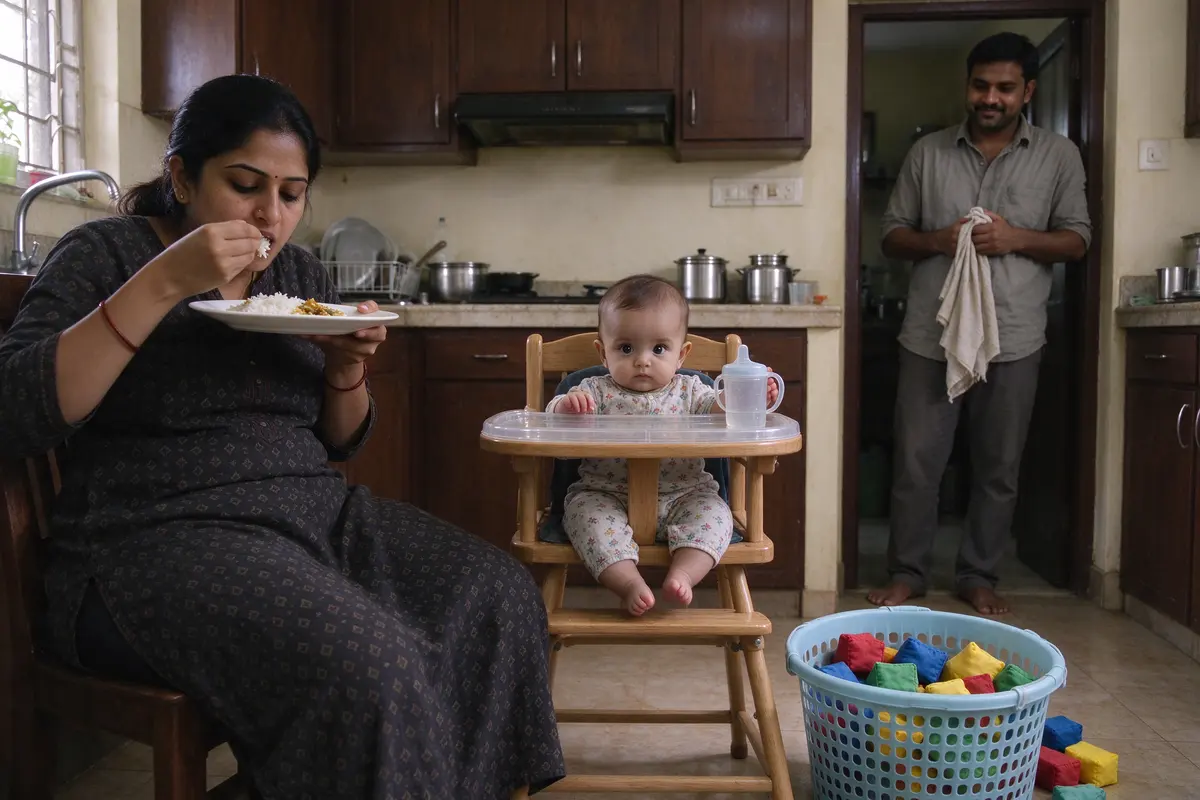
Pick it up five times, then stop. The game is theirs (AAP), and it doesn't need a perfect retrieval system to work. Five trips is enthusiasm; the sixth is a meal eaten standing up. After five, the spoon stays down and you say so, warmly: "All gone." Nothing is lost; the lesson was learned on trip one, and the rest was the baby checking that the world still works, which it does. If the fifth trip finds your temper rising, that's information too: put the spoon down, sit, eat something.
If you're the partner: dinner is the fetch shift, and it's yours. Five trips, a basket, and then your own plate, hot, for once.
Sources
- American Academy of Pediatrics. "Hand and Finger Skills." HealthyChildren.org, updated 2009. https://www.healthychildren.org/English/ages-stages/baby/Pages/Hand-and-Finger-Skills.aspx
- American Academy of Pediatrics. "Cognitive Development in Infants: 8 to 12 Months." HealthyChildren.org, updated 2023. https://www.healthychildren.org/English/ages-stages/baby/Pages/Cognitive-Development-8-to-12-Months.aspx
- Centers for Disease Control and Prevention. "Milestones by 9 Months." Learn the Signs. Act Early. program, updated 2026. https://www.cdc.gov/act-early/milestones/9-months.html
- American Academy of Pediatrics. "When Can Babies Start Solid Foods? Readiness & Feeding Tips." HealthyChildren.org, updated 2026. https://www.healthychildren.org/English/ages-stages/baby/feeding-nutrition/Pages/Starting-Solid-Foods.aspx
- Agbim IA, Hurtado CW. "Baby-Led Weaning: Is It Safe?" HealthyChildren.org, updated 2024. https://www.healthychildren.org/English/ages-stages/baby/feeding-nutrition/Pages/baby-led-weaning-is-it-safe.aspx
- Bradin S. "Choking Prevention for Babies & Children: What Every Parent Needs to Know." HealthyChildren.org, updated 2026. https://www.healthychildren.org/English/health-issues/injuries-emergencies/Pages/Choking-Prevention.aspx
- American Academy of Pediatrics. "Fever" (symptom checker). HealthyChildren.org, accessed 2026. https://www.healthychildren.org/English/tips-tools/symptom-checker/Pages/symptomviewer.aspx?symptom=Fever
- Centers for Disease Control and Prevention. "Milestones by 1 Year." Learn the Signs. Act Early. program, updated 2026. https://www.cdc.gov/act-early/milestones/1-year.html
This guide is general education that summarizes published research and guidance from groups like the American Academy of Pediatrics, the CDC, and the WHO. It isn’t medical advice, and every child develops on their own timeline. Your pediatrician knows your child; if something feels wrong, call them. In an emergency, call 911.
Get each day’s note the morning it applies
Add your baby to a free Chorevia household with their date of birth, and every morning for 300 days the day’s note arrives in the app and by email: what’s developing, one thing to try, what to watch for, and a word for you.
Create your household