Day 272 of 300 · Week 37
Pulling up
Last reviewed · 4 min read · 9 sources · Plain-text version
Pulling up to stand is a 12-month milestone that often arrives before the way down. Which furniture is safe to pull on, why the crib is the first gym, and the pull-up spot.
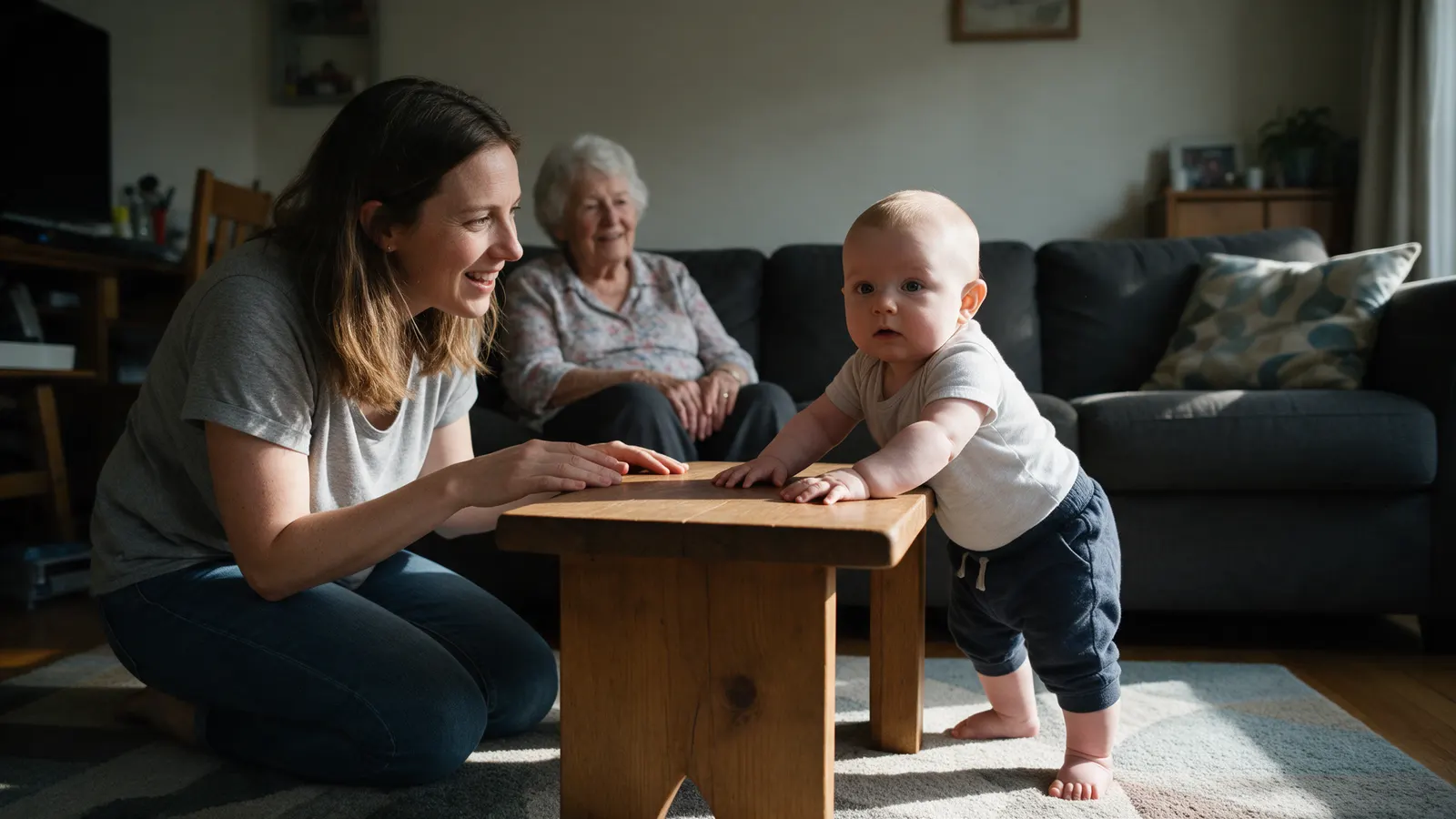
Last month was the first try at the sofa, chin on the cushion. This month, for many babies, it finishes: knees, then one foot, then upright and amazed. Today is what to let them pull up on, and what to change before they do it in the crib.
Heart
Pulling up to stand is a 12-month milestone (CDC), and it often comes before a baby knows how to get back down (AAP). Your baby is 9 months old; the window has three months left in it. What it looks like: a grip on whatever's nearest, a knee up, a long pause, and a face that says the room looks different from here. It does, and everything on the coffee table is now in reach.
Head
CDC suggests placing your baby near furniture they can safely pull up on (CDC). "Safely" is the whole sentence: a sofa, an armchair, a heavy low table, sturdy, won't tip, no sharp edges. Not a dining chair, a floor lamp, or a folding table, and not a bookcase or dresser unless it's anchored to the wall, because a baby pulls on whatever is there (AAP). CPSC counted 234 deaths from dresser and other clothing-storage tip-overs from 2000 to April 2022, 199 of them children (CPSC). Month eight's anchor afternoon was for this month.
Body
The crib rail is the first gym, because it's the one piece of furniture your baby is alone with. Set the mattress at its lowest position before your baby learns to stand, and keep cords well away from the crib (AAP). Keep it bare, no pillows, blankets, bumpers, or stuffed toys (Moon, AAP), since anything soft in there is also a step. If you lowered the mattress last month, check tonight; a sheet change can put it back a notch too high. Then teach the way down, which saves you many trips to a crib where a baby is standing and crying (AAP).
Try today
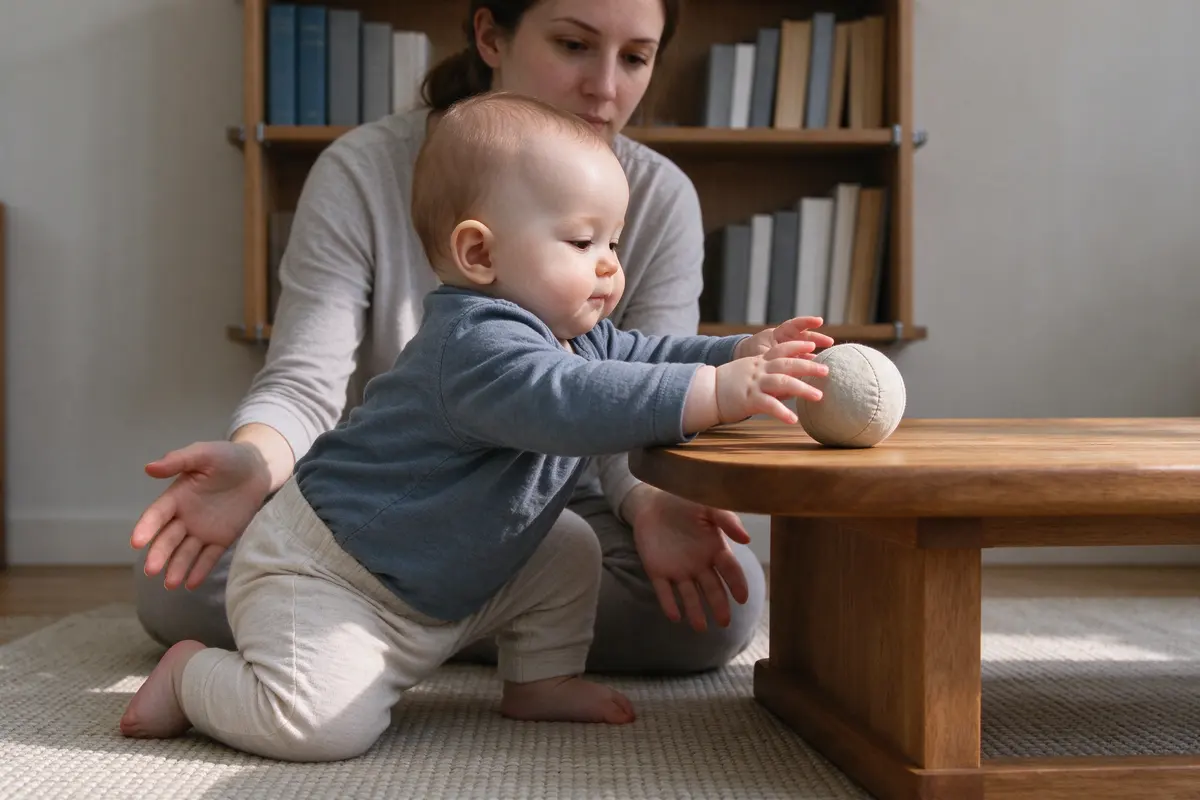
The pull-up spot
Time: A few minutes, several times a day · Crawling, cruising, and first steps in the guide
Set a toy on top, where only a standing baby can reach it, and sit your baby in front of it.
Let them work. Knees count. Hands an inch behind their hips, not on them, unless they tip.
When they get there, cheer, then teach the way down: hands on their hips, "sit," and fold them gently to the rug (AAP).
Make it work:Same spot every day: the one place in the house where pulling up is always safe, so you stop having to check.
Watch for
Normal
pulling up to the knees and no higher for weeks; pulling up to stand has until 12 months (CDC).
Talk with your pediatrician
if your baby uses one arm or leg much more than the other (AAP).
Normal
a sit-down onto a diapered bottom and a surprised face.
Call your pediatrician now
for any head injury in a baby under 1 year, even if your baby seems fine (AAP).
Normal
a baby found standing in the crib at dawn, holding the rail, crying to be rescued, with the mattress at its lowest (AAP).
Call 911
if after a fall your baby has a seizure, was knocked out for more than a minute, is hard to wake, or has bleeding you can't stop (AAP).
For you
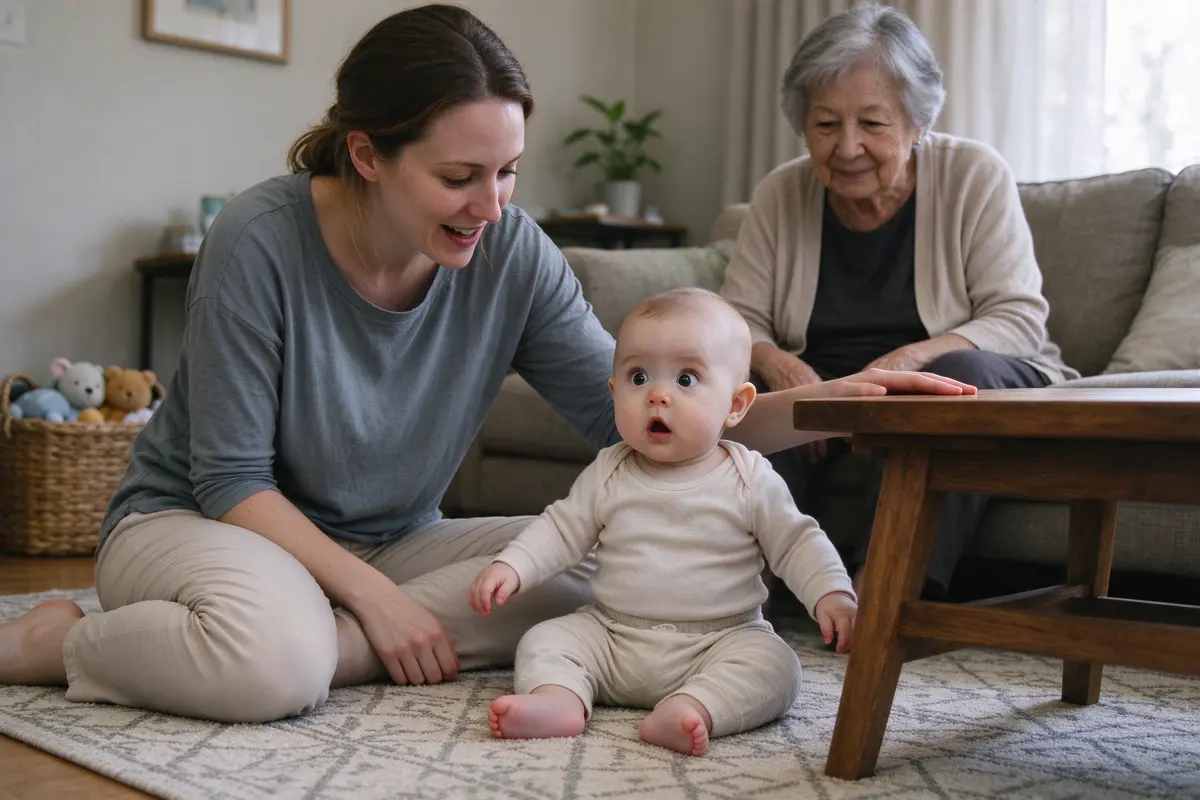
Your own back, when you catch the fall. You'll lunge for a lot of them this month, and most didn't need you: once walking starts, babies average 17 falls an hour in free play (Adolph et al., 2012), and they keep walking. Catch fewer by teaching the way down, the AAP's advice for the crib that works just as well at the sofa (AAP). Catch the rest without hurting yourself by being down there already: sit on the rug beside the spot instead of bending over it from standing. A parent on the floor is at the right height for a hand behind the hips; a parent bent double is a back that complains by Friday.
If you're the partner: the evening pull-up sessions are yours, on the floor, and the mattress check tonight is too.
Sources
- Centers for Disease Control and Prevention. "Milestones by 1 Year." Learn the Signs. Act Early. program, updated 2026. https://www.cdc.gov/act-early/milestones/1-year.html
- American Academy of Pediatrics. "Movement Milestones in Babies 8 to 12 Months Old." HealthyChildren.org, updated 2021. https://www.healthychildren.org/English/ages-stages/baby/Pages/Movement-8-to-12-Months.aspx
- Centers for Disease Control and Prevention. "Milestones by 9 Months." Learn the Signs. Act Early. program, updated 2026. https://www.cdc.gov/act-early/milestones/9-months.html
- American Academy of Pediatrics. "Home Safety: Tips for Families With Young Children." HealthyChildren.org, updated 2022. https://www.healthychildren.org/English/safety-prevention/at-home/Pages/Home-Safety-Heres-How.aspx
- US Consumer Product Safety Commission. "CPSC Adopts Final Consumer Product Safety Standard to Prevent Tip-overs of Dressers and Other Clothing Storage Units." 2023. https://www.cpsc.gov/Newsroom/News-Releases/2023/CPSC-Adopts-Final-Consumer-Product-Safety-Standard-to-Prevent-Tip-overs-of-Dressers-and-Other-Clothing-Storage-Units
- American Academy of Pediatrics. "Make Baby's Room Safe: Parent Checklist." HealthyChildren.org, updated 2020. https://www.healthychildren.org/English/safety-prevention/at-home/Pages/Make-Babys-Room-Safe.aspx
- Moon RY. "How to Keep Your Sleeping Baby Safe: AAP Policy Explained." HealthyChildren.org, updated 2026. https://www.healthychildren.org/English/ages-stages/baby/sleep/Pages/a-parents-guide-to-safe-sleep.aspx
- American Academy of Pediatrics. "Head Injury" (symptom checker). HealthyChildren.org, accessed 2026. https://www.healthychildren.org/English/tips-tools/symptom-checker/Pages/symptomviewer.aspx?symptom=Head+Injury
- Adolph KE, Cole WG, Komati M, et al. "How do you learn to walk? Thousands of steps and dozens of falls per day." Psychological Science, 2012. https://pubmed.ncbi.nlm.nih.gov/23085640/
This guide is general education that summarizes published research and guidance from groups like the American Academy of Pediatrics, the CDC, and the WHO. It isn’t medical advice, and every child develops on their own timeline. Your pediatrician knows your child; if something feels wrong, call them. In an emergency, call 911.
Get each day’s note the morning it applies
Add your baby to a free Chorevia household with their date of birth, and every morning for 300 days the day’s note arrives in the app and by email: what’s developing, one thing to try, what to watch for, and a word for you.
Create your household