Day 277 of 300 · Week 37
Thirty-seven weeks: shoes, still no
Last reviewed · 4 min read · 10 sources · Plain-text version
Thirty-seven weeks. A cruising baby doesn't need shoes until they walk outside, and 'supportive' shoes have no proven benefit. The sock-off hour, and the fit rules for the day shoes do make sense.
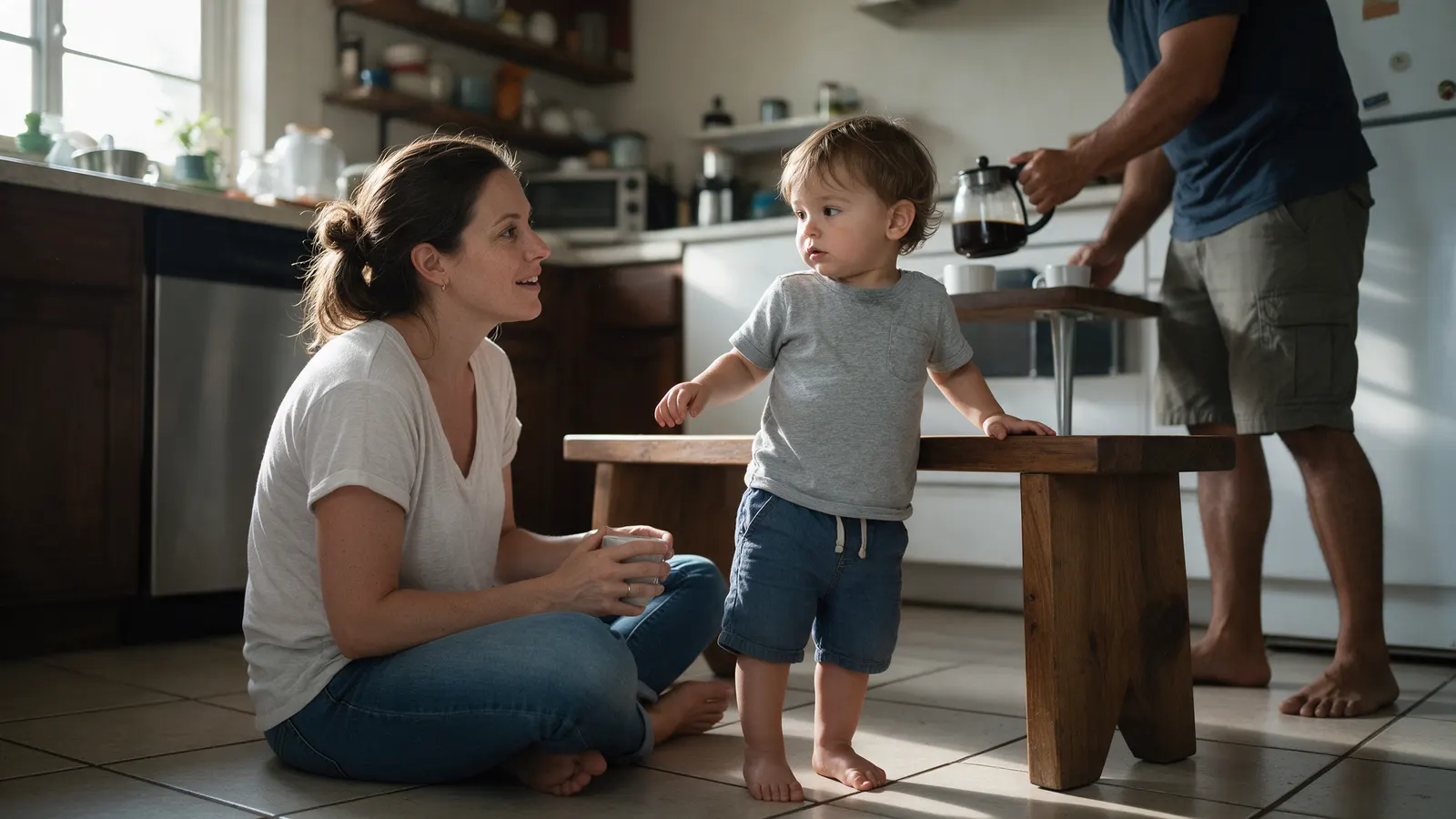
Thirty-seven weeks. The tiny shoes arrived anyway, in a box with tissue paper, and today is why they stay in the box a while longer: a baby learning to stand and cruise is better equipped without them.
Heart
Your baby doesn't need shoes until they start walking outside, and special "supportive" shoes have no proven benefit (AAP). Watch a barefoot baby at the sofa and you can see why. The toes curl into the rug at the moment of pulling up, spread on the way to standing, and grip the edge when a foot shuffles sideways. Socks slide on wood; a shoe sole can't feel the floor at all. Walking while holding on to furniture is a 12-month milestone (CDC), and bare feet are the equipment for it.
Head
For the day shoes do make sense, the AAP's rules are short. Choose closed-toe, comfortable, flexible shoes with nonskid soles and room to grow; sneakers are a great choice. Skip wedges, inserts, high backs, and special arches: they have no proven benefit for most children and may make walking harder. A first pair usually lasts 2 to 3 months, so check the fit monthly (AAP). The shoes in the tissue paper may fit none of that, and that's fine; they're a keepsake, and keepsakes don't have to be worn.
Body
What feet need now is practice, and variety. Filmed during free play, 12- to 19-month-olds averaged 2,368 steps and 17 falls per hour (Adolph et al., 2012); this month's standing and cruising is the work before those steps. The WHO's prescription is interactive floor play several times a day (WHO), and a kitchen floor counts as floor. Check it first: floors and between cushions for coins, toy parts, and pen caps (AAP), and in the kitchen, the cabinet under the sink stays locked, cleaners and all (AAP).
Try today
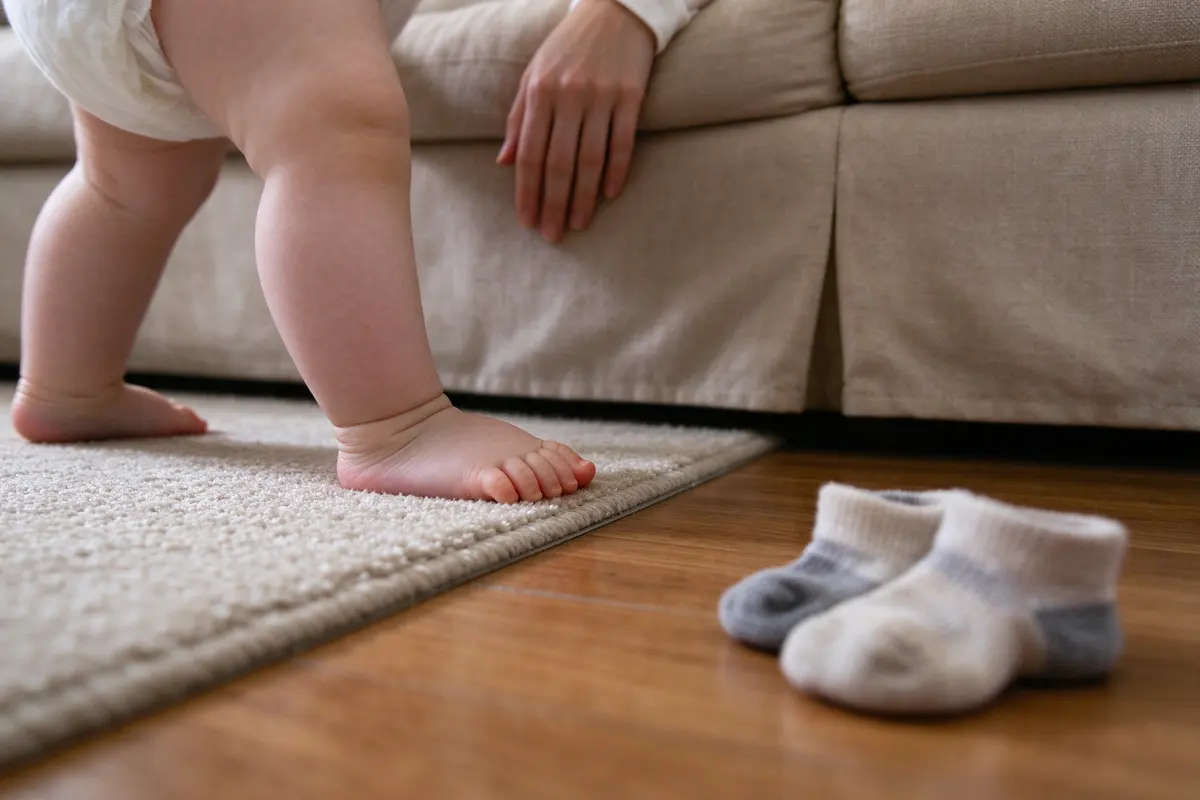
The sock-off hour
Time: 60 minutes, in pieces across the day · Does my baby need shoes to learn to walk? in the guide
Socks off before the morning floor time, and leave them off (AAP).
Run the cruise course on the rug barefoot: pull up at the sofa, shuffle to the toy, sit down.
Move the pull-up spot to a hard floor for the second piece: a sturdy low bench or the sofa's end on tile or wood, sturdy and no sharp edges (CDC). Watch the toes grip differently.
Add up the barefoot pieces until they reach an hour. Note which foot leads the shuffle; it changes week to week, and that's fine.
Make it work:A cold floor isn't a reason for socks; it's a different texture, and the toes will tell you so. Save socks for the stroller.
Watch for
Normal
warm feet and pink toes after an hour of cruising; that isn't a fever.
Use a thermometer
if you're wondering; feeling the forehead isn't accurate (AAP).
Normal
a baby who cruises straight to the cabinet under the sink and pulls at the door; the lock is the answer (AAP).
Call Poison Help, 1-800-222-1222,
if you think your baby swallowed anything poisonous, even if they seem fine, and call 911 if they collapse, have a seizure, have trouble breathing, or can't be woken (Poison Control).
Normal
a clingy, hot afternoon on a teething day when the floor holds no interest.
Call your pediatrician right away
for a fever over 104°F (40°C), or shaking chills lasting more than 30 minutes (AAP).
For you
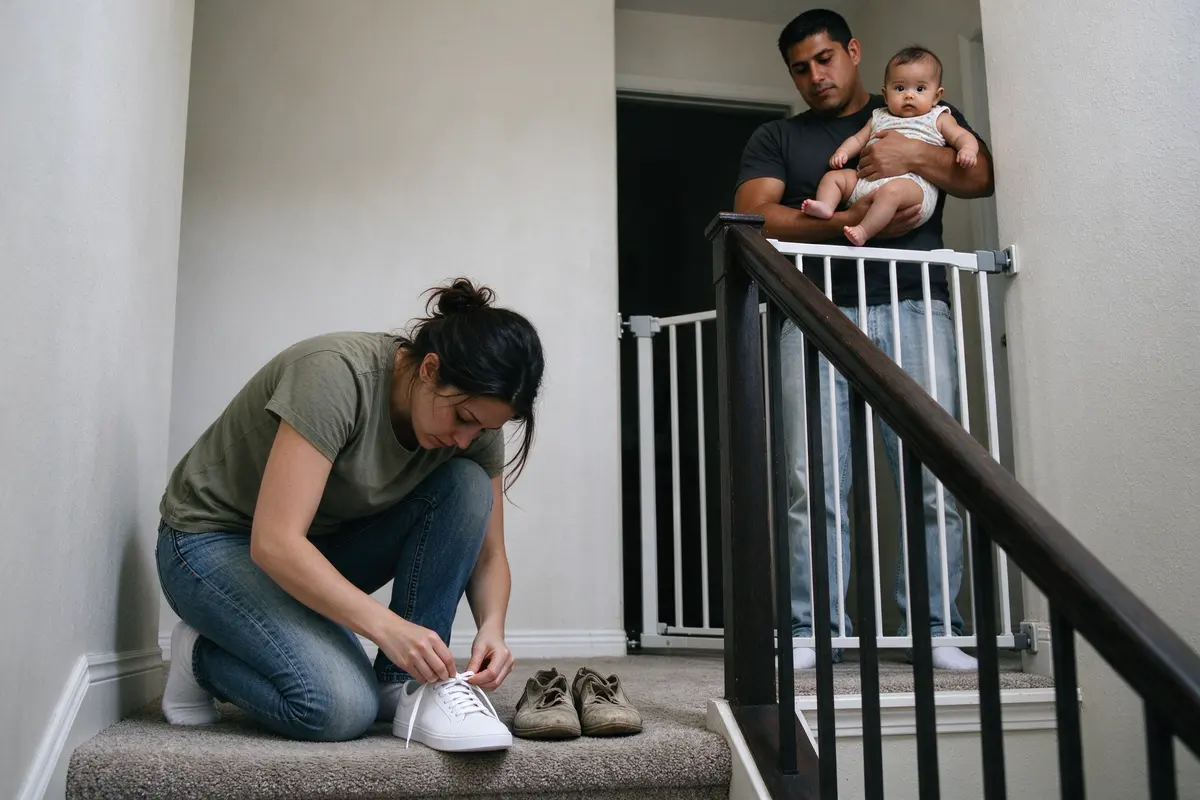
Your own shoes, flat and comfortable. You said this to yourself last month and bought the baby's instead. The AAP's rules for a first pair, flexible, nonskid, comfortable, room to grow (AAP), are the rules for the shoes you wear up and down the stairs with a baby on one hip who got heavier this month and leans out to see what's below. Nonskid is the word that matters on stairs. If the pair at the door has a smooth-worn sole, that's the pair to replace, before the baby's.
If you're the partner: the sneakers are a gift that says you noticed. Her size, not the baby's, and the box with tissue paper this time is hers.
Sources
- American Academy of Pediatrics. "Movement Milestones in Babies 8 to 12 Months Old." HealthyChildren.org, updated 2021. https://www.healthychildren.org/English/ages-stages/baby/Pages/Movement-8-to-12-Months.aspx
- Centers for Disease Control and Prevention. "Milestones by 1 Year." Learn the Signs. Act Early. program, updated 2026. https://www.cdc.gov/act-early/milestones/1-year.html
- Adolph KE, Cole WG, Komati M, et al. "How do you learn to walk? Thousands of steps and dozens of falls per day." Psychological Science, 2012. https://pubmed.ncbi.nlm.nih.gov/23085640/
- World Health Organization. "To grow up healthy, children need to sit less and play more." 2019. https://www.who.int/news/item/24-04-2019-to-grow-up-healthy-children-need-to-sit-less-and-play-more
- Bradin S. "Choking Prevention for Babies & Children: What Every Parent Needs to Know." HealthyChildren.org, updated 2026. https://www.healthychildren.org/English/health-issues/injuries-emergencies/Pages/Choking-Prevention.aspx
- American Academy of Pediatrics. "Home Safety: Tips for Families With Young Children." HealthyChildren.org, updated 2022. https://www.healthychildren.org/English/safety-prevention/at-home/Pages/Home-Safety-Heres-How.aspx
- Centers for Disease Control and Prevention. "Milestones by 9 Months." Learn the Signs. Act Early. program, updated 2026. https://www.cdc.gov/act-early/milestones/9-months.html
- American Academy of Pediatrics. "Fever and Your Baby." HealthyChildren.org, updated 2025. https://www.healthychildren.org/English/health-issues/conditions/fever/Pages/Fever-and-Your-Baby.aspx
- National Capital Poison Center. "Poison Control." Accessed 2026. https://www.poison.org/
- American Academy of Pediatrics. "Fever" (symptom checker). HealthyChildren.org, accessed 2026. https://www.healthychildren.org/English/tips-tools/symptom-checker/Pages/symptomviewer.aspx?symptom=Fever
This guide is general education that summarizes published research and guidance from groups like the American Academy of Pediatrics, the CDC, and the WHO. It isn’t medical advice, and every child develops on their own timeline. Your pediatrician knows your child; if something feels wrong, call them. In an emergency, call 911.
Get each day’s note the morning it applies
Add your baby to a free Chorevia household with their date of birth, and every morning for 300 days the day’s note arrives in the app and by email: what’s developing, one thing to try, what to watch for, and a word for you.
Create your household