Day 298 of 300 · Week 40
Fortieth week: screens before one, again
Last reviewed · 4 min read · 10 sources · Plain-text version
The WHO recommends no screen time under 1; the AAP calls TV and apps a bad idea before 18 months, with video chat the exception, and background TV cuts parent talk. The video call, named.
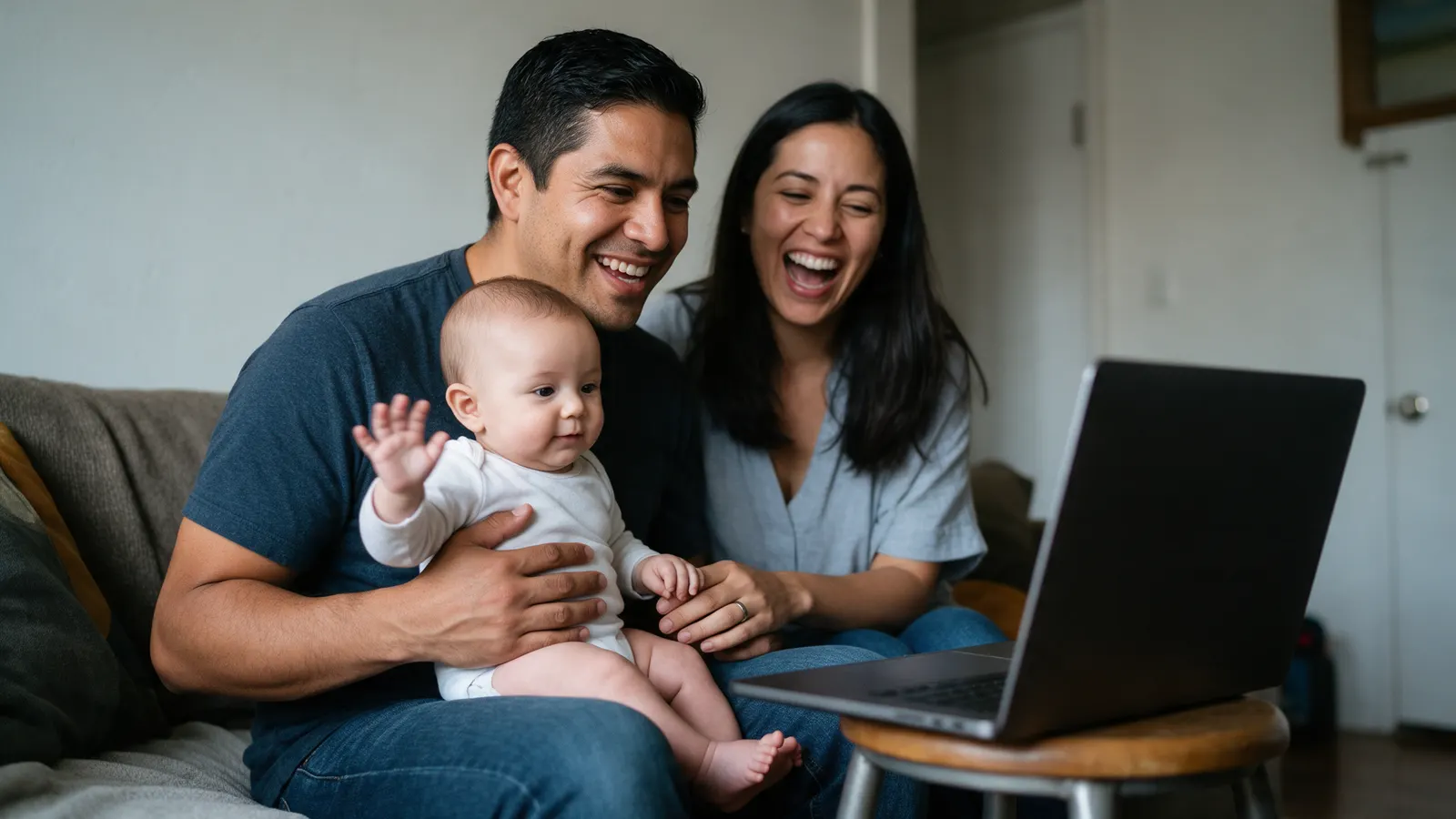
Fortieth week, and a baby who is starting to wave. Today is the one screen that waves back, and why it's the only one the AAP makes room for before 18 months.
Heart
The WHO doesn't recommend any screen time for babies under 1 (WHO). The AAP calls TV and apps a bad idea before 18 months, with video chats with faraway family as the exception, and warns that a TV on in the background cuts down how much parents talk (Hill, AAP). What's new at 40 weeks is the wave. Waving bye-bye is a 12-month milestone (CDC), and toward the end of the first year babies copy the gestures they see you use (AAP). A grandparent on a call is someone to copy.
Head
Why the exception holds: babies this age learn best from real-world interactions (Munzer, AAP), and a video call is one, because the face on it answers. The research behind that is the same you've read before: 9.5-month-olds whose mothers answered their babble right away quickly reshaped it, and babies answered at random times didn't (Goldstein & Schwade, 2008). A show can't answer on time. A grandmother can, and does, and waves. The guide's section is Screens before age 1.
Body
The call works like any other conversation at this age. Keep names consistent, "Grandma" today and not "Nana" tomorrow, ask questions, and wait for an answer (AAP). Gestures talk: wave bye-bye, shake your head for "no," and lift your arms to say "up" (CDC), and on a call the person on the other end can do all three while you move your baby's hands. Then it ends with bye-bye, and the screen goes off, which is the other half of the AAP's rule (Hill, AAP).
Try today

The video call, named
Time: 5 to 10 minutes · Screens before age 1 in the guide
Call someone your baby knows, and say the name before the face appears: "Grandma. Here's Grandma." The same name every time (AAP).
Baby on your lap, screen propped, your hands free. You're in the call, not watching it (Munzer, AAP).
Ask the grandparent to wave, lift their arms for "so big," and shake their head for "no," and move your baby's hands through each one (CDC).
After each thing they say, pause and give your baby the turn (Goldstein & Schwade, 2008).
End with "bye-bye" and a wave, then the screen goes off and out of sight (Hill, AAP).
Make it work:The call is the day's screen. The TV stays off in the background while your baby plays (Hill, AAP).
Watch for
Normal
a baby who stares in silence for the first two minutes of the call, then babbles at the dark screen after it ends.
Bring it up
if by 12 months your baby doesn't wave bye-bye, pull up to stand, or look for a toy they saw you hide (CDC).
Normal
a wave at the dog, the mail carrier, and the ceiling fan, and none at Grandma; waving bye-bye has until 12 months (CDC).
Talk with your pediatrician
if your baby seems not to see or hear well (AAP).
Normal
a stuffy, snuffling baby on the call with the first cold of the season.
Call your pediatrician right away
for trouble breathing that isn't severe, and call 911 if your baby is struggling for each breath or can barely cry (AAP).
For you
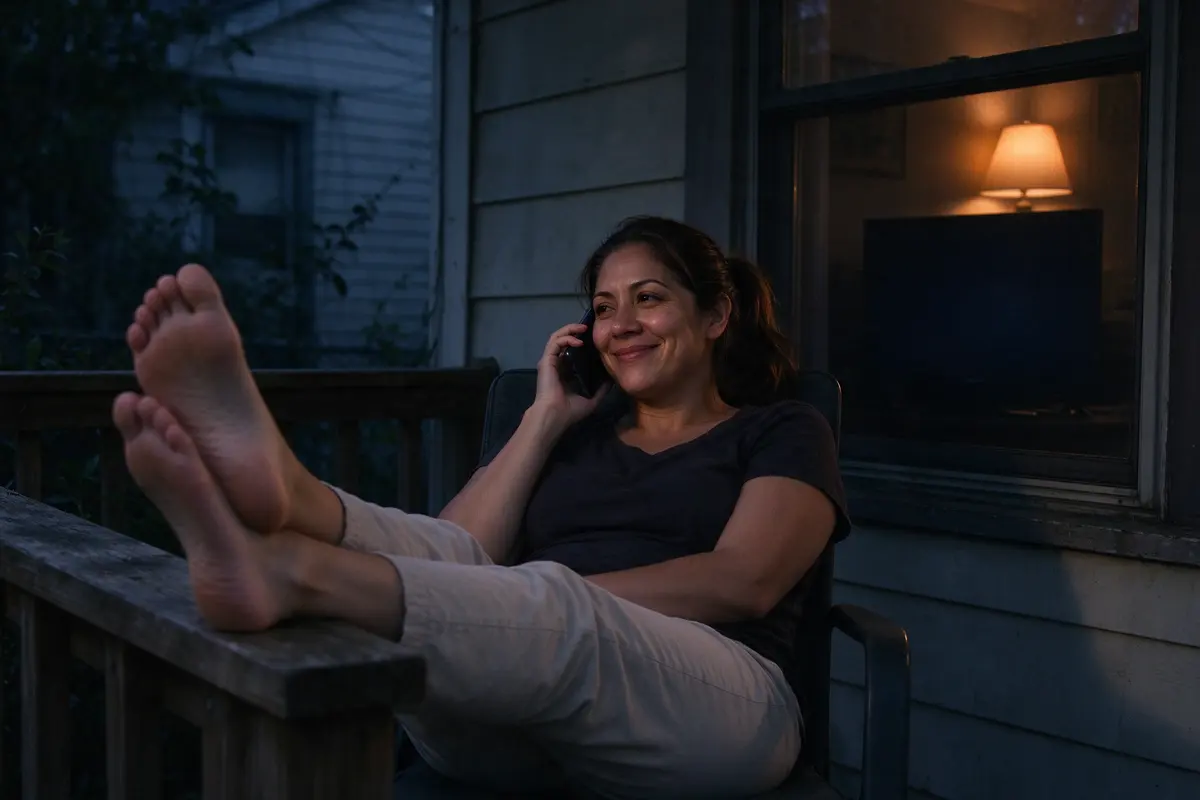
Your own screen, honestly, means your own calls too. The WHO's zero is for the baby's screen, not yours (WHO), and the AAP's warning is about the TV running in the background while you'd otherwise be talking (Hill, AAP). The phone on the porch after bedtime, with a friend's voice on it, is the opposite of that. Make one call today that's only for you: the friend you haven't spoken to since the summer, your mother, or your own doctor if the flat feeling has lasted more than two weeks, which is the point at which the advice is to go and not wait (Office on Women's Health).
If you're the partner: tonight you run the bedtime so she can take the porch. Then tomorrow, swap.
Sources
- World Health Organization. "To grow up healthy, children need to sit less and play more." 2019. https://www.who.int/news/item/24-04-2019-to-grow-up-healthy-children-need-to-sit-less-and-play-more
- Hill DL. "Why to Avoid TV for Infants & Toddlers." HealthyChildren.org, updated 2016. https://www.healthychildren.org/English/family-life/Media/Pages/Why-to-Avoid-TV-Before-Age-2.aspx
- Centers for Disease Control and Prevention. "Milestones by 1 Year." Learn the Signs. Act Early. program, updated 2026. https://www.cdc.gov/act-early/milestones/1-year.html
- American Academy of Pediatrics. "Language Development: 8 to 12 Months." HealthyChildren.org, updated 2009. https://www.healthychildren.org/English/ages-stages/baby/Pages/Language-Development-8-to-12-Months.aspx
- Munzer T. "Helping Kids Thrive in a Digital World: AAP Policy Explained." HealthyChildren.org, updated 2026. https://www.healthychildren.org/English/family-life/Media/Pages/helping-kids-thrive-in-a-digital-world-AAP-policy-explained.aspx
- Goldstein MH, Schwade JA. "Social feedback to infants' babbling facilitates rapid phonological learning." Psychological Science, 2008. https://pubmed.ncbi.nlm.nih.gov/18466414/
- Centers for Disease Control and Prevention. "Milestones by 9 Months." Learn the Signs. Act Early. program, updated 2026. https://www.cdc.gov/act-early/milestones/9-months.html
- American Academy of Pediatrics. "Checkup Checklist: 9 Months Old." HealthyChildren.org, updated 2021. https://www.healthychildren.org/English/ages-stages/Your-Childs-Checkups/Pages/Your-Checkup-Checklist-9-Months-Old.aspx
- American Academy of Pediatrics. "Fever" (symptom checker). HealthyChildren.org, accessed 2026. https://www.healthychildren.org/English/tips-tools/symptom-checker/Pages/symptomviewer.aspx?symptom=Fever
- Office on Women's Health. "Recovering from birth." US Department of Health and Human Services, 2021. https://womenshealth.gov/pregnancy/childbirth-and-beyond/recovering-birth
This guide is general education that summarizes published research and guidance from groups like the American Academy of Pediatrics, the CDC, and the WHO. It isn’t medical advice, and every child develops on their own timeline. Your pediatrician knows your child; if something feels wrong, call them. In an emergency, call 911.
Get each day’s note the morning it applies
Add your baby to a free Chorevia household with their date of birth, and every morning for 300 days the day’s note arrives in the app and by email: what’s developing, one thing to try, what to watch for, and a word for you.
Create your household