Day 299 of 300 · Ten months
What ten months changed
Last reviewed · 4 min read · 14 sources · Plain-text version
Standing, cruising, pinching, waving, maybe a first word: ten months in one look, the 12-month visit ahead with its anemia check, and the notes that continue. Ten-month photo and letter.

Tomorrow is ten months. Today is the look back at what the tenth month did, the visit that's coming, and the photo in the spot where the first one was taken.
Heart
By 1 year, most babies pull up to stand, walk while holding on to furniture, drink from a cup without a lid as you hold it, pick up small bits of food between thumb and pointer finger, wave bye-bye, and call a parent "mama," "dada," or another special name (CDC). Some of that list arrived this month and some of it hasn't, and both are the point: the checklists hold skills at least 75% of babies show by each age, so a missed one is a reason to check in, not to wait and see (Zubler et al., 2022). Born early? Use your baby's corrected age for milestones during the first 2 years (AAP).
Head
The 12-month visit is the next fixed point. Your baby will be checked for anemia and, depending on risk, lead; near 12 months, growth slows and appetite often levels off (AAP). At or soon after the first birthday come MMR, chickenpox, and hepatitis A, plus boosters (Bracho-Sánchez, AAP), and US guidance is in flux: the AAP and CDC schedules differ in 2026 (AAP), so the question for the visit is which schedule your pediatrician follows. The guide's section is The 9-month and 12-month checkups.
Body
The honest range, once more, because the next two months will bring the question from everyone you meet. Healthy children in the WHO's study started walking alone anywhere from 8.2 to 17.6 months (WHO Multicentre Growth Reference Study Group, 2006), and taking a few steps alone is a 15-month milestone (CDC). Walking, when it comes, is learned the way everything this month was: filmed during free play, 12- to 19-month-olds averaged 2,368 steps and 17 falls per hour (Adolph et al., 2012). The falls are the method, not the problem.
Try today
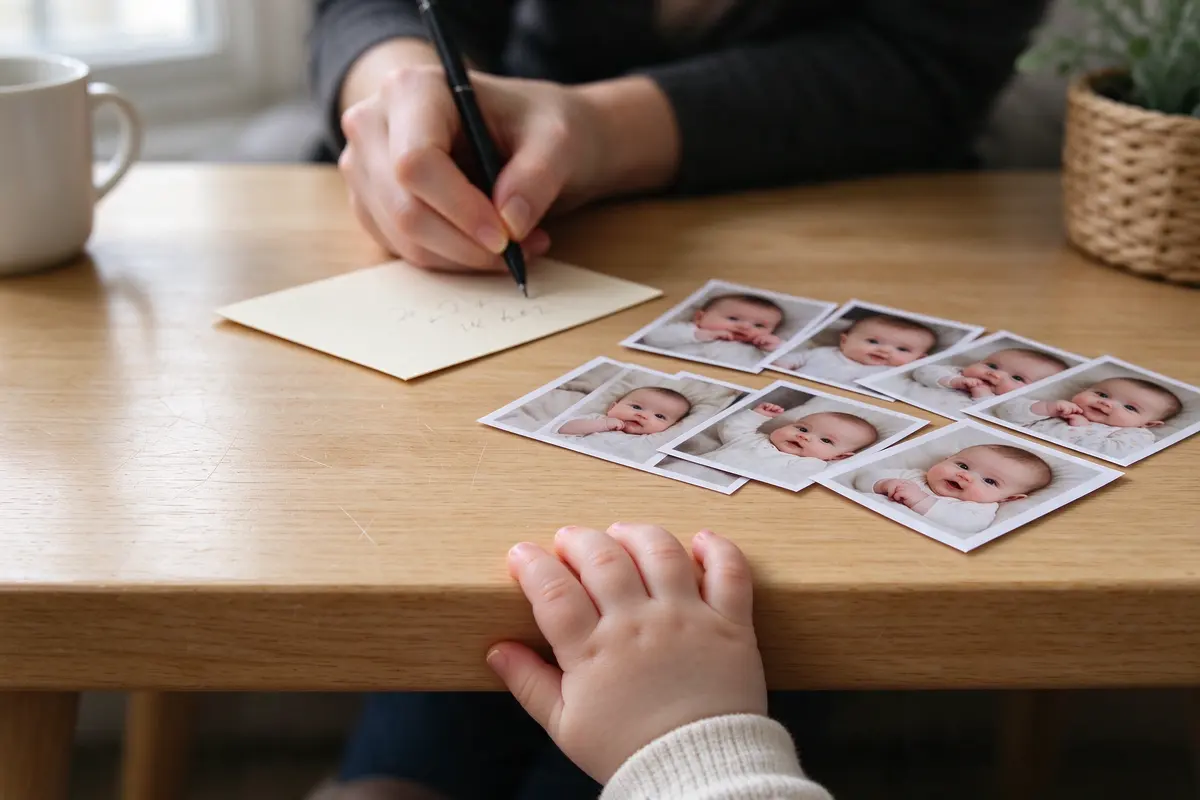
Ten-month photo and letter
Time: 15 minutes
Take the photo in the day-one spot: your baby standing at the sofa with your hands ready behind them, or sitting there if standing isn't here yet. There's nothing to prove.
Write the letter: what they do now that they didn't at nine months, in plain words, with the word "should" left out.
Add one thing from the 12-month list you've seen a hint of and one you haven't, as a note to your future self, not a score (CDC).
Date it, put the photo with it, and file it with the other nine.
Make it work:If your baby was born early, write both ages at the top; corrected age is the one that counts for milestones (AAP).
Watch for
Normal
a baby who cruises the whole sofa and never lets go of it; walking alone runs from 8.2 to 17.6 months (WHO Multicentre Growth Reference Study Group, 2006).
Ask about a developmental screening
if your baby isn't pulling to stand by 12 months or has lost skills (CDC).
Normal
"mama" aimed at the dog, the spoon, and the ceiling; calling a parent by name is a 12-month milestone (CDC).
Bring it up
if your baby has lost skills they used to have (CDC).
Normal
a day of a dozen sit-downs onto a diapered bottom from standing; the walkers in the study fell 17 times an hour (Adolph et al., 2012).
Call your pediatrician now
for any head injury in a baby under 1 year, even if your baby seems fine (AAP).
Normal
a clingy, cross week right before a new skill shows up.
Call 911
if your baby has purple or blood-colored spots or dots on the skin (AAP).
For you

The photo of you, standing. Not on the blanket this time: in the doorway, on your feet, with the baby on your hip, because that's where ten months of this has put you, up and carrying. Take it before you've fixed anything. And one line from the CDC that still applies, ten months out: tell any provider you see this year that you were pregnant within the last year, and if something just doesn't feel right, or you aren't sure if it's serious, talk to your health care provider (CDC). The urgent list hasn't expired because the baby stands.
If you're the partner: you take hers, then hand her the phone and stand in the doorway yourself. About 10% of fathers have depression around a birth, with higher rates reported at 3 to 6 months after (Paulson & Bazemore, 2010); look at your own photo as honestly as you'd look at hers.
Sources
- Centers for Disease Control and Prevention. "Milestones by 1 Year." Learn the Signs. Act Early. program, updated 2026. https://www.cdc.gov/act-early/milestones/1-year.html
- Zubler JM, Wiggins LD, Macias MM, et al. "Evidence-Informed Milestones for Developmental Surveillance Tools." Pediatrics, 2022. https://pubmed.ncbi.nlm.nih.gov/35132439/
- American Academy of Pediatrics. "Corrected Age For Preemies." HealthyChildren.org, updated 2018. https://www.healthychildren.org/English/ages-stages/baby/preemie/Pages/Corrected-Age-For-Preemies.aspx
- American Academy of Pediatrics. "Checkup Checklist: First Birthday (12 Months Old)." HealthyChildren.org, updated 2021. https://www.healthychildren.org/English/ages-stages/Your-Childs-Checkups/Pages/Your-Checkup-Checklist-12-Months-Old.aspx
- Bracho-Sánchez E. "AAP Guide: Vaccines Your Child Needs by Age 6." HealthyChildren.org, updated 2026. https://www.healthychildren.org/English/safety-prevention/immunizations/Pages/Your-Babys-First-Vaccines.aspx
- American Academy of Pediatrics. "AAP Releases Recommended Childhood and Adolescent Immunization Schedule for 2026." HealthyChildren.org, 2026. https://www.healthychildren.org/English/news/Pages/AAPs-recommended-childhood-and-adolescent-immunization-schedule-for-2026.aspx
- WHO Multicentre Growth Reference Study Group. "WHO Motor Development Study: windows of achievement for six gross motor development milestones." Acta Paediatrica Supplement, 2006. https://pubmed.ncbi.nlm.nih.gov/16817682/
- Centers for Disease Control and Prevention. "Milestones by 15 Months." Learn the Signs. Act Early. program, accessed 2026. https://www.cdc.gov/act-early/milestones/15-months.html
- Adolph KE, Cole WG, Komati M, et al. "How do you learn to walk? Thousands of steps and dozens of falls per day." Psychological Science, 2012. https://pubmed.ncbi.nlm.nih.gov/23085640/
- Centers for Disease Control and Prevention. "Milestones by 9 Months." Learn the Signs. Act Early. program, updated 2026. https://www.cdc.gov/act-early/milestones/9-months.html
- American Academy of Pediatrics. "Head Injury" (symptom checker). HealthyChildren.org, accessed 2026. https://www.healthychildren.org/English/tips-tools/symptom-checker/Pages/symptomviewer.aspx?symptom=Head+Injury
- American Academy of Pediatrics. "Fever" (symptom checker). HealthyChildren.org, accessed 2026. https://www.healthychildren.org/English/tips-tools/symptom-checker/Pages/symptomviewer.aspx?symptom=Fever
- Centers for Disease Control and Prevention. "Urgent Maternal Warning Signs and Symptoms." HEAR HER, 2024. https://www.cdc.gov/hearher/maternal-warning-signs/index.html
- Paulson JF, Bazemore SD. "Prenatal and postpartum depression in fathers and its association with maternal depression: a meta-analysis." JAMA, 2010. https://pubmed.ncbi.nlm.nih.gov/20483973/
This guide is general education that summarizes published research and guidance from groups like the American Academy of Pediatrics, the CDC, and the WHO. It isn’t medical advice, and every child develops on their own timeline. Your pediatrician knows your child; if something feels wrong, call them. In an emergency, call 911.
Get each day’s note the morning it applies
Add your baby to a free Chorevia household with their date of birth, and every morning for 300 days the day’s note arrives in the app and by email: what’s developing, one thing to try, what to watch for, and a word for you.
Create your household