Day 273 of 300 · Week 37
Getting down
Last reviewed · 4 min read · 6 sources · Plain-text version
Up is the easy half. How to help a baby who's standing and stuck without lifting them, the honest count of falls once walking starts, and the soft landing.

Up is the easy half. Today is the other one: the sit-down from standing, how to help without doing it for them, and what the research says about how many times a baby lands on the floor on the way to walking.
Heart
Pulling up to stand often comes before a baby knows how to get back down (AAP). The picture is the same in every house: upright at the sofa, pleased, then stuck, then crying, then rescued. The AAP's advice is to show them how to bend their knees and sit down, which saves you many trips to a crib where a baby is standing and crying (AAP). The help that teaches is a hand to lower, not a lift. Scoop them up and the legs learn nothing; fold them down and the legs learn the fold.
Head
Bumps happen, and they're the method. Filmed during free play, 12- to 19-month-olds averaged 2,368 steps and 17 falls per hour (Adolph et al., 2012). A 9-month-old's falls at the sofa are shorter: from standing to a diapered bottom, onto whatever the floor is made of. That last part is the only part you control: a rug, with nothing hard in the fall line.
Body
The rule that doesn't change: call your pediatrician now for any head injury in a baby under 1 year, even if your baby seems fine (AAP). A sit-down onto a bottom isn't a head injury; a backward topple onto a hard floor or a sideways one into a table edge can be, which is why the pull-up spot is sturdy, won't tip, and has no sharp edges (CDC). Falls from furniture are a common cause of injury hospitalizations in young children, and beds top the list (Pomerantz et al., 2012); a baby who can pull up on a bed can go over its edge, so play stays on the floor.
Try today

The soft landing
Time: 5 minutes, two or three times today · Cruise to the toy in the guide
Stand your baby at the sofa on a rug, their hands on the cushion, your hands under their arms, carrying none of their weight.
Say "sit," and lower them slowly so the knees bend and the bottom reaches the rug. Let the legs do the folding; your hands only steer.
Let them pull back up, then sit them again. Three or four rounds.
Over the next few days, move your hands from under the arms to the hips, then to a fingertip nudge, then to open hands behind them and nothing else (AAP).
Make it work:The practice is the mechanism; falls are part of it (Adolph et al., 2012). The plop at step three, onto a rug, is a success.
Watch for
Normal
a thump onto the bottom, a surprised face, and straight back up.
Go to the ER now
if after a head injury your baby vomits 2 or more times, cries nonstop, or seems "out of it" (AAP).
Normal
a baby who stands at the sofa and cries to be rescued every ten minutes for a week (AAP).
Call your pediatrician right away
if your baby cries when touched or moved, or won't move an arm or leg normally (AAP).
Normal
a bruise on a shin from the table leg.
Talk with your pediatrician
if your baby doesn't seem to be moving normally (AAP).
For you
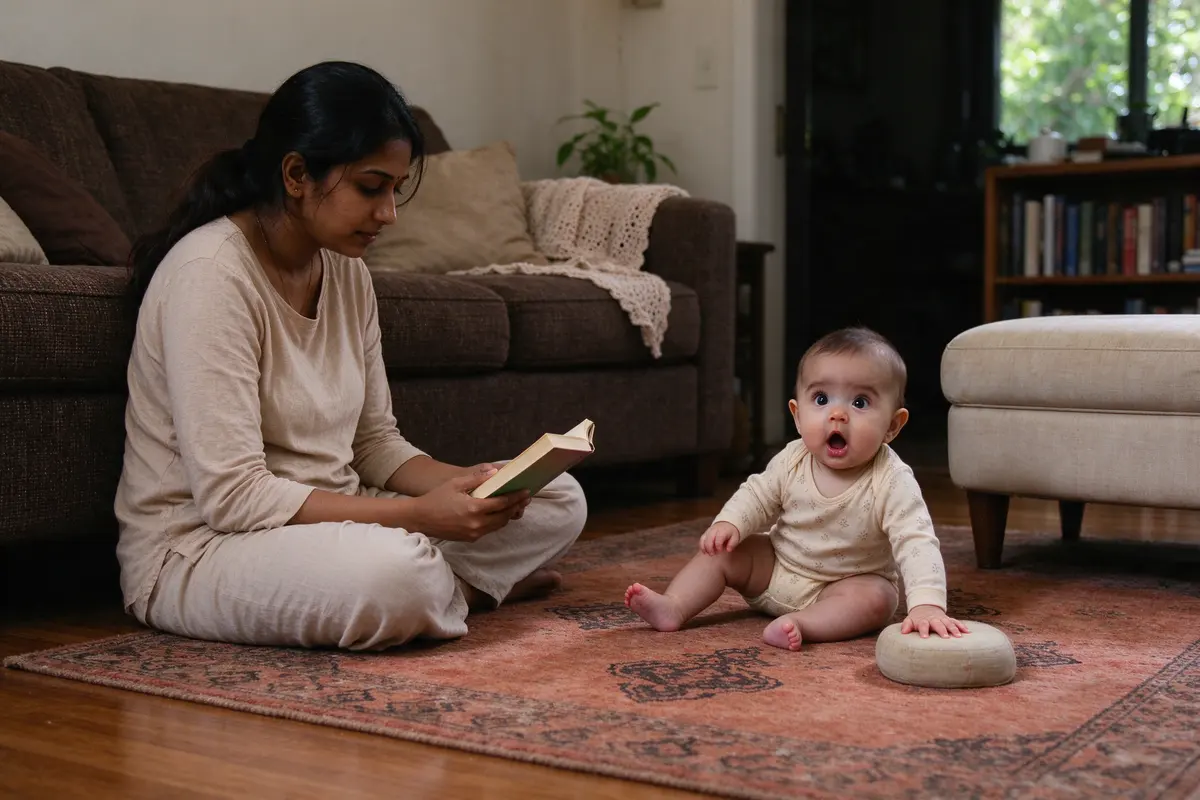
Falls onto a padded floor are the normal ones, and there will be many: 17 an hour is the count for new walkers in free play (Adolph et al., 2012). You won't catch them all, and you're not supposed to. What stays is the call rule: any head injury in a baby under 1, a call, even if they seem fine (AAP). Put that sentence on the fridge next to the 911 and call-now lists, so the decision after a bad thump is already made and you don't have to make it while your baby is crying.
If you're the partner: your job isn't to stand guard. It's the rug and the fall line: move the side table, pad the hearth if there is one, and then sit down.
Sources
- American Academy of Pediatrics. "Movement Milestones in Babies 8 to 12 Months Old." HealthyChildren.org, updated 2021. https://www.healthychildren.org/English/ages-stages/baby/Pages/Movement-8-to-12-Months.aspx
- Adolph KE, Cole WG, Komati M, et al. "How do you learn to walk? Thousands of steps and dozens of falls per day." Psychological Science, 2012. https://pubmed.ncbi.nlm.nih.gov/23085640/
- American Academy of Pediatrics. "Head Injury" (symptom checker). HealthyChildren.org, accessed 2026. https://www.healthychildren.org/English/tips-tools/symptom-checker/Pages/symptomviewer.aspx?symptom=Head+Injury
- Centers for Disease Control and Prevention. "Milestones by 9 Months." Learn the Signs. Act Early. program, updated 2026. https://www.cdc.gov/act-early/milestones/9-months.html
- Pomerantz WJ, Gittelman MA, Hornung R, Husseinzadeh H. "Falls in children birth to 5 years: different mechanisms lead to different injuries." Journal of Trauma and Acute Care Surgery, 2012. https://pubmed.ncbi.nlm.nih.gov/23026963/
- American Academy of Pediatrics. "Fever" (symptom checker). HealthyChildren.org, accessed 2026. https://www.healthychildren.org/English/tips-tools/symptom-checker/Pages/symptomviewer.aspx?symptom=Fever
This guide is general education that summarizes published research and guidance from groups like the American Academy of Pediatrics, the CDC, and the WHO. It isn’t medical advice, and every child develops on their own timeline. Your pediatrician knows your child; if something feels wrong, call them. In an emergency, call 911.
Get each day’s note the morning it applies
Add your baby to a free Chorevia household with their date of birth, and every morning for 300 days the day’s note arrives in the app and by email: what’s developing, one thing to try, what to watch for, and a word for you.
Create your household