Day 275 of 300 · Week 37
Push the box
Last reviewed · 4 min read · 9 sources · Plain-text version
CDC suggests letting babies push things around, like empty boxes, and says walkers aren't recommended. Why a diaper box beats a walker, where the route can't go, and the push-the-box walk.
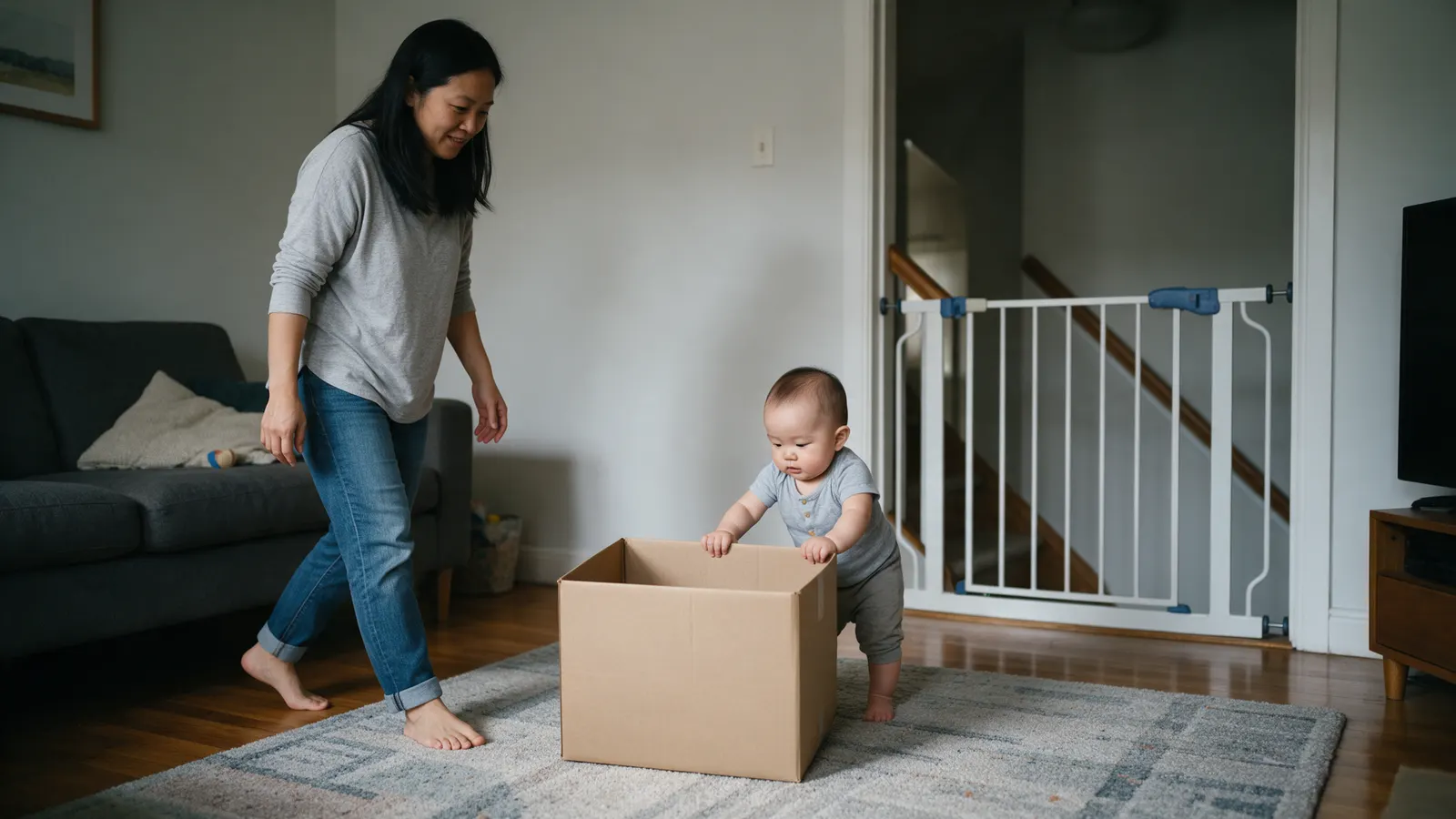
The best walking toy you own is in the recycling. Today is why a box on a rug does what a walker claims to, and the one place the route can never go.
Heart
CDC suggests letting babies push things around, such as empty boxes, and says baby walkers aren't recommended (CDC). Pushing a box is walking with support, and the support is the baby's own legs: stand, lean, the box moves a few inches, step to catch up. Babies learn to walk through huge amounts of practice, thousands of steps and dozens of falls a day (Adolph et al., 2012); a box collects the steps and keeps the falls short.
Head
A walker does the opposite. Baby walkers don't help children learn to walk and can delay it, and they send thousands of children to hospitals each year, mostly from falls down stairs (AAP). A baby in a walker can move more than 3 feet in a second, faster than an adult can react (AAP). A box moves as fast as the baby, stops when they stop, and tips them forward onto a rug. The one thing it shares with a walker is the stairs: keep the route well away from them, and keep the gates at the top and bottom, mounted firmly to the wall studs (AAP).
Body
The box is floor time with a job: the WHO's advice is interactive floor play several times a day and no more than 1 hour at a time strapped into a stroller, high chair, or carrier (WHO). Check the floor and between cushions first for coins, toy parts, and pen caps (AAP), because a baby who stops pushing sits down and finds whatever is there. The box gets chewed; cardboard corners come off in a mouth, so a box with soggy edges is swapped for the next one.
Try today

Push-the-box walk
Time: About 5 minutes · Push-the-box walk in the guide
Find a sturdy empty box, like a diaper box, with the flaps taped shut so the top is flat (CDC).
Help your baby stand behind it with both hands on the top edge, on a rug, well away from any stairs (AAP).
Let them push it across the rug while you walk alongside. Don't pull the box for them; if it won't move, the rug is too thick or the box too light, and a folded towel inside fixes the second.
When it stalls at the wall, turn it around and let them go again. Stop when they sit down.
Make it work:A box with soft, chewed corners is done (AAP). The next diaper box is a week away.
Watch for
Normal
a corner of cardboard in the mouth before you noticed.
Call 911
if your baby is choking and can't breathe, cry, or make noise, turns bluish, or goes limp, and start back blows and chest thrusts while someone calls (AAP).
Normal
a baby who heads for the stairs the moment the box reaches the hall; the gate is the answer, at the top and the bottom (AAP).
Call your pediatrician now
for any head injury in a baby under 1 year, even if your baby seems fine (AAP).
Normal
a sweaty, thirsty baby after a hard push across the room.
Call your pediatrician right away
for signs of dehydration: no urine in more than 8 hours, dark urine, a very dry mouth, and no tears (AAP).
For you

The walker, still no, one more time. The offer comes back because the baby is standing now, and a standing baby makes a walker look like the obvious next thing. It isn't. From 1990 to 2014, an estimated 230,676 US children under 15 months were treated in emergency rooms for walker injuries, 74.1% from falls down stairs (Sims et al., 2018); the AAP has called for a ban, and walkers are banned in Canada (AAP). If one has already arrived, the AAP's safer alternatives are a play yard or a stationary activity center with no wheels (AAP), kept inside the WHO's hour (WHO). The box cost nothing and does the job.
If you're the partner: if the walker came from your side of the family, the return trip is yours. Bring the diaper box to show them what the baby uses instead.
Sources
- Centers for Disease Control and Prevention. "Milestones by 1 Year." Learn the Signs. Act Early. program, updated 2026. https://www.cdc.gov/act-early/milestones/1-year.html
- Adolph KE, Cole WG, Komati M, et al. "How do you learn to walk? Thousands of steps and dozens of falls per day." Psychological Science, 2012. https://pubmed.ncbi.nlm.nih.gov/23085640/
- American Academy of Pediatrics. "Baby Walkers: A Dangerous Choice." HealthyChildren.org, updated 2022. https://www.healthychildren.org/English/safety-prevention/at-home/Pages/Baby-Walkers-A-Dangerous-Choice.aspx
- American Academy of Pediatrics. "Home Safety: Tips for Families With Young Children." HealthyChildren.org, updated 2022. https://www.healthychildren.org/English/safety-prevention/at-home/Pages/Home-Safety-Heres-How.aspx
- World Health Organization. "To grow up healthy, children need to sit less and play more." 2019. https://www.who.int/news/item/24-04-2019-to-grow-up-healthy-children-need-to-sit-less-and-play-more
- Bradin S. "Choking Prevention for Babies & Children: What Every Parent Needs to Know." HealthyChildren.org, updated 2026. https://www.healthychildren.org/English/health-issues/injuries-emergencies/Pages/Choking-Prevention.aspx
- American Academy of Pediatrics. "Head Injury" (symptom checker). HealthyChildren.org, accessed 2026. https://www.healthychildren.org/English/tips-tools/symptom-checker/Pages/symptomviewer.aspx?symptom=Head+Injury
- American Academy of Pediatrics. "Fever" (symptom checker). HealthyChildren.org, accessed 2026. https://www.healthychildren.org/English/tips-tools/symptom-checker/Pages/symptomviewer.aspx?symptom=Fever
- Sims A, Chounthirath T, Yang J, Hodges NL, Smith GA. "Infant Walker-Related Injuries in the United States." Pediatrics, 2018. https://pubmed.ncbi.nlm.nih.gov/30224365/
This guide is general education that summarizes published research and guidance from groups like the American Academy of Pediatrics, the CDC, and the WHO. It isn’t medical advice, and every child develops on their own timeline. Your pediatrician knows your child; if something feels wrong, call them. In an emergency, call 911.
Get each day’s note the morning it applies
Add your baby to a free Chorevia household with their date of birth, and every morning for 300 days the day’s note arrives in the app and by email: what’s developing, one thing to try, what to watch for, and a word for you.
Create your household