Day 283 of 300 · Week 38
Waving and arms up
Last reviewed · 4 min read · 7 sources · Plain-text version
Lifting arms to be picked up is a 9-month milestone; waving bye-bye is a 12-month one. Gestures talk, and babies copy the ones they see. The gesture trio: wave, arms up, head shake, each named.
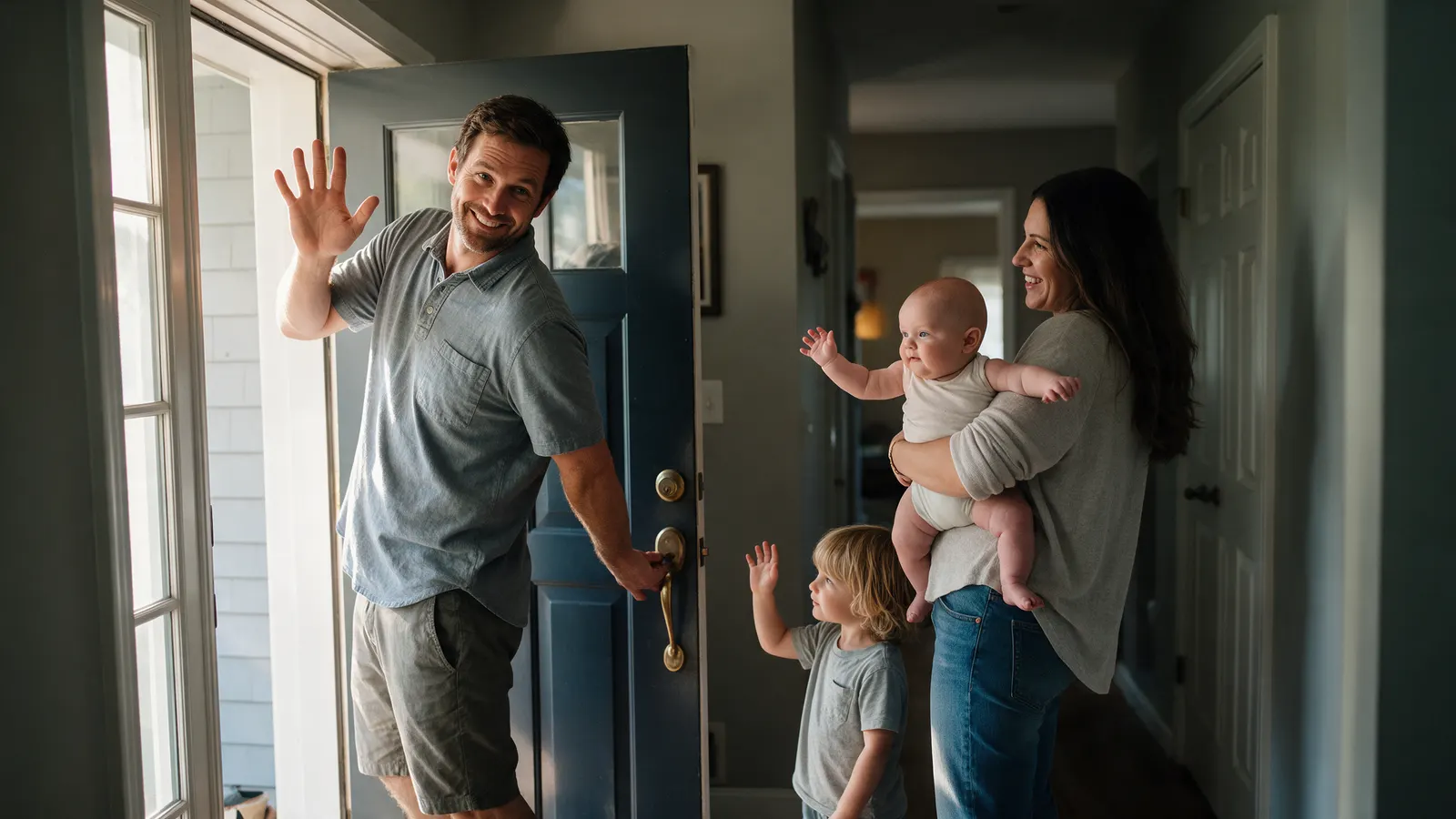
Before the words come, the hands talk. Today is the three gestures your baby is closest to, what each one has until, and how to teach them without turning the hallway into a classroom.
Heart
One gesture is a 9-month skill: most babies lift their arms to be picked up (CDC). The next two are 12-month skills: waving "bye-bye," and understanding "no," which at this age means pausing briefly or stopping when you say it (CDC). Your baby is 9 months old, so the wave and the pause have months to arrive. What makes them arrive is watching: toward the end of the first year, babies copy the gestures they see you use (AAP). Every goodbye at the door is a lesson whether you mean it to be or not.
Head
The guide's lesson is three words long: gestures talk. CDC suggests teaching them on purpose: wave bye-bye, shake your head for "no," and lift your arms to say "up" (CDC). Whether practice speeds the milestones up hasn't been tested, which is why the guide rates its gesture game as emerging evidence. What the research does support is the order of things: gestures come before words, and in a study of 10 toddlers, many things children first pointed at later became words (Iverson & Goldin-Meadow, 2005). A wave is a word your baby can say with no mouth involved.
Body
Each gesture gets one word, the same word every time, because that's how names stick: name what your baby sees, touches, and does, the same way each time (AAP). The head shake is the one to be careful with. Save "no" for safety and swap a forbidden object for one that's okay (AAP), so the shake means something when it comes. The guide's game is Bye-bye and pat-a-cake; today is the three gestures, named, without the song.
Try today
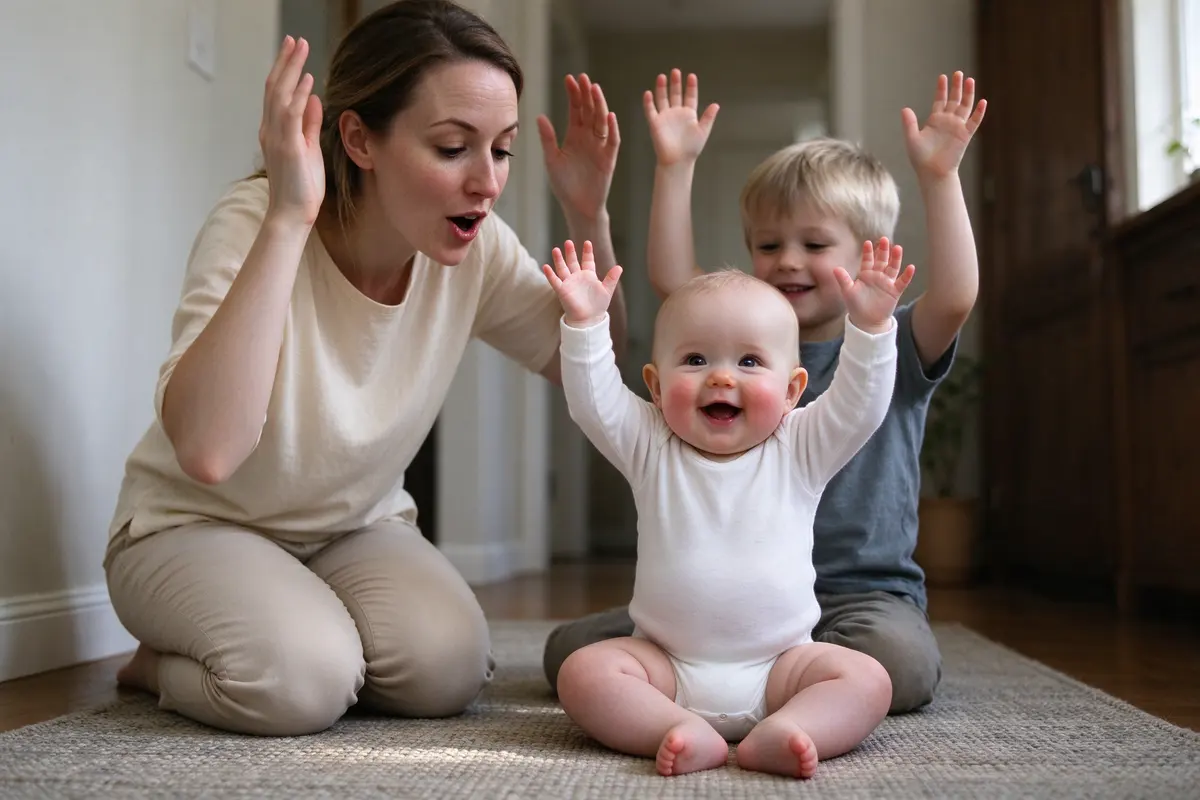
The gesture trio
Time: A few seconds each, many times today
Wave: whenever anyone leaves the room, wave and say "bye-bye," and gently help your baby's hand wave too (CDC).
Arms up: before you lift your baby, raise your own arms, say "Up?", and wait a beat for theirs to rise (CDC). Then lift.
Head shake: the one time today something has to come out of their hand for safety, shake your head slowly, say "no" once, and swap in the thing that's okay (AAP).
At bedtime, count which of the three got copied, even badly. Tomorrow, the same three, the same words.
Make it work:One word per gesture. "Bye-bye" is a gesture's name; "Say goodbye to Grandma, sweetheart" is a sentence a baby can't attach to a hand.
Watch for
Normal
a wave that's a whole-arm flap aimed at nobody, or a hand that opens and closes at the wrist; waving has until 12 months (CDC).
Bring it up
if your baby doesn't look when you call their name (CDC).
Normal
arms up to a stranger, then a scream when the stranger takes them; by 9 months most babies are shy, clingy, or fearful around strangers (CDC).
Mention it at the 12-month visit
if your baby's fear of new people is very intense (Brooker et al., 2013).
Normal
a head shake so enthusiastic that a sitting baby tips over onto the rug.
Call your pediatrician now
for any head injury in a baby under 1, even one who seems fine, and go to the ER now if after a head injury your baby vomits 2 or more times, cries and won't stop, or is awake but not alert (AAP).
For you
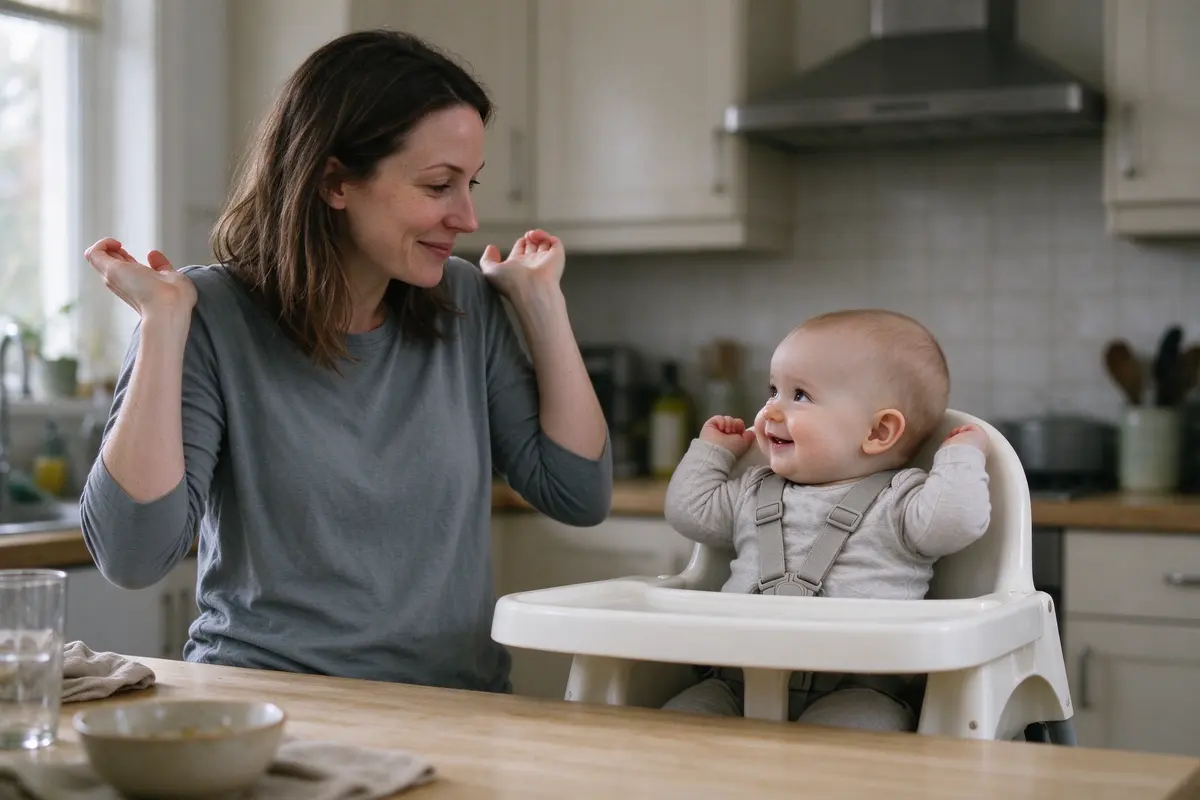
Your own gestures are being copied. Not just the wave: the shrug, the hand through the hair, the flat palm that means "wait," the way you hold the phone. Babies this age copy the gestures they see you use (AAP), and they don't sort them into the ones you meant to teach and the ones you didn't. That's not a reason to perform. It's a reason to notice, once today, what your hands say when you're tired, and to decide whether that's a word you'd like in the baby's first vocabulary. Most of what they'll copy is fine. The shrug is fine.
If you're the partner: you're the one who leaves in the morning, so the wave is yours to teach. Do it at the door, every day, the same two syllables, even when you're late. Especially when you're late.
Sources
- Centers for Disease Control and Prevention. "Milestones by 9 Months." Learn the Signs. Act Early. program, updated 2026. https://www.cdc.gov/act-early/milestones/9-months.html
- Centers for Disease Control and Prevention. "Milestones by 1 Year." Learn the Signs. Act Early. program, updated 2026. https://www.cdc.gov/act-early/milestones/1-year.html
- American Academy of Pediatrics. "Language Development: 8 to 12 Months." HealthyChildren.org, updated 2009. https://www.healthychildren.org/English/ages-stages/baby/Pages/Language-Development-8-to-12-Months.aspx
- Iverson JM, Goldin-Meadow S. "Gesture paves the way for language development." Psychological Science, 2005. https://pubmed.ncbi.nlm.nih.gov/15869695/
- American Academy of Pediatrics. "What's the Best Way to Discipline My Child?" HealthyChildren.org, updated 2018. https://www.healthychildren.org/English/family-life/family-dynamics/communication-discipline/Pages/Disciplining-Your-Child.aspx
- Brooker RJ, Buss KA, Lemery-Chalfant K, et al. "The development of stranger fear in infancy and toddlerhood: normative development, individual differences, antecedents, and outcomes." Developmental Science, 2013. https://pubmed.ncbi.nlm.nih.gov/24118713/
- American Academy of Pediatrics. "Head Injury" (symptom checker). HealthyChildren.org, accessed 2026. https://www.healthychildren.org/English/tips-tools/symptom-checker/Pages/symptomviewer.aspx?symptom=Head+Injury
This guide is general education that summarizes published research and guidance from groups like the American Academy of Pediatrics, the CDC, and the WHO. It isn’t medical advice, and every child develops on their own timeline. Your pediatrician knows your child; if something feels wrong, call them. In an emergency, call 911.
Get each day’s note the morning it applies
Add your baby to a free Chorevia household with their date of birth, and every morning for 300 days the day’s note arrives in the app and by email: what’s developing, one thing to try, what to watch for, and a word for you.
Create your household