Day 288 of 300 · Week 39
Child care, if it's starting
Last reviewed · 4 min read · 11 sources · Plain-text version
If you can, avoid starting child care in this window or ease in slowly, with extra time at drop-off. A familiar sitter helps; a new one arrives early. The drop-off rehearsal, you in the next room.

If someone else is about to start caring for your baby, this is a hard month to begin and a good one to rehearse. Today is the AAP on timing, what to ask any caregiver, and a practice drop-off where you leave the room, not the house.
Heart
If you can, avoid starting child care during this stage, or ease in slowly, and take a little extra time at drop-off (AAP). The reason is the one you read yesterday: separation anxiety peaks between 10 and 18 months (AAP), and your baby is 9 months old and heading into it. Many families can't choose the timing; easing in is still available. A familiar sitter helps, and a new one should arrive early enough to get acquainted; then offer a distraction, say goodbye, and go (AAP).
Head
The questions for any program haven't changed. For babies 12 months and younger, the AAP recommends no more than 3 babies per caregiver and no more than 6 in a group; ask about CPR training (AAP) and for a written safe sleep policy (AAP). Back to sleep is for every sleep until age 1 (AAP), and it has to be true in someone else's room too: in 1990s data from 11 states, 20.4% of SIDS deaths happened in child care, and babies who died there were more likely than others to have been put down on their stomachs when they usually slept on their backs or sides (Moon et al., 2000). Ask the question out loud, and share what calms your baby (AAP).
Body
The drop-off itself is yesterday's goodbye in a new room: never sneak away (CDC), the same short ritual every time, back when you said (Swanson, AAP). The guide's script is "Bye-bye! I'm going to work. I'll be back after your nap," then kiss, wave, go. Rehearse it before the first real morning, in your own house, with you in the next room. The guide's section is Ease goodbyes and new faces.
Try today
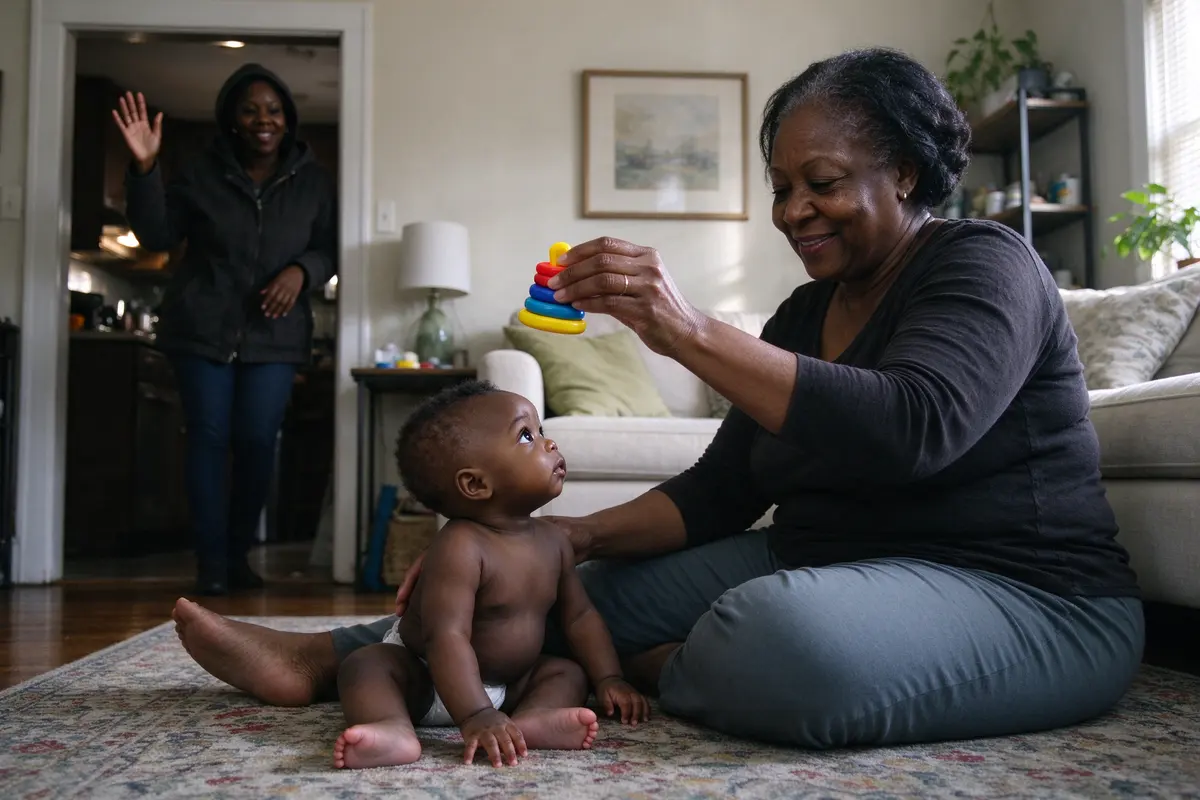
The drop-off rehearsal
Time: 20 minutes, with the sitter, grandparent, or a center teacher at a settling-in visit
The caregiver arrives early and sits on the floor a few feet away while you and they talk; a new sitter should arrive early enough to get acquainted (AAP).
After ten minutes, the caregiver offers a toy at arm's length. Tell them the two things that calm your baby, in words they can repeat (AAP).
Do the ritual, the real one: "Bye-bye! I'm going to the kitchen. Back in five minutes." Kiss, wave, go (Swanson, AAP).
Five minutes in the next room by the clock, door open, no peeking. Come back when you said, with a big hello.
Ask the caregiver what worked. Tomorrow, ten minutes; the day after, the front door instead of the kitchen.
Make it work:The rehearsal is the goodbye, not the hiding. Sneaking out teaches the baby to watch you every second (CDC).
Watch for
Normal
a baby who cries at the handoff and is playing within minutes; tears usually stop soon after you leave (AAP).
Call your pediatrician right away
if your baby looks or acts very sick, or you think they need to be seen urgently (AAP).
Normal
the first cold within weeks of a new room full of babies.
Call within 24 hours
for a fever with no other symptoms for more than 2 days, any fever that lasts more than 3 days, or a fever that comes back after a day without one (AAP).
Normal
a rough week of nights when the days change; reassure calmly and consistently (AAP).
Call 911
if your baby is not moving, is very weak, or can't be woken (AAP).
For you

The rehearsal is for you too. The AAP's advice to take a little extra time at drop-off (AAP) is about the baby, but the five minutes on the stairs today is about you: finding out what it feels like to hear the crying and not go, and that it ends. The first real morning will still be hard, and less hard than the version you've never rehearsed. And if the program can't answer the safe sleep question in writing, that's not a feeling, that's a reason to keep looking (AAP).
If you're the partner: go to the first real drop-off together, let her say the goodbye if she wants to, and then you drive. Nobody should do the first one alone and then merge onto a highway.
Sources
- American Academy of Pediatrics. "Making Baby Drop Off at Child Care Easier." HealthyChildren.org, updated 2022. https://www.healthychildren.org/English/family-life/work-and-child-care/Pages/making-baby-drop-off-at-child-care-easier.aspx
- American Academy of Pediatrics. "Emotional and Social Development: 8 to 12 Months." HealthyChildren.org, updated 2009. https://www.healthychildren.org/English/ages-stages/baby/Pages/Emotional-and-Social-Development-8-12-Months.aspx
- American Academy of Pediatrics. "Separation Anxiety & Sleeping Trouble in Young Children." HealthyChildren.org, updated 2022. https://www.healthychildren.org/English/healthy-living/sleep/Pages/separation-anxiety-and-sleeping.aspx
- American Academy of Pediatrics. "Choosing a Child Care Center." HealthyChildren.org, updated 2022. https://www.healthychildren.org/English/family-life/work-and-child-care/Pages/choosing-a-child-care-center.aspx
- American Academy of Pediatrics. "Back to Sleep, Tummy to Play." HealthyChildren.org, updated 2026. https://www.healthychildren.org/English/ages-stages/baby/sleep/Pages/back-to-sleep-tummy-to-play.aspx
- American Academy of Pediatrics. "Getting Your Baby to Sleep." HealthyChildren.org, updated 2024. https://www.healthychildren.org/English/ages-stages/baby/sleep/Pages/getting-your-baby-to-sleep.aspx
- Moon RY, Patel KM, Shaefer SJ. "Sudden infant death syndrome in child care settings." Pediatrics, 2000. https://pubmed.ncbi.nlm.nih.gov/10920154/
- American Academy of Pediatrics. "Emotional & Social Development: Birth Through 3 Months." HealthyChildren.org, updated 2026. https://www.healthychildren.org/English/ages-stages/baby/Pages/Emotional-and-Social-Development-Birth-to-3-Months.aspx
- Centers for Disease Control and Prevention. "Milestones by 9 Months." Learn the Signs. Act Early. program, updated 2026. https://www.cdc.gov/act-early/milestones/9-months.html
- Swanson WS. "How to Ease Your Child's Separation Anxiety." HealthyChildren.org, updated 2026. https://www.healthychildren.org/English/ages-stages/toddler/Pages/Soothing-Your-Childs-Separation-Anxiety.aspx
- American Academy of Pediatrics. "Fever" (symptom checker). HealthyChildren.org, accessed 2026. https://www.healthychildren.org/English/tips-tools/symptom-checker/Pages/symptomviewer.aspx?symptom=Fever
This guide is general education that summarizes published research and guidance from groups like the American Academy of Pediatrics, the CDC, and the WHO. It isn’t medical advice, and every child develops on their own timeline. Your pediatrician knows your child; if something feels wrong, call them. In an emergency, call 911.
Get each day’s note the morning it applies
Add your baby to a free Chorevia household with their date of birth, and every morning for 300 days the day’s note arrives in the app and by email: what’s developing, one thing to try, what to watch for, and a word for you.
Create your household