Day 280 of 300 · Week 38
In the container
Last reviewed · 4 min read · 11 sources · Plain-text version
Putting something in a container is a 12-month milestone, and the dump comes before the fill. Wooden spoons, pots, and plastic tubs as the best toys, the low cabinet, and the cup and the block.

In goes the block. Not today, probably; today it goes out, and out again, and the cup gets thrown. But out is the first half of in, and the objects that teach it are already in your kitchen.
Heart
Putting something in a container, like a block in a cup, is a 12-month milestone (CDC). Your baby is 9 months old, and the dump comes first: tip the tub, watch everything spill, do it again. CDC suggests practicing dumping and refilling blocks (CDC; CDC); the refilling takes months, because "in" is a drop with aim, and letting go on purpose only just arrived (AAP).
Head
The toys for it cost nothing: at this age, ordinary household objects are the most fascinating toys, wooden spoons, pots, and plastic containers (AAP). One big idea of this stage is that things have uses: hand over a cup, a spoon, or a hairbrush and be an enthusiastic audience when your baby copies you (AAP). A baby who dumps the tub thirty times is studying that from the other end.
Body
The set lives in the low cabinet, the yes space: tempting and dangerous things out of reach so you need "no" less often, and a low cabinet stocked with wooden spoons, pots, and plastic containers (AAP; AAP). Lock up cleaners and alcohol, and don't rely on child-resistant caps (AAP). Everything in the set is too big to fit entirely in the mouth (AAP). By 12 months, most babies pause when they hear "no" (CDC); save it, and the cabinet is where you never have to say it.
Try today
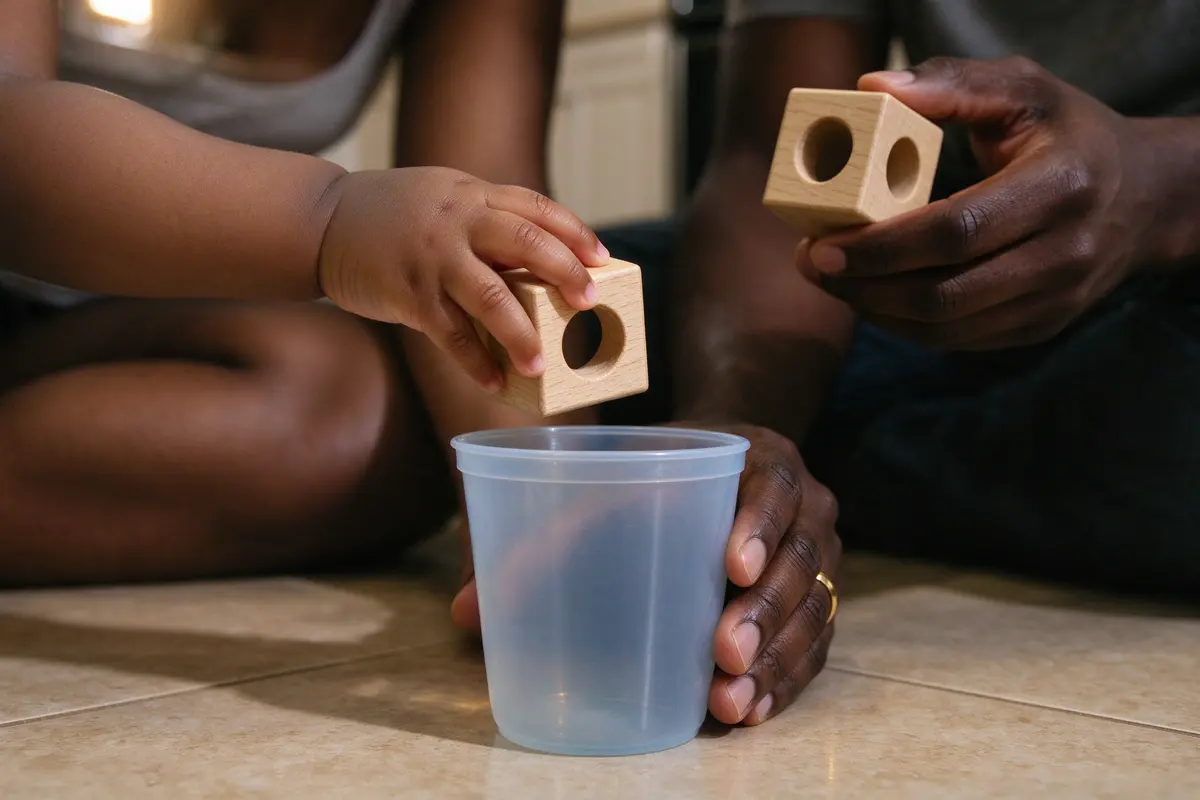
The cup and the block
Time: About 5 minutes · In and out in the guide
Sit on the kitchen floor with a wide plastic cup or tub and three wooden blocks or large plastic lids, each too big to fit entirely in the mouth (AAP).
Drop one in yourself, slowly: "In!" Tip it out: "Out!"
Hand your baby a block and hold the cup still right under their hand. Wait. Don't guide the hand.
Whatever happens, cheer it: a block in the cup is "in!", a cup tipped over is "out!" Then dump it all out together and go again (CDC).
When they're done, the set goes back in the low cabinet, where they can find it tomorrow.
Make it work:The "in" may be months off; it's a 12-month skill (CDC). The dump is today's win.
Watch for
Normal
dumping everything and putting nothing in, for weeks (CDC).
Bring it up
if by 12 months your baby doesn't pull up to stand, wave bye-bye, or look for a toy they saw you hide (CDC).
Normal
a hot, miserable baby with a cold who wants to be held and then wants the tub.
Normal
a baby who ignores the yes cabinet for the one with the lock; the lock is doing its job (AAP).
Call 911
if your baby collapses, has a seizure, has trouble breathing, or can't be woken; for anything less, Poison Help is 1-800-222-1222, free and confidential (Poison Control).
Normal
knowing this baby better than any list on the fridge.
Call anyway
if your baby just doesn't seem right to you. Trust your instincts; two hundred and eighty days have built them (Lurie Children's).
For you
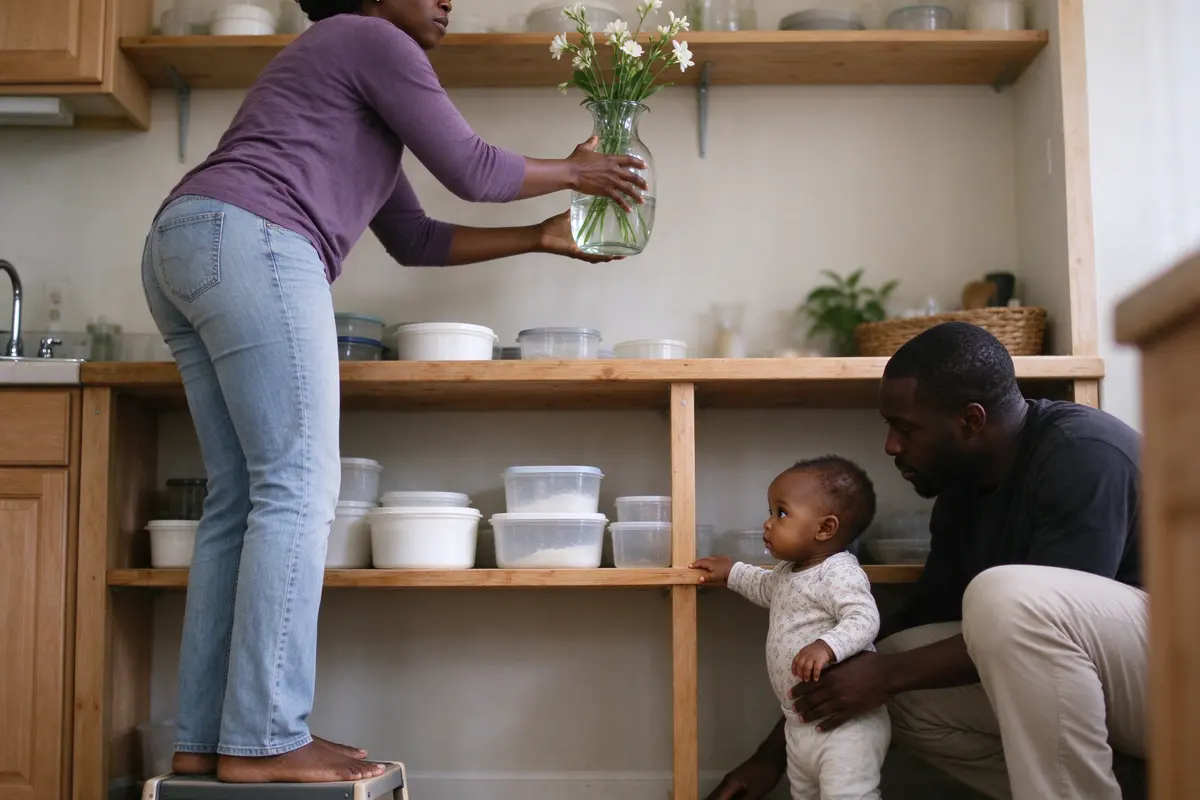
The yes space grows with the reach. Last month it was a cabinet; this month a standing baby can see the shelf above it, and every object there is either something they can have or something you'll say "no" about ten times a day. The AAP's way out is the same at every height: tempting and dangerous things out of reach so you need "no" less often (AAP). So tonight, one shelf: whatever's breakable, small, or sharp goes up, and a tub of spoons and lids goes in its place. A house arranged for a cruising baby has fewer arguments in it, and every argument you don't have is five minutes you keep.
If you're the partner: ask her which shelf she's been eyeing and do it tonight, step stool and all. Glass high, tub low, and then you both sit down.
Sources
- Centers for Disease Control and Prevention. "Milestones by 1 Year." Learn the Signs. Act Early. program, updated 2026. https://www.cdc.gov/act-early/milestones/1-year.html
- Centers for Disease Control and Prevention. "Milestones by 9 Months." Learn the Signs. Act Early. program, updated 2026. https://www.cdc.gov/act-early/milestones/9-months.html
- American Academy of Pediatrics. "Hand and Finger Skills." HealthyChildren.org, updated 2009. https://www.healthychildren.org/English/ages-stages/baby/Pages/Hand-and-Finger-Skills.aspx
- American Academy of Pediatrics. "Cognitive Development in Infants: 8 to 12 Months." HealthyChildren.org, updated 2023. https://www.healthychildren.org/English/ages-stages/baby/Pages/Cognitive-Development-8-to-12-Months.aspx
- American Academy of Pediatrics. "What's the Best Way to Discipline My Child?" HealthyChildren.org, updated 2018. https://www.healthychildren.org/English/family-life/family-dynamics/communication-discipline/Pages/Disciplining-Your-Child.aspx
- American Academy of Pediatrics. "Home Safety: Tips for Families With Young Children." HealthyChildren.org, updated 2022. https://www.healthychildren.org/English/safety-prevention/at-home/Pages/Home-Safety-Heres-How.aspx
- Bradin S. "Choking Prevention for Babies & Children: What Every Parent Needs to Know." HealthyChildren.org, updated 2026. https://www.healthychildren.org/English/health-issues/injuries-emergencies/Pages/Choking-Prevention.aspx
- Di Giovine M, Catenaccio E. "Febrile Seizures in Children." HealthyChildren.org, updated 2025. https://www.healthychildren.org/English/health-issues/conditions/fever/Pages/Febrile-Seizures.aspx
- American Academy of Pediatrics. "Fever" (symptom checker). HealthyChildren.org, accessed 2026. https://www.healthychildren.org/English/tips-tools/symptom-checker/Pages/symptomviewer.aspx?symptom=Fever
- National Capital Poison Center. "Poison Control." Accessed 2026. https://www.poison.org/
- Lurie Children's Hospital of Chicago. "When to Call the Pediatrician for Your Newborn." 2024. https://www.luriechildrens.org/en/blog/when-to-call-the-pediatrician-for-your-newborn/
This guide is general education that summarizes published research and guidance from groups like the American Academy of Pediatrics, the CDC, and the WHO. It isn’t medical advice, and every child develops on their own timeline. Your pediatrician knows your child; if something feels wrong, call them. In an emergency, call 911.
Get each day’s note the morning it applies
Add your baby to a free Chorevia household with their date of birth, and every morning for 300 days the day’s note arrives in the app and by email: what’s developing, one thing to try, what to watch for, and a word for you.
Create your household