Day 294 of 300 · Week 40
Redirect, month ten
Last reviewed · 4 min read · 10 sources · Plain-text version
Model what you want, use positive words like 'Time to sit,' save 'no' for safety, and swap the object. By 12 months most babies pause at 'no.' The positive-words day: every 'don't' rephrased.

A cruising baby meets more "don't" in a day than a sitting one ever did. Today is the AAP's short program for this age, and one day of saying it the other way round.
Heart
The AAP's advice for babies is simple: model what you want, use positive words ("Time to sit" instead of "Don't stand"), save "no" for safety, and swap a forbidden object for one that's okay. Get every caregiver to agree on the same few rules (AAP). By 12 months, most babies pause when they hear "no" (CDC), but they'll test it, and that's normal (AAP). Your baby is nine months old; the pause is coming, and what you say in the meantime is what it will be a pause for.
Head
Why "no" wears out: the AAP advises putting tempting and dangerous things out of reach so you need it less often (AAP). And why nothing harsher is on the table: meta-analyses covering 160,927 children found spanking linked to worse results on 13 of 17 outcomes, and to better results on none (Gershoff & Grogan-Kaylor, 2016). The AAP concludes that physical punishment works poorly in the short term and not at all in the long term (Sege & Siegel, 2018), and that hitting babies under 18 months raises the risk of injury (AAP). The guide's section is Redirect instead of punishing.
Body
The script is two sentences: "Phones aren't for chewing. Here's your cup to bang." Hand it over, then move the phone (AAP). The modeling half is the fun half: hand over a cup, a spoon, or a hairbrush and be an enthusiastic audience when your baby copies you (AAP). And the last line of the AAP's advice is for you, not the baby: if you feel yourself losing control, put your baby somewhere safe and take a few minutes to breathe (AAP).
Try today
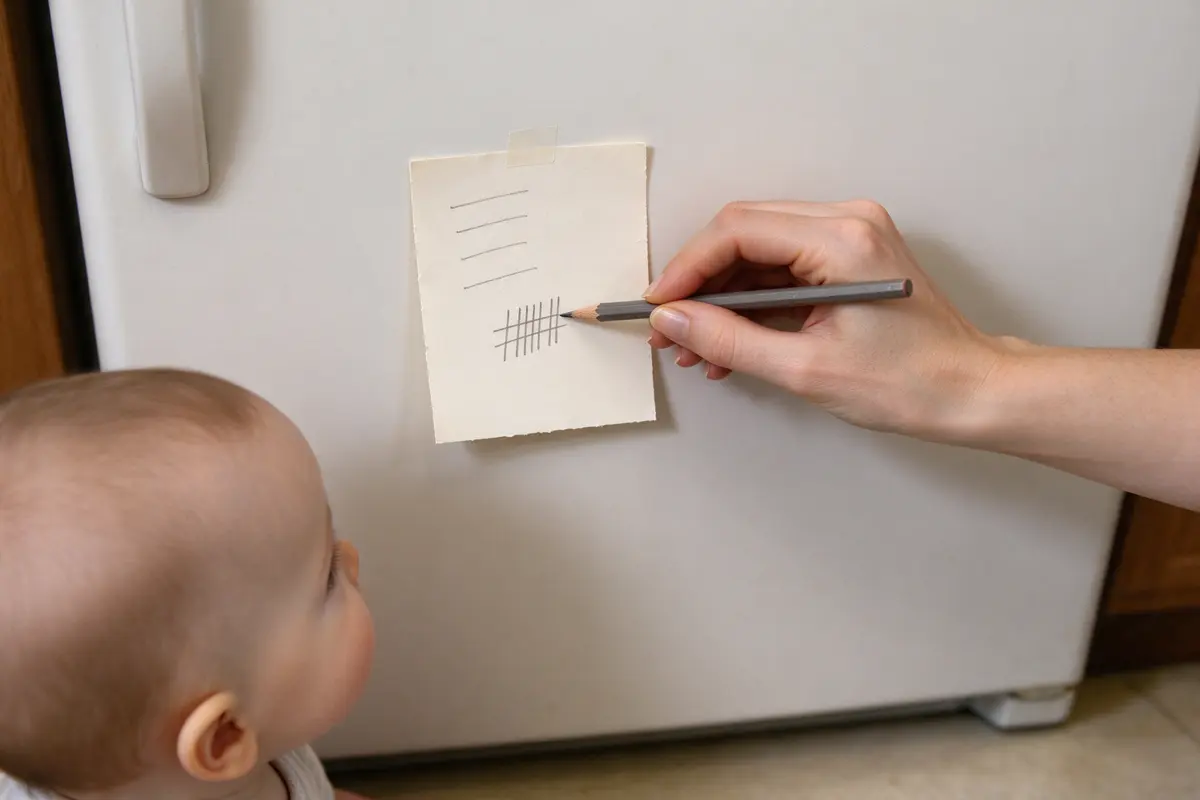
The positive-words day
Time: All day, with a pencil on the fridge · Redirect instead of punishing in the guide
Every time a "don't" starts in your mouth, turn it into the thing you want instead: "Time to sit" for "Don't stand," "Cup stays on the tray" for "Don't throw" (AAP).
Pair the words with the swap: the forbidden thing leaves, an allowed thing arrives (AAP).
Save "no" for safety only, and make a pencil mark on the fridge each time you needed it.
Tonight, for every mark, ask whether that thing can go out of reach so tomorrow needs one mark fewer (AAP).
Make it work:Write your three or four rephrasings on an index card so the sitter's "Time to sit" sounds the same as yours.
Watch for
Normal
Keep electrical cords out of reach
rather than relying on the word (AAP).
Normal
a wail at the swap, forgotten in a minute.
Call your pediatrician right away
if your baby cries nonstop, cries when touched or moved, or won't move an arm or leg normally (AAP).
Normal
a pull up to the coffee table and a sit-down with a thump on the way back.
Call your pediatrician now
for any head injury in a baby under 1 year, even if your baby seems fine (AAP).
For you
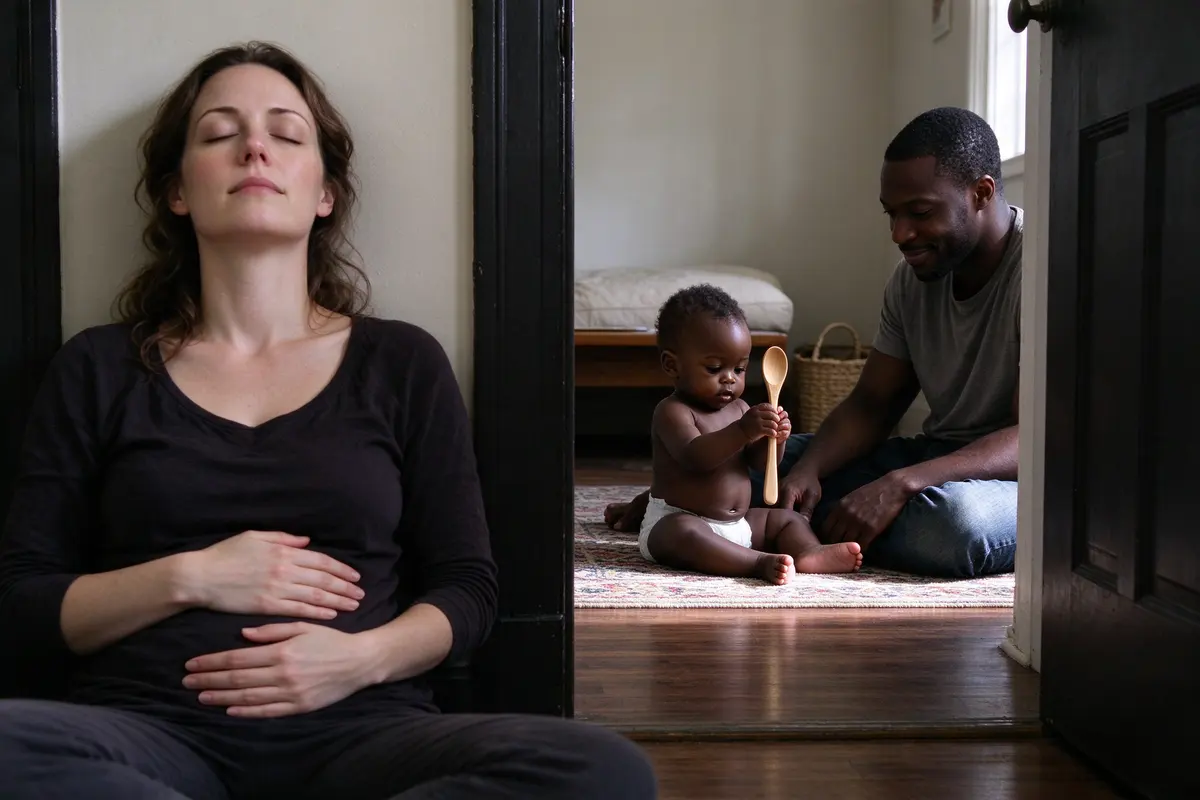
Fewer no's is less work, and the pencil marks are a measurement of your house, not of you. The AAP's instruction is to arrange the setting so "no" is rare (AAP); each mark on the fridge is a latch or a higher shelf, and a cruising baby reaches a new shelf most weeks. The few minutes to breathe in the hall are part of the program, not a failure of it (AAP). And if the breathing isn't enough, if the thoughts on the hallway floor go somewhere darker than tired, thoughts of harming yourself or your baby are on the CDC's list of urgent maternal warning signs: get care today, and tell whoever you see that you had a baby within the last year (CDC).
If you're the partner: the index card gets your handwriting on it too. Your "Time to sit" and hers have to be the same words, and tonight's fridge count is yours to turn into one moved lamp.
Sources
- American Academy of Pediatrics. "What's the Best Way to Discipline My Child?" HealthyChildren.org, updated 2018. https://www.healthychildren.org/English/family-life/family-dynamics/communication-discipline/Pages/Disciplining-Your-Child.aspx
- Centers for Disease Control and Prevention. "Milestones by 1 Year." Learn the Signs. Act Early. program, updated 2026. https://www.cdc.gov/act-early/milestones/1-year.html
- Gershoff ET, Grogan-Kaylor A. "Spanking and child outcomes: Old controversies and new meta-analyses." Journal of Family Psychology, 2016. https://pubmed.ncbi.nlm.nih.gov/27055181/
- Sege RD, Siegel BS; AAP Council on Child Abuse and Neglect; Committee on Psychosocial Aspects of Child and Family Health. "Effective Discipline to Raise Healthy Children." Pediatrics, 2018. https://pubmed.ncbi.nlm.nih.gov/30397164/
- American Academy of Pediatrics. "Where We Stand: Spanking." HealthyChildren.org, updated 2018. https://www.healthychildren.org/English/family-life/family-dynamics/communication-discipline/Pages/Where-We-Stand-Spanking.aspx
- American Academy of Pediatrics. "Cognitive Development in Infants: 8 to 12 Months." HealthyChildren.org, updated 2023. https://www.healthychildren.org/English/ages-stages/baby/Pages/Cognitive-Development-8-to-12-Months.aspx
- American Academy of Pediatrics. "Home Safety: Tips for Families With Young Children." HealthyChildren.org, updated 2022. https://www.healthychildren.org/English/safety-prevention/at-home/Pages/Home-Safety-Heres-How.aspx
- American Academy of Pediatrics. "Fever" (symptom checker). HealthyChildren.org, accessed 2026. https://www.healthychildren.org/English/tips-tools/symptom-checker/Pages/symptomviewer.aspx?symptom=Fever
- American Academy of Pediatrics. "Head Injury" (symptom checker). HealthyChildren.org, accessed 2026. https://www.healthychildren.org/English/tips-tools/symptom-checker/Pages/symptomviewer.aspx?symptom=Head+Injury
- Centers for Disease Control and Prevention. "Urgent Maternal Warning Signs and Symptoms." HEAR HER, 2024. https://www.cdc.gov/hearher/maternal-warning-signs/index.html
This guide is general education that summarizes published research and guidance from groups like the American Academy of Pediatrics, the CDC, and the WHO. It isn’t medical advice, and every child develops on their own timeline. Your pediatrician knows your child; if something feels wrong, call them. In an emergency, call 911.
Get each day’s note the morning it applies
Add your baby to a free Chorevia household with their date of birth, and every morning for 300 days the day’s note arrives in the app and by email: what’s developing, one thing to try, what to watch for, and a word for you.
Create your household