Day 296 of 300 · Week 40
Hot drinks and burns, month ten
Last reviewed · 4 min read · 10 sources · Plain-text version
Hot liquids cause 27% to 60% of scald burns in children under 5, and a cruising baby reaches the table edge now. No hot drink while holding the baby, mugs back, 120°F. The table-edge clear.

The mug that was safe on the table in month eight is at hand height now. Today is burns for a baby who stands, and the line on every surface in the kitchen that moves back a hand's width.
Heart
Hot liquids in cups, mugs, and tableware cause 27% to 60% of scald burns in children under 5. Never carry a hot drink while holding your baby, and keep mugs away from table edges (AAP). What changed since the last time you read that: by 1 year, most babies pull up to stand and walk while holding on to furniture (CDC), and the furniture includes the table with the coffee on it. A cruising baby's hand lands exactly where the mug handle is.
Head
Scalds are the most common burns in young children. Don't hold your baby while you're holding something hot, and keep hot drinks away from table and counter edges (Seattle Children's). The tap is the other hot liquid in the house: set your water heater to no more than 120°F (AAP), which matters more now that the baby in the bath can reach the handle. The guide's section is Hot drinks and burns.
Body
The cruising route in most kitchens runs along the cabinet fronts, under the counter, where the kettle and the coffee maker live and their cords hang. Keep electrical cords out of reach (AAP); a cord is a handle to a baby, and what's on the other end is full of boiling water. The rule for guests is the same as for you, and worth saying out loud before the first cup is poured: hot drinks on the far side, and nobody holds the baby and a mug at once (AAP).
Try today
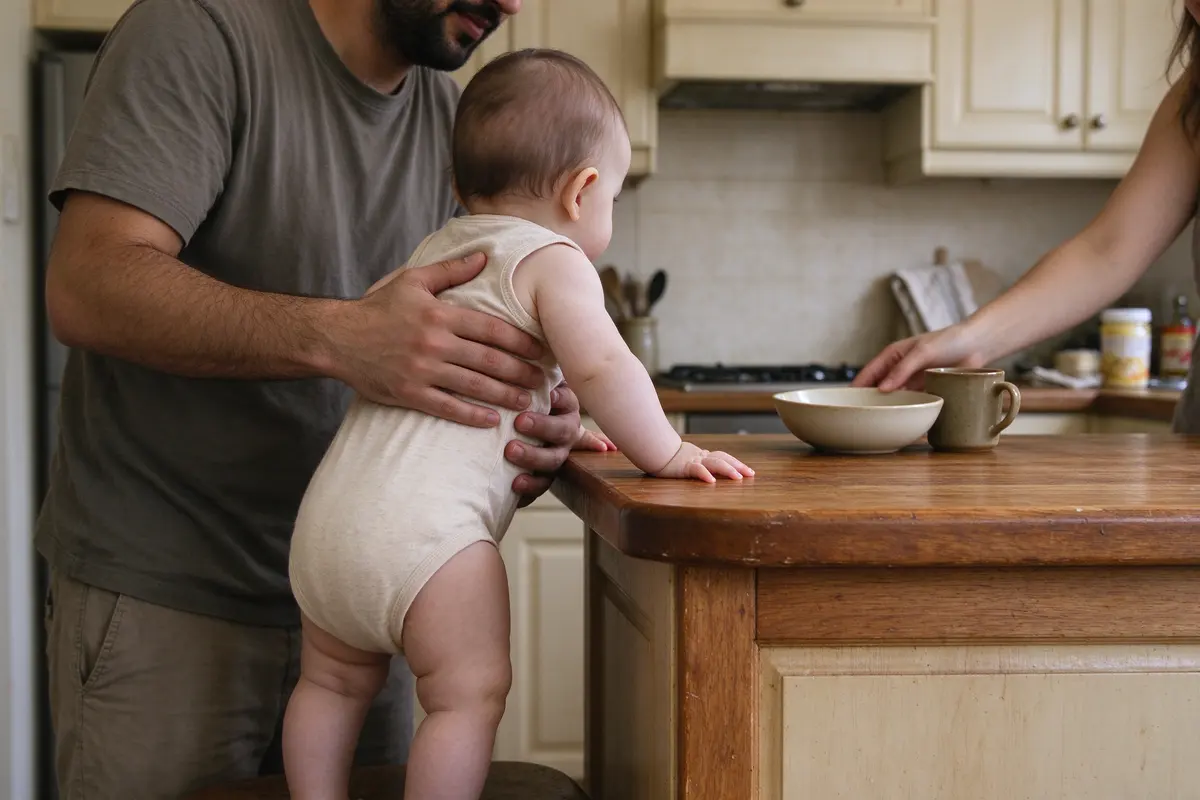
The table-edge clear
Time: 5 minutes, then a habit · Hot drinks and burns in the guide
Stand your baby at the table and then the counter, your hands on them, and watch where their fingers land. That line is the new edge.
Push every mug, bowl, and plate a hand's width past the line, and keep them there from now on (AAP; Seattle Children's).
Move the kettle and the coffee maker so their cords hang nowhere a hand can reach (AAP).
Say the guest rule once to everyone who'll be in the kitchen this week: far side, and never the baby and a hot drink together (AAP).
Make it work:A hand's width past a nine-month-old's reach isn't past a twelve-month-old's. Redraw the line each month.
Watch for
Normal
a hand slapped flat on the table the moment a plate lands, and a pull toward it; by 1 year most babies pull up and cruise (CDC).
Call your pediatrician now
for any head injury in a baby under 1 year, even if your baby seems fine (AAP).
Normal
a baby warm and pink after laps of a hot kitchen who reads normal on the thermometer; use a thermometer, because feeling the forehead isn't accurate (AAP).
Call your pediatrician right away
for a fever over 104°F (40°C), or shaking chills lasting more than 30 minutes (AAP).
Normal
a mouth on the cabinet front, the chair leg, and the cold tap on the way round.
Call 911
if your baby is choking and can't breathe, cry, or make noise, turns bluish, or goes limp (AAP).
For you
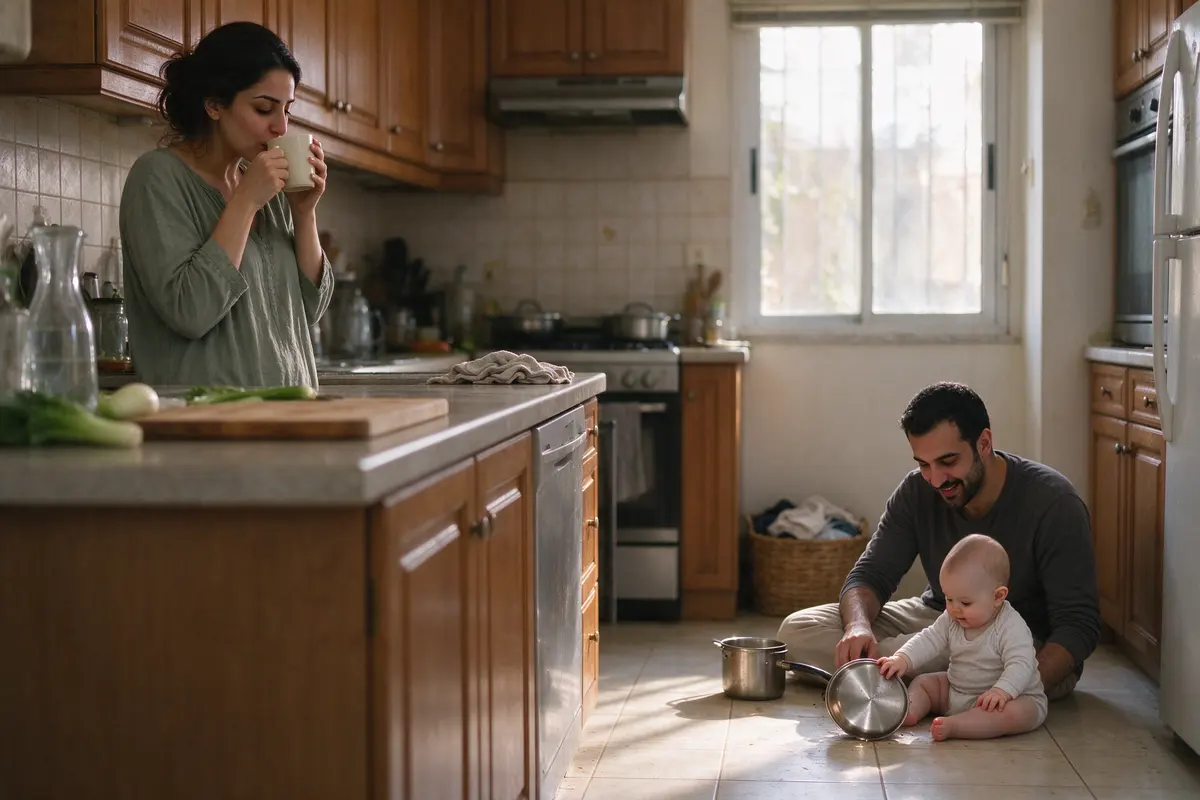
The far end of the counter is yours. The rule is never carry a hot drink while holding your baby (AAP); it isn't that the coffee has to go cold. Put the baby on the floor with the pot lid, stand at the far end, and drink it hot while they cruise the cabinets in your sight. And notice what the coffee is for. Tiredness that's overwhelming is on the CDC's list of urgent maternal warning signs, ten months out as much as ten days: if the mug isn't touching it, say so to a provider, and say you had a baby within the last year (CDC).
If you're the partner: the guests' mugs are your job. Say the far-side rule at the door before the first cup is poured, so she doesn't have to be the one who says it.
Sources
- American Academy of Pediatrics. "Infant Drowning Prevention & Water Safety: How to Protect Your Baby." HealthyChildren.org, updated 2026. https://www.healthychildren.org/English/safety-prevention/at-play/Pages/Infant-Water-Safety.aspx
- Centers for Disease Control and Prevention. "Milestones by 1 Year." Learn the Signs. Act Early. program, updated 2026. https://www.cdc.gov/act-early/milestones/1-year.html
- Seattle Children's Hospital. "Preventing Scald Burns." Accessed 2026. https://www.seattlechildrens.org/health-safety/injury-prevention/preventing-scald-burns/
- American Academy of Pediatrics. "Burn Treatment & Prevention Tips for Families." HealthyChildren.org, updated 2023. https://www.healthychildren.org/English/health-issues/injuries-emergencies/Pages/Treating-and-Preventing-Burns.aspx
- American Academy of Pediatrics. "Home Safety: Tips for Families With Young Children." HealthyChildren.org, updated 2022. https://www.healthychildren.org/English/safety-prevention/at-home/Pages/Home-Safety-Heres-How.aspx
- American Academy of Pediatrics. "Head Injury" (symptom checker). HealthyChildren.org, accessed 2026. https://www.healthychildren.org/English/tips-tools/symptom-checker/Pages/symptomviewer.aspx?symptom=Head+Injury
- American Academy of Pediatrics. "Fever and Your Baby." HealthyChildren.org, updated 2025. https://www.healthychildren.org/English/health-issues/conditions/fever/Pages/Fever-and-Your-Baby.aspx
- American Academy of Pediatrics. "Fever" (symptom checker). HealthyChildren.org, accessed 2026. https://www.healthychildren.org/English/tips-tools/symptom-checker/Pages/symptomviewer.aspx?symptom=Fever
- Bradin S. "Choking Prevention for Babies & Children: What Every Parent Needs to Know." HealthyChildren.org, updated 2026. https://www.healthychildren.org/English/health-issues/injuries-emergencies/Pages/Choking-Prevention.aspx
- Centers for Disease Control and Prevention. "Urgent Maternal Warning Signs and Symptoms." HEAR HER, 2024. https://www.cdc.gov/hearher/maternal-warning-signs/index.html
This guide is general education that summarizes published research and guidance from groups like the American Academy of Pediatrics, the CDC, and the WHO. It isn’t medical advice, and every child develops on their own timeline. Your pediatrician knows your child; if something feels wrong, call them. In an emergency, call 911.
Get each day’s note the morning it applies
Add your baby to a free Chorevia household with their date of birth, and every morning for 300 days the day’s note arrives in the app and by email: what’s developing, one thing to try, what to watch for, and a word for you.
Create your household