Day 287 of 300 · Week 39
Separation anxiety, in full
Last reviewed · 4 min read · 7 sources · Plain-text version
It peaks between 10 and 18 months and it's a sign of attachment. Never sneak away, keep the goodbye short and the same, come back when you said. The timed goodbye: two minutes by the clock.

The crying at the door isn't new, but this month it's louder, faster, and sometimes starts when you pick up your keys. Today is the full picture of separation anxiety, the AAP's short rules, and a goodbye with a clock on it.
Heart
Separation anxiety usually gets stronger around 9 months (Swanson, AAP), peaks between 10 and 18 months, and the AAP calls it a sign of attachment, not of spoiling (AAP). Your baby is 9 months old, which puts the peak a few weeks ahead, not behind. New fears of the dark, thunder, or the vacuum are common at the same time (AAP). The baby who knows you exist when you're gone, and has little sense of how long gone is, has every reason to object. Objecting is the attachment working.
Head
The AAP's rules are short. Never sneak away; say a quick, cheerful goodbye, even if your baby cries (CDC). Use the same short ritual every time, and come back when you said you would (Swanson, AAP). Separations are harder when babies are tired, hungry, or sick, and tears usually stop within minutes of your leaving (AAP). None of these tips has been tested in a trial; they're the AAP's best advice, and each one makes the leaving predictable, which is what a baby can learn the end of.
Body
The AAP suggests short practice separations at home and quick, consistent goodbye rituals (AAP; Swanson, AAP). Last month's practice goodbyes were a trip to the next room. Today's adds the one thing that makes a promise a promise: a clock. The same shape shows up at night, since separation anxiety can bring back night waking (AAP); the guide's section is Ease goodbyes and new faces.
Try today
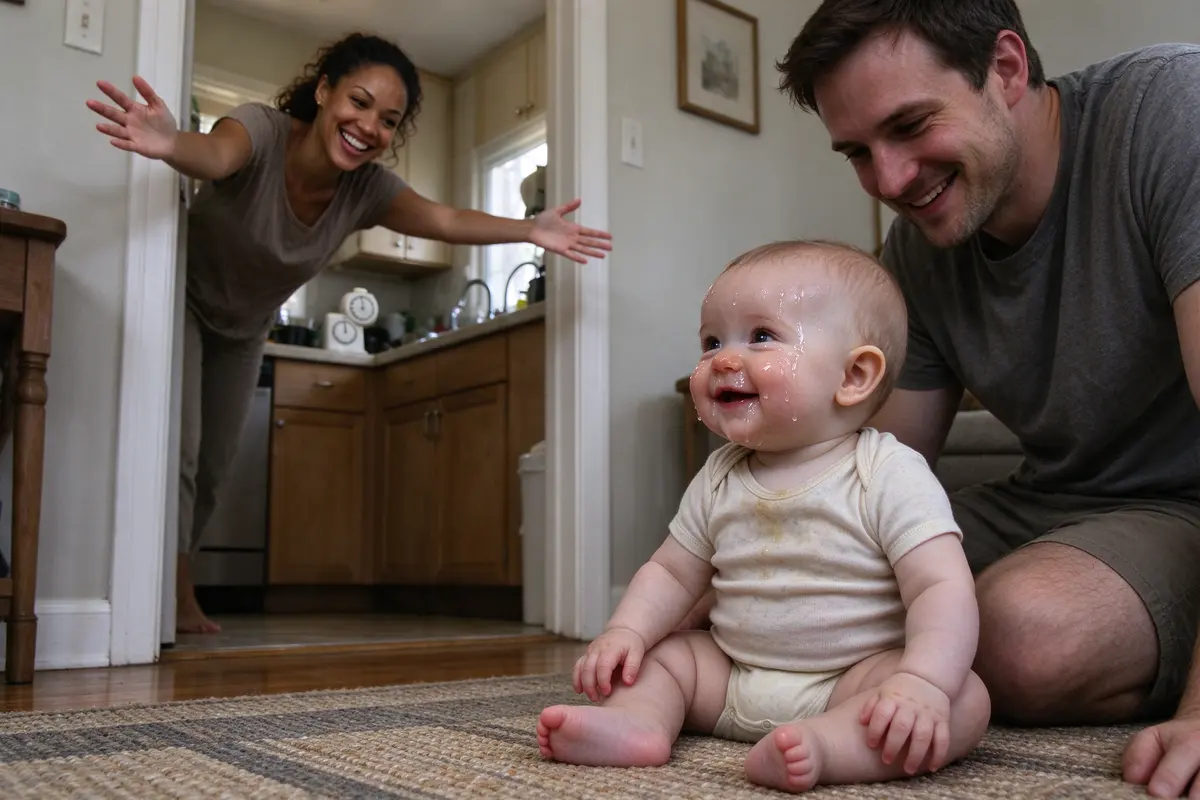
The timed goodbye
Time: 2 minutes by the clock, two or three times today · Practice goodbyes in the guide
Pick a rested, fed hour; separations are harder when a baby is tired, hungry, or sick (AAP).
Say the ritual, the same words every time: "Bye-bye! I'm going to the kitchen. Back in two minutes." Kiss, wave, go (Swanson, AAP).
Set a two-minute timer where you can see it. If the crying starts, call out once from where you are, and don't come back early (CDC).
When the timer rings, come back with a big hello, exactly as promised. Note how long the crying lasted.
Tomorrow, the same words and the same two minutes. The promise kept is the lesson, not the length.
Make it work:Another adult in the room with the baby, on the floor, with a toy, not at the window pointing at the door.
Watch for
Normal
crying that starts when you pick up your keys, before you've reached the door, and stops within minutes of your leaving (AAP).
Call your pediatrician right away
if your baby has cried nonstop for more than 2 hours, or you're afraid someone might hurt or shake them (AAP).
Normal
a new terror of the vacuum cleaner, the dark hallway, or a thunderstorm (AAP).
Mention it at the 12-month visit
if your baby's fear is very intense across the board; in 1,285 twins, fear that was high and steady from the start, or rose sharply, went with more inhibition at age 3 (Brooker et al., 2013).
Normal
a clingier week with a cold, since being sick makes goodbyes harder (AAP).
Go to the ER now
if your baby had a seizure with a fever, has a stiff neck, or has a bulging soft spot (AAP).
For you
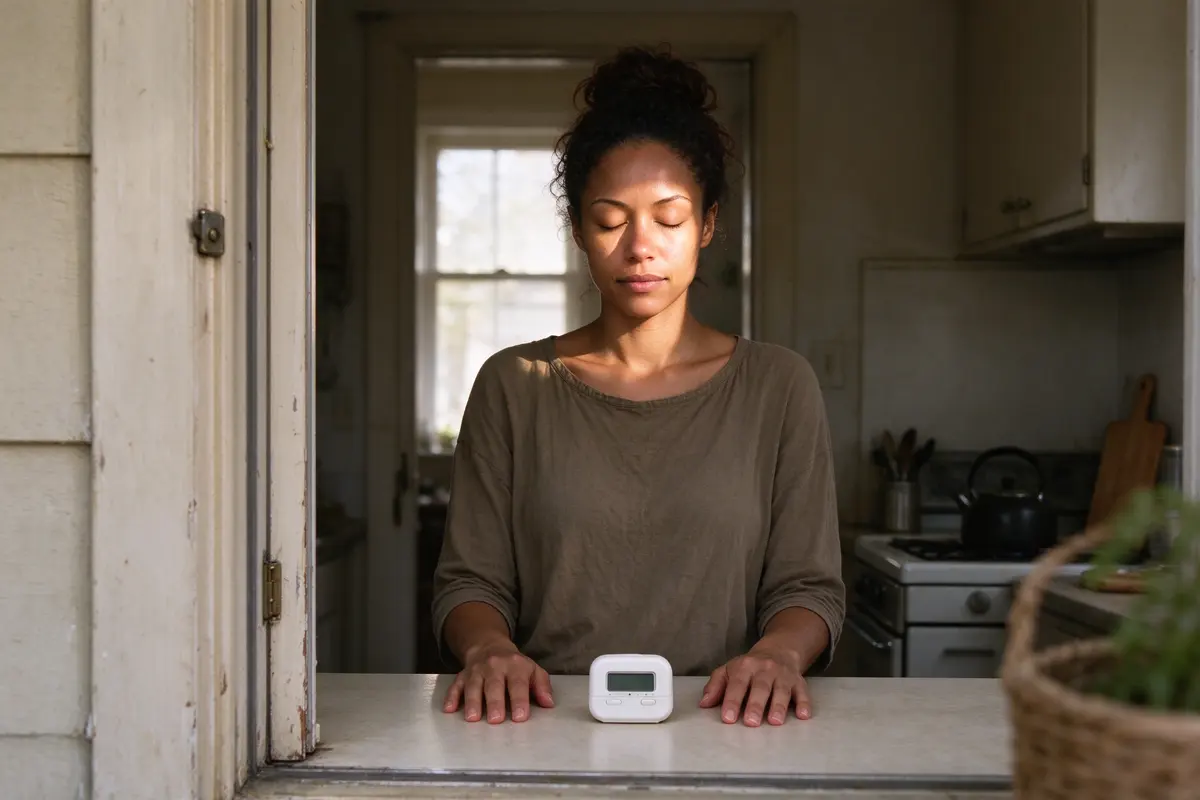
The tears stop faster than your guilt does. The AAP's line is that they usually stop within minutes of your leaving (AAP); yours can run the whole errand. That gap is the thing to notice. The crying is information about the baby's attachment, and it's over by the time you've found your shoes. The guilt is information about you, and it isn't a reason to sneak, to stall at the door, or to cancel the thing you left to do. Go when you said. Come back when you said. The coming back is what you're teaching, and you can't teach it without the going.
If you're the partner: you're on the floor for this one. Time the crying on your phone, and when she comes back through the door, tell her the number before she asks. It will be smaller than the number in her head.
Sources
- Swanson WS. "How to Ease Your Child's Separation Anxiety." HealthyChildren.org, updated 2026. https://www.healthychildren.org/English/ages-stages/toddler/Pages/Soothing-Your-Childs-Separation-Anxiety.aspx
- American Academy of Pediatrics. "Emotional and Social Development: 8 to 12 Months." HealthyChildren.org, updated 2009. https://www.healthychildren.org/English/ages-stages/baby/Pages/Emotional-and-Social-Development-8-12-Months.aspx
- Centers for Disease Control and Prevention. "Milestones by 9 Months." Learn the Signs. Act Early. program, updated 2026. https://www.cdc.gov/act-early/milestones/9-months.html
- American Academy of Pediatrics. "Separation Anxiety & Sleeping Trouble in Young Children." HealthyChildren.org, updated 2022. https://www.healthychildren.org/English/healthy-living/sleep/Pages/separation-anxiety-and-sleeping.aspx
- American Academy of Pediatrics. "Crying Child - 3 Months and Older" (symptom checker). HealthyChildren.org, accessed 2026. https://www.healthychildren.org/English/tips-tools/symptom-checker/Pages/symptomviewer.aspx?symptom=Crying+Child+-+3+Months+and+Older
- Brooker RJ, Buss KA, Lemery-Chalfant K, et al. "The development of stranger fear in infancy and toddlerhood: normative development, individual differences, antecedents, and outcomes." Developmental Science, 2013. https://pubmed.ncbi.nlm.nih.gov/24118713/
- American Academy of Pediatrics. "Fever" (symptom checker). HealthyChildren.org, accessed 2026. https://www.healthychildren.org/English/tips-tools/symptom-checker/Pages/symptomviewer.aspx?symptom=Fever
This guide is general education that summarizes published research and guidance from groups like the American Academy of Pediatrics, the CDC, and the WHO. It isn’t medical advice, and every child develops on their own timeline. Your pediatrician knows your child; if something feels wrong, call them. In an emergency, call 911.
Get each day’s note the morning it applies
Add your baby to a free Chorevia household with their date of birth, and every morning for 300 days the day’s note arrives in the app and by email: what’s developing, one thing to try, what to watch for, and a word for you.
Create your household