Day 316 of 365 · Week 43
Whole milk at twelve months
Last reviewed · 4 min read · 8 sources · Plain-text version
Around the first birthday most babies switch to whole cow's milk, not before; after, about 16 ounces a day and never more than 24. Breastfeeding goes on as long as you both want. The milk plan.

The birthday is about seven weeks off, and one of the things that changes on it is what's in the cup. Today is the switch to whole milk, written down as a plan so that nothing happens early and nothing gets forgotten.
Heart
Around 12 months, most babies can switch to whole cow's milk; before that, the AAP says babies shouldn't drink cow's milk or other milk substitutes (AAP). The reason is iron: cow's milk lacks enough iron and other nutrients babies need, and in some babies it irritates the gut and causes iron-deficiency anemia (AAP). So for seven more weeks the main drink stays breast milk or formula, plus 4 to 8 ounces of water (Muth, AAP), and the carton of whole milk is for the grown-ups' coffee.
Head
After the first birthday, keep milk to about 16 ounces (2 cups) a day or less; more than 24 ounces is linked to iron deficiency (AAP). Whole milk is recommended for most children from 12 to 24 months, though your pediatrician may suggest 2% for some (AAP; Muth, AAP). The 1-year guide adds two things worth knowing before you shop: toddler milks aren't recommended, and plant milks other than soy shouldn't replace dairy unless there's a medical or dietary reason (AAP).
Body
The 12-month visit is where the question gets asked, and it's also where your baby is checked for anemia and, depending on risk, lead (AAP), which is the same iron the milk rules are protecting. Bring the plan on paper. If you're breastfeeding, the switch may not be a switch at all: the AAP supports continuing as long as you both want, to 2 years or beyond (Muth, AAP). The guide's answer is When can my baby drink cow's milk?, and the toddler side of it is in the 1-year guide's Mealtimes without battles.
Try today
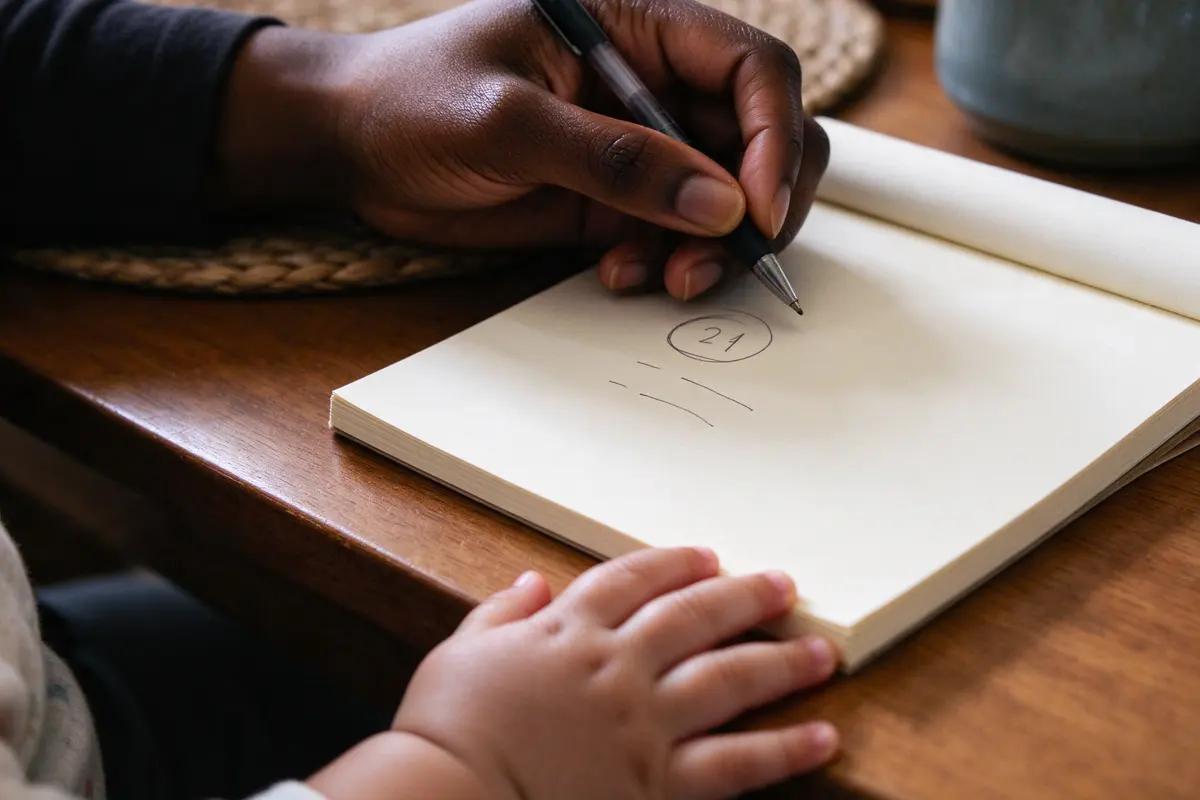
The milk plan
Time: 10 minutes with a pen
Write the birthday week's date at the top. Under it, line one: what the main drink is until then (breast milk, formula, or both), unchanged (Muth, AAP).
Line two: what happens that week. For formula, "whole milk in the meal cups, about 16 ounces a day, never more than 24" (AAP). For breastfeeding, "keep going," and whether any milk joins it.
Line three, the question for the 12-month visit: "Whole milk or 2% for this baby, and how much?" (AAP)
Pin it under the bottle map. Nothing on it happens before the visit.
Make it work:If anyone in the house has a milk allergy or you're planning a plant milk, that's a second question for the same visit, not a decision for today (AAP).
Watch for
Normal
the formula tin or the nursing sessions unchanged this month, because the switch is at 12 months, not before (AAP).
Check with your pediatrician first
before changing any feed if your baby isn't growing and gaining weight steadily (AAP).
Normal
yogurt on the tray and cheese in the fingers; plain yogurt and cheese are fine now, even though milk as a drink isn't (CDC).
Call your pediatrician right away
for signs of dehydration: no urine in more than 8 hours, dark urine, a very dry mouth, and no tears (AAP).
Normal
an appetite that levels off as the first birthday nears (AAP).
Go to the ER now
if your baby is hard to wake, isn't alert when awake, or seems confused (AAP).
For you

Your own feeding choice is yours, either way. If you've breastfed to ten months, the AAP's support runs to 2 years or beyond (Muth, AAP), and the birthday changes nothing unless you want it to. If you've used formula since the first week, the switch to whole milk is the same one every formula-fed baby makes, and the carton is cheaper. Nobody at the visit gets a vote beyond the two questions on the paper. While you're thinking about iron: overwhelming tiredness is on the CDC's list of urgent maternal warning signs for the full year after birth, so if "tired" has become something heavier, see your own provider and tell them when you gave birth (CDC).
If you're the partner: your job is the paper at the visit and the carton on the birthday, not the opinion. Buy whole unless the pediatrician said otherwise, and nothing labeled "toddler."
Sources
- American Academy of Pediatrics. "Why Do Infants Need Baby Formula Instead of Cow's Milk?" HealthyChildren.org, updated 2024. https://www.healthychildren.org/English/ages-stages/baby/formula-feeding/Pages/Why-Formula-Instead-of-Cows-Milk.aspx
- Muth ND. "Recommended Drinks for Children Age 5 & Younger." HealthyChildren.org, updated 2023. https://www.healthychildren.org/English/healthy-living/nutrition/Pages/Recommended-Drinks-for-Young-Children-Ages-0-5.aspx
- American Academy of Pediatrics Institute for Healthy Childhood Weight. "Healthy Beverage Quick Reference Guide." 2021. https://downloads.aap.org/AAP/PDF/HealthyBeverageQuickReferenceGuideDownload.pdf
- American Academy of Pediatrics. "Checkup Checklist: First Birthday (12 Months Old)." HealthyChildren.org, updated 2021. https://www.healthychildren.org/English/ages-stages/Your-Childs-Checkups/Pages/Your-Checkup-Checklist-12-Months-Old.aspx
- American Academy of Pediatrics. "Sleeping Through the Night." HealthyChildren.org, updated 2013. https://www.healthychildren.org/English/ages-stages/baby/sleep/Pages/Sleeping-Through-the-Night.aspx
- Centers for Disease Control and Prevention. "When, What, and How to Introduce Solid Foods." 2026. https://www.cdc.gov/infant-toddler-nutrition/foods-and-drinks/when-what-and-how-to-introduce-solid-foods.html
- American Academy of Pediatrics. "Fever" (symptom checker). HealthyChildren.org, accessed 2026. https://www.healthychildren.org/English/tips-tools/symptom-checker/Pages/symptomviewer.aspx?symptom=Fever
- Centers for Disease Control and Prevention. "Urgent Maternal Warning Signs and Symptoms." HEAR HER campaign, accessed 2026. https://www.cdc.gov/hearher/maternal-warning-signs/index.html
This guide is general education that summarizes published research and guidance from groups like the American Academy of Pediatrics, the CDC, and the WHO. It isn’t medical advice, and every child develops on their own timeline. Your pediatrician knows your child; if something feels wrong, call them. In an emergency, call 911.
Get each day’s note the morning it applies
Add your baby to a free Chorevia household with their date of birth, and every morning for 365 days the day’s note arrives in the app and by email: what’s developing, one thing to try, what to watch for, and a word for you.
Create your household