Day 327 of 365 · Week 44
Screens, the last month before one
Last reviewed · 4 min read · 11 sources · Plain-text version
The WHO recommends no screen time under 1; the AAP calls TV and apps a bad idea before 18 months, video chat excepted, and says background TV cuts your talk. The TV-off evening: count the turns.
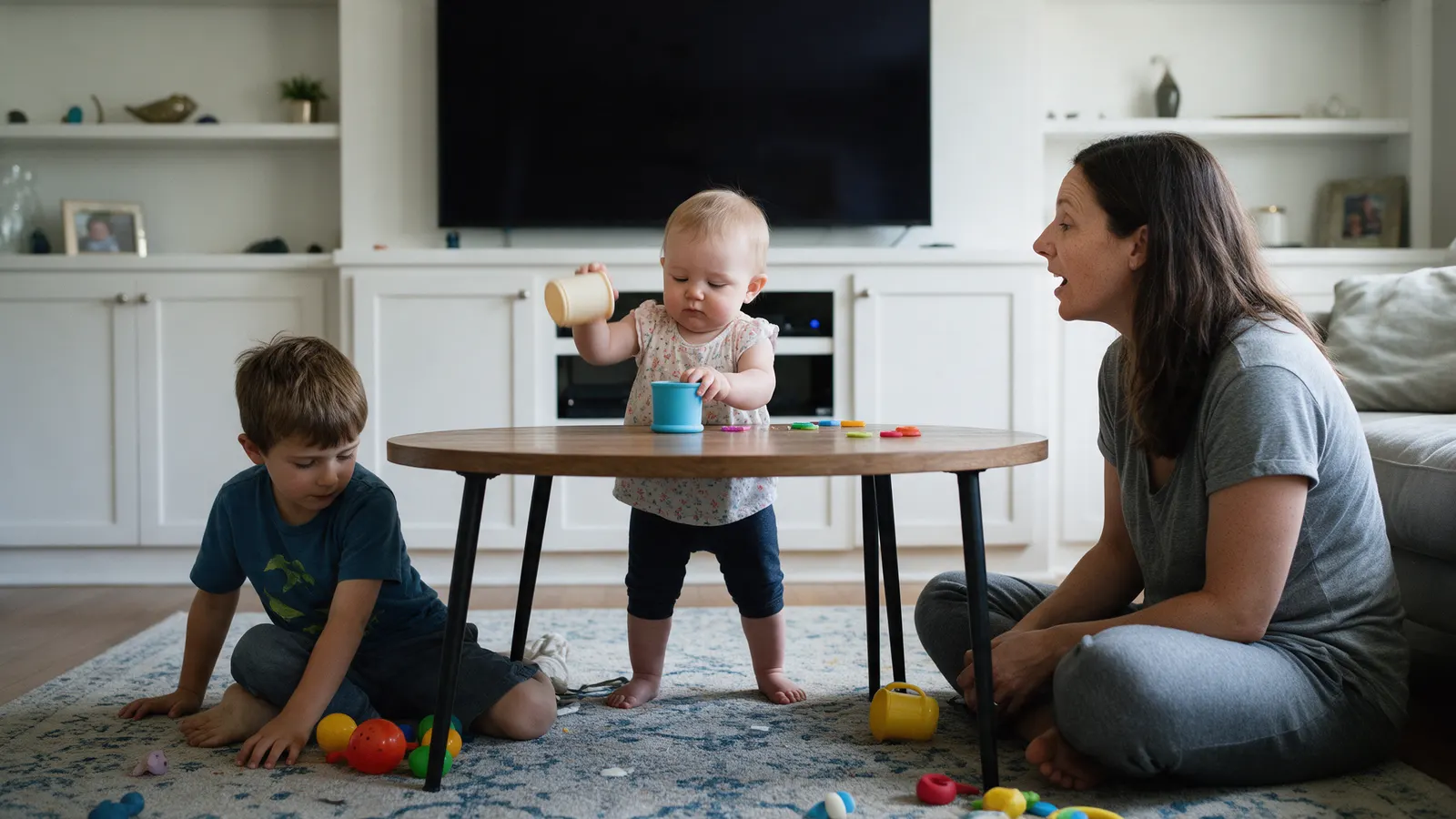
Evenings are when the TV goes on, and evenings are when the words happen: dinner, bath, the book, the last babble before bed. Today is the screen rule one last time before the birthday, and an evening with the TV off that counts what comes back.
Heart
The WHO doesn't recommend any screen time for babies under 1 (WHO). The AAP calls TV and apps a bad idea before 18 months, with video chats with faraway family as the exception, and warns that a TV on in the background cuts down how much parents talk (Hill, AAP). Babies this age learn best from real-world interactions (Munzer, AAP). The guide's section is Screens before age 1. None of it is about the baby staring at the screen; it's about the adults going quiet in front of it.
Head
The talk is the mechanism, and the evidence for that is the strongest this month has. In a lab experiment, 9.5-month-olds whose mothers answered their babble right away quickly reshaped it using sounds from their mothers' speech; babies answered at random times didn't (Goldstein & Schwade, 2008). In a randomized trial of 71 families, coaching parents at 6, 10, and 14 months increased parentese and back-and-forth turns (Ferjan Ramírez et al., 2020), and in a follow-up of 59 children, the coached group had larger vocabularies through 30 months (Huber et al., 2023). The trial and its follow-up are small and come from one lab group. A show can't answer on time; a parent facing the baby instead of the screen can.
Body
What you're listening for tonight: by 12 months, most babies call a parent "mama," "dada," or another special name (CDC), and to a baby, a "word" is any sound used the same way each time, so "mog" for milk counts (AAP). Having few or no other clear words at the first birthday is normal (CDC). The evening's shape stays the same: a short bedtime routine like a bath, then stories or songs, and down drowsy but awake (Nemours KidsHealth).
Try today
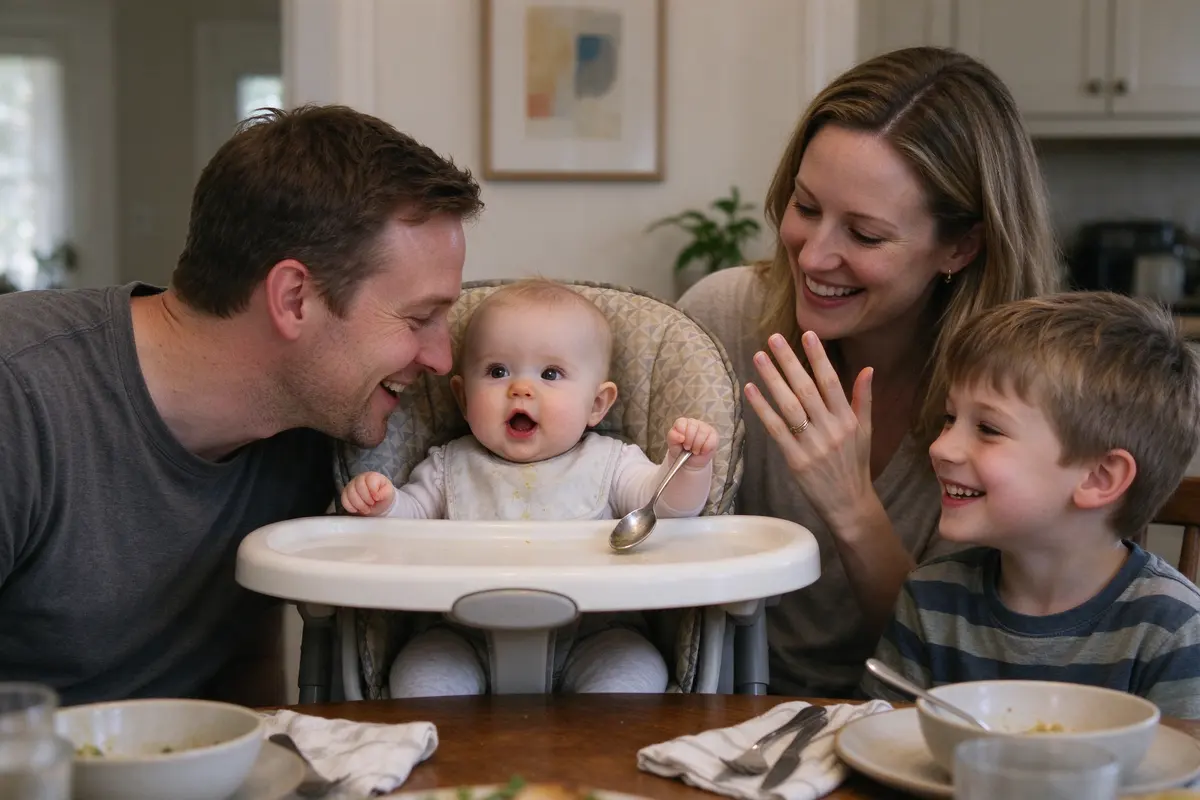
The TV-off evening
Time: Dinner to bedtime, one evening · Talk back with words in the guide
The TV stays off from dinner through bedtime, including as background, and the phones go face-down in another room (Hill, AAP).
At dinner, answer every babble right away and count the back-and-forth turns on your fingers; the goal is the count, not a number (Goldstein & Schwade, 2008).
Write down any sound your baby used the same way twice, and what it seemed to mean (AAP).
One board book before bed, pointing and naming, and let them turn the page (CDC).
Compare the count to a normal evening tomorrow, if you're curious; the difference is usually in your talk, not theirs (Hill, AAP).
Make it work:The video call with Grandma still counts as off-screen time for this purpose; it answers back.
Watch for
Normal
"dada" for the dog, the father, and the doorbell; a word is any sound used the same way each time, and the consistent target comes later (AAP).
Bring it up
if your baby doesn't look when you call their name (CDC).
Normal
a quieter dinner than you expected for the first ten minutes; the turns build once someone starts them (Goldstein & Schwade, 2008).
Ask about a developmental screening
if by 12 months your baby doesn't wave bye-bye, pull up to stand, or look for a toy they saw you hide (CDC).
Normal
9 to 12 hours at night plus two naps, with a waking or two from separation anxiety that a quiet reassurance settles (Nemours KidsHealth).
Call your pediatrician right away
if your baby cries nonstop, or looks or acts very sick (AAP).
For you
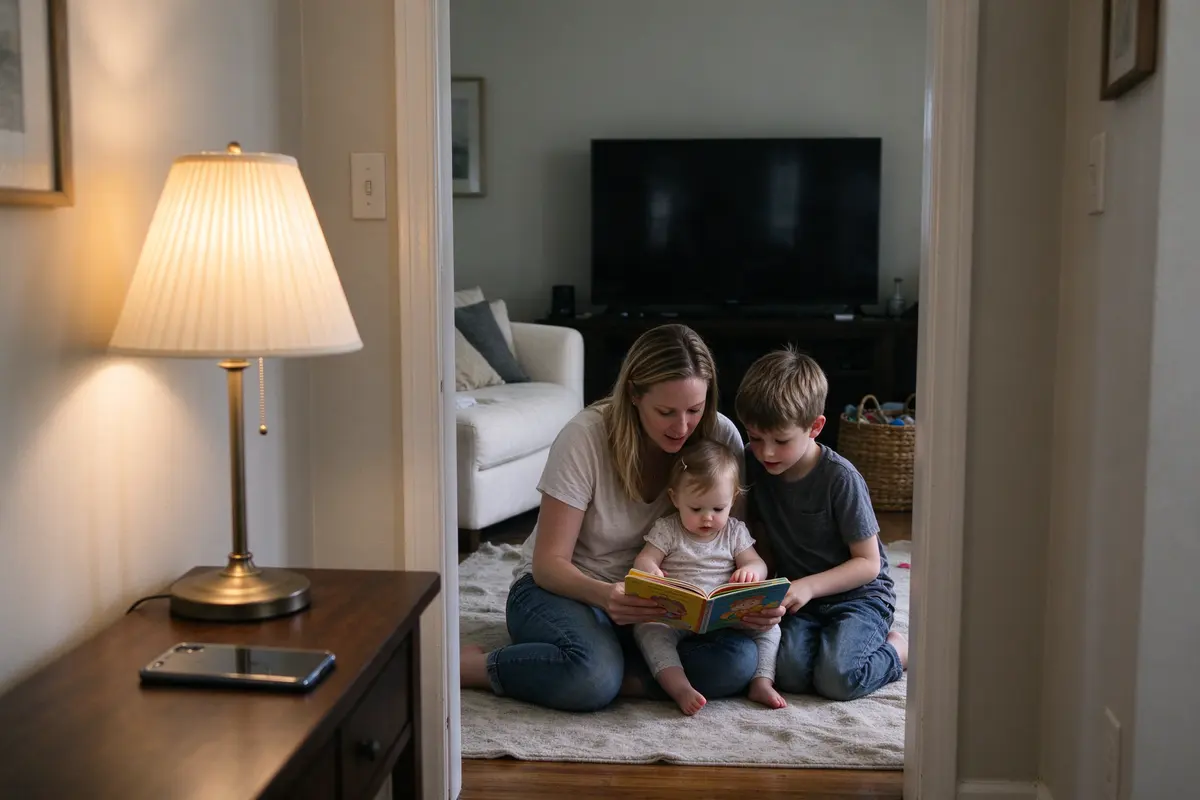
Your own screen, honestly. The AAP's advice for the adults is to put your own phone down at meals and bedtime (Munzer, AAP), and the honest part is that the phone is also where your friends, your mother, and the only adult conversation of some days live. The evening isn't a test of your willpower. It's one evening, with a count, so you can see what the room sounds like when nothing in it is talking except the people. After bedtime, the phone comes back, and the show you were going to watch is still there.
If you're the partner: you count at dinner, so she's free to answer. Then tell her the number, and the thing the baby said that you both decided was a word.
Sources
- World Health Organization. "To grow up healthy, children need to sit less and play more." 2019. https://www.who.int/news/item/24-04-2019-to-grow-up-healthy-children-need-to-sit-less-and-play-more
- Hill DL. "Why to Avoid TV for Infants & Toddlers." HealthyChildren.org, updated 2016. https://www.healthychildren.org/English/family-life/Media/Pages/Why-to-Avoid-TV-Before-Age-2.aspx
- Munzer T. "Helping Kids Thrive in a Digital World: AAP Policy Explained." HealthyChildren.org, updated 2026. https://www.healthychildren.org/English/family-life/Media/Pages/helping-kids-thrive-in-a-digital-world-AAP-policy-explained.aspx
- Goldstein MH, Schwade JA. "Social feedback to infants' babbling facilitates rapid phonological learning." Psychological Science, 2008. https://pubmed.ncbi.nlm.nih.gov/18466414/
- Ferjan Ramírez N, Lytle SR, Kuhl PK. "Parent coaching increases conversational turns and advances infant language development." Proceedings of the National Academy of Sciences, 2020. https://pubmed.ncbi.nlm.nih.gov/32015127/
- Huber E, Ferjan Ramírez N, Corrigan NM, Kuhl PK. "Parent coaching from 6 to 18 months improves child language outcomes through 30 months of age." Developmental Science, 2023. https://pubmed.ncbi.nlm.nih.gov/36999222/
- Centers for Disease Control and Prevention. "Milestones by 1 Year." Learn the Signs. Act Early. program, updated 2026. https://www.cdc.gov/act-early/milestones/1-year.html
- American Academy of Pediatrics. "Language Development: 8 to 12 Months." HealthyChildren.org, updated 2009. https://www.healthychildren.org/English/ages-stages/baby/Pages/Language-Development-8-to-12-Months.aspx
- Nemours KidsHealth. "Baby Sleep: 8- to 12-Month-Olds." Reviewed 2025. https://kidshealth.org/en/parents/sleep812m.html
- Centers for Disease Control and Prevention. "Milestones by 9 Months." Learn the Signs. Act Early. program, updated 2026. https://www.cdc.gov/act-early/milestones/9-months.html
- American Academy of Pediatrics. "Fever" (symptom checker). HealthyChildren.org, accessed 2026. https://www.healthychildren.org/English/tips-tools/symptom-checker/Pages/symptomviewer.aspx?symptom=Fever
This guide is general education that summarizes published research and guidance from groups like the American Academy of Pediatrics, the CDC, and the WHO. It isn’t medical advice, and every child develops on their own timeline. Your pediatrician knows your child; if something feels wrong, call them. In an emergency, call 911.
Get each day’s note the morning it applies
Add your baby to a free Chorevia household with their date of birth, and every morning for 365 days the day’s note arrives in the app and by email: what’s developing, one thing to try, what to watch for, and a word for you.
Create your household