Day 304 of 365 · Week 41
Things have uses
Last reviewed · 4 min read · 10 sources · Plain-text version
Hand over a cup, a spoon, a hairbrush, and be the audience when your baby copies you. Using things the right way is a 15-month skill; this is its first draft. The brush and the cup.
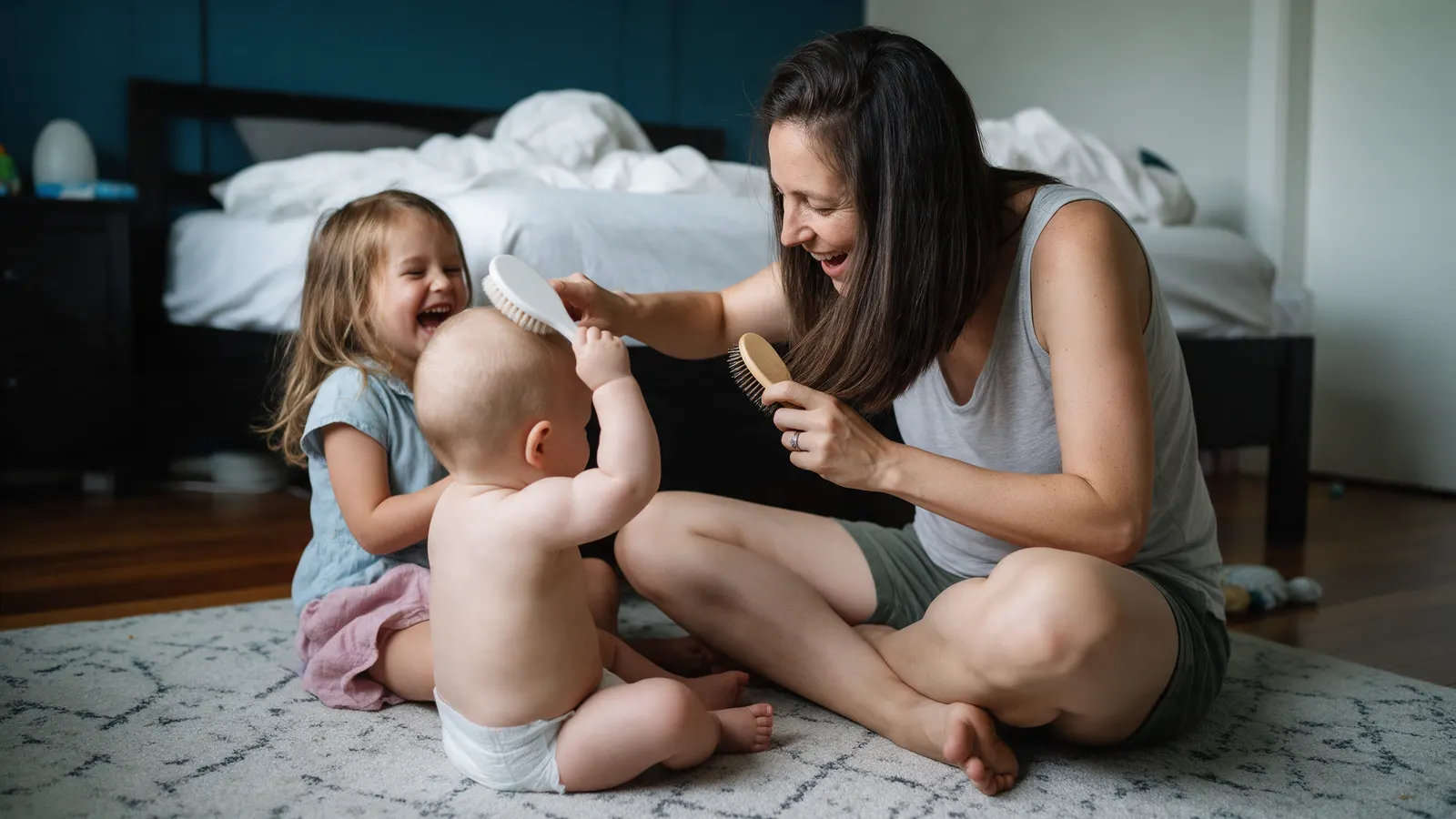
A spoon used to be a thing to bang. This month it starts to be a thing that goes to the mouth, and the hairbrush goes, roughly, to the head. Today is the baby discovering that objects have jobs, and you being the audience.
Heart
The AAP's suggestion for this stage: hand over a cup, a spoon, or a hairbrush and be an enthusiastic audience when your baby copies you (AAP). One of those uses is already on the 12-month list: by 1 year, most babies drink from a cup without a lid as you hold it (CDC). And toward the end of the first year, babies copy the gestures they see you use (AAP). Your baby is 10 months old. The copy will be wrong in every detail, the brush backwards and the cup tipped onto the tray, and it's the copying that's the point.
Head
Where it goes next. Trying to use things the right way, like a phone, a cup, or a book, is a 15-month milestone (CDC), and simple pretend play, like feeding a stuffed animal with a spoon, is something CDC suggests trying by 18 months (CDC). So the brush to the head at 10 months is the first draft of a skill with months of runway. One honest note: a major review found little proof that pretend play itself causes gains in language, thinking, or social skills (Lillard et al., 2013). Do it because it's funny and because it's what your baby is reaching for, not because it's a program. Next year's version is Feed the teddy.
Body
At this age ordinary household objects are the most fascinating toys (AAP), so the props are already in the house. Everything still goes in the mouth, so check the floor often (AAP), and keep the small parts out of it: coins, toy parts, and pen caps are the AAP's examples of what to clear (AAP). A soft baby brush, a spoon, and an open cup are the whole kit.
Try today
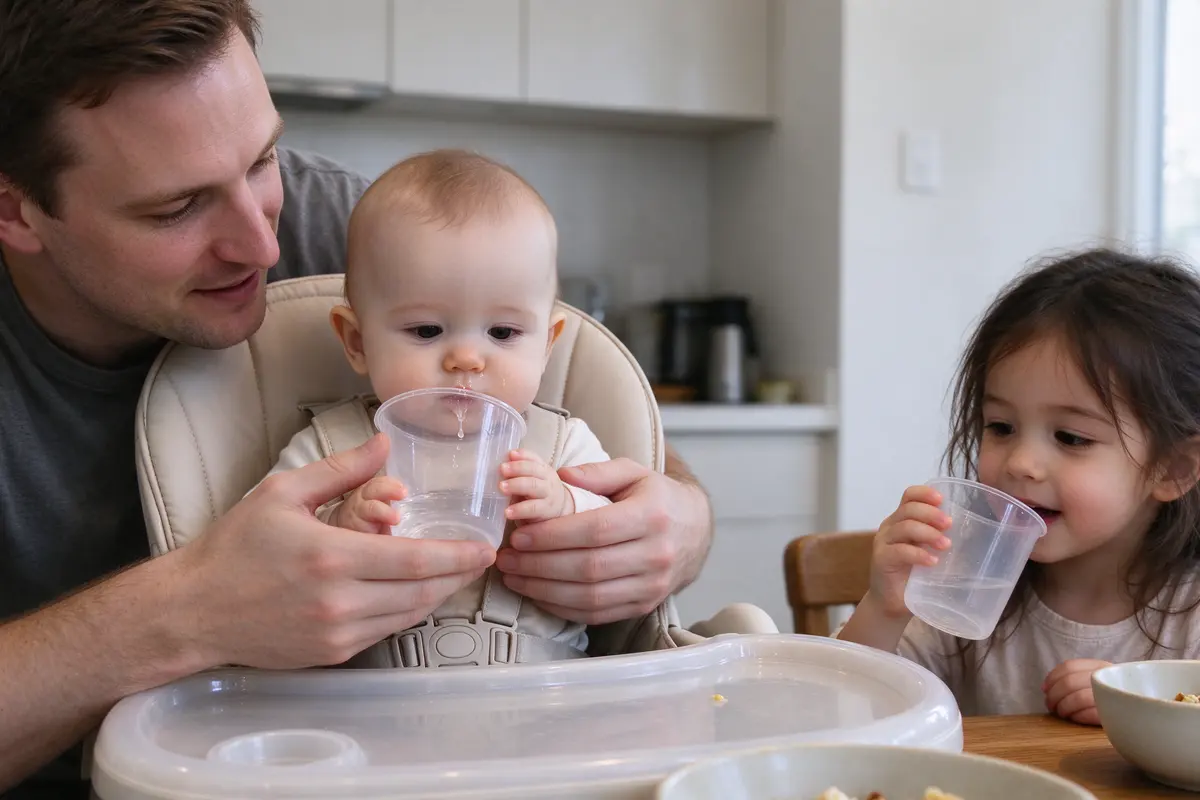
The brush and the cup
Time: 5 minutes, twice today · What to teach in the guide
Sit facing your baby with a soft baby hairbrush. Brush your own hair slowly, three strokes, saying "brush." Then hand it over and wait (AAP).
Whatever they do with it, to the head, the ear, or the dog, be the audience: a big face, "You're brushing!" Then take a turn and hand it back.
At a meal, hold an open cup with a sip of water to their lips, and let their hands come onto yours. Drinking from a cup you hold is the 12-month version of this (CDC).
Hand over the spoon at the end of the meal and let it go wherever it goes. Name each thing once, the same word every time (AAP).
Make it work:Bristles go in the mouth; that's fine with a soft baby brush and not with a stiff adult one. Nothing with loose or small parts.
Watch for
Normal
the brush chewed, the cup tipped, the spoon thrown; letting go on purpose makes dropping and throwing favorite games (AAP).
Call 911
if your baby is choking and can't breathe, cry, or make noise, turns bluish, or goes limp (AAP), and start back blows and chest thrusts while someone calls.
Normal
a cup held with the left hand one meal and the right the next.
Talk with your pediatrician
if your baby uses one arm or leg much more than the other (AAP).
Normal
a warm day of fussing with a new tooth and no interest in the game.
Call your pediatrician right away
if your baby has a fever over 104°F (40°C), or shaking chills lasting more than 30 minutes (AAP).
For you
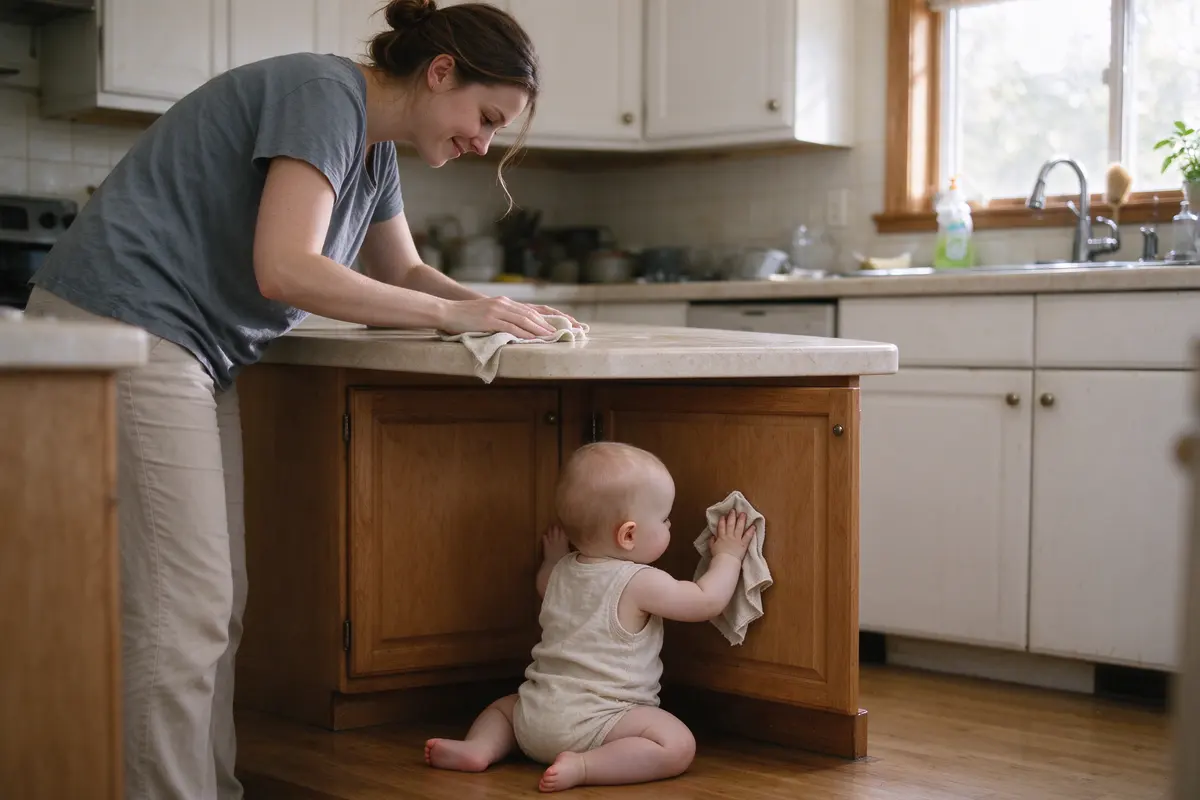
Being copied is the curriculum. The AAP's advice is to be the audience when your baby copies you (AAP), which means the lesson is whatever you do with your hands in front of them: the cloth on the counter, the brush, the cup, the phone. There's no extra time in this. You were going to wipe the counter anyway; do it slowly, name it, and hand over a dry cloth. The baby who rubs the cabinet door with a washcloth is learning that things have uses, and that one of the things is you, doing them.
If you're the partner: pick one thing you do every evening, the dishes or your shoes, and do it at the baby's eye level with a running commentary. Then hand over a spoon or a shoe and watch what comes back.
Sources
- American Academy of Pediatrics. "Cognitive Development in Infants: 8 to 12 Months." HealthyChildren.org, updated 2023. https://www.healthychildren.org/English/ages-stages/baby/Pages/Cognitive-Development-8-to-12-Months.aspx
- Centers for Disease Control and Prevention. "Milestones by 1 Year." Learn the Signs. Act Early. program, updated 2026. https://www.cdc.gov/act-early/milestones/1-year.html
- American Academy of Pediatrics. "Language Development: 8 to 12 Months." HealthyChildren.org, updated 2009. https://www.healthychildren.org/English/ages-stages/baby/Pages/Language-Development-8-to-12-Months.aspx
- Centers for Disease Control and Prevention. "Milestones by 15 Months." Learn the Signs. Act Early. program, accessed 2026. https://www.cdc.gov/act-early/milestones/15-months.html
- Centers for Disease Control and Prevention. "Milestones by 18 Months." Learn the Signs. Act Early. program, updated 2026. https://www.cdc.gov/act-early/milestones/18-months.html
- Lillard AS, Lerner MD, Hopkins EJ, et al. "The impact of pretend play on children's development: a review of the evidence." Psychological Bulletin, 2013. https://pubmed.ncbi.nlm.nih.gov/22905949/
- Bradin S. "Choking Prevention for Babies & Children: What Every Parent Needs to Know." HealthyChildren.org, updated 2026. https://www.healthychildren.org/English/health-issues/injuries-emergencies/Pages/Choking-Prevention.aspx
- American Academy of Pediatrics. "Hand and Finger Skills." HealthyChildren.org, updated 2009. https://www.healthychildren.org/English/ages-stages/baby/Pages/Hand-and-Finger-Skills.aspx
- American Academy of Pediatrics. "Movement Milestones in Babies 8 to 12 Months Old." HealthyChildren.org, updated 2021. https://www.healthychildren.org/English/ages-stages/baby/Pages/Movement-8-to-12-Months.aspx
- American Academy of Pediatrics. "Fever" (symptom checker). HealthyChildren.org, accessed 2026. https://www.healthychildren.org/English/tips-tools/symptom-checker/Pages/symptomviewer.aspx?symptom=Fever
This guide is general education that summarizes published research and guidance from groups like the American Academy of Pediatrics, the CDC, and the WHO. It isn’t medical advice, and every child develops on their own timeline. Your pediatrician knows your child; if something feels wrong, call them. In an emergency, call 911.
Get each day’s note the morning it applies
Add your baby to a free Chorevia household with their date of birth, and every morning for 365 days the day’s note arrives in the app and by email: what’s developing, one thing to try, what to watch for, and a word for you.
Create your household