Day 325 of 365 · Week 44
Sun and outside, month eleven
Last reviewed · 4 min read · 11 sources · Plain-text version
Sunscreen on uncovered skin from 6 months, SPF 15 or higher, mineral, every 90 minutes to 2 hours, shade first. Outside at floor level is where cruising goes next. The outside hour.
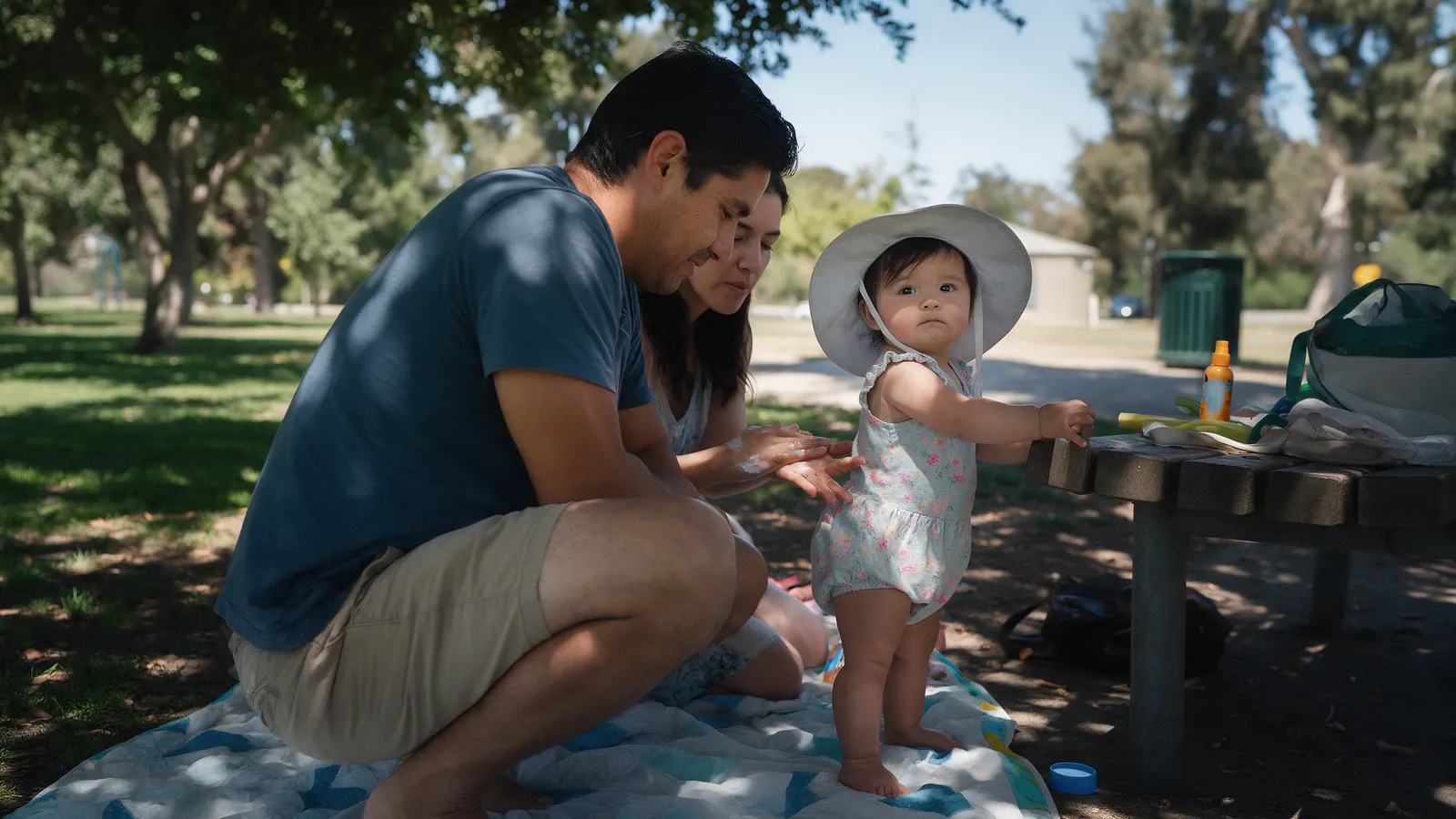
A baby who cruises indoors can cruise a park bench. Today is the sun rules that have held since six months, why outside is where this month's standing and pointing want to go, and an hour out there that costs nothing.
Heart
From 6 months, sunscreen is fine on uncovered skin like the face and hands. Choose broad-spectrum SPF 15 or higher, ideally a mineral formula (zinc oxide or titanium dioxide), and reapply every 90 minutes to 2 hours. Shade still comes first (AAP). Nothing about that changed with standing, except how much of the baby is out of the stroller and in the light. The guide that holds the rule is the 6-month guide; this month's version is the same bottle, applied to a baby who won't hold still for it.
Head
Why outside, and why now. The WHO advises plenty of floor play and not keeping babies strapped into a stroller, high chair, or carrier for more than 1 hour at a time (WHO), and a walk that's all stroller is an hour strapped in. Grass, a blanket, a bench, and a parent's hands turn the walk into practice: pulling up and cruising along furniture are 12-month milestones (CDC), and a bench is furniture. Bare feet are fine; your baby doesn't need shoes until they start walking outside (AAP).
Body
The words come outside too. In 24 babies followed monthly from 9 to 15 months, mothers' talk about what the baby was already looking at predicted the earliest gestures and words (Carpenter et al., 1998), and a park is full of things to look at that the living room ran out of weeks ago: dog, bird, leaf, truck. When your baby points or stares, name it (CDC). The 1-year guide turns this into a daily habit, the outdoor explore walk, for a toddler who walks part of the way; today's baby does it from a blanket and a bench.
Try today
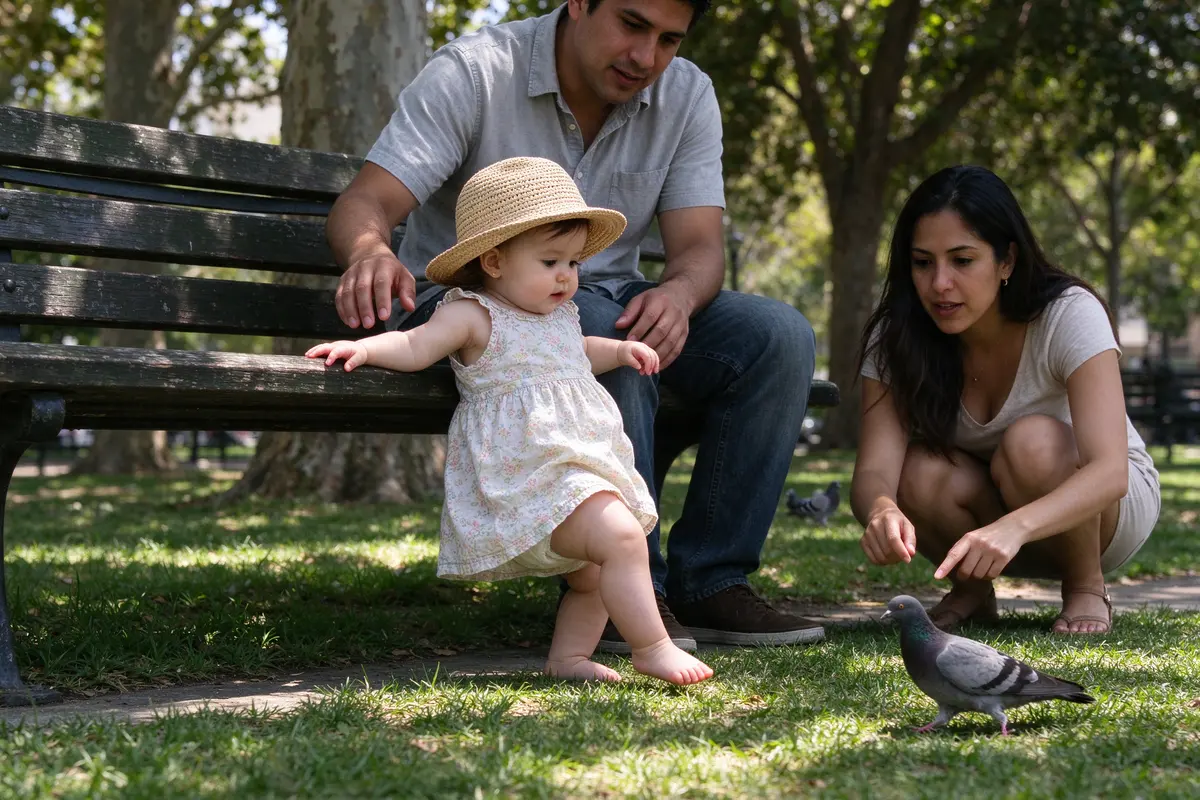
The outside hour
Time: About an hour, in the shade · Outdoor explore walk in the guide
Pick shade and a time outside the hottest part of the day. Hat on, sunscreen on the uncovered skin that's left, SPF 15 or higher (AAP).
Out of the stroller and onto a blanket on the grass, socks off, for the first stretch: sitting, crawling, touching the grass (WHO).
Stand them at a low bench or a tree-trunk-height wall, your hands at their ribs, and let them cruise it toward a toy (CDC).
Name what they look at, every time, and wait a beat for their turn (CDC).
If you're out past 90 minutes, reapply before you think you need to (AAP).
Make it work:Check the grass under the blanket the way you check the floor at home: a bottle cap or a cigarette end is a choking hazard outside too (AAP).
Watch for
Normal
a fistful of grass heading for the mouth, caught halfway; everything still goes in the mouth, so check the ground often (AAP).
Call 911
if your baby is choking and can't breathe, cry, or make noise, turns bluish, or goes limp, and start back blows and chest thrusts while someone calls (AAP).
Normal
a sideways cruise along the bench that ends in a sit-down on the grass and a laugh.
Call your pediatrician now
for any head injury in a baby under 1 year, even on soft ground, even if your baby seems fine (AAP).
Normal
a warm, pink, sweaty baby who drinks a few sips of water from the cup you hold and cools down in the shade; 4 to 8 ounces of water a day is the AAP's figure at this age (Muth, AAP).
Call your pediatrician right away
for a fever over 104°F (40°C), or if your baby looks or acts very sick (AAP).
For you

The outside hour is yours too. Not a walk you push through while the baby naps, but an hour on a blanket in the shade where the baby does the work and you lie down. Overwhelming tiredness is on the CDC's list of maternal warning signs that still runs for a full year after birth (CDC); ordinary tiredness isn't, and the difference is partly whether you ever stop. Your own hat, your own sunscreen, your own water bottle beside the baby's cup. If you fall asleep on the blanket with the other adult awake and the baby cruising the bench, that was the point.
If you're the partner: you're the hands at the bench this hour, and the one who notices when 90 minutes is up. She lies down. Don't narrate that she's lying down.
Sources
- American Academy of Pediatrics. "Baby Sunburn Prevention Tips." HealthyChildren.org, updated 2026. https://www.healthychildren.org/English/ages-stages/baby/bathing-skin-care/Pages/Baby-Sunburn-Prevention.aspx
- World Health Organization. "To grow up healthy, children need to sit less and play more." 2019. https://www.who.int/news/item/24-04-2019-to-grow-up-healthy-children-need-to-sit-less-and-play-more
- Centers for Disease Control and Prevention. "Milestones by 1 Year." Learn the Signs. Act Early. program, updated 2026. https://www.cdc.gov/act-early/milestones/1-year.html
- American Academy of Pediatrics. "Movement Milestones in Babies 8 to 12 Months Old." HealthyChildren.org, updated 2021. https://www.healthychildren.org/English/ages-stages/baby/Pages/Movement-8-to-12-Months.aspx
- Carpenter M, Nagell K, Tomasello M. "Social cognition, joint attention, and communicative competence from 9 to 15 months of age." Monographs of the Society for Research in Child Development, 1998. https://pubmed.ncbi.nlm.nih.gov/9835078/
- Bradin S. "Choking Prevention for Babies & Children: What Every Parent Needs to Know." HealthyChildren.org, updated 2026. https://www.healthychildren.org/English/health-issues/injuries-emergencies/Pages/Choking-Prevention.aspx
- American Academy of Pediatrics. "Cognitive Development in Infants: 8 to 12 Months." HealthyChildren.org, updated 2023. https://www.healthychildren.org/English/ages-stages/baby/Pages/Cognitive-Development-8-to-12-Months.aspx
- American Academy of Pediatrics. "Head Injury" (symptom checker). HealthyChildren.org, accessed 2026. https://www.healthychildren.org/English/tips-tools/symptom-checker/Pages/symptomviewer.aspx?symptom=Head+Injury
- Muth ND. "Recommended Drinks for Children Age 5 & Younger." HealthyChildren.org, updated 2023. https://www.healthychildren.org/English/healthy-living/nutrition/Pages/Recommended-Drinks-for-Young-Children-Ages-0-5.aspx
- American Academy of Pediatrics. "Fever" (symptom checker). HealthyChildren.org, accessed 2026. https://www.healthychildren.org/English/tips-tools/symptom-checker/Pages/symptomviewer.aspx?symptom=Fever
- Centers for Disease Control and Prevention. "Urgent Maternal Warning Signs and Symptoms." HEAR HER, 2024. https://www.cdc.gov/hearher/maternal-warning-signs/index.html
This guide is general education that summarizes published research and guidance from groups like the American Academy of Pediatrics, the CDC, and the WHO. It isn’t medical advice, and every child develops on their own timeline. Your pediatrician knows your child; if something feels wrong, call them. In an emergency, call 911.
Get each day’s note the morning it applies
Add your baby to a free Chorevia household with their date of birth, and every morning for 365 days the day’s note arrives in the app and by email: what’s developing, one thing to try, what to watch for, and a word for you.
Create your household