Day 320 of 365 · Week 43
Separation, still peaking
Last reviewed · 4 min read · 11 sources · Plain-text version
Ten months old is inside the 10-to-18-month peak. The ritual is the whole method: the same words, back when you said, extra time at drop-off. The goodbye, same words, from every adult who leaves.

Three weeks ago the goodbye got a clock. Today it gets a script, the same one from every adult who leaves, because the peak is here and the ritual is the one thing in it you control.
Heart
Separation anxiety usually gets stronger around 9 months (Swanson, AAP) and peaks between 10 and 18 months, and the AAP calls it a sign of attachment, not of spoiling (AAP). Ten months old is the front edge of that peak. Your baby knows you exist when you're gone and has little sense of how long gone is, so the crying at the door is a fair response to the only information they have. You add the rest: leaving has a shape, and it ends with you back.
Head
The method hasn't changed. Never sneak away; say a quick, cheerful goodbye, even if your baby cries (CDC). Use the same short ritual every time, and come back when you said you would (Swanson, AAP). Separations are harder when babies are tired, hungry, or sick, and tears usually stop within minutes of your leaving (AAP). If child care is part of the week, the AAP's advice is to ease in slowly and take a little extra time at drop-off (AAP). None of it has been tested in a trial; every piece makes the leaving predictable.
Body
What's different from the timed goodbye is who says it. A ritual that only works in your voice isn't a ritual yet; it's you. The guide's activity, Practice goodbyes, has you call out instead of rushing back, then come back with a big hello (AAP). Today's version writes the words down so the partner, the grandparent, and the sitter all leave the same way. The guide's section is Ease goodbyes and new faces.
Try today
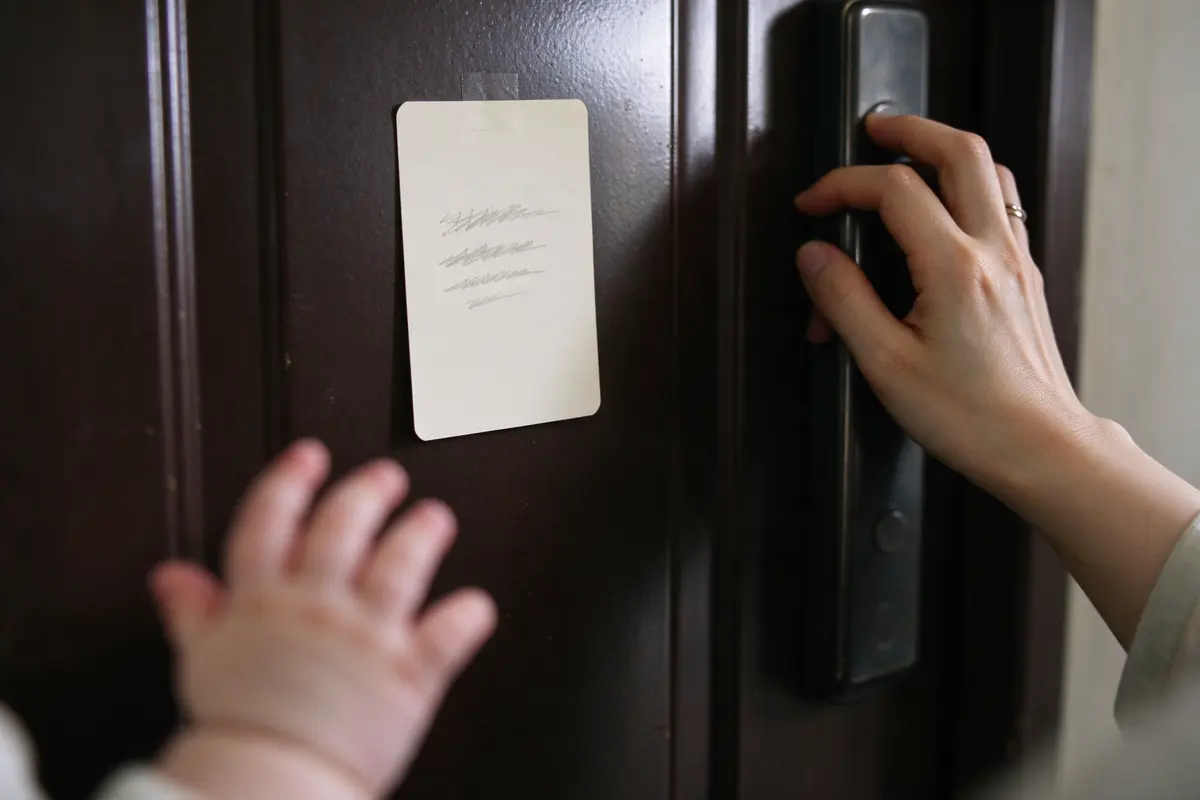
The goodbye, same words
Time: 5 minutes to write it, then every leaving · Practice goodbyes in the guide
Write the ritual on an index card in three lines: the words ("Bye-bye! I'm going to work. Back after your nap."), the gesture (kiss, wave), and the rule (then go) (Swanson, AAP).
Tape it inside the front door at adult eye level, and give a copy to every caregiver.
Every adult who leaves the room or the house today uses the card, word for word, even for the trip to the mailbox (CDC).
Whoever stays gets on the floor with a toy, not at the window.
Come back when you said, with a big hello. Note on the card's back how long the crying lasted; the AAP's line is minutes (AAP).
Make it work:Pick words a grandparent will actually say. "I'll be back" beats anything cute.
Watch for
Normal
a baby who protests the goodbye at home and waves you off at Grandma's; separations are harder when babies are tired, hungry, or sick (AAP).
Call within 24 hours
if a fever comes back after a day without one (AAP).
Normal
night waking that came back the same week as the daytime tears (AAP).
Go to the ER now
if your baby is hard to wake, isn't alert when awake, or seems confused (AAP).
Normal
a wave at the door that's aimed at the dog, or no wave at all; waving bye-bye has until 12 months (CDC).
Bring it up
if by 12 months your baby doesn't wave bye-bye (CDC).
Normal
knowing, from the stairwell, which cry means the toy worked.
Call anyway
if your baby just doesn't seem right to you. Trust your instincts; three hundred and twenty days have built them (Lurie Children's).
For you
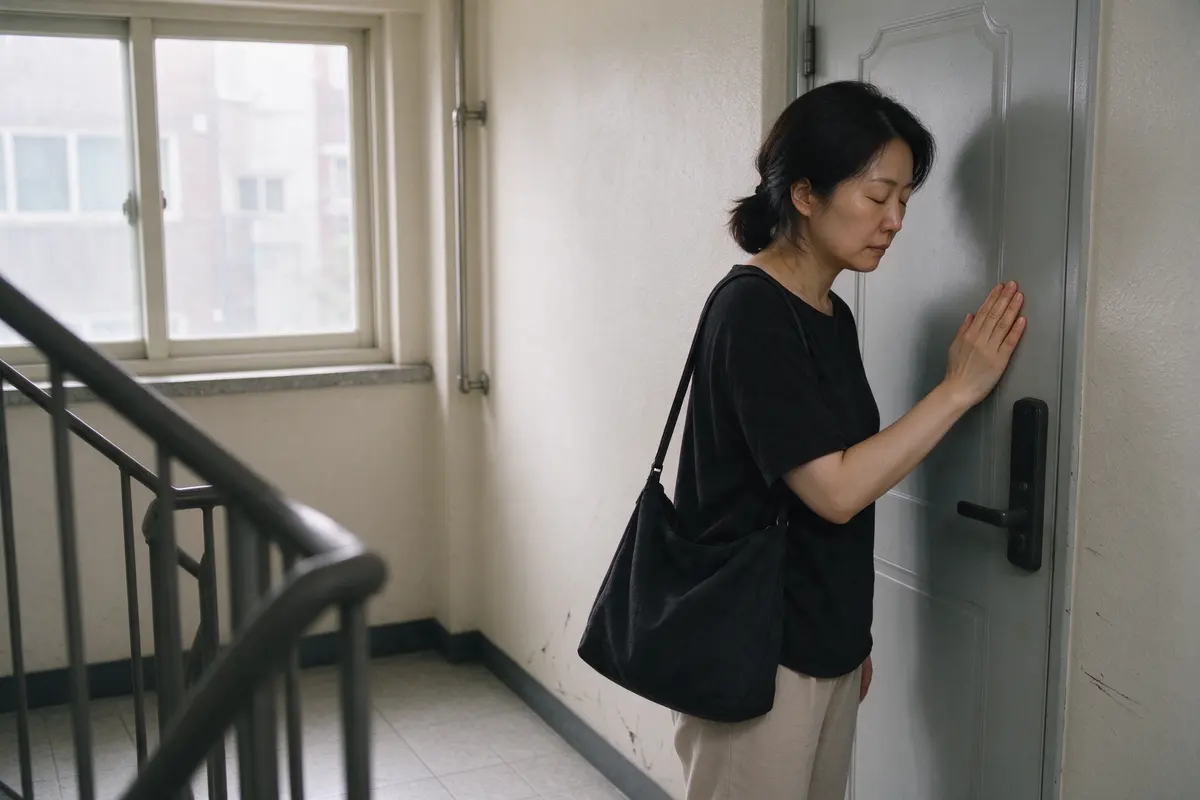
The ritual is for both of you. The same words every morning let you leave without negotiating with yourself at the door, and the card lets you stop being the only adult who can do it. The AAP's rules are about the baby (Swanson, AAP); the one about never sneaking away also keeps you honest about going. The 6-month visit was the last checkup at which the AAP recommends screening the birthing parent for depression (Earls et al., 2019), so if the goodbye has become dread rather than a pang, nobody will ask except you: 1-833-TLC-MAMA (1-833-852-6262), call or text, or 988 (CDC).
If you're the partner: the card is in your voice half the week. About 10% of fathers have depression around a birth, with higher rates reported at 3 to 6 months after (Paulson & Bazemore, 2010). Say the three lines, go, and come back when you said.
Sources
- Swanson WS. "How to Ease Your Child's Separation Anxiety." HealthyChildren.org, updated 2026. https://www.healthychildren.org/English/ages-stages/toddler/Pages/Soothing-Your-Childs-Separation-Anxiety.aspx
- American Academy of Pediatrics. "Emotional and Social Development: 8 to 12 Months." HealthyChildren.org, updated 2009. https://www.healthychildren.org/English/ages-stages/baby/Pages/Emotional-and-Social-Development-8-12-Months.aspx
- Centers for Disease Control and Prevention. "Milestones by 9 Months." Learn the Signs. Act Early. program, updated 2026. https://www.cdc.gov/act-early/milestones/9-months.html
- American Academy of Pediatrics. "Making Baby Drop Off at Child Care Easier." HealthyChildren.org, updated 2022. https://www.healthychildren.org/English/family-life/work-and-child-care/Pages/making-baby-drop-off-at-child-care-easier.aspx
- American Academy of Pediatrics. "Fever" (symptom checker). HealthyChildren.org, accessed 2026. https://www.healthychildren.org/English/tips-tools/symptom-checker/Pages/symptomviewer.aspx?symptom=Fever
- American Academy of Pediatrics. "Separation Anxiety & Sleeping Trouble in Young Children." HealthyChildren.org, updated 2022. https://www.healthychildren.org/English/healthy-living/sleep/Pages/separation-anxiety-and-sleeping.aspx
- Centers for Disease Control and Prevention. "Milestones by 1 Year." Learn the Signs. Act Early. program, updated 2026. https://www.cdc.gov/act-early/milestones/1-year.html
- Latimer T. "When to Call the Pediatrician for Your Newborn." Lurie Children's Hospital of Chicago, 2022. https://www.luriechildrens.org/en/blog/when-to-call-the-pediatrician-for-your-newborn/
- Earls MF, Yogman MW, Mattson G, Rafferty J; AAP Committee on Psychosocial Aspects of Child and Family Health. "Incorporating Recognition and Management of Perinatal Depression Into Pediatric Practice." Pediatrics, 2019. https://pubmed.ncbi.nlm.nih.gov/30559120/
- Centers for Disease Control and Prevention. "Symptoms of Depression Among Women." 2024. https://www.cdc.gov/reproductive-health/depression/index.html
- Paulson JF, Bazemore SD. "Prenatal and postpartum depression in fathers and its association with maternal depression: a meta-analysis." JAMA, 2010. https://pubmed.ncbi.nlm.nih.gov/20483973/
This guide is general education that summarizes published research and guidance from groups like the American Academy of Pediatrics, the CDC, and the WHO. It isn’t medical advice, and every child develops on their own timeline. Your pediatrician knows your child; if something feels wrong, call them. In an emergency, call 911.
Get each day’s note the morning it applies
Add your baby to a free Chorevia household with their date of birth, and every morning for 365 days the day’s note arrives in the app and by email: what’s developing, one thing to try, what to watch for, and a word for you.
Create your household