Day 308 of 365 · Week 42
Cruising to standing alone
Last reviewed · 4 min read · 8 sources · Plain-text version
Standing alone starts anywhere from 6.9 to 16.9 months and walking alone from 8.2 to 17.6. The moment between cruising and standing is letting go of the sofa for a second. Count it, no goal.

The hands are on the sofa all day now. Sometime soon one of them lifts, and then both, and for a second there's a baby standing in the middle of the room with nothing holding on. Today is that second: how wide its window is, and how to help without holding.
Heart
In the WHO's study of 816 healthy children in Ghana, India, Norway, Oman, and the US, standing alone started anywhere from 6.9 to 16.9 months, and walking alone from 8.2 to 17.6 months, 1st to 99th percentiles (WHO Multicentre Growth Reference Study Group, 2006). Your baby is 10 months old, which is inside the standing window and nowhere near the end of it. What most babies do by 12 months is pull up to stand and walk while holding on to furniture (CDC); standing with no hands isn't on that list. If it happens this month, it's early-ish. If it doesn't happen for months, it's on time.
Head
The sequence, from the AAP: pulling up to stand, often before they know how to get back down, then cruising sideways along furniture, then wobbly first steps, which many babies take around their first birthday (AAP). Between cruising and steps is the unlisted move: a hand comes off to reach for a toy, the body balances for a beat, the hand goes back. The AAP's one coaching tip for this stage is about the other direction, showing a stuck baby how to bend their knees to sit down (AAP). Getting down safely is what makes letting go safe to try. Walking itself is learned by volume: filmed during free play, 12- to 19-month-olds averaged 2,368 steps and 17 falls per hour (Adolph et al., 2012).
Body
The setting does the coaching. CDC suggests placing your baby near furniture they can safely pull up on (CDC), and safely means anchored: bookcases, dressers, and TV stands fixed to the wall (AAP), and the crib mattress at its lowest position before your baby learns to stand (AAP). The guide's activity is Cruise to the toy; today adds a count.
Try today
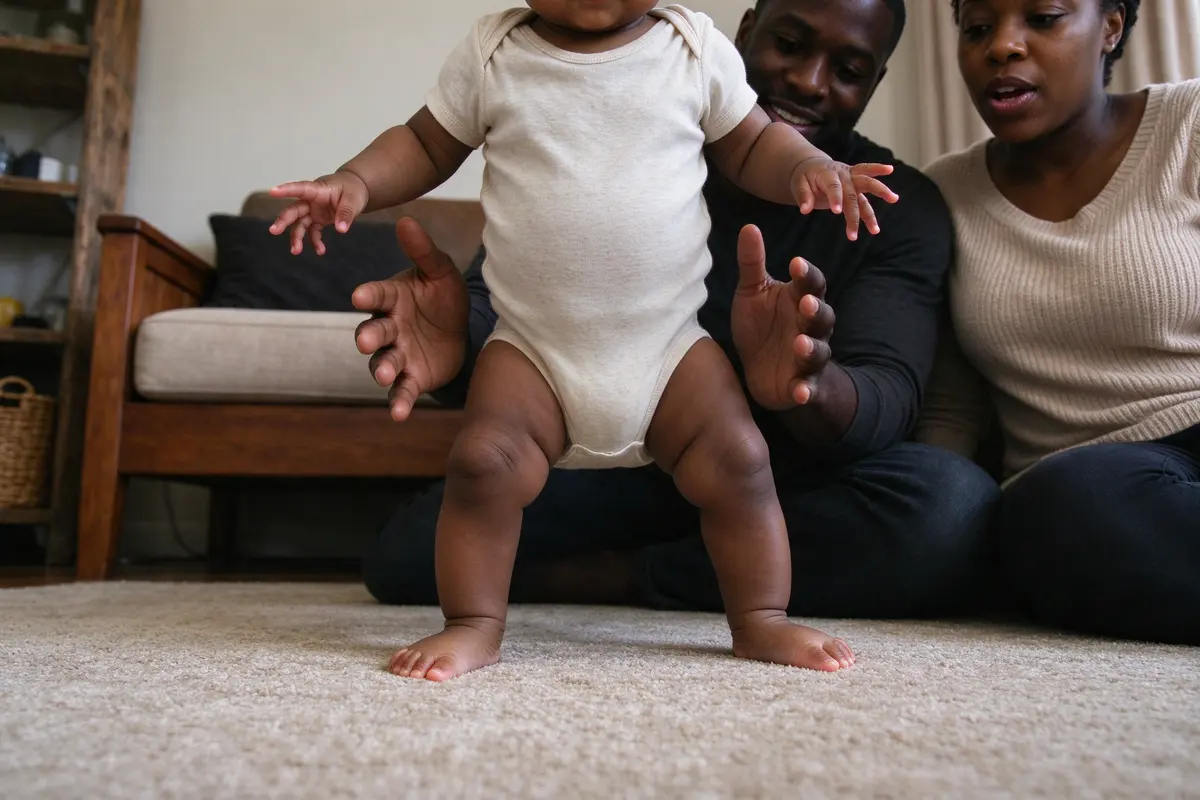
The let-go second
Time: 2 minutes, once today · Cruise to the toy in the guide
Stand your baby at the sofa on a rug, both hands on the cushion, and kneel behind them with your hands hovering at their ribs, not touching.
Hold a toy a little in front of them, at chest height, so reaching for it means a hand has to leave the sofa.
The moment the second hand lifts, count out loud, slowly. Stop counting when a hand goes back or they sit. Write the number, even if it's zero.
Once, show the sit-down: a hand on each hip, bend the knees, bottom to the rug, "Down!" (AAP).
Do it again next week, not tomorrow. Standing alone runs from 6.9 to 16.9 months (WHO Multicentre Growth Reference Study Group, 2006); there's no goal and no pass mark.
Make it work:Hovering, not holding. A baby held up by the armpits isn't balancing, and the balancing is the lesson.
Watch for
Normal
both hands glued to the sofa all month; standing alone has until 16.9 months in the WHO's range (WHO Multicentre Growth Reference Study Group, 2006).
Ask about a developmental screening
if your baby isn't pulling to stand by 12 months (CDC).
Normal
a let-go that ends on a diapered bottom with a thump and a surprised face; the study's walkers fell 17 times an hour (Adolph et al., 2012).
Call your pediatrician now
for any head injury in a baby under 1 year, even if your baby seems fine (AAP).
Normal
cruising left along the sofa and not right, for a day.
Talk with your pediatrician
if your baby uses one arm or leg much more than the other (AAP).
For you
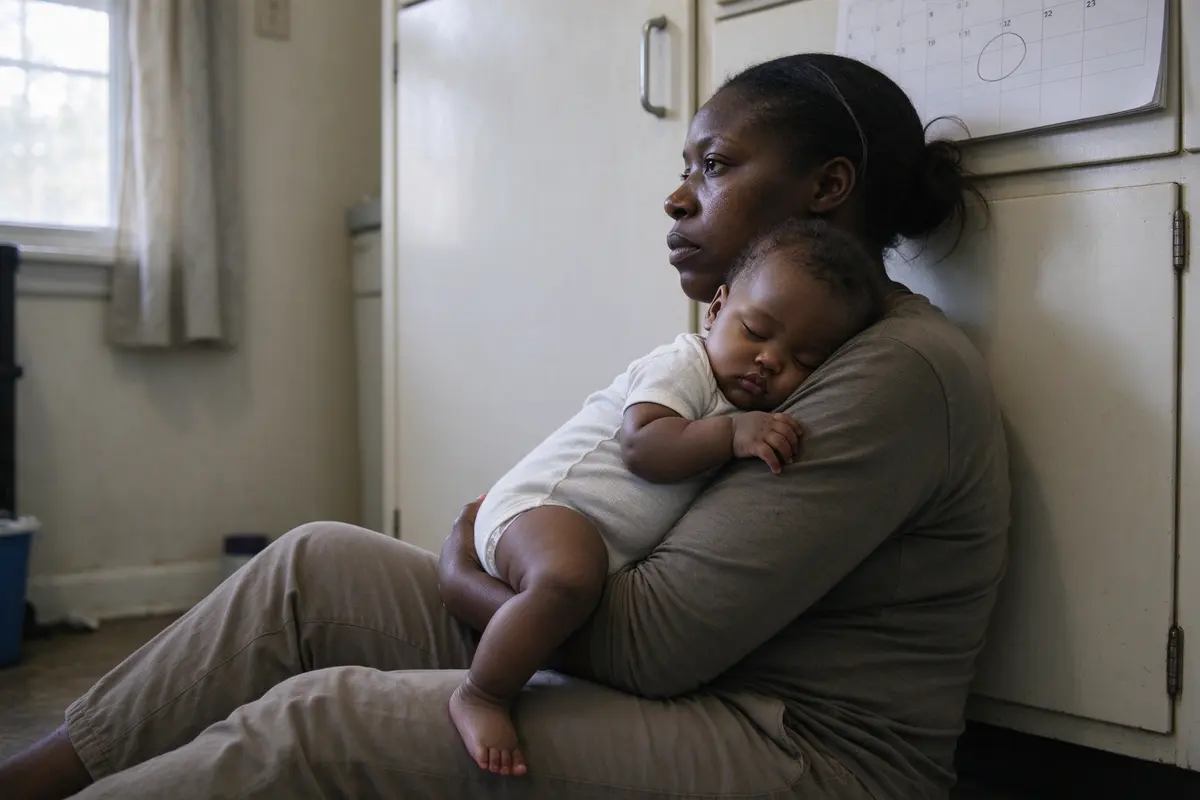
The range, not the calendar. The birthday is circled on the wall and it has started to look like a deadline, because the word "first" is attached to "steps" in every song and card. The WHO's window for walking alone is 8.2 to 17.6 months (WHO Multicentre Growth Reference Study Group, 2006), which is to say the birthday sits in the middle of it, not at the end. The only line that has a job is the 12-month one about pulling up (CDC), and your baby is at the sofa all day. The calendar is for cake.
If you're the partner: if the let-go second happens while she's at work, film it, send it, and then don't say "you missed it." Say "it'll happen again tonight," because it will.
Sources
- WHO Multicentre Growth Reference Study Group. "WHO Motor Development Study: windows of achievement for six gross motor development milestones." Acta Paediatrica Supplement, 2006. https://pubmed.ncbi.nlm.nih.gov/16817682/
- Centers for Disease Control and Prevention. "Milestones by 1 Year." Learn the Signs. Act Early. program, updated 2026. https://www.cdc.gov/act-early/milestones/1-year.html
- American Academy of Pediatrics. "Movement Milestones in Babies 8 to 12 Months Old." HealthyChildren.org, updated 2021. https://www.healthychildren.org/English/ages-stages/baby/Pages/Movement-8-to-12-Months.aspx
- Adolph KE, Cole WG, Komati M, et al. "How do you learn to walk? Thousands of steps and dozens of falls per day." Psychological Science, 2012. https://pubmed.ncbi.nlm.nih.gov/23085640/
- Centers for Disease Control and Prevention. "Milestones by 9 Months." Learn the Signs. Act Early. program, updated 2026. https://www.cdc.gov/act-early/milestones/9-months.html
- American Academy of Pediatrics. "Home Safety: Tips for Families With Young Children." HealthyChildren.org, updated 2022. https://www.healthychildren.org/English/safety-prevention/at-home/Pages/Home-Safety-Heres-How.aspx
- American Academy of Pediatrics. "Make Baby's Room Safe: Parent Checklist." HealthyChildren.org, updated 2020. https://www.healthychildren.org/English/safety-prevention/at-home/Pages/Make-Babys-Room-Safe.aspx
- American Academy of Pediatrics. "Head Injury" (symptom checker). HealthyChildren.org, accessed 2026. https://www.healthychildren.org/English/tips-tools/symptom-checker/Pages/symptomviewer.aspx?symptom=Head+Injury
This guide is general education that summarizes published research and guidance from groups like the American Academy of Pediatrics, the CDC, and the WHO. It isn’t medical advice, and every child develops on their own timeline. Your pediatrician knows your child; if something feels wrong, call them. In an emergency, call 911.
Get each day’s note the morning it applies
Add your baby to a free Chorevia household with their date of birth, and every morning for 365 days the day’s note arrives in the app and by email: what’s developing, one thing to try, what to watch for, and a word for you.
Create your household