Day 123 of 300 · Week 17
Toy hand-offs
Last reviewed · 3 min read · 11 sources · Plain-text version
From bringing things to the mouth to a raking grip, then hand to hand and the pincer: what the hands are working on, and why no special gear is needed.

The hands are the project this month. Here is the order they learn in, and the one toy trick that helps.
Heart
By 4 months, most babies can easily bring objects to their mouth. Next comes a mitten-like raking grip; passing a toy from hand to hand arrives at 6 to 8 months, and the pincer grasp, thumb and finger, at about 9 months (AAP). Holding a toy you put in their hand is on the 4-month list, and so is swinging an arm at toys (CDC). They also spot nearby objects now and often reach for them (AAP).
Head
You don't need to buy anything. In a 2002 study of 32 three-month-olds, babies who played in Velcro "sticky mittens" that let them pick up toys later explored objects more (Needham et al., 2002), but a pre-registered trial of 96 Swedish 3-month-olds found daily mitten training didn't improve reaching (van den Berg et al., 2022), and a review rated the overall evidence low to very low (Righetto Greco et al., 2023). Floor time and toys within reach do the job. Hand to hand will come on its own schedule.
Body
Mouthing is how they learn (CDC). Federal rules ban small parts in toys meant for children under 3, tested with a cylinder sized like a young child's throat (CPSC), but household objects aren't tested. Keep toys that can be squeezed to fit in a mouth, button batteries, and coin batteries away from your baby, and check under cushions for coins and other small things (Bradin, AAP). If there's an older child, teach them the rule too; many choking incidents start with a sibling sharing a toy or snack.
Try today
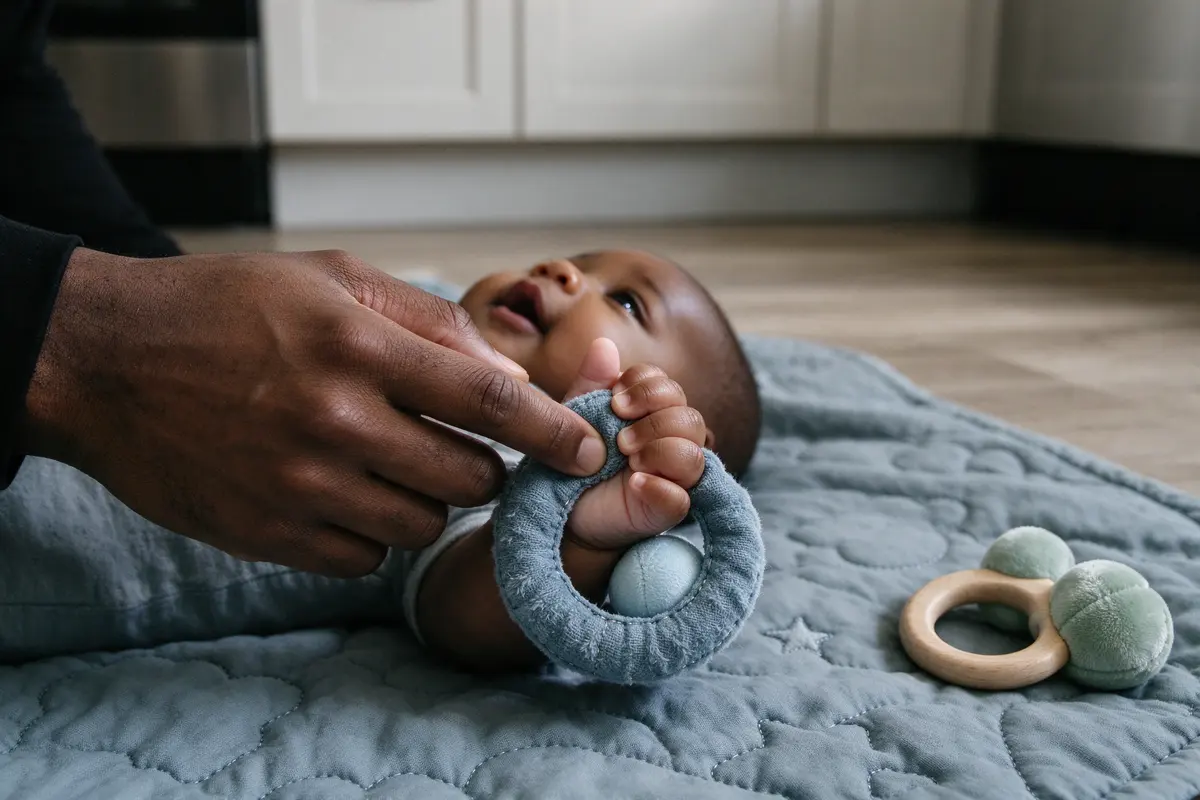
Toy hand-offs
Time: A few minutes, a few times a day · Toy hand-offs in the guide
Offer a light rattle or soft ring by touching it to your baby's palm.
Let them grab, shake, and mouth it; say its name each time.
Offer the next toy to the other hand.
When both hands are full, hold out a third and watch what they do. Dropping one is the right answer for now.
Make it work:CDC suggests easy-to-grip toys like rattles and cloth books (CDC); the hand-off itself hasn't been studied. Nothing small enough to fit in their mouth.
Watch for
- Normal: every toy soaked in drool. Call 911 if your baby choked on a small object that could still be stuck (AAP); call your pediatrician right away if they swallowed a small object but seem fine (AAP).
- Normal: a grip that lets go without warning. Bring it up if your baby doesn't bring their hands to their mouth or hold a toy you give them (CDC).
- Never normal: a battery anywhere near them. A button or coin battery stuck in the throat can burn through it within 2 hours; if you think your baby swallowed one, go to the ER or call 911 right away, and save the National Battery Ingestion Hotline, 800-498-8666 (AAP).
For you
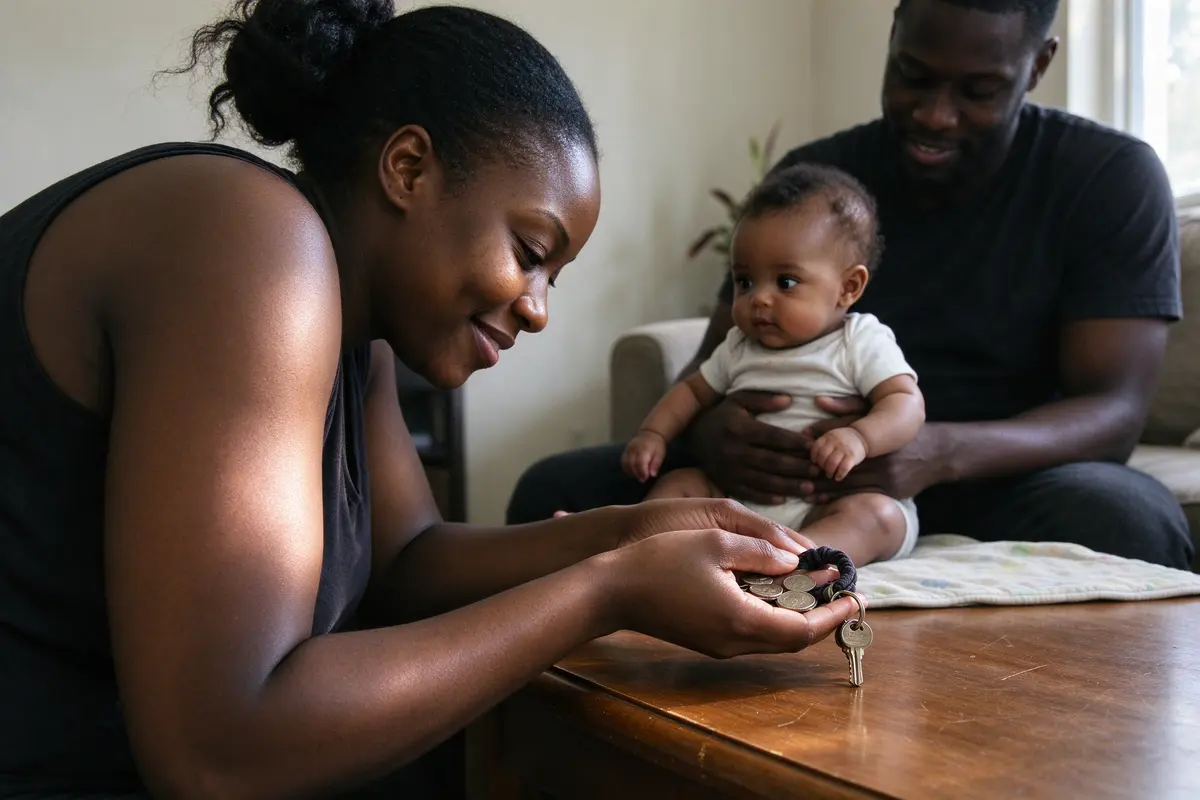
Nothing small on the coffee table. It's at reaching height now, and so are the side table and the low shelf. Coins, keys, earrings, hair ties, the remote with its loose battery door: up high, or gone. The AAP's rule is to check under cushions for coins and other small things, and to keep button and coin batteries away (Bradin, AAP). Do it once, today, and then once a week when you vacuum.
If you're the partner: your pockets empty onto a high shelf from now on, not the coffee table.
Sources
- American Academy of Pediatrics. "Movement Milestones: Babies 4 to 7 Months." HealthyChildren.org, 2021. https://www.healthychildren.org/English/ages-stages/baby/Pages/Movement-4-to-7-Months.aspx
- Centers for Disease Control and Prevention. "Milestones by 4 Months." Learn the Signs. Act Early., 2026. https://www.cdc.gov/act-early/milestones/4-months.html
- American Academy of Pediatrics. "Infant Vision Development: What Can Babies See?" HealthyChildren.org, 2024. https://www.healthychildren.org/English/ages-stages/baby/Pages/Babys-Vision-Development.aspx
- Needham A, Barrett T, Peterman K. "A pick-me-up for infants' exploratory skills: Early simulated experiences reaching for objects using 'sticky mittens' enhances young infants' object exploration skills." Infant Behavior & Development, 2002. https://doi.org/10.1016/S0163-6383%2802%2900097-8
- van den Berg L, Libertus K, Nyström P, et al. "A pre-registered sticky mittens study: active training does not increase reaching and grasping in a Swedish context." Child Development, 2022. https://pubmed.ncbi.nlm.nih.gov/36047569/
- Righetto Greco AL, Sato NTDS, Moreira RFC, et al. "Sticky Mittens Training to Improve Reaching Skills and Manual Exploration of Full-Term and At-Risk Infants: A Systematic Review." Physical & Occupational Therapy in Pediatrics, 2023. https://pubmed.ncbi.nlm.nih.gov/36195977/
- US Consumer Product Safety Commission. "Small Parts Ban and Choking Hazard Labeling." 2026. https://www.cpsc.gov/Business--Manufacturing/Business-Education/Business-Guidance/Small-Parts-for-Toys-and-Childrens-Products
- Bradin S. "Choking Prevention for Babies & Children: What Every Parent Needs to Know." HealthyChildren.org, 2026. https://www.healthychildren.org/English/health-issues/injuries-emergencies/Pages/Choking-Prevention.aspx
- American Academy of Pediatrics. "Breathing Trouble" (symptom checker). HealthyChildren.org, 2026. https://www.healthychildren.org/English/tips-tools/symptom-checker/Pages/symptomviewer.aspx?symptom=Breathing+Trouble
- American Academy of Pediatrics. "Swallowed Foreign Object" (symptom checker). HealthyChildren.org, 2026. https://www.healthychildren.org/English/tips-tools/symptom-checker/Pages/symptomviewer.aspx?symptom=Swallowed+Foreign+Object
- American Academy of Pediatrics. "What Parents Need to Know about Button Batteries and Lithium Coin Batteries." HealthyChildren.org, 2024. https://www.healthychildren.org/English/safety-prevention/at-home/Pages/What-Parents-Need-to-Know-about-Button-and-Lithium-Coin-Batteries.aspx
This guide is general education that summarizes published research and guidance from groups like the American Academy of Pediatrics, the CDC, and the WHO. It isn’t medical advice, and every child develops on their own timeline. Your pediatrician knows your child; if something feels wrong, call them. In an emergency, call 911.
Get each day’s note the morning it applies
Add your baby to a free Chorevia household with their date of birth, and every morning for 300 days the day’s note arrives in the app and by email: what’s developing, one thing to try, what to watch for, and a word for you.
Create your household