Day 135 of 300 · Week 19
Floor time beats container time
Last reviewed · 4 min read · 13 sources · Plain-text version
WHO's numbers for this age: floor play several times a day, 30 minutes of tummy time, and no more than an hour at a time strapped in. Plus a one-day tally to see where you stand.

The swing, the bouncer, the car seat, the carrier. Each one is useful. Added up, they can take the floor away from a baby who needs it most right now.
Heart
WHO advises floor play several times a day, including at least 30 minutes of tummy time spread through the day, and not keeping babies strapped into strollers, high chairs, or carriers for more than 1 hour at a time (WHO). CDC suggests daily play on a mat or blanket and not keeping babies in swings, strollers, or bouncy seats for too long (CDC). The floor is where a baby this age practices pushing up, pivoting, and the first rolls. A seat holds them still and does the work for them.
Head
Tummy time earns its place. A systematic review of 16 mostly observational studies linked tummy time to better gross motor development and to rolling and crawling (Hewitt et al., 2020). Put toys in a circle around your baby so reaching builds the muscles for rolling and crawling (AAP). No gear needed: a pre-registered trial of 96 Swedish 3-month-olds found daily "sticky mitten" training didn't improve reaching (van den Berg et al., 2022), and a review rated the evidence low to very low (Righetto Greco et al., 2023). Floor time and toys within reach do the job.
Body
Two containers need their own rules. Baby walkers with wheels aren't safe; the AAP has called for a ban. Babies in walkers can roll down stairs, reach hot liquids, and move more than 3 feet in a second, and walkers don't help babies learn to walk. Stationary activity centers without wheels are a safer alternative (AAP), but the 1-hour limit still applies (WHO). Bouncers go on the floor only, never on a counter, table, or soft surface, and stop once your baby can sit up alone (CPSC).
Try today
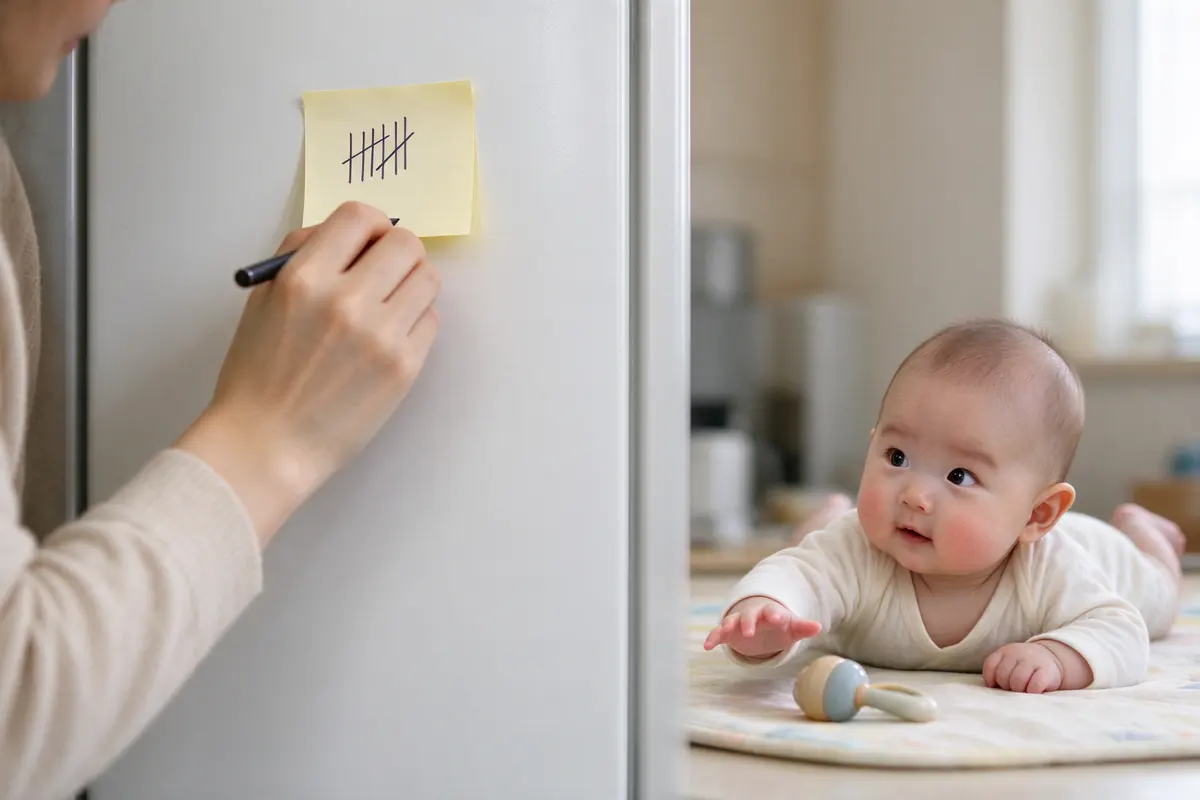
The container count
Time: One ordinary day, a pen, and a sticky note
Put a note on the fridge. Each time your baby goes into anything with straps, swing, bouncer, carrier, stroller, car seat, write the start time.
When one stretch reaches an hour, out they come, onto the floor or into arms (WHO).
Mark tummy-time minutes on the same note, with the toys in a circle (AAP).
At bedtime, add both up: strapped minutes against the 1-hour-at-a-time rule, tummy minutes against 30 (WHO).
Move one habit tomorrow: the after-breakfast swing becomes mat time, or the long carrier stretch gets a floor break in the middle.
Make it work:The count is information, not a grade. Car rides count as strapped time, and some days are car days.
Watch for
Normal
a baby who flops face-down and complains after a few minutes on the tummy.
Normal
a bouncer on the floor, buckled, within your sight.
Call your pediatrician right away
for any head injury, including a fall from a counter, bed, couch, or changing table, and call 911 for a seizure afterward (AAP).
Normal
pivoting in a circle on the mat without going anywhere.
Talk with your pediatrician
if your baby doesn't roll in either direction by 5 months (AAP).
For you

The stroller walk is still allowed. An hour at a time is the limit, not a ban (WHO), and the walk is for you as much as the baby. In one study of 56 babies 6 to 12 weeks old, those who slept better at night got more daytime light, especially in the early afternoon, a link that doesn't prove cause (Harrison, 2004). Walking helps healing after a C-section and helps prevent clots (MedlinePlus). Go before 10 a.m. or after 4 p.m., in the shade, with a hat on the baby (Gupta & Mahoney, AAP), and when you get home, the stroller stays by the door and the baby goes to the floor.
If you're the partner: tonight's floor session is yours, on your stomach, face to face. Her back gets the evening off.
Sources
- World Health Organization. "To grow up healthy, children need to sit less and play more." 2019. https://www.who.int/news/item/24-04-2019-to-grow-up-healthy-children-need-to-sit-less-and-play-more
- Centers for Disease Control and Prevention. "Milestones by 4 Months." Learn the Signs. Act Early., updated 2026. https://www.cdc.gov/act-early/milestones/4-months.html
- Hewitt L, Kerr E, Stanley RM, Okely AD. "Tummy Time and Infant Health Outcomes: A Systematic Review." Pediatrics, 2020. https://pubmed.ncbi.nlm.nih.gov/32371428/
- American Academy of Pediatrics. "Back to Sleep, Tummy to Play: Give Your Baby a Safe, Strong Start." HealthyChildren.org, updated 2026. https://www.healthychildren.org/English/ages-stages/baby/sleep/Pages/back-to-sleep-tummy-to-play.aspx
- van den Berg L, Libertus K, Nyström P, et al. "A pre-registered sticky mittens study: active training does not increase reaching and grasping in a Swedish context." Child Development, 2022. https://pubmed.ncbi.nlm.nih.gov/36047569/
- Righetto Greco AL, Sato NTDS, Moreira RFC, et al. "Sticky Mittens Training to Improve Reaching Skills and Manual Exploration of Full-Term and At-Risk Infants: A Systematic Review." Physical & Occupational Therapy in Pediatrics, 2023. https://pubmed.ncbi.nlm.nih.gov/36195977/
- American Academy of Pediatrics. "Baby Walkers: A Dangerous Choice." HealthyChildren.org, updated 2022. https://www.healthychildren.org/English/safety-prevention/at-home/Pages/Baby-Walkers-A-Dangerous-Choice.aspx
- US Consumer Product Safety Commission. "New Federal Standard to Improve Safety of Infant Bouncer Seats Takes Effect." 2018. https://www.cpsc.gov/Newsroom/News-Releases/2018/New-Federal-Standard-to-Improve-Safety-of-Infant-Bouncer-Seats-Takes-Effect
- American Academy of Pediatrics. "Developmental Milestones: 7 Months." HealthyChildren.org, updated 2009. https://www.healthychildren.org/English/ages-stages/baby/Pages/Developmental-Milestones-7-Months.aspx
- American Academy of Pediatrics. "Head Injury" (symptom checker). HealthyChildren.org, accessed 2026. https://www.healthychildren.org/English/tips-tools/symptom-checker/Pages/symptomviewer.aspx?symptom=Head+Injury
- Harrison Y. "The relationship between daytime exposure to light and night-time sleep in 6-12-week-old infants." Journal of Sleep Research, 2004. https://pubmed.ncbi.nlm.nih.gov/15560769/
- MedlinePlus. "Going home after a C-section." National Library of Medicine. https://medlineplus.gov/ency/patientinstructions/000624.htm
- Gupta D, Mahoney M. "Baby Sunburn Prevention Tips." HealthyChildren.org, updated 2026. https://www.healthychildren.org/English/ages-stages/baby/bathing-skin-care/Pages/Baby-Sunburn-Prevention.aspx
This guide is general education that summarizes published research and guidance from groups like the American Academy of Pediatrics, the CDC, and the WHO. It isn’t medical advice, and every child develops on their own timeline. Your pediatrician knows your child; if something feels wrong, call them. In an emergency, call 911.
Get each day’s note the morning it applies
Add your baby to a free Chorevia household with their date of birth, and every morning for 300 days the day’s note arrives in the app and by email: what’s developing, one thing to try, what to watch for, and a word for you.
Create your household