Day 128 of 300 · Week 18
If you're thinking about sleep training
Last reviewed · 4 min read · 11 sources · Plain-text version
Optional, and only if night waking is wearing you down: the basics first, gradual versus checking, what the trials found and at which ages, and the rules that never bend.
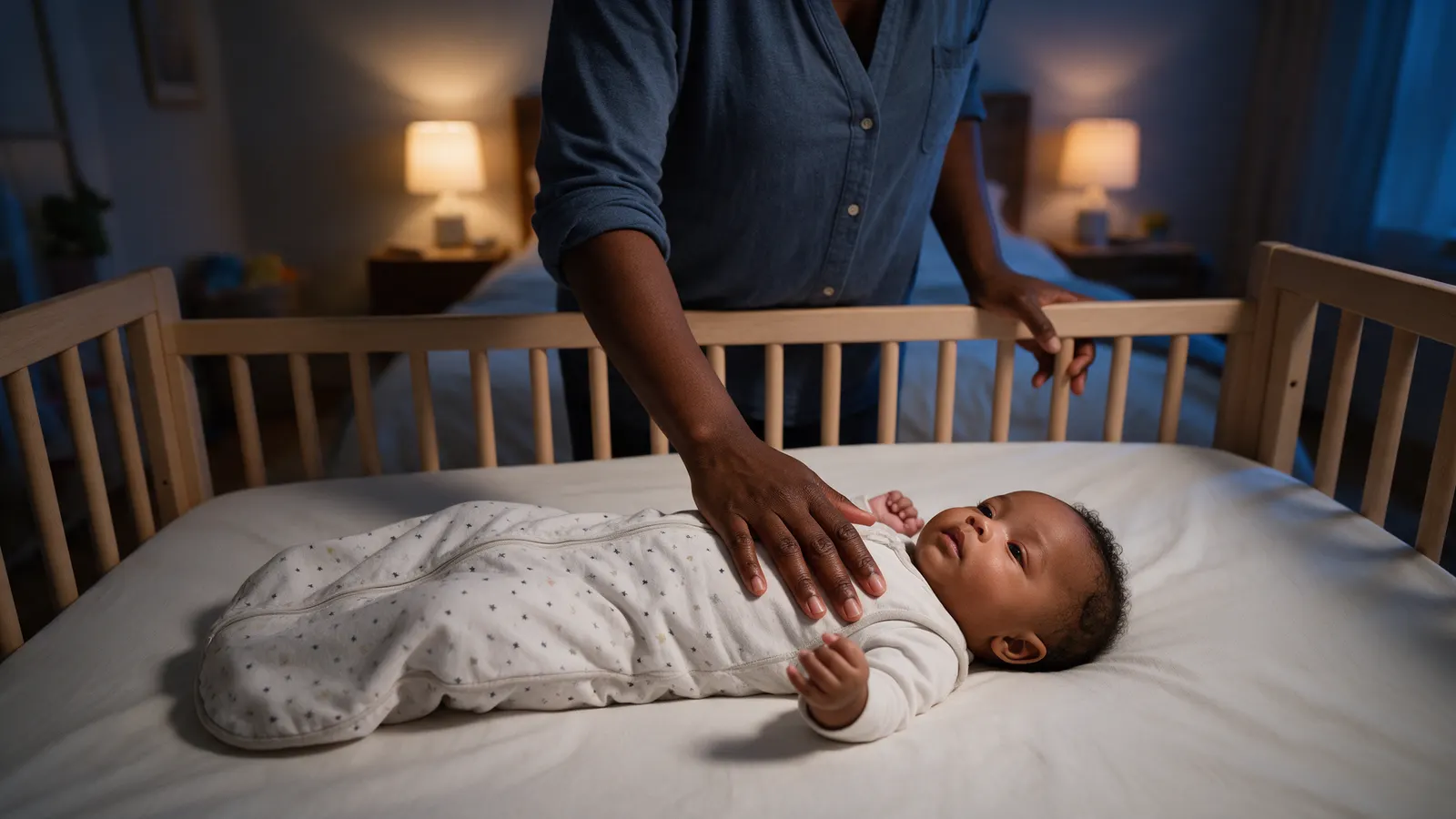
Sleep training is a family choice, not a requirement. If night waking is wearing you down, here is what's known and what never changes.
Heart
Start with the basics before any method: calm, quiet night feeds; lively days; and putting your baby down drowsy so they practice falling asleep in their own bed (AAP). Then know the options. Gradual methods wait a little longer each night before going in to soothe; "cold turkey" means checking but not soothing. Pediatricians generally give the okay at 3 or 4 months, so talk it over first (Lurie Children's). Whatever you choose, hunger, a dirty diaper, or illness always gets an answer (AAP).
Head
What the trials found. A review of 52 studies found that behavioral methods, from letting a baby settle alone to gradual approaches and bedtime routines, reliably improved sleep (Mindell et al., 2006). In an Australian trial of 328 mothers of 7-month-olds with sleep problems, those taught these methods reported fewer sleep problems and less depression at 12 months (Hiscock et al., 2007); at age 6, the 225 children followed up showed no differences in emotions, behavior, stress, or closeness to parents (Price et al., 2012). A trial of 43 babies 6 to 16 months old found no rise in stress hormones and no effect on attachment (Gradisar et al., 2016). One small study of 25 babies raised a concern: they stopped crying at bedtime by day 3, but their stress hormones stayed high (Middlemiss et al., 2012). Note the ages. These trials involved babies 6 months and older.
Body
Try today
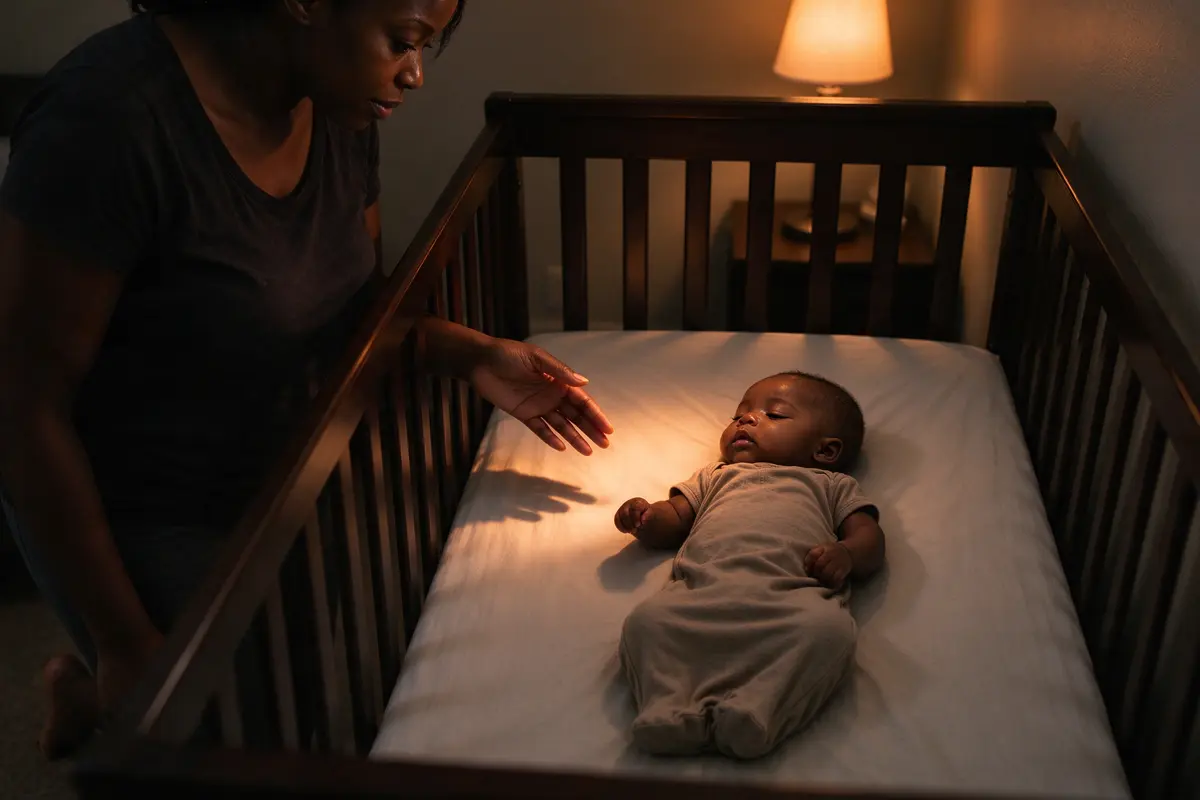
Drowsy, then down
Time: A few minutes at bedtime tonight · If you're thinking about sleep training in the guide
Run the usual routine: gums, one book, dim light.
Watch for drowsy: heavy eyes, slowing down, still awake.
Lay your baby on their back in the bare crib while they're still awake; from 4 months, the AAP suggests drowsy rather than asleep so they practice falling asleep in their own bed (AAP).
A hand on their chest, a quiet word, then step back and give it a moment.
If the crying builds, pick up, soothe, and lay them down again. That's the whole exercise tonight.
Make it work:This is practice, not a program. Hunger, a dirty diaper, or illness always gets an answer (AAP).
Watch for
Normal
protest at being put down awake.
Normal
a method that worked for a friend's baby and not for yours; the trials were in babies 6 months and older (Hiscock et al., 2007; Price et al., 2012).
Talk it over
with your pediatrician before you start anything formal (Lurie Children's).
Normal
a baby who rolls onto their tummy once they're down. Lay them on their back every time; if they roll both ways on their own, leave them (Moon, AAP).
Call 911
if your baby can't be woken, isn't moving, or is very weak (AAP).
For you
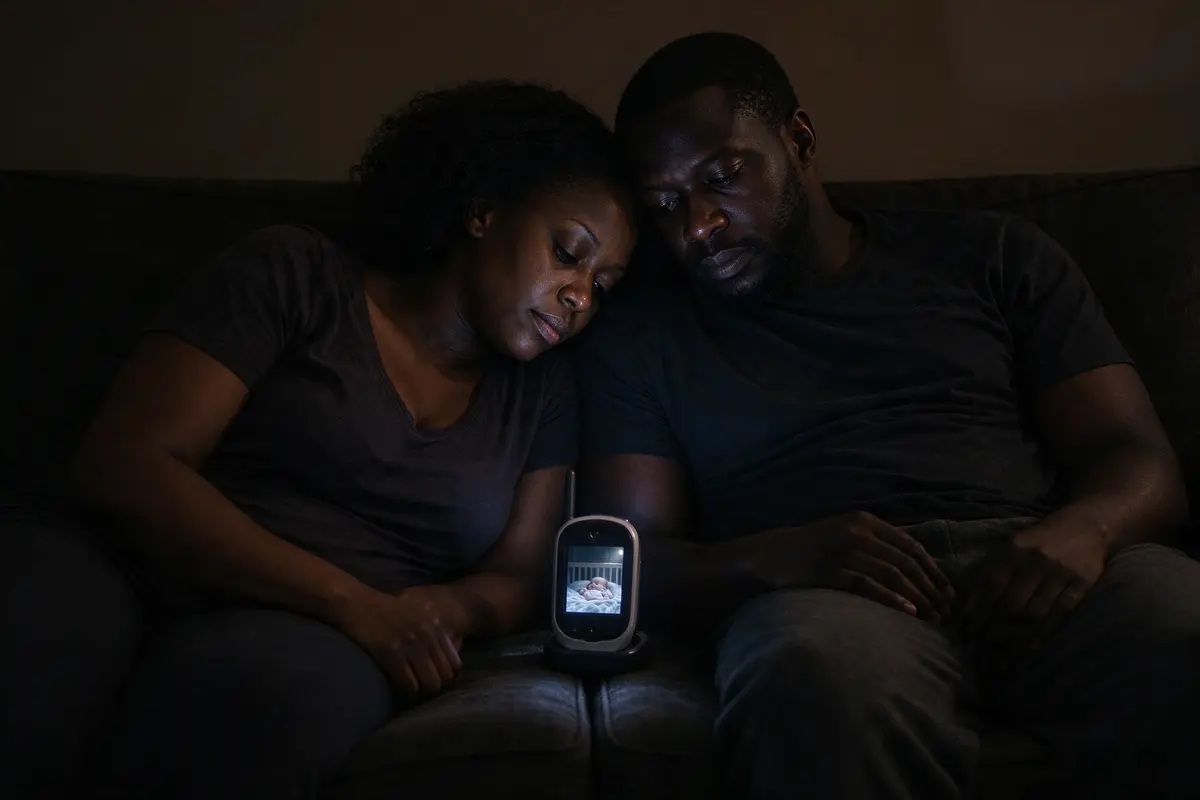
It's a family choice, and no choice is a verdict. The mothers in the Australian trial who were taught these methods reported less depression at 12 months (Hiscock et al., 2007), which is a real reason some families choose it. Choosing to wait, or never, is also fine; the babies in that trial were 7 months old, and yours isn't. What's not fine is wearing yourself down to nothing and calling it devotion. Low, numb, or frightened still counts, whatever you decide about sleep: call or text 1-833-TLC-MAMA (1-833-852-6262) or 988 (CDC).
If you're the partner: decide together, and decide for this month only. You can change your mind at 6 months.
Sources
- American Academy of Pediatrics. "Getting Your Baby to Sleep." HealthyChildren.org, 2024. https://www.healthychildren.org/English/ages-stages/baby/sleep/Pages/getting-your-baby-to-sleep.aspx
- Freeman I. "How to Sleep Train Your Baby." Lurie Children's Hospital of Chicago, 2022. https://www.luriechildrens.org/en/blog/sleep-training-for-babies/
- Mindell JA, Kuhn B, Lewin DS, Meltzer LJ, Sadeh A. "Behavioral treatment of bedtime problems and night wakings in infants and young children." Sleep, 2006. https://pubmed.ncbi.nlm.nih.gov/17068979/
- Hiscock H, Bayer J, Gold L, et al. "Improving infant sleep and maternal mental health: a cluster randomised trial." Archives of Disease in Childhood, 2007. https://pubmed.ncbi.nlm.nih.gov/17158146/
- Price AMH, Wake M, Ukoumunne OC, Hiscock H. "Five-year follow-up of harms and benefits of behavioral infant sleep intervention: randomized trial." Pediatrics, 2012. https://pubmed.ncbi.nlm.nih.gov/22966034/
- Gradisar M, Jackson K, Spurrier NJ, et al. "Behavioral Interventions for Infant Sleep Problems: A Randomized Controlled Trial." Pediatrics, 2016. https://pubmed.ncbi.nlm.nih.gov/27221288/
- Middlemiss W, Granger DA, Goldberg WA, Nathans L. "Asynchrony of mother-infant hypothalamic-pituitary-adrenal axis activity following extinction of infant crying responses induced during the transition to sleep." Early Human Development, 2012. https://pubmed.ncbi.nlm.nih.gov/21945361/
- Moon RY. "How to Keep Your Sleeping Baby Safe: AAP Policy Explained." HealthyChildren.org, 2026. https://www.healthychildren.org/English/ages-stages/baby/sleep/Pages/a-parents-guide-to-safe-sleep.aspx
- Moon RY, Glassy D. "Swaddling: Is it Safe for Your Baby?" HealthyChildren.org, 2022. https://www.healthychildren.org/English/ages-stages/baby/diapers-clothing/Pages/Swaddling-Is-it-Safe.aspx
- American Academy of Pediatrics. "Fever" (symptom checker). HealthyChildren.org, 2026. https://www.healthychildren.org/English/tips-tools/symptom-checker/Pages/symptomviewer.aspx?symptom=Fever
- Centers for Disease Control and Prevention. "Symptoms of Depression Among Women." 2024. https://www.cdc.gov/reproductive-health/depression/index.html
This guide is general education that summarizes published research and guidance from groups like the American Academy of Pediatrics, the CDC, and the WHO. It isn’t medical advice, and every child develops on their own timeline. Your pediatrician knows your child; if something feels wrong, call them. In an emergency, call 911.
Get each day’s note the morning it applies
Add your baby to a free Chorevia household with their date of birth, and every morning for 300 days the day’s note arrives in the app and by email: what’s developing, one thing to try, what to watch for, and a word for you.
Create your household