Day 142 of 300 · Week 20
Burns and hot drinks
Last reviewed · 4 min read · 12 sources · Plain-text version
Grabbing hands reach mugs now. The two rules that prevent most scalds, no baby plus hot drink and a water heater at 120°F, and the counter habit that makes them automatic.

The reach is the news this month, and the reach doesn't know what's hot. Today is about the two rules that keep a grabbing baby and a hot drink apart.
Heart
By 4 months, most babies can easily bring objects to their mouth, and the next step is a mitten-like raking grip (AAP). Babies now spot nearby objects and often reach for them (AAP). The AAP's burns page puts it plainly: grabbing hands reach mugs. Don't carry your baby and a hot drink or soup at the same time (AAP). The mug you've held safely over this baby's head for twenty weeks is now within arm's reach of a hand that wants it.
Head
Scalds are the most common burns in young children (Seattle Children's), and they come from ordinary things: a cup at the edge of a table, a pot handle, a tap that runs too hot. Keep hot drinks away from table and counter edges (Seattle Children's), and set your water heater so the faucet runs no hotter than 120°F (AAP); the AAP's 2-month checkup page gives the same number as 120°F (48.9°C) (AAP). Bath water is still about 2 inches deep and warm, not hot, tested with your wrist or elbow (AAP).
Body
The carry is the hard part, because a baby on your hip and a coffee in your other hand is how every parent moves through a kitchen. The fix is an order of operations: the baby goes down first, on the floor mat or in a bouncer on the floor, never on the counter (CPSC), and then you pour. In a carrier, the same rule: don't hold your baby while handling anything hot (Seattle Children's). Drink sitting down, with the baby somewhere other than your lap. The burns section of the 4-month guide is short, because the rules are.
Try today
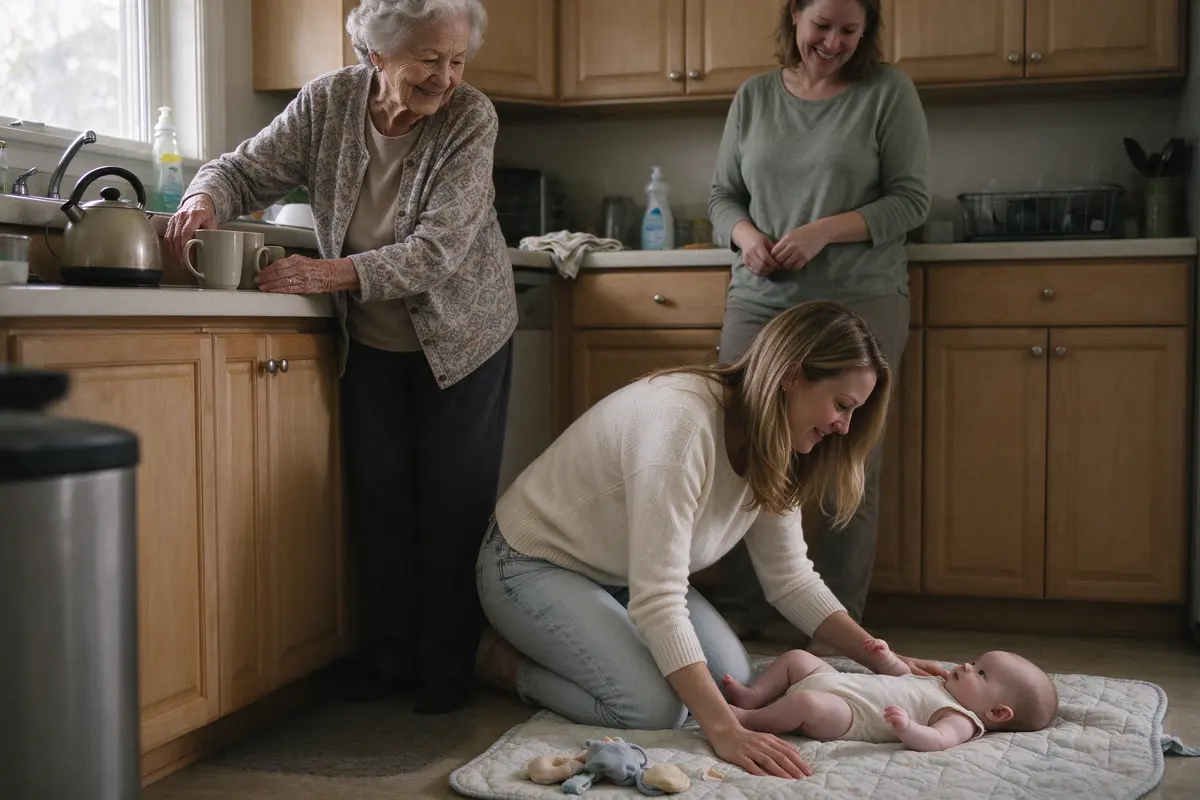
The far-side-of-the-counter habit
Time: 10 minutes once, then every pour · Burns in the guide
Walk the kitchen and slide every mug, kettle, and pan to the far side of the counter or the back burner, handles turned in, away from edges (Seattle Children's).
Pick the baby's spot: a floor mat where they can see you, or a bouncer on the floor, never on a table or counter (CPSC).
From now on, the order is baby down, then pour; carry the baby or the drink, never both (AAP).
Tonight, find the water heater and check it's set so the faucet runs no hotter than 120°F (AAP).
Make it work:Say "baby down, then pour" out loud for a week. Habits that get said get kept.
Watch for
Normal
a lunge for whatever is on the table, including your plate; swinging an arm at toys is a 4-month milestone (CDC).
Call your pediatrician right away
if your baby looks or acts very sick, or you think they need to be seen urgently (AAP).
Normal
a baby who wants to be held while you cook, and cries on the mat for a minute.
Call 911
if your baby choked on a small object that could still be stuck, or is struggling for each breath (AAP).
Normal
a swiped teaspoon or a grabbed napkin.
Go to the ER now
if your baby swallowed, or might have swallowed, a button battery or magnet (AAP).
For you
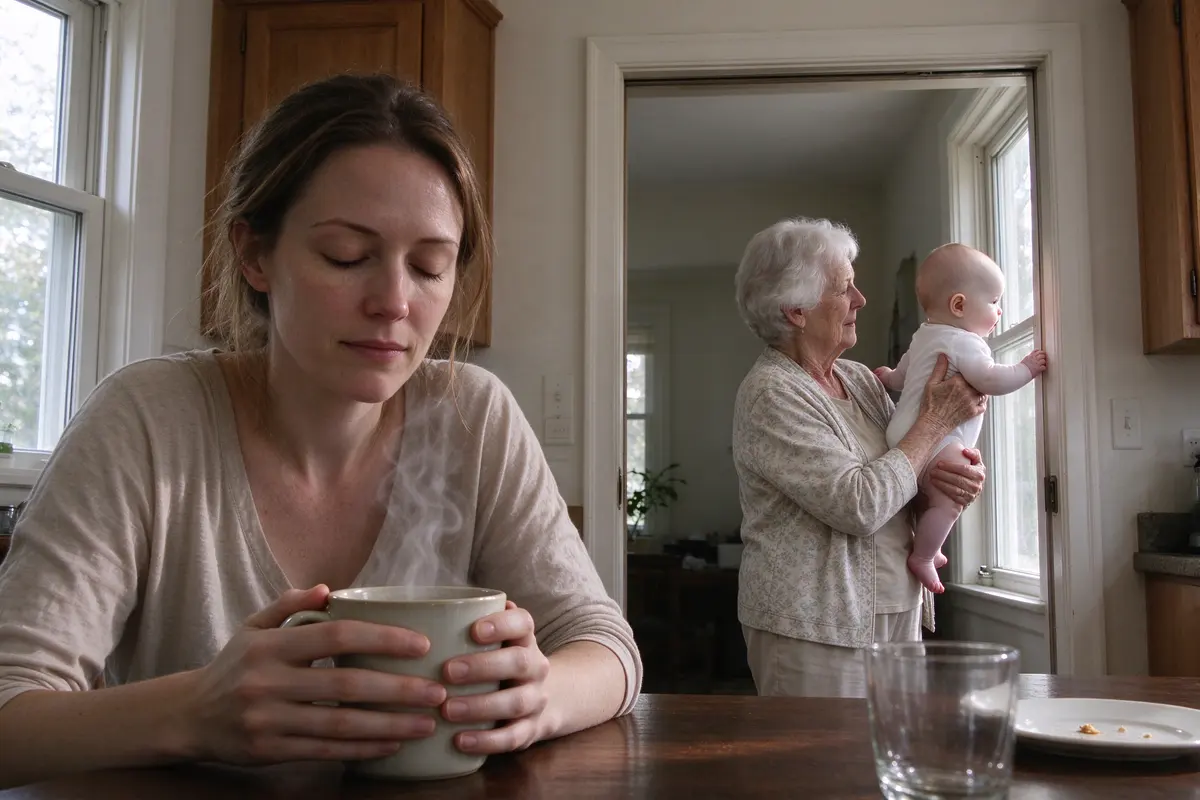
The kettle after the handoff. That's the deal: when someone else has the baby, you get to drink the whole thing while it's hot, sitting down, without reheating it three times. It's a small pleasure and you are allowed to protect it.
The reason the counter habit matters is not carelessness; it's that you're tired, and tired hands and hot liquids are a bad pair. Overwhelming tiredness is also on the CDC's list of urgent maternal warning signs, the kind to tell a provider about rather than push through (CDC). Twenty weeks of broken nights is reason enough to be tired. If it feels like more than that, say so.
If you're the partner: the handoff is your line today. "I've got the baby. Go drink it hot."
Sources
- American Academy of Pediatrics. "Movement Milestones: Babies 4 to 7 Months." HealthyChildren.org, 2021. https://www.healthychildren.org/English/ages-stages/baby/Pages/Movement-4-to-7-Months.aspx
- American Academy of Pediatrics. "Infant Vision Development: What Can Babies See?" HealthyChildren.org, 2024. https://www.healthychildren.org/English/ages-stages/baby/Pages/Babys-Vision-Development.aspx
- American Academy of Pediatrics. "Burn Treatment & Prevention Tips for Families." HealthyChildren.org, 2023. https://www.healthychildren.org/English/health-issues/injuries-emergencies/Pages/Treating-and-Preventing-Burns.aspx
- Seattle Children's Hospital. "Preventing Scald Burns." Accessed 2026. https://www.seattlechildrens.org/health-safety/injury-prevention/preventing-scald-burns/
- American Academy of Pediatrics. "Checkup Checklist: 2 Months Old." HealthyChildren.org, 2021. https://www.healthychildren.org/English/ages-stages/Your-Childs-Checkups/Pages/Your-Checkup-Checklist-2-Months-Old.aspx
- American Academy of Pediatrics. "Bathing Your Newborn." HealthyChildren.org, 2024. https://www.healthychildren.org/English/ages-stages/baby/bathing-skin-care/Pages/Bathing-Your-Newborn.aspx
- US Consumer Product Safety Commission. "New Federal Standard to Improve Safety of Infant Bouncer Seats Takes Effect." 2018. https://www.cpsc.gov/Newsroom/News-Releases/2018/New-Federal-Standard-to-Improve-Safety-of-Infant-Bouncer-Seats-Takes-Effect
- Centers for Disease Control and Prevention. "Milestones by 4 Months." Learn the Signs. Act Early., 2026. https://www.cdc.gov/act-early/milestones/4-months.html
- American Academy of Pediatrics. "Fever" (symptom checker). HealthyChildren.org, 2026. https://www.healthychildren.org/English/tips-tools/symptom-checker/Pages/symptomviewer.aspx?symptom=Fever
- American Academy of Pediatrics. "Breathing Trouble" (symptom checker). HealthyChildren.org, 2026. https://www.healthychildren.org/English/tips-tools/symptom-checker/Pages/symptomviewer.aspx?symptom=Breathing+Trouble
- American Academy of Pediatrics. "Swallowed Foreign Object" (symptom checker). HealthyChildren.org, 2026. https://www.healthychildren.org/English/tips-tools/symptom-checker/Pages/symptomviewer.aspx?symptom=Swallowed+Foreign+Object
- Centers for Disease Control and Prevention. "Urgent Maternal Warning Signs and Symptoms." HEAR HER, 2024. https://www.cdc.gov/hearher/maternal-warning-signs/index.html
This guide is general education that summarizes published research and guidance from groups like the American Academy of Pediatrics, the CDC, and the WHO. It isn’t medical advice, and every child develops on their own timeline. Your pediatrician knows your child; if something feels wrong, call them. In an emergency, call 911.
Get each day’s note the morning it applies
Add your baby to a free Chorevia household with their date of birth, and every morning for 300 days the day’s note arrives in the app and by email: what’s developing, one thing to try, what to watch for, and a word for you.
Create your household