Day 139 of 300 · Week 19
Solids: not yet
Last reviewed · 4 min read · 17 sources · Plain-text version
Watching you eat isn't a green light. CDC and WHO put first foods at about 6 months, what the readiness signs are, the iron and vitamin D questions, and a no-food high-chair rehearsal.
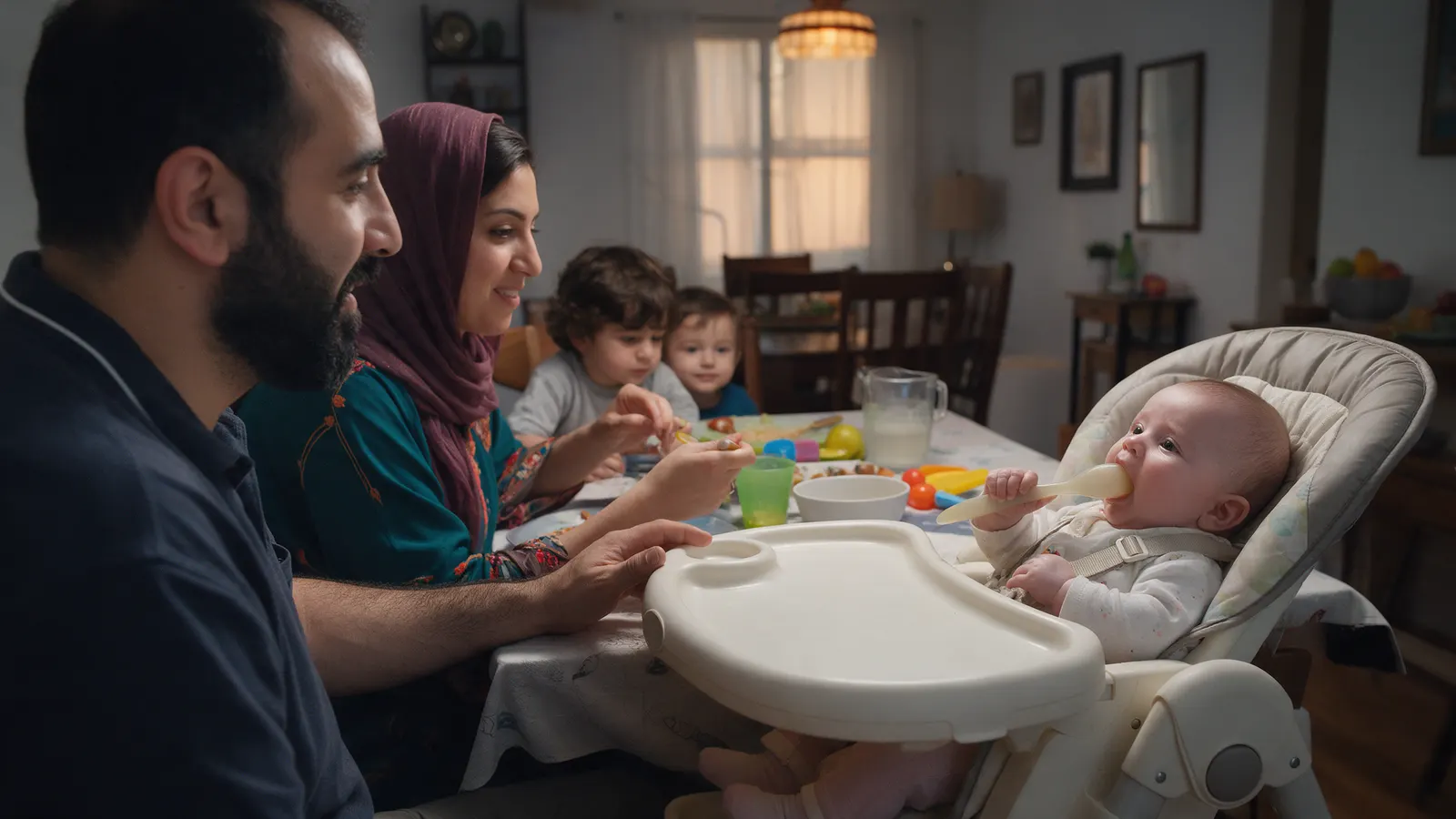
Your baby stares at your fork now, and someone has said, "Looks ready to me." Here is what ready means, and why the answer is still not yet.
Heart
Breast milk or formula is still the only food and drink your baby needs; CDC says babies aren't ready for other foods, water, or other drinks for about the first 6 months (CDC). CDC says babies can start solids at about 6 months and that starting before 4 months isn't recommended (CDC); WHO guidance also starts other foods at about 6 months (WHO, 2023). Many babies double their birth weight at about 4 months (AAP), on milk alone. The staring is interest, not a signal.
Head
The readiness signs come as a set: sitting up with support, steady head control, opening the mouth when food comes, and swallowing rather than pushing food out (CDC). The research on starting early is mixed and doesn't change the advice. In a UK trial of 1,303 breastfed babies, those assigned to start solids at 3 months slept about 16.6 minutes longer a night at 6 months than those who waited (Perkin et al., 2018), while in a US study of 847 children, formula-fed babies who started solids before 4 months had about 6 times the odds of obesity at age 3, a link that doesn't prove cause (Huh et al., 2011).
Body
Two things to ask about now rather than at 6 months. Breastfed babies need vitamin D drops: the AAP recommends 400 IU a day, and formula-fed babies need a supplement until they drink about 32 ounces of formula a day (Porto & Abu-Alreesh, AAP). The AAP's 4-month checkup page recommends a liquid iron supplement of 1 mg per kilogram a day for breastfed babies until iron-rich foods start at about 6 months (AAP), while its July 2026 clinical report calls for iron supplements for exclusively breastfed babies by 6 months (AAP, 2026), so ask about timing and dose. And if your baby has severe eczema or an egg allergy, ask about peanut now (NIAID).
Try today
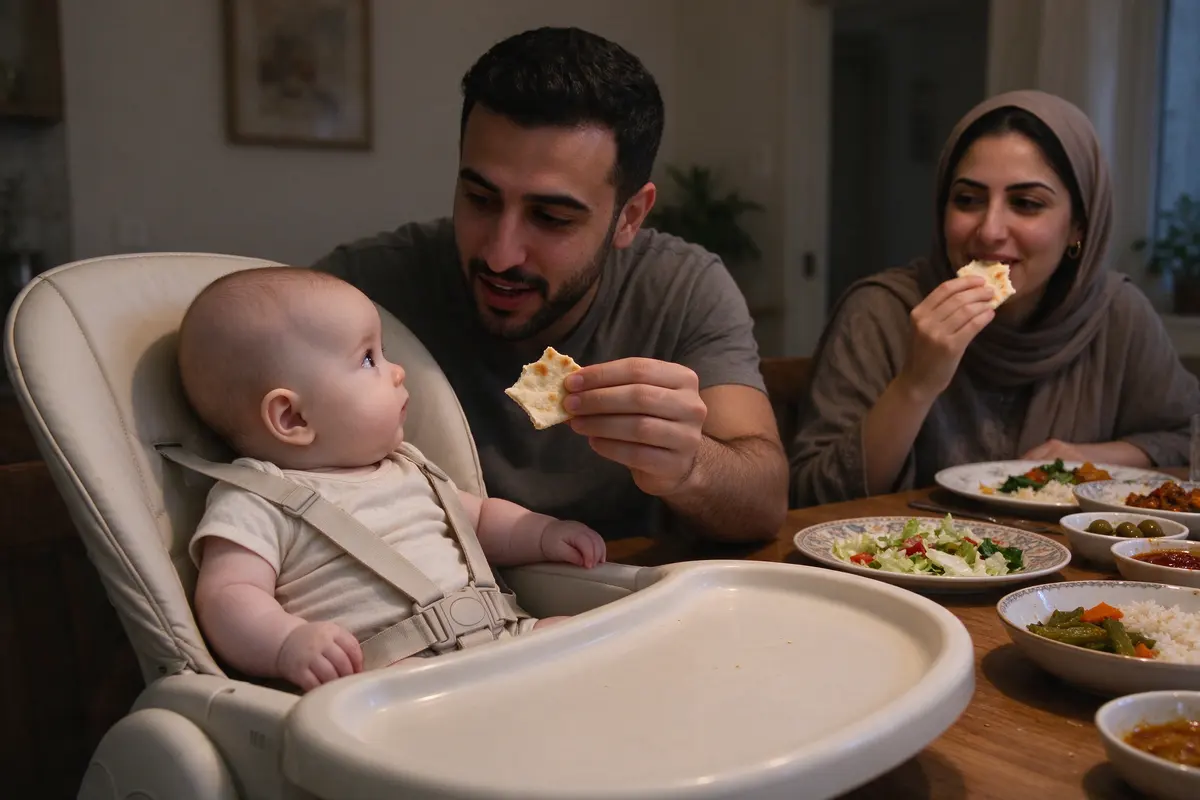
The high-chair rehearsal
Time: One family meal, 20 minutes or less
If your high chair reclines or supports a baby who can't sit alone yet, buckle them in at the table's end; otherwise, a lap at the table.
No food on the tray. Give them a big plastic cup or a spoon from the mouthing basket to hold and gum (AAP).
Eat your meal and narrate it: "Rice. Hot rice. Mama's eating rice." Say what you see without feeding.
Out of the chair before an hour, and sooner when they fuss (WHO).
Make it work:This is practice at being part of the table, not at eating. Nothing goes in the mouth but milk until about 6 months (CDC).
Watch for
Normal
an open mouth and a lunge at your plate. That's one sign of a set, not a start date (CDC).
Call your pediatrician
if your baby seems unwell, has fewer wet diapers, or isn't growing as expected (Jain & Bunik, AAP).
Normal
spit-up after a wriggly feed at the table.
Go to the ER now
if your baby vomits green (bile) or blood (AAP).
Normal
a day with a little less milk and a little more play.
Call your pediatrician right away
for signs of dehydration: no wet diaper in more than 8 hours, a very dry mouth, or no tears (AAP).
For you
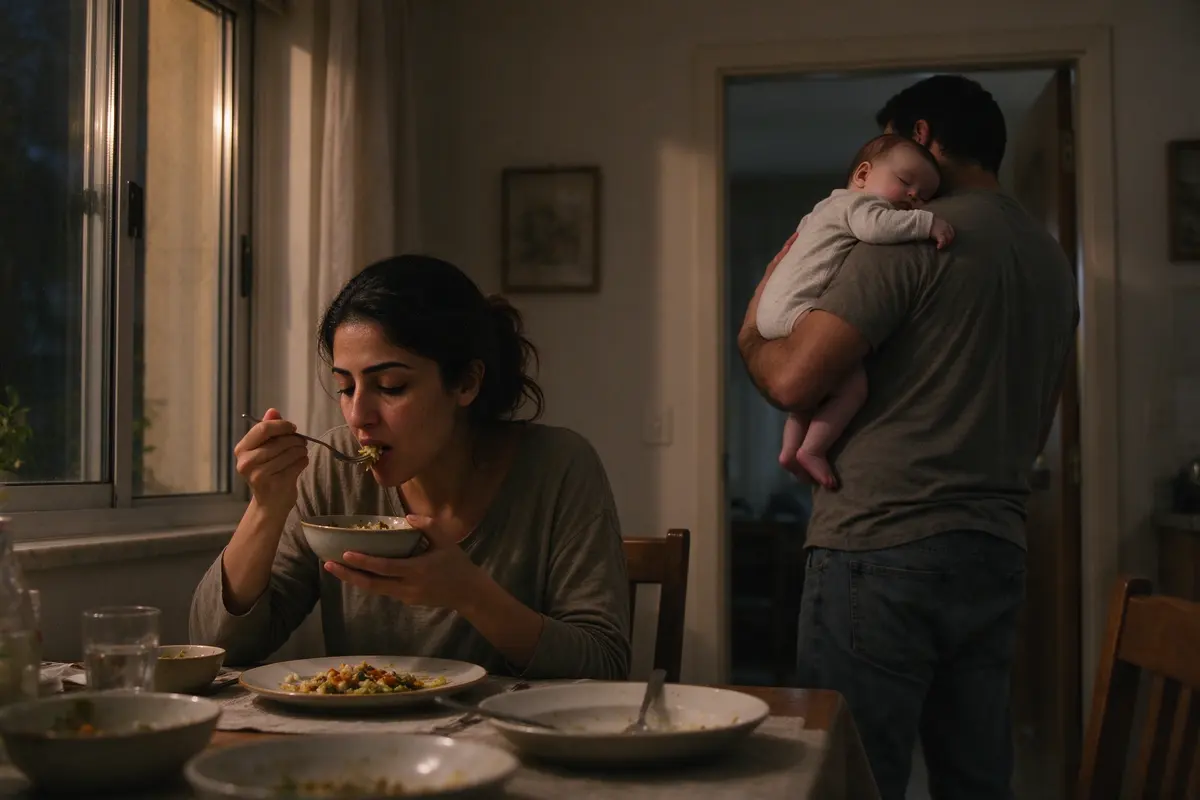
Your own meal at the table. Make it the rule tonight: your plate gets filled first and finished, sitting, with two hands, in front of your baby. Plenty of water and fresh fruits and vegetables on it are the plain fix for the constipation that often follows birth (OWH).
Overwhelming tiredness is on the CDC's list of urgent maternal warning signs, and the rule is still to seek care and say you were pregnant within the last year (CDC). Tired is expected. Tired past the point of function is a call.
If you're the partner: you plate her food first and sit the baby next to you, not her. She eats without a lap.
Sources
- Centers for Disease Control and Prevention. "Milestones by 4 Months." Learn the Signs. Act Early., updated 2026. https://www.cdc.gov/act-early/milestones/4-months.html
- Centers for Disease Control and Prevention. "When, What, and How to Introduce Solid Foods." Updated 2026. https://www.cdc.gov/infant-toddler-nutrition/foods-and-drinks/when-what-and-how-to-introduce-solid-foods.html
- World Health Organization. "WHO Guideline for complementary feeding of infants and young children 6–23 months of age." 2023. https://www.who.int/publications/i/item/9789240081864
- American Academy of Pediatrics. "When Can Babies Start Solid Foods? Readiness & Feeding Tips." HealthyChildren.org, updated 2026. https://www.healthychildren.org/English/ages-stages/baby/feeding-nutrition/Pages/Starting-Solid-Foods.aspx
- Perkin MR, Bahnson HT, Logan K, et al. "Association of Early Introduction of Solids With Infant Sleep: A Secondary Analysis of a Randomized Clinical Trial." JAMA Pediatrics, 2018. https://pubmed.ncbi.nlm.nih.gov/29987321/
- Huh SY, Rifas-Shiman SL, Taveras EM, Oken E, Gillman MW. "Timing of solid food introduction and risk of obesity in preschool-aged children." Pediatrics, 2011. https://pubmed.ncbi.nlm.nih.gov/21300681/
- Porto A, Abu-Alreesh S. "Vitamin D for Babies, Children & Adolescents." HealthyChildren.org, updated 2022. https://www.healthychildren.org/English/healthy-living/nutrition/Pages/vitamin-d-on-the-double.aspx
- American Academy of Pediatrics. "Checkup Checklist: 4 Months Old." HealthyChildren.org, updated 2023. https://www.healthychildren.org/English/ages-stages/Your-Childs-Checkups/Pages/Your-Checkup-Checklist-4-Months-Old.aspx
- American Academy of Pediatrics. "Iron Deficiency & Iron Deficiency Anemia: AAP Updates Screening, Prevention & Treatment Guidance." HealthyChildren.org, 2026. https://www.healthychildren.org/English/news/Pages/iron-deficiency-anemia-prevention-screening-treatment-AAP-updates-guidance.aspx
- National Institute of Allergy and Infectious Diseases. "Addendum Guidelines for the Prevention of Peanut Allergy in the United States: Summary for Parents and Caregivers." 2017. https://www.niaid.nih.gov/sites/default/files/peanut-allergy-prevention-guidelines-parent-summary.pdf
- American Academy of Pediatrics. "Cognitive Development in Infants: 4 to 7 Months." HealthyChildren.org, updated 2023. https://www.healthychildren.org/English/ages-stages/baby/Pages/Cognitive-Development-4-to-7-Months.aspx
- World Health Organization. "To grow up healthy, children need to sit less and play more." 2019. https://www.who.int/news/item/24-04-2019-to-grow-up-healthy-children-need-to-sit-less-and-play-more
- Jain S, Bunik M. "How Often and How Much Should Your Baby Eat?" HealthyChildren.org, updated 2024. https://www.healthychildren.org/English/ages-stages/baby/feeding-nutrition/Pages/How-Often-and-How-Much-Should-Your-Baby-Eat.aspx
- American Academy of Pediatrics. "Vomiting Without Diarrhea" (symptom checker). HealthyChildren.org, accessed 2026. https://www.healthychildren.org/English/tips-tools/symptom-checker/Pages/symptomviewer.aspx?symptom=Vomiting+Without+Diarrhea
- American Academy of Pediatrics. "Fever" (symptom checker). HealthyChildren.org, accessed 2026. https://www.healthychildren.org/English/tips-tools/symptom-checker/Pages/symptomviewer.aspx?symptom=Fever
- Office on Women's Health. "Recovering from birth." US Department of Health and Human Services. https://womenshealth.gov/pregnancy/childbirth-and-beyond/recovering-birth
- Centers for Disease Control and Prevention. "Urgent Maternal Warning Signs and Symptoms." HEAR HER, 2024. https://www.cdc.gov/hearher/maternal-warning-signs/index.html
This guide is general education that summarizes published research and guidance from groups like the American Academy of Pediatrics, the CDC, and the WHO. It isn’t medical advice, and every child develops on their own timeline. Your pediatrician knows your child; if something feels wrong, call them. In an emergency, call 911.
Get each day’s note the morning it applies
Add your baby to a free Chorevia household with their date of birth, and every morning for 300 days the day’s note arrives in the app and by email: what’s developing, one thing to try, what to watch for, and a word for you.
Create your household