Day 125 of 300 · Week 17
I can make things happen
Last reviewed · 3 min read · 13 sources · Plain-text version
Around 4 months babies discover that a kick shakes the mat and a wave rattles the rattle. What that memory looks like in the lab, and a safe way to stage the concert.

Somewhere around now, your baby works out that they can make things happen. Today you put an instrument where their feet are.
Heart
Around 4 months, babies start figuring out that they can make things happen: a kick shakes the crib, a wave rattles the rattle. Sometime after 4 months, they also begin to learn that things still exist when they're out of sight (AAP). Rattles rattle, kicks shake the mat, and smiles bring you closer; that is the lesson of the month, and it needs no teacher beyond you (AAP).
Head
The classic experiment was built on kicking. Three-month-olds learned that kicking moved a crib mobile. They usually forgot after about 8 days, but a brief reminder the day before the test let them remember for 2 to 4 weeks (Rovee-Collier et al., 1980). Repeated games stick; your baby is learning what to expect. What they know about hidden things is harder to pin down: 5-month-olds in the famous "drawbridge" study looked longer at a screen that seemed to rotate through a hidden box (Baillargeon et al., 1985), but a later study found babies looked longer at the bigger rotation even with no box at all (Rivera et al., 1999). Play the games for the fun of them.
Body
The AAP's example is a kick that shakes the crib. Yours happens on the floor, with you holding the instrument. Never tie anything to your baby's arms or legs, and nothing goes in the crib: a firm, flat surface with only a fitted sheet, no toys, no positioners (Moon, AAP). The same goes for anything dangling: use cordless blinds or keep cords out of reach (AAP).
Try today

The crib-kick concert
Time: 2 to 5 minutes · Kick and see in the guide
Lay your baby on their back on the floor mat and hold a crinkly toy or a soft drum where their feet can reach it.
When a kick lands and it makes a sound, react with delight.
Hold it still and wait. See if they kick again on purpose.
Swap the instrument: a rattle held against the soles, a square of crinkly fabric, your own hands clapping when a foot hits.
Do it again tomorrow; a reminder is what keeps the memory (Rovee-Collier et al., 1980).
Make it work:The toy stays in your hand, never tied to them, and never left in the crib (Moon, AAP).
Watch for
- Normal: kicks strong enough to scoot across the mat. Never leave your baby alone on a changing table, even for a moment, even strapped in (AAP), and call your pediatrician right away for any head injury, including a fall from a bed, couch, or changing table (AAP).
- Normal: feeds cut short by looking around; babies get far more aware of the world around 4 to 6 months, and a phone, a pet, or a voice can pull them off mid-feed (Australian Breastfeeding Association). Call your pediatrician right away for signs of dehydration: no wet diaper in more than 8 hours, a very dry mouth, or no tears (AAP).
- Go to the ER now if your baby vomits green (bile) or blood (AAP).
For you
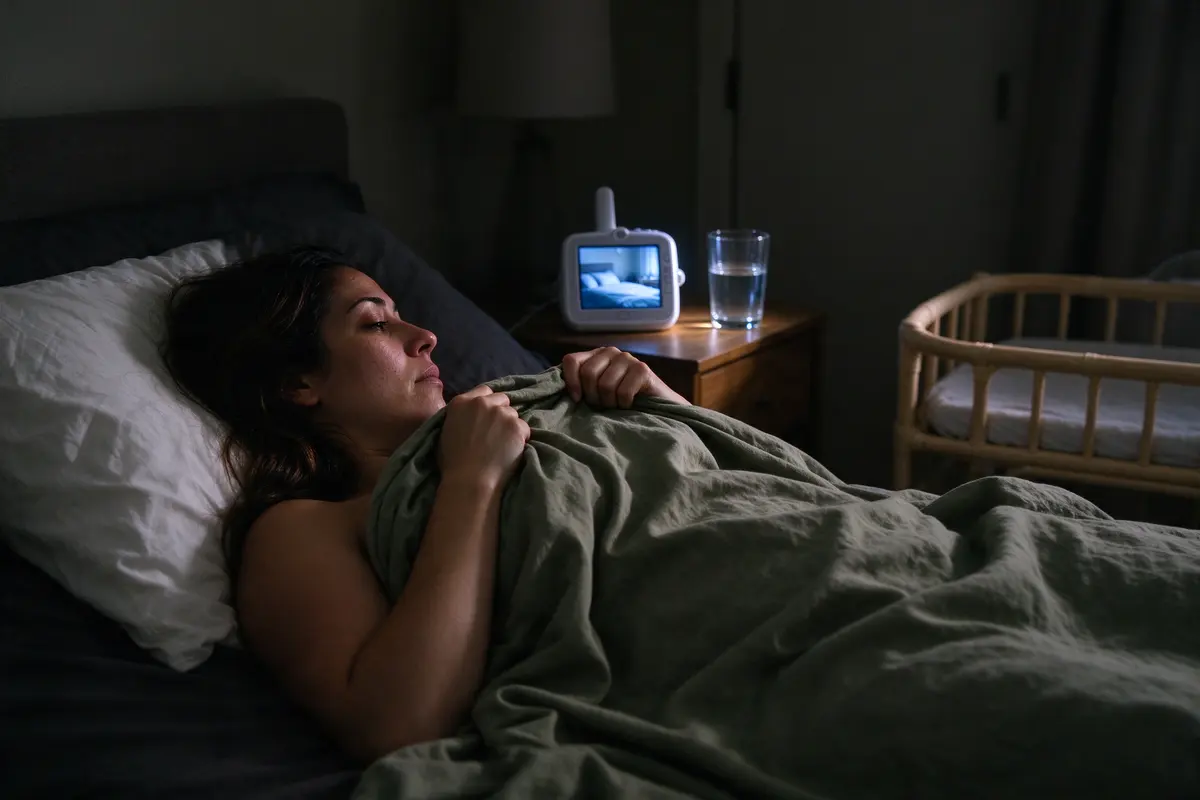
One cause and effect for you. New mothers' sleep is more broken than short, and it gets less fragmented over the first 4 months (Montgomery-Downs et al., 2010), so a long stretch is finally something that can exist. The AAP's tip for tired parents is to bank sleep: nap when your baby naps, and go to bed right after the last feed (Moon, AAP). Tonight, run the experiment. Last feed, lights out, no scrolling. See what the kick does.
If you're the partner: the first waking is yours tonight, so her stretch stays whole.
Sources
- American Academy of Pediatrics. "Cognitive Development in Infants: 4 to 7 Months." HealthyChildren.org, 2023. https://www.healthychildren.org/English/ages-stages/baby/Pages/Cognitive-Development-4-to-7-Months.aspx
- Rovee-Collier CK, Sullivan MW, Enright M, Lucas D, Fagen JW. "Reactivation of infant memory." Science, 1980. https://pubmed.ncbi.nlm.nih.gov/7375924/
- Baillargeon R, Spelke ES, Wasserman S. "Object permanence in five-month-old infants." Cognition, 1985. https://pubmed.ncbi.nlm.nih.gov/4064606/
- Rivera SM, Wakeley A, Langer J. "The drawbridge phenomenon: representational reasoning or perceptual preference?" Developmental Psychology, 1999. https://pubmed.ncbi.nlm.nih.gov/10082013/
- Moon RY. "How to Keep Your Sleeping Baby Safe: AAP Policy Explained." HealthyChildren.org, 2026. https://www.healthychildren.org/English/ages-stages/baby/sleep/Pages/a-parents-guide-to-safe-sleep.aspx
- American Academy of Pediatrics. "Home Safety: Tips for Families With Young Children." HealthyChildren.org, 2022. https://www.healthychildren.org/English/safety-prevention/at-home/Pages/home-safety-heres-how.aspx
- American Academy of Pediatrics. "Changing Table Safety." HealthyChildren.org, 2009. https://www.healthychildren.org/English/safety-prevention/at-home/Pages/Changing-Table-Safety.aspx
- American Academy of Pediatrics. "Head Injury" (symptom checker). HealthyChildren.org, 2026. https://www.healthychildren.org/English/tips-tools/symptom-checker/Pages/symptomviewer.aspx?symptom=Head+Injury
- Australian Breastfeeding Association. "Feeding your distractible baby." 2025. https://www.breastfeeding.asn.au/resources/distractible-baby
- American Academy of Pediatrics. "Fever" (symptom checker). HealthyChildren.org, 2026. https://www.healthychildren.org/English/tips-tools/symptom-checker/Pages/symptomviewer.aspx?symptom=Fever
- American Academy of Pediatrics. "Vomiting Without Diarrhea" (symptom checker). HealthyChildren.org, 2026. https://www.healthychildren.org/English/tips-tools/symptom-checker/Pages/symptomviewer.aspx?symptom=Vomiting+Without+Diarrhea
- Montgomery-Downs HE, Insana SP, Clegg-Kraynok MM, Mancini LM. "Normative longitudinal maternal sleep: the first 4 postpartum months." American Journal of Obstetrics and Gynecology, 2010. https://pubmed.ncbi.nlm.nih.gov/20719289/
- Moon RY. "Safe Sleep Tips for Sleep-Deprived New Parents." HealthyChildren.org, 2026. https://www.healthychildren.org/English/ages-stages/baby/sleep/Pages/safe-sleep-tips-for-sleep-deprived-parents.aspx
This guide is general education that summarizes published research and guidance from groups like the American Academy of Pediatrics, the CDC, and the WHO. It isn’t medical advice, and every child develops on their own timeline. Your pediatrician knows your child; if something feels wrong, call them. In an emergency, call 911.
Get each day’s note the morning it applies
Add your baby to a free Chorevia household with their date of birth, and every morning for 300 days the day’s note arrives in the app and by email: what’s developing, one thing to try, what to watch for, and a word for you.
Create your household