Day 144 of 300 · Week 20
Sun
Last reviewed · 4 min read · 12 sources · Plain-text version
Babies under 6 months stay out of direct and indirect sun: shade, light long sleeves, a wide-brimmed hat, and no outings from 10 a.m. to 4 p.m. Why daylight still matters, and a shade walk to try.
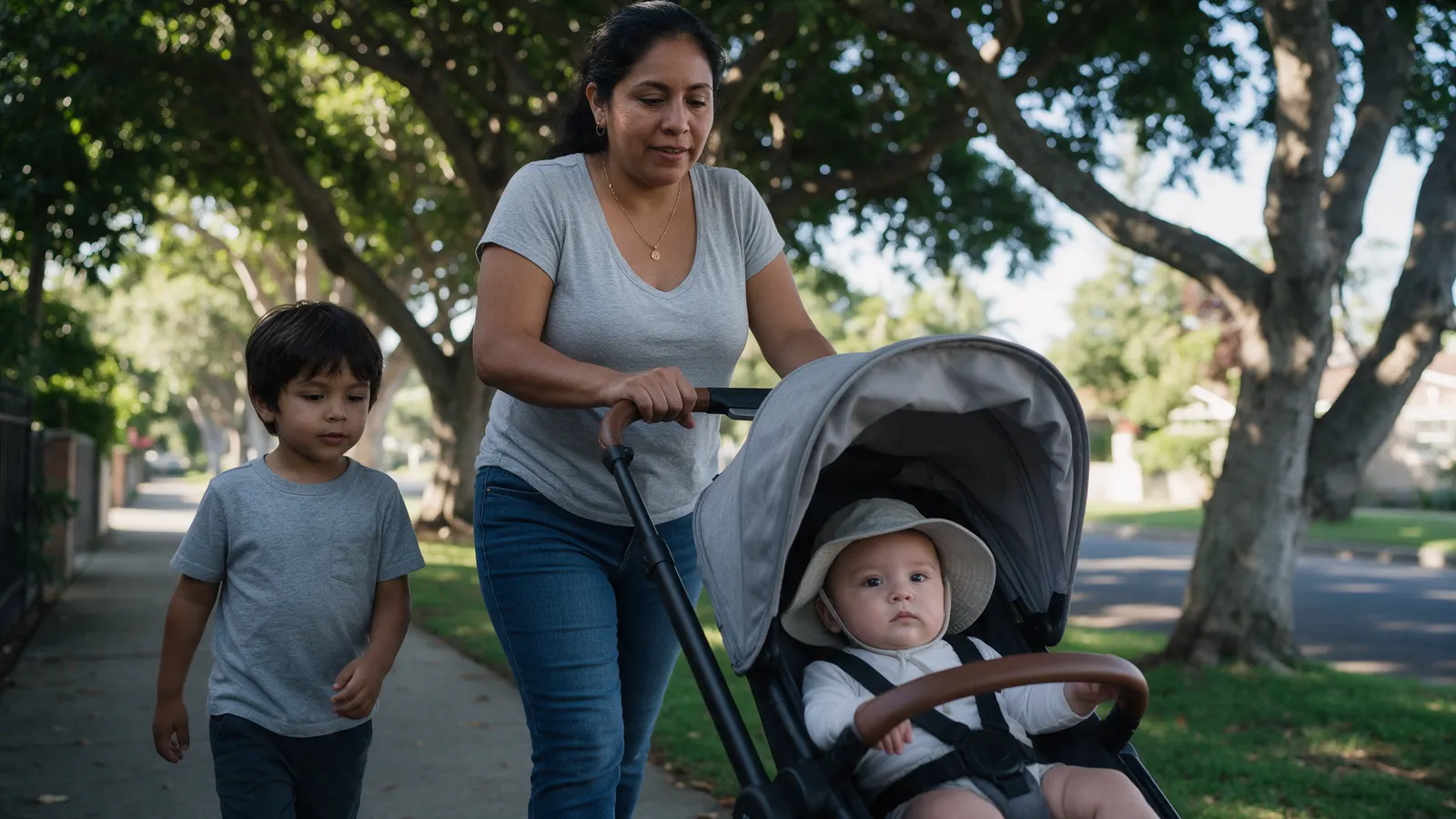
Spring, summer, or a bright winter morning: the sun rule for babies under 6 months is strict, and the reason is heat, not just skin. Here is how to get outside anyway.
Heart
The AAP says babies under 6 months should be kept out of direct and indirect sun because of the risk of heat stroke; use shade, light long sleeves, and a wide-brimmed hat, and avoid outings from 10 a.m. to 4 p.m. (Gupta & Mahoney, AAP). "Indirect" is the word to notice: the stroller canopy and the shade of a tree are the plan, not a sunny blanket on the grass. The hat will come off, because hands grab everything now (AAP), so the shade has to do the work the hat can't.
Head
Daylight still matters, in the right hours. In one study of 56 babies 6 to 12 weeks old, those who slept better at night got more daytime light, especially in the early afternoon, a link that doesn't prove cause (Harrison, 2004). In the middle of the day, the NHS suggestion is to open the curtains and play near a window instead of going out (NHS). So the walk goes early or late, and the bright hours happen indoors with the blinds up.
Body
Keep the strapped-in time short: WHO advises not keeping babies in strollers, high chairs, or carriers for more than 1 hour at a time, with floor play several times a day (WHO). Dress for the walk in light long sleeves and a wide-brimmed hat (Gupta & Mahoney, AAP), and when you're home, check the chest or the back of the neck for signs of overheating like sweating, a hot chest, or flushed skin (AAP; NHS). A warm baby gets a layer off and a feed, and a very hot one gets a thermometer.
Try today
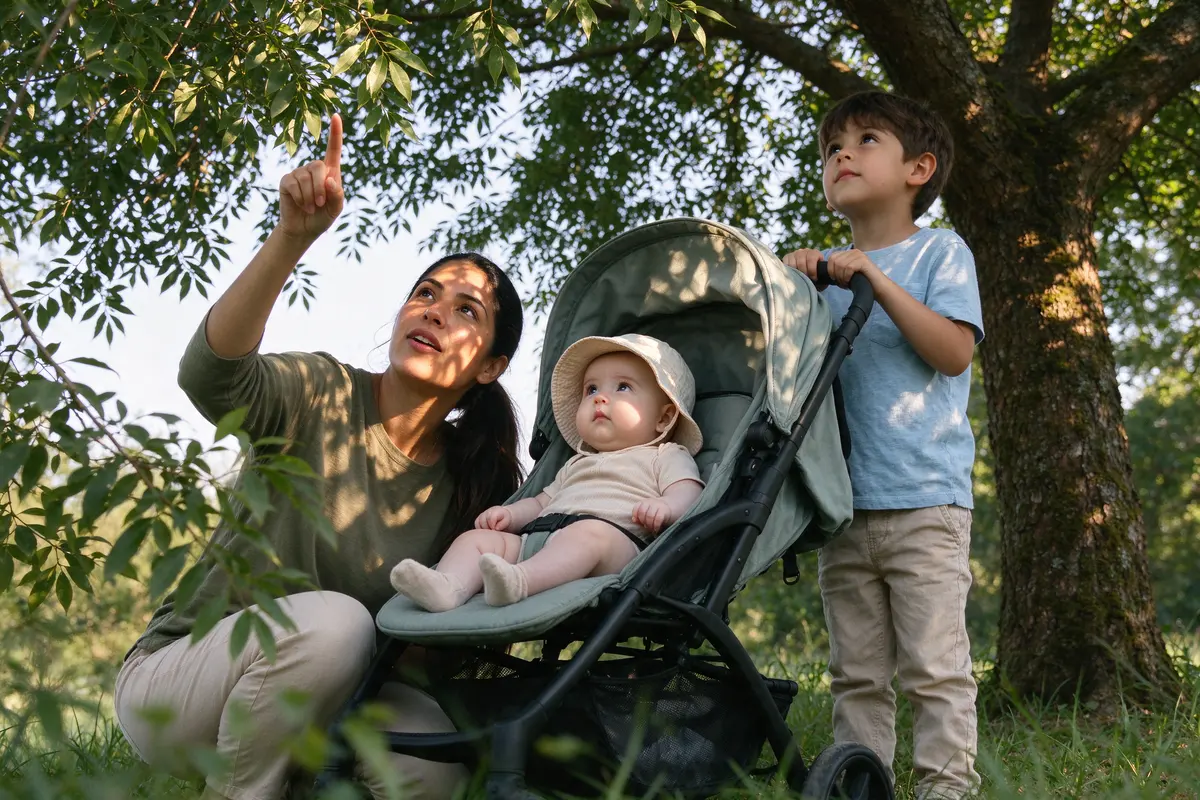
The shade walk
Time: 20 to 40 minutes, before 10 a.m. or after 4 p.m. · Daylight walk in the guide
Pick the hour: before 10 a.m. or after 4 p.m., never the middle of the day (Gupta & Mahoney, AAP).
Dress your baby in light long sleeves and a wide-brimmed hat, and put the stroller canopy all the way up (Gupta & Mahoney, AAP).
Walk the shady side of the street and stop under trees; narrate what you see, with pauses for their reply.
Keep it under an hour strapped in, then floor time at home (WHO).
Make it work:In a carrier, the same shade rules apply, and you still check often that you can see your baby's face and nothing blocks their nose and mouth (CPSC).
Watch for
Normal
a damp head under the hat on a warm day; skip hats indoors and dress your baby in only one more layer than you'd wear (AAP).
Call your pediatrician right away
for signs of dehydration: no wet diaper in more than 8 hours, a very dry mouth, or no tears (AAP).
Normal
a warm baby after a walk who cools down with a layer off. A rectal temperature of 100.4°F (38°C) or higher is a fever; at 3 to 6 months,
contact your pediatrician within 24 hours
about any fever, and sooner for 104°F (40°C) or higher or a baby who seems very sick (AAP).
Normal
fast breathing for a moment after a big squeal.
Go to the ER now
for any trouble breathing, or ribs pulling in with each breath (AAP).
For you
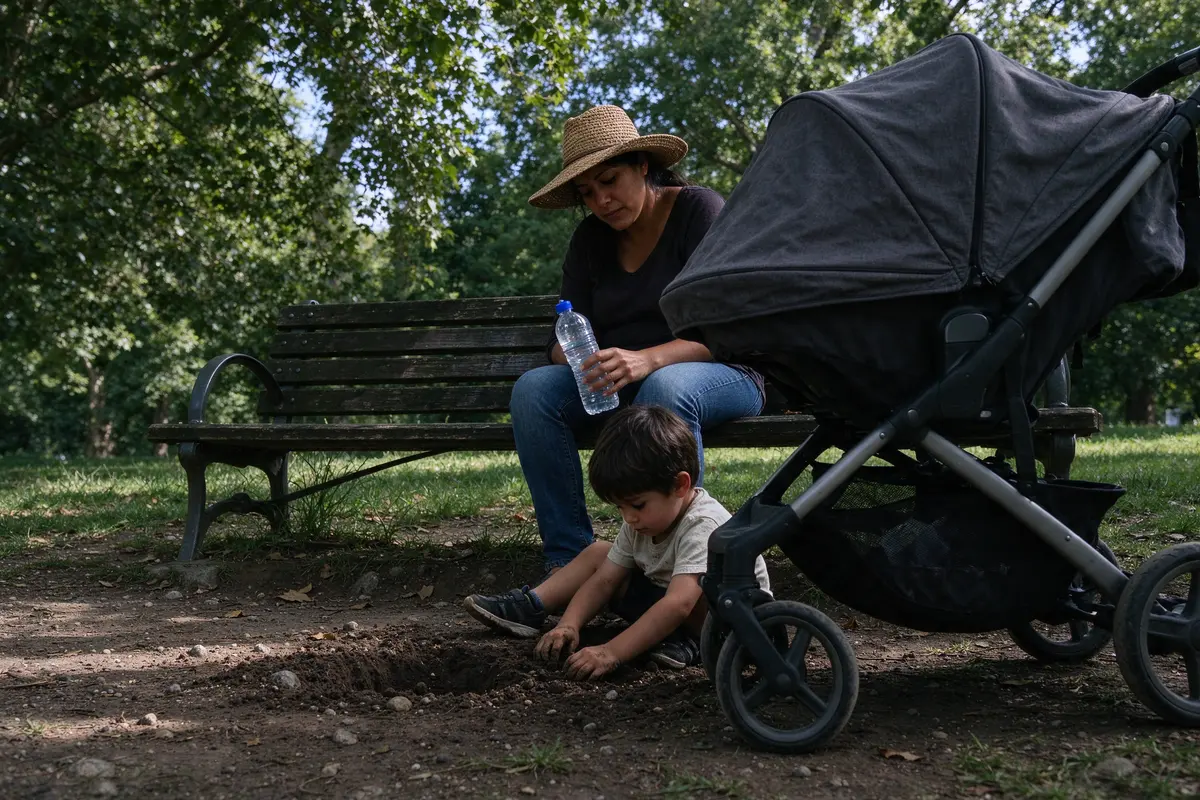
Your own hat. And your own water bottle, and the bench in the shade. The walk is for both of you, and the rules you follow for the baby's head apply nearly as well to yours.
If you had a C-section, walking is still medicine: it helps healing and helps prevent clots (MedlinePlus). Whatever kind of birth you had, the early walk is also one of the few quiet places to notice how you're doing. If the low mood has lasted more than two weeks, go to the doctor; don't wait for a visit that's already on the calendar (OWH).
If you're the partner: take the evening walk, after 4 p.m., so she gets the quiet hour at home.
Sources
- Gupta D, Mahoney M. "Baby Sunburn Prevention Tips." HealthyChildren.org, 2026. https://www.healthychildren.org/English/ages-stages/baby/bathing-skin-care/Pages/Baby-Sunburn-Prevention.aspx
- American Academy of Pediatrics. "Infant Vision Development: What Can Babies See?" HealthyChildren.org, 2024. https://www.healthychildren.org/English/ages-stages/baby/Pages/Babys-Vision-Development.aspx
- Harrison Y. "The relationship between daytime exposure to light and night-time sleep in 6-12-week-old infants." Journal of Sleep Research, 2004. https://pubmed.ncbi.nlm.nih.gov/15560769/
- NHS. "Helping your baby to sleep." 2023. https://www.nhs.uk/baby/caring-for-a-newborn/helping-your-baby-to-sleep/
- World Health Organization. "To grow up healthy, children need to sit less and play more." 2019. https://www.who.int/news/item/24-04-2019-to-grow-up-healthy-children-need-to-sit-less-and-play-more
- Moon RY. "How to Keep Your Sleeping Baby Safe: AAP Policy Explained." HealthyChildren.org, 2026. https://www.healthychildren.org/English/ages-stages/baby/sleep/Pages/a-parents-guide-to-safe-sleep.aspx
- NHS. "Sudden infant death syndrome (SIDS)." 2023. https://www.nhs.uk/conditions/sudden-infant-death-syndrome-sids/
- US Consumer Product Safety Commission. "CPSC Educates New Parents on Safe Babywearing." 2011. https://www.cpsc.gov/Newsroom/News-Releases/2011/CPSC-Educates-New-Parents-on-Safe-BabywearingInfant-suffocation-deaths-in-slings-prompt-renewed-effort-to-warn-moms-and-dads
- American Academy of Pediatrics. "Fever" (symptom checker). HealthyChildren.org, 2026. https://www.healthychildren.org/English/tips-tools/symptom-checker/Pages/symptomviewer.aspx?symptom=Fever
- American Academy of Pediatrics. "Breathing Trouble" (symptom checker). HealthyChildren.org, 2026. https://www.healthychildren.org/English/tips-tools/symptom-checker/Pages/symptomviewer.aspx?symptom=Breathing+Trouble
- MedlinePlus. "Going home after a C-section." National Library of Medicine, 2024. https://medlineplus.gov/ency/patientinstructions/000624.htm
- Office on Women's Health. "Recovering from birth." US Department of Health and Human Services, 2021. https://womenshealth.gov/pregnancy/childbirth-and-beyond/recovering-birth
This guide is general education that summarizes published research and guidance from groups like the American Academy of Pediatrics, the CDC, and the WHO. It isn’t medical advice, and every child develops on their own timeline. Your pediatrician knows your child; if something feels wrong, call them. In an emergency, call 911.
Get each day’s note the morning it applies
Add your baby to a free Chorevia household with their date of birth, and every morning for 300 days the day’s note arrives in the app and by email: what’s developing, one thing to try, what to watch for, and a word for you.
Create your household