Day 150 of 300 · Five months
Five months
Last reviewed · 4 min read · 16 sources · Plain-text version
Five months. The 6-month list as coming soon, for most: laughs, raspberries, rolling, straight arms. What you've done in 150 days of answering, a first-roll video to keep, and the next guide.

Five months. Today's list is for celebrating, and nobody is keeping score.
Heart
Coming soon, for most: the 6-month list has laughing, taking turns making sounds, blowing raspberries, reaching for a toy they want, rolling from tummy to back, and pushing up on straight arms (CDC). Those are skills at least 75% of babies show by 6 months (Zubler et al., 2022), so at five months many babies don't yet, and that's on schedule. Rocking and "swimming" on the tummy usually appear at about 5 months and lead to rolling, most often tummy to back first (AAP).
Head
What you've done. You cannot spoil a young baby with attention, and babies whose calls for help are answered cry less overall (AAP); you answered for 150 days. Those answers helped build brain circuits (Harvard Center on the Developing Child). The games stuck: in a classic experiment, 3-month-olds who learned that kicking moved a mobile remembered it for 2 to 4 weeks with a brief reminder (Rovee-Collier et al., 1980), and 4½-month-olds in a lab preferred the sound of their own name over other names (Mandel et al., 1995). Your baby knows the peekaboo rhythm and the sound of their name, and you taught both without a lesson.
Body
The rules that don't change: on the back for every sleep, a firm, flat surface with only a fitted sheet, and room-sharing, never bed-sharing, for at least the first 6 months; once your baby rolls both ways on their own, you don't need to keep turning them back, as long as the crib is bare (Moon, AAP). Everything else about the next month is in the 5-month guide.
Try today
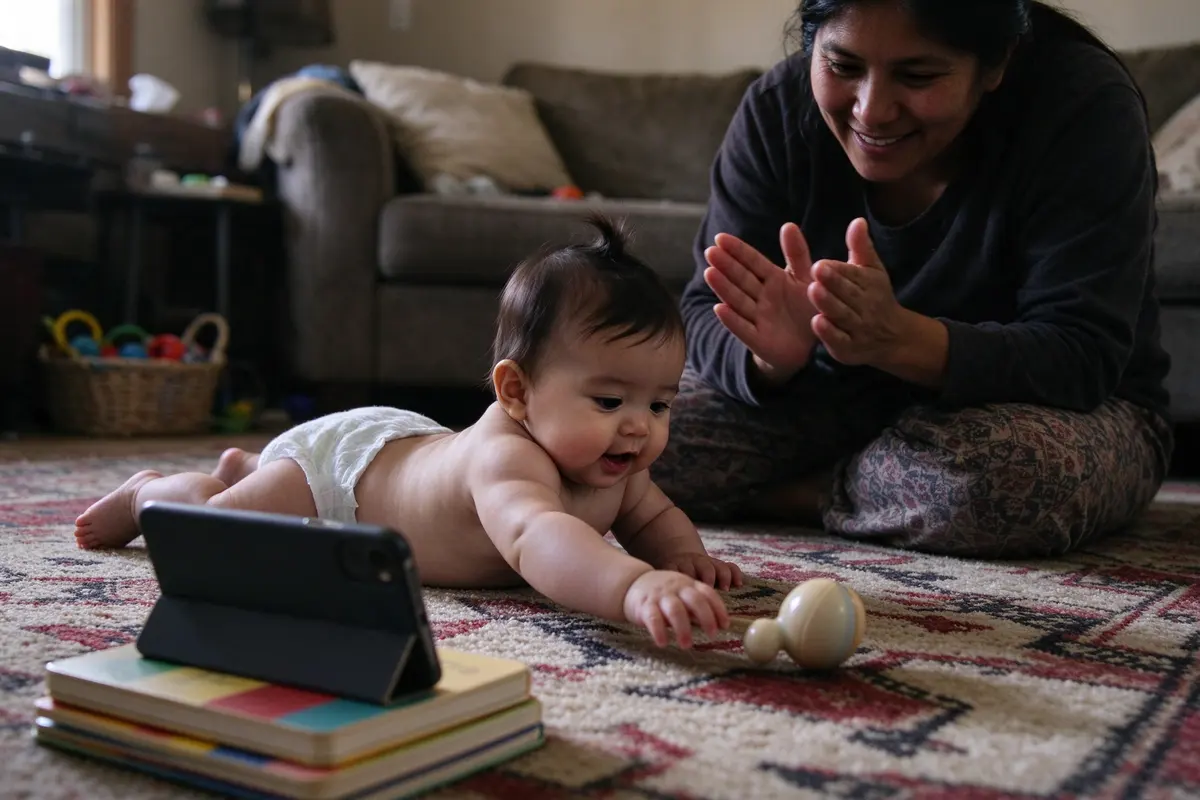
The first-roll video
Time: 5 to 10 minutes of tummy time, phone propped, hands free · Toy circle tummy time in the guide
Lay your baby tummy-down on a firm mat on the floor, and prop the phone against a book, recording; your hands and face are for the baby (AAP).
Put a favorite toy just out of reach to one side, so twisting toward it gives the roll a reason (AAP).
Get down at eye level and cheer every rock, swim, and pivot (AAP).
If the roll comes, you have it. If not, you have the rocking, the first half of the roll, and you'll still watch it most.
Save it next to the first-smile video, with the date.
Make it work:No studies show that practice makes rolling happen sooner (AAP). A keepsake, not a drill; stop when they fuss, floor only.
Watch for
Normal
a first roll in the crib, in either direction; always lay your baby down on their back, and stop swaddling at the first sign of rolling (AAP).
Turn them back and ask your pediatrician
what to do next if your baby rolls one way but can't roll back yet (Moon, AAP).
Normal
drool and gnawing; teething typically starts between 4 and 7 months (AAP). Teething doesn't cause a true fever, so a rectal temperature of 100.4°F (38°C) or higher, or a very unhappy baby, means
call your pediatrician
(AAP).
Normal
a stuffy nose.
Call 911
if your baby is struggling for each breath, has stopped breathing, or has bluish lips or face (AAP).
Normal
not being sure whether something is wrong.
Call anyway
if your baby just doesn't seem right to you. Trust your instincts; five months have trained them (Lurie Children's).
For you

You did five months. Nobody hands out the certificate, so here it is: one hundred and fifty mornings, every one answered. If it's heavier than tired: feelings that are severe or last longer than 2 weeks may be postpartum depression, and it responds to treatment (NIMH). Five months in is not too late to say it.
Once more, lightly: the National Maternal Mental Health Hotline is 1-833-TLC-MAMA (1-833-852-6262), call or text, and 988 is for anyone (CDC).
If you're the partner: you did it too, and the numbers are yours as well. Say one thing she did this month that you noticed, then read what's next together: the 5-month guide.
Sources
- Centers for Disease Control and Prevention. "Milestones by 6 Months." Learn the Signs. Act Early., 2026. https://www.cdc.gov/act-early/milestones/6-months.html
- Zubler JM, Wiggins LD, Macias MM, et al. "Evidence-Informed Milestones for Developmental Surveillance Tools." Pediatrics, 2022. https://pubmed.ncbi.nlm.nih.gov/35132439/
- American Academy of Pediatrics. "Movement Milestones: Babies 4 to 7 Months." HealthyChildren.org, 2021. https://www.healthychildren.org/English/ages-stages/baby/Pages/Movement-4-to-7-Months.aspx
- American Academy of Pediatrics. "Responding to Your Baby's Cries." HealthyChildren.org, 2025. https://www.healthychildren.org/English/ages-stages/baby/crying-colic/Pages/Responding-to-Your-Babys-Cries.aspx
- Center on the Developing Child at Harvard University. "Serve and Return." Accessed 2026. https://developingchild.harvard.edu/key-concept/serve-and-return/
- Rovee-Collier CK, Sullivan MW, Enright M, Lucas D, Fagen JW. "Reactivation of infant memory." Science, 1980. https://pubmed.ncbi.nlm.nih.gov/7375924/
- Mandel DR, Jusczyk PW, Pisoni DB. "Infants' recognition of the sound patterns of their own names." Psychological Science, 1995. https://pubmed.ncbi.nlm.nih.gov/25152566/
- Moon RY. "How to Keep Your Sleeping Baby Safe: AAP Policy Explained." HealthyChildren.org, 2026. https://www.healthychildren.org/English/ages-stages/baby/sleep/Pages/a-parents-guide-to-safe-sleep.aspx
- Moon RY, Glassy D. "Swaddling: Is it Safe for Your Baby?" HealthyChildren.org, 2022. https://www.healthychildren.org/English/ages-stages/baby/diapers-clothing/Pages/Swaddling-Is-it-Safe.aspx
- American Academy of Pediatrics. "Back to Sleep, Tummy to Play: Give Your Baby a Safe, Strong Start." HealthyChildren.org, 2026. https://www.healthychildren.org/English/ages-stages/baby/sleep/Pages/back-to-sleep-tummy-to-play.aspx
- American Academy of Pediatrics. "When Does Teething Start?" HealthyChildren.org, 2024. https://www.healthychildren.org/English/ages-stages/baby/teething-tooth-care/Pages/Teething-4-to-7-Months.aspx
- American Academy of Pediatrics. "Fever and Your Baby." HealthyChildren.org, 2025. https://www.healthychildren.org/English/health-issues/conditions/fever/Pages/Fever-and-Your-Baby.aspx
- American Academy of Pediatrics. "Breathing Trouble" (symptom checker). HealthyChildren.org, 2026. https://www.healthychildren.org/English/tips-tools/symptom-checker/Pages/symptomviewer.aspx?symptom=Breathing+Trouble
- Lurie Children's Hospital of Chicago. "When to Call the Pediatrician for Your Newborn." 2024. https://www.luriechildrens.org/en/blog/when-to-call-the-pediatrician-for-your-newborn/
- National Institute of Mental Health. "Perinatal Depression." 2023. https://www.nimh.nih.gov/health/publications/perinatal-depression
- Centers for Disease Control and Prevention. "Symptoms of Depression Among Women." 2024. https://www.cdc.gov/reproductive-health/depression/index.html
This guide is general education that summarizes published research and guidance from groups like the American Academy of Pediatrics, the CDC, and the WHO. It isn’t medical advice, and every child develops on their own timeline. Your pediatrician knows your child; if something feels wrong, call them. In an emergency, call 911.
Get each day’s note the morning it applies
Add your baby to a free Chorevia household with their date of birth, and every morning for 300 days the day’s note arrives in the app and by email: what’s developing, one thing to try, what to watch for, and a word for you.
Create your household