Day 132 of 300 · Week 18
Teeth, maybe
Last reviewed · 4 min read · 8 sources · Plain-text version
Teething usually starts between 4 and 7 months, but drool alone doesn't prove a tooth is coming. What research found, what helps sore gums, and the products to skip.

Somebody has told you it's teeth. Maybe. The drool has been here since month three, and the first tooth could be weeks or months away. Here is how to tell what's what, and what helps.
Heart
Teething typically starts somewhere between 4 and 7 months, usually with the two front teeth, top or bottom. Timing varies a lot and may run in families (AAP). So if your mother says you cut a tooth early, that's worth something; if nothing has shown by five months, that's ordinary too. Drool isn't the clue people think it is, because saliva ramped up for every baby at 2 to 3 months (Shu, AAP).
Head
The research is specific. Parents of 125 babies logged symptoms daily from 4 months to age 1. Drooling, fussiness, and a slight temperature rise clustered in the 8 days around each new tooth, no symptom showed up in more than 35% of teething babies, no set of symptoms reliably predicted a new tooth, and fevers over 102°F weren't linked to teething (Macknin et al., 2000). A meta-analysis of 16 studies agreed that any temperature rise didn't amount to a fever (Massignan et al., 2016). Swollen, tender gums are the most common sign (AAP). So look at the gums, not the chin.
Body
What helps is simple: rub your baby's gums with a clean finger, or offer a firm rubber teething ring that isn't frozen (AAP). What doesn't: benzocaine or lidocaine gels and homeopathic teething tablets can cause serious harm, and the FDA has received reports of deaths and serious injuries, including strangulation and choking, from teething jewelry like amber necklaces (FDA). The AAP says the necklaces don't relieve pain at all, and nothing should ever go around a baby's neck (AAP). Ask your pediatrician before any pain medicine; ibuprofen isn't for babies under 6 months unless a doctor says so (AAP).
Try today
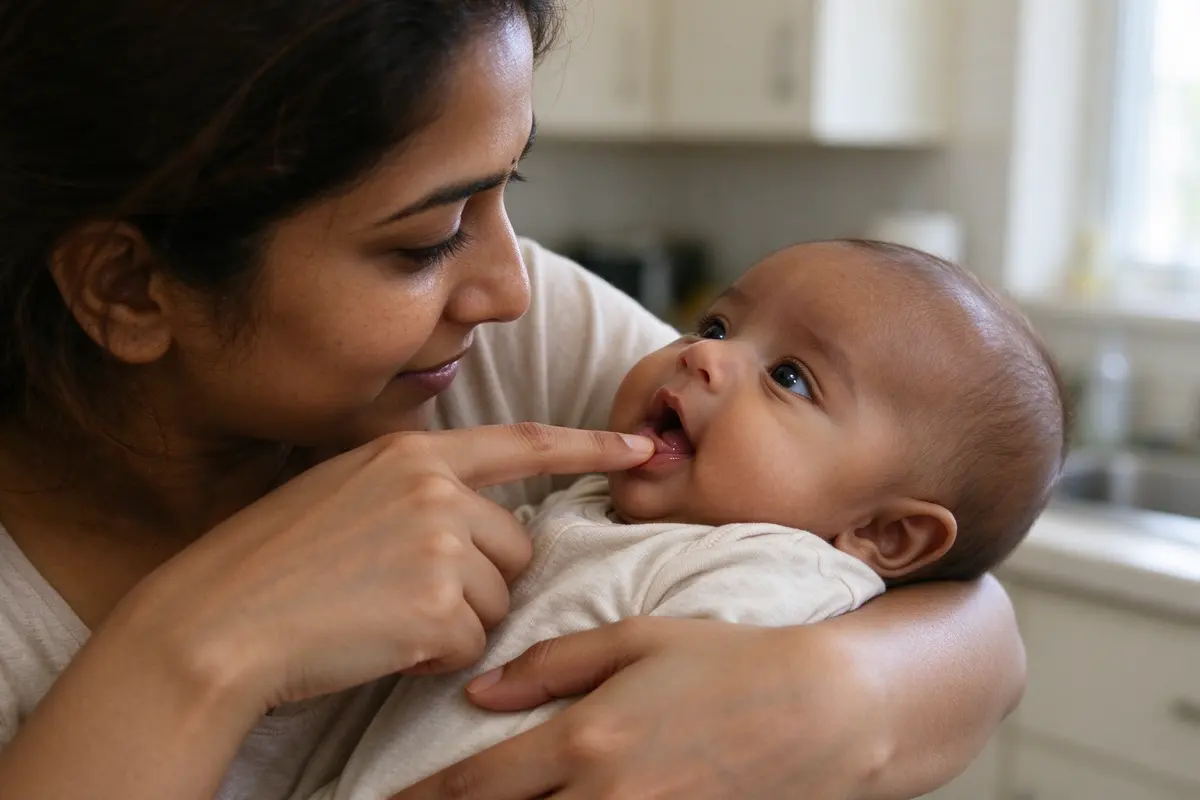
The gum rub
Time: A minute, whenever the gnawing picks up
Wash your hands, then sit your baby upright on your lap, facing you or facing out.
Slide a clean finger along the front of the lower gum, then the upper, with firm, slow circles (AAP).
Feel for a swollen or hard ridge, and look while you're there. That's your real teething check.
Follow with a firm rubber ring from the fridge, cool but never frozen (AAP).
Stop when they turn away or clamp down and fuss.
Make it work:The finger is the tool. No gel on it, ever (FDA).
Watch for
Normal
drool, gum rubbing, and a fussier day or two near a tooth (Macknin et al., 2000).
Call your pediatrician within 24 hours
about any fever at 3 to 6 months, and sooner for 104°F (40°C) or higher or a baby who seems very sick; teething doesn't cause a true fever (AAP).
Normal
a forehead that feels warm after crying.
Take a rectal temperature
to know; 100.4°F (38°C) or higher is a fever, and ear thermometers aren't for babies under 6 months (AAP).
Normal
a slight temperature rise in the days around a tooth that doesn't reach a fever (Massignan et al., 2016).
Call your pediatrician right away
if your baby cries nonstop, or cries when touched or moved (AAP).
Normal
no tooth at all this month (AAP).
Call
if your baby looks or acts very sick, or you think they need to be seen urgently (AAP).
For you

Skip the products. The teething aisle is long, and most of it is either useless or on the FDA's list of things that have hurt babies: numbing gels, homeopathic tablets, necklaces and bracelets (FDA). The whole kit is one firm rubber ring, a clean finger, and bibs (AAP). Keep the money.
When a relative or a stranger in the checkout line presses a remedy on you, one sentence closes it: "Our pediatrician said no gels and nothing around the neck." You don't owe anyone the research.
If you're the partner: you buy the ring, and you take the amber necklace conversation with whoever is offering.
Sources
- American Academy of Pediatrics. "When Does Teething Start?" HealthyChildren.org, updated 2024. https://www.healthychildren.org/English/ages-stages/baby/teething-tooth-care/Pages/Teething-4-to-7-Months.aspx
- Shu J. "Drooling Baby? Here's Why Spit Happens." HealthyChildren.org, updated 2026. https://www.healthychildren.org/English/ages-stages/baby/teething-tooth-care/Pages/Drooling-and-Your-Baby.aspx
- Macknin ML, Piedmonte M, Jacobs J, Skibinski C. "Symptoms associated with infant teething: a prospective study." Pediatrics, 2000. https://pubmed.ncbi.nlm.nih.gov/10742315/
- Massignan C, Cardoso M, Porporatti AL, et al. "Signs and Symptoms of Primary Tooth Eruption: A Meta-analysis." Pediatrics, 2016. https://pubmed.ncbi.nlm.nih.gov/26908659/
- US Food and Drug Administration. "Safely Soothing Teething Pain in Infants and Children." Updated 2024. https://www.fda.gov/consumers/consumer-updates/safely-soothing-teething-pain-and-sensory-needs-babies-and-older-children
- American Academy of Pediatrics. "Ibuprofen Dosing Table for Fever and Pain." HealthyChildren.org, updated 2024. https://www.healthychildren.org/English/safety-prevention/at-home/medication-safety/Pages/Ibuprofen-for-Fever-and-Pain.aspx
- American Academy of Pediatrics. "Fever" (symptom checker). HealthyChildren.org, accessed 2026. https://www.healthychildren.org/English/tips-tools/symptom-checker/Pages/symptomviewer.aspx?symptom=Fever
- American Academy of Pediatrics. "Fever and Your Baby." HealthyChildren.org, updated 2025. https://www.healthychildren.org/English/health-issues/conditions/fever/Pages/Fever-and-Your-Baby.aspx
This guide is general education that summarizes published research and guidance from groups like the American Academy of Pediatrics, the CDC, and the WHO. It isn’t medical advice, and every child develops on their own timeline. Your pediatrician knows your child; if something feels wrong, call them. In an emergency, call 911.
Get each day’s note the morning it applies
Add your baby to a free Chorevia household with their date of birth, and every morning for 300 days the day’s note arrives in the app and by email: what’s developing, one thing to try, what to watch for, and a word for you.
Create your household