Day 136 of 300 · Week 19
Peekaboo, month five
Last reviewed · 4 min read · 10 sources · Plain-text version
Sometime after 4 months, babies begin to learn that hidden things come back. Why the famous study is contested, why anticipation is the real game, and a cloth version to try.

You've played peekaboo for weeks. Around now, the game starts to change on your baby's side, and the change is the fun part.
Heart
Sometime after 4 months, babies begin to learn that things still exist when they're out of sight (AAP). CDC suggests peekaboo for 4-month-olds, and the AAP says hiding games help with that idea (CDC; AAP). What you'll notice first isn't understanding. It's anticipation: the kick before the pop-out, the stare at the cloth, the breath held. Your baby is learning that you come back, which is a bigger lesson than where the face went.
Head
What babies "know" here is argued about. In the famous "drawbridge" study, 5-month-olds looked longer at a screen that seemed to rotate through a hidden box, which researchers read as surprise, a sign the babies knew the box was still there (Baillargeon et al., 1985). A 1999 study found babies looked longer at the bigger rotation even with no box at all, suggesting they may simply like more motion (Rivera et al., 1999). The honest takeaway is that it's hard to measure, and that the game is worth playing for the fun of it. Repetition does stick: a brief reminder let 3-month-olds remember a learned game for 2 to 4 weeks (Rovee-Collier et al., 1980).
Body
The reward is the laugh, or the near-laugh. Chuckling when you try to make them laugh is a 4-month milestone; a full laugh is on the 6-month list, alongside taking turns making sounds and reaching for a toy they want (CDC; CDC). Reaching is why the cloth version works now: your baby can pull the cloth, which turns peekaboo into something they do.
Try today

Peekaboo with a cloth
Time: A few minutes · Peekaboo in the guide
Sit face to face on the floor, your baby on their back or propped against your knees.
Drape a light cloth over your own face, never theirs, and say, "Where's Mama?" (AAP).
Wait for the reach. If it doesn't come, guide their hand to the cloth's edge and let them tug.
Pop out with "Peekaboo!" and a big smile, then do it again, a little slower each time, so the anticipation stretches (CDC).
Stop while they're still having fun, and put the cloth away.
Make it work:The cloth is yours. It never goes over the baby's face, and it never stays in the crib (Moon, AAP).
Watch for
Normal
a stare and a kick instead of a chuckle; full laughs are a 6-month skill (CDC).
Bring it up with your pediatrician
if your baby doesn't chuckle when you try to make them laugh, or doesn't smile on their own to get your attention (CDC).
Normal
a cloth that ends up in the mouth for a chew before the next round.
Keep the crib bare:
a firm, flat surface with only a fitted sheet, for every sleep (Moon, AAP).
Normal
a mouthful of spit-up after a big laughing round on a full stomach.
Go to the ER now
if your baby vomits green (bile) or blood (AAP).
For you
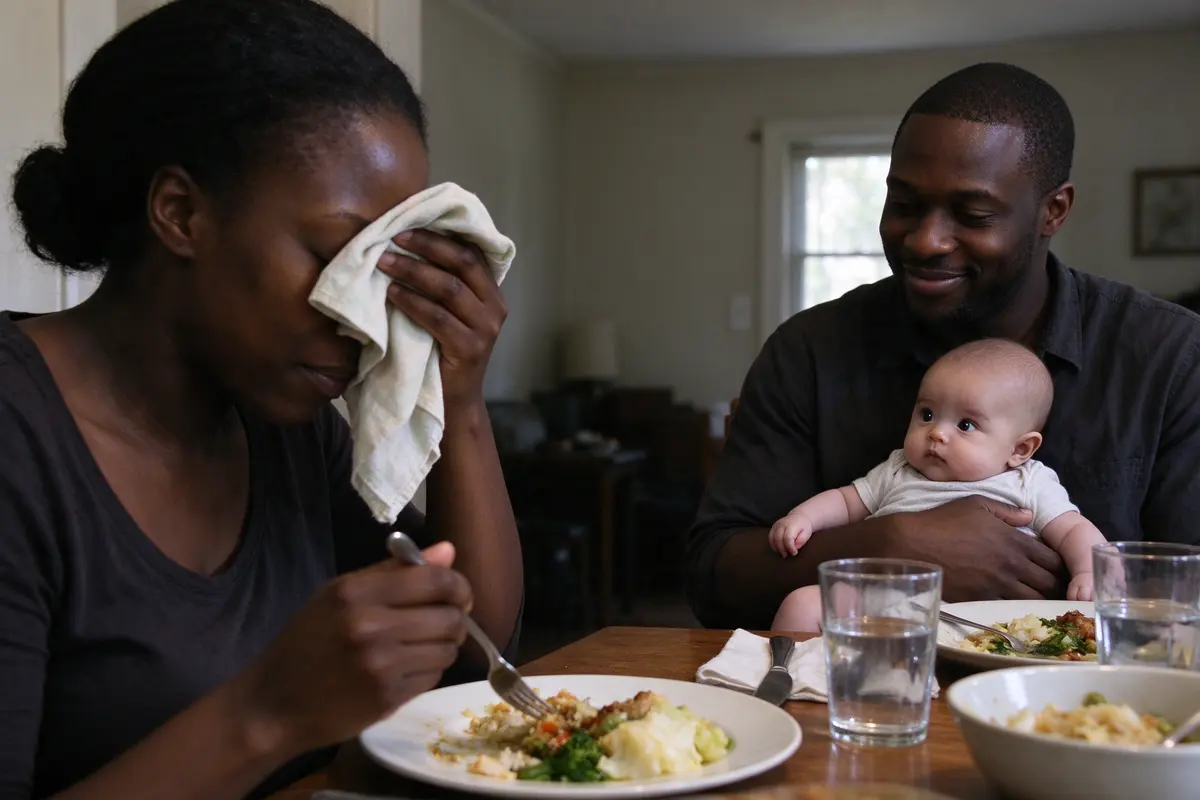
The game at the dinner table. You're allowed to eat sitting down, and peekaboo is the rare activity that happens while you do: a napkin over your eyes between bites, the baby on someone's lap across from you, "Where's Mama?" with your mouth full. The exchanges count. When your baby babbles or looks and you answer with your face, those back-and-forths help build brain circuits (Harvard Center on the Developing Child). Hiding games are exactly the AAP's suggestion for this age (AAP); nobody said they had to happen on the floor.
Plenty of water and fresh fruits and vegetables on that plate are the plain fix for constipation after birth (OWH). Finish the plate before the baby goes back on your lap.
If you're the partner: you hold the baby for the whole meal, facing her. She does the napkin. You do the dishes.
Sources
- American Academy of Pediatrics. "Cognitive Development in Infants: 4 to 7 Months." HealthyChildren.org, updated 2023. https://www.healthychildren.org/English/ages-stages/baby/Pages/Cognitive-Development-4-to-7-Months.aspx
- Centers for Disease Control and Prevention. "Milestones by 4 Months." Learn the Signs. Act Early., updated 2026. https://www.cdc.gov/act-early/milestones/4-months.html
- Baillargeon R, Spelke ES, Wasserman S. "Object permanence in five-month-old infants." Cognition, 1985. https://pubmed.ncbi.nlm.nih.gov/4064606/
- Rivera SM, Wakeley A, Langer J. "The drawbridge phenomenon: representational reasoning or perceptual preference?" Developmental Psychology, 1999. https://pubmed.ncbi.nlm.nih.gov/10082013/
- Rovee-Collier CK, Sullivan MW, Enright M, Lucas D, Fagen JW. "Reactivation of infant memory." Science, 1980. https://pubmed.ncbi.nlm.nih.gov/7375924/
- Centers for Disease Control and Prevention. "Milestones by 6 Months." Learn the Signs. Act Early., updated 2026. https://www.cdc.gov/act-early/milestones/6-months.html
- Moon RY. "How to Keep Your Sleeping Baby Safe: AAP Policy Explained." HealthyChildren.org, updated 2026. https://www.healthychildren.org/English/ages-stages/baby/sleep/Pages/a-parents-guide-to-safe-sleep.aspx
- American Academy of Pediatrics. "Vomiting Without Diarrhea" (symptom checker). HealthyChildren.org, accessed 2026. https://www.healthychildren.org/English/tips-tools/symptom-checker/Pages/symptomviewer.aspx?symptom=Vomiting+Without+Diarrhea
- Center on the Developing Child at Harvard University. "Serve and Return." Accessed 2026. https://developingchild.harvard.edu/key-concept/serve-and-return/
- Office on Women's Health. "Recovering from birth." US Department of Health and Human Services. https://womenshealth.gov/pregnancy/childbirth-and-beyond/recovering-birth
This guide is general education that summarizes published research and guidance from groups like the American Academy of Pediatrics, the CDC, and the WHO. It isn’t medical advice, and every child develops on their own timeline. Your pediatrician knows your child; if something feels wrong, call them. In an emergency, call 911.
Get each day’s note the morning it applies
Add your baby to a free Chorevia household with their date of birth, and every morning for 300 days the day’s note arrives in the app and by email: what’s developing, one thing to try, what to watch for, and a word for you.
Create your household