Day 137 of 300 · Week 19
Books, month five
Last reviewed · 4 min read · 13 sources · Plain-text version
Shared reading from birth is the AAP's advice, and a randomized trial found fewer behavior problems years later. How to read to a baby who eats the book, and a point-and-name game.
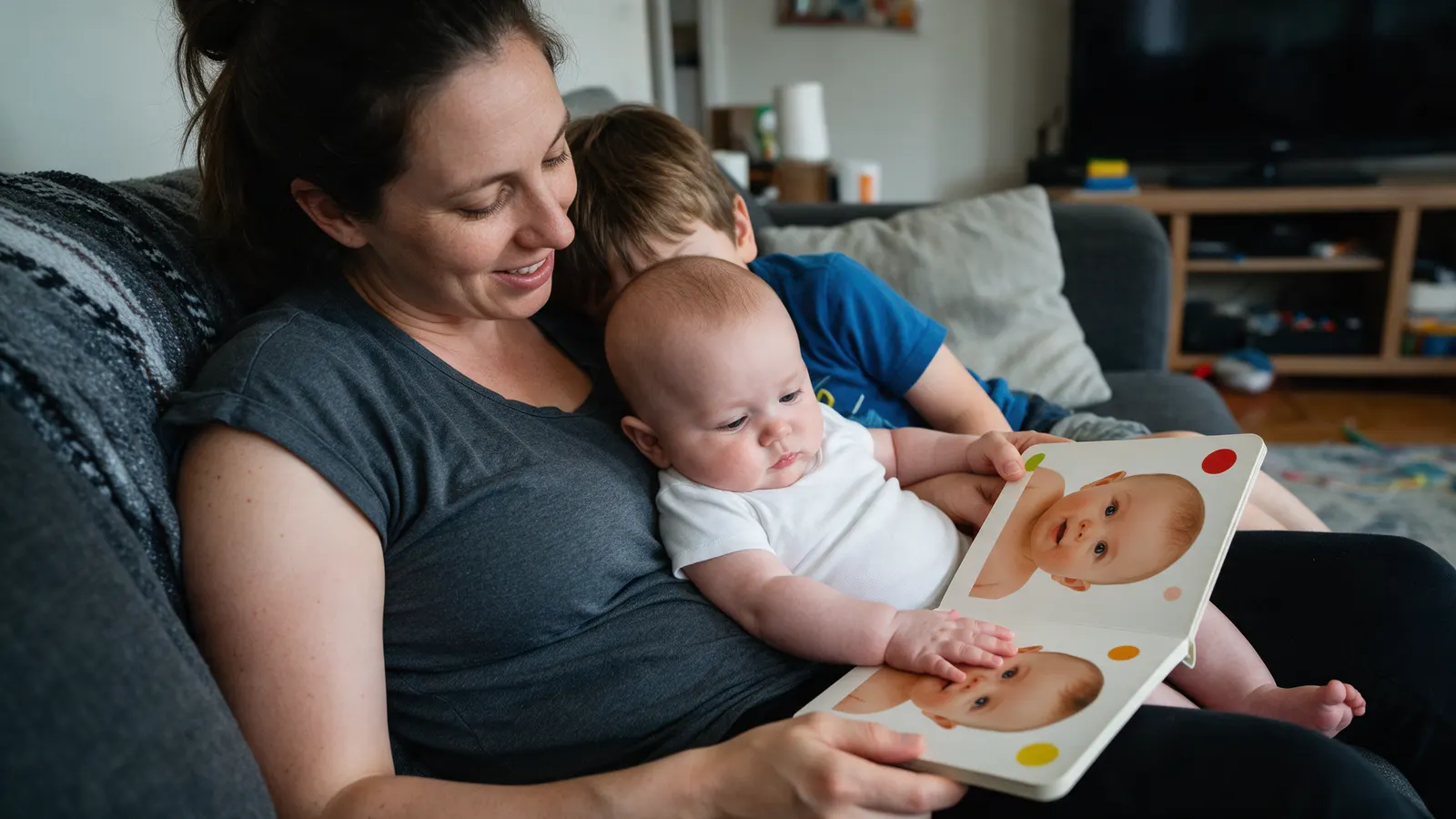
The book gets chewed more than read. That's fine. Today is about why the reading still counts, and how to do it with a baby who grabs.
Heart
The AAP recommends shared reading starting at birth, based on research linking it to language, literacy, and social-emotional development (Klass et al., 2024). At this age, that means a board or cloth book with bright pictures or faces, your baby allowed to hold, pat, and mouth it, and you pointing and naming in a lively voice (AAP). It doesn't matter what you read; the time together is what counts (AAP).
Head
The strongest evidence comes from a trial. In a randomized trial at a New York public hospital clinic, coaching parents to read and play with children from birth to age 3 led to fewer behavior problems at age 4½ (Mendelsohn et al., 2018). That's years away, and the mechanism is the same as the one you're already using: back-and-forth. In a study of 40 three-month-olds, babies whose adult partner answered in a rhythm made more speech-like sounds than babies whose partner responded at random times (Bloom et al., 1987). A book gives you something to answer about.
Body
At 4 months, babies see colors and shades better and may love circles and spirals, one reason faces are so appealing (AAP), which is why the baby-faces book wins. The hands are the other half: by 4 months, most babies can easily bring objects to their mouth (AAP), and CDC suggests easy-to-grip toys like cloth books (CDC). So a page in the mouth isn't a failed reading. It's the same book, read with a different sense.
Try today
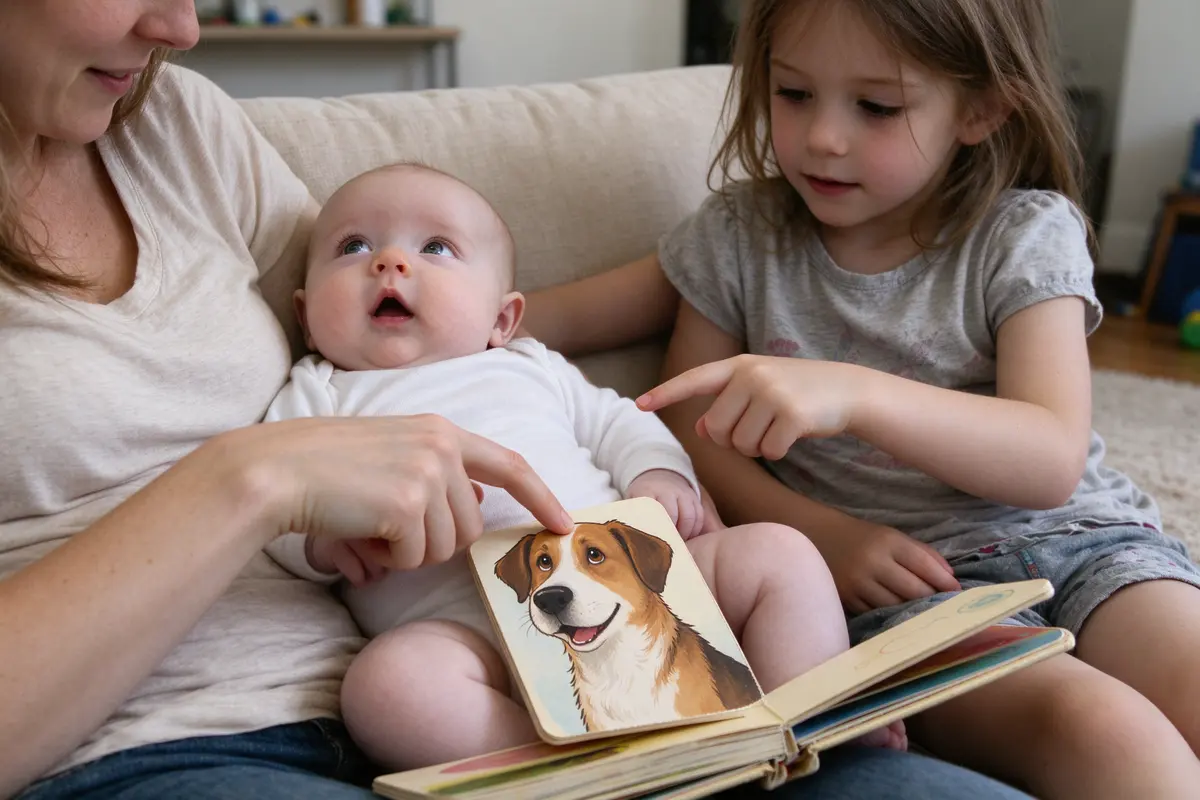
Point and name
Time: 5 minutes, once or twice a day · Board book time in the guide
Choose a board or cloth book with big faces or single bold pictures, and settle your baby on your lap with their back against you.
Point to one thing and name it, slowly: "Dog. Big dog." Then pause (AAP).
Watch where your baby's eyes or hand go, and name that instead, even if it's the corner of the page.
When a sound comes, repeat it, then add a word that has it: "Bah? Bah! Ball" (AAP).
Let them hold, pat, and mouth the book between pages; close it when they look away.
Make it work:Board and cloth books only for now. Paper tears, and small pieces go in the mouth.
Watch for
Normal
a corner of the board book soggy and dented from chewing (AAP).
Call your pediatrician right away
if your baby swallowed a small object, such as a torn scrap, but seems fine (AAP).
Normal
eyes that drift briefly when they're tired.
Normal
one page held in a long stare, then a hard look away that means "done."
Call your pediatrician right away
if your baby has a fever of 104°F (40°C) or higher, or looks or acts very sick (AAP).
For you
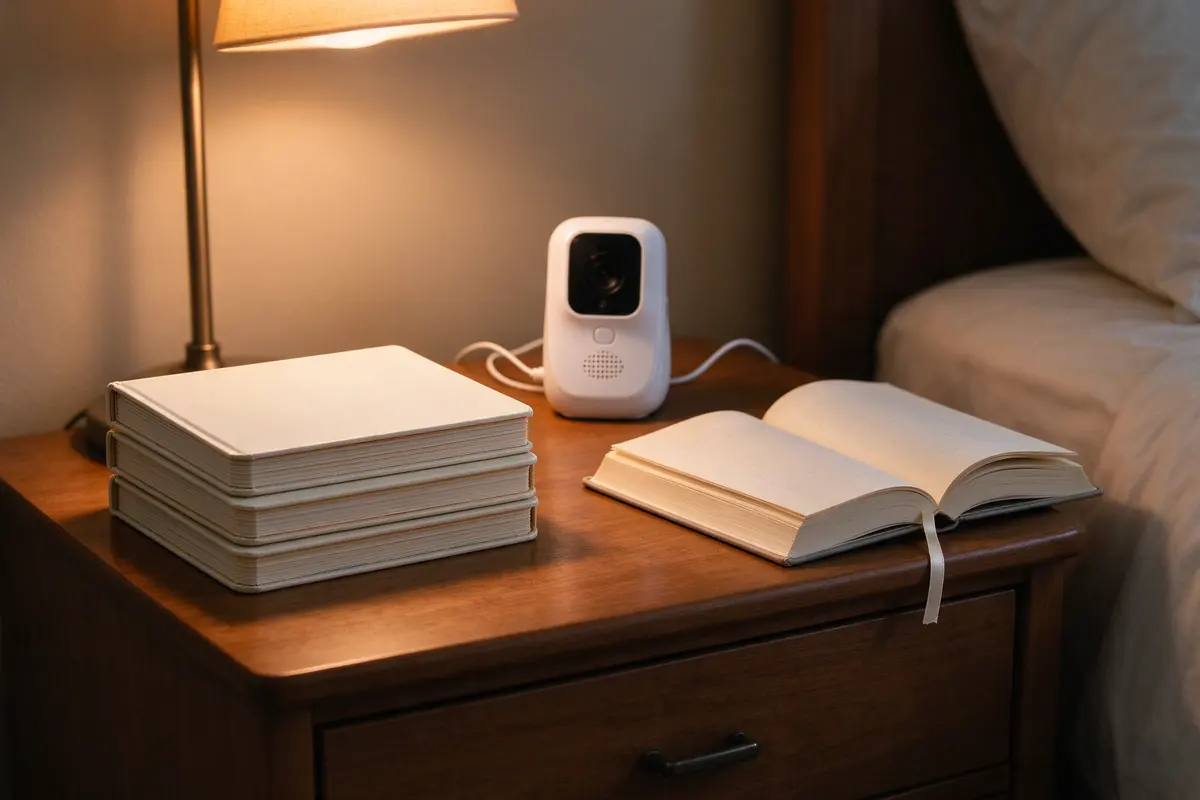
The same three books forever is fine. Repetition is the feature, not the failure: in a classic study, a brief reminder let 3-month-olds remember a learned game for 2 to 4 weeks (Rovee-Collier et al., 1980). A book your baby has heard forty times is a book they can anticipate, and the AAP's own line is that it doesn't matter what you read (AAP). Stop feeling you should rotate.
Then put a book of your own on the nightstand, the one you were reading before. Ten pages while someone else holds the baby is a real thing, and it's yours. If you find you can't focus on a page at all, for weeks, and the flatness goes beyond tired, that's a reason to see your doctor rather than wait (OWH).
If you're the partner: one of the three books is yours, in your voice, same words every night. The baby will know the difference.
Sources
- Klass P, Miller-Fitzwater A, High PC; AAP Council on Early Childhood. "Literacy Promotion: An Essential Component of Primary Care Pediatric Practice: Policy Statement." Pediatrics, 2024. https://pubmed.ncbi.nlm.nih.gov/39342414/
- American Academy of Pediatrics. "Checkup Checklist: 4 Months Old." HealthyChildren.org, updated 2023. https://www.healthychildren.org/English/ages-stages/Your-Childs-Checkups/Pages/Your-Checkup-Checklist-4-Months-Old.aspx
- Mendelsohn AL, Cates CB, Weisleder A, et al. "Reading Aloud, Play, and Social-Emotional Development." Pediatrics, 2018. https://pubmed.ncbi.nlm.nih.gov/29632254/
- Bloom K, Russell A, Wassenberg K. "Turn taking affects the quality of infant vocalizations." Journal of Child Language, 1987. https://doi.org/10.1017/s0305000900012897
- American Academy of Pediatrics. "Infant Vision Development: What Can Babies See?" HealthyChildren.org, updated 2024. https://www.healthychildren.org/English/ages-stages/baby/Pages/Babys-Vision-Development.aspx
- American Academy of Pediatrics. "Movement Milestones: Babies 4 to 7 Months." HealthyChildren.org, updated 2021. https://www.healthychildren.org/English/ages-stages/baby/Pages/Movement-4-to-7-Months.aspx
- Centers for Disease Control and Prevention. "Milestones by 4 Months." Learn the Signs. Act Early., updated 2026. https://www.cdc.gov/act-early/milestones/4-months.html
- American Academy of Pediatrics. "Language Development: 4 to 7 Months." HealthyChildren.org, updated 2009. https://www.healthychildren.org/English/ages-stages/baby/Pages/Language-Development-4-to-7-Months.aspx
- American Academy of Pediatrics. "Swallowed Foreign Object" (symptom checker). HealthyChildren.org, accessed 2026. https://www.healthychildren.org/English/tips-tools/symptom-checker/Pages/symptomviewer.aspx?symptom=Swallowed+Foreign+Object
- American Academy of Pediatrics. "Developmental Milestones: 7 Months." HealthyChildren.org, updated 2009. https://www.healthychildren.org/English/ages-stages/baby/Pages/Developmental-Milestones-7-Months.aspx
- American Academy of Pediatrics. "Fever" (symptom checker). HealthyChildren.org, accessed 2026. https://www.healthychildren.org/English/tips-tools/symptom-checker/Pages/symptomviewer.aspx?symptom=Fever
- Rovee-Collier CK, Sullivan MW, Enright M, Lucas D, Fagen JW. "Reactivation of infant memory." Science, 1980. https://pubmed.ncbi.nlm.nih.gov/7375924/
- Office on Women's Health. "Recovering from birth." US Department of Health and Human Services. https://womenshealth.gov/pregnancy/childbirth-and-beyond/recovering-birth
This guide is general education that summarizes published research and guidance from groups like the American Academy of Pediatrics, the CDC, and the WHO. It isn’t medical advice, and every child develops on their own timeline. Your pediatrician knows your child; if something feels wrong, call them. In an emergency, call 911.
Get each day’s note the morning it applies
Add your baby to a free Chorevia household with their date of birth, and every morning for 300 days the day’s note arrives in the app and by email: what’s developing, one thing to try, what to watch for, and a word for you.
Create your household