Day 124 of 300 · Week 17
Babble begins
Last reviewed · 3 min read · 10 sources · Plain-text version
Babbling often starts around 4 months with the rise and fall of your own language. Copy the sound, then add a word, and count how many turns you can keep going.
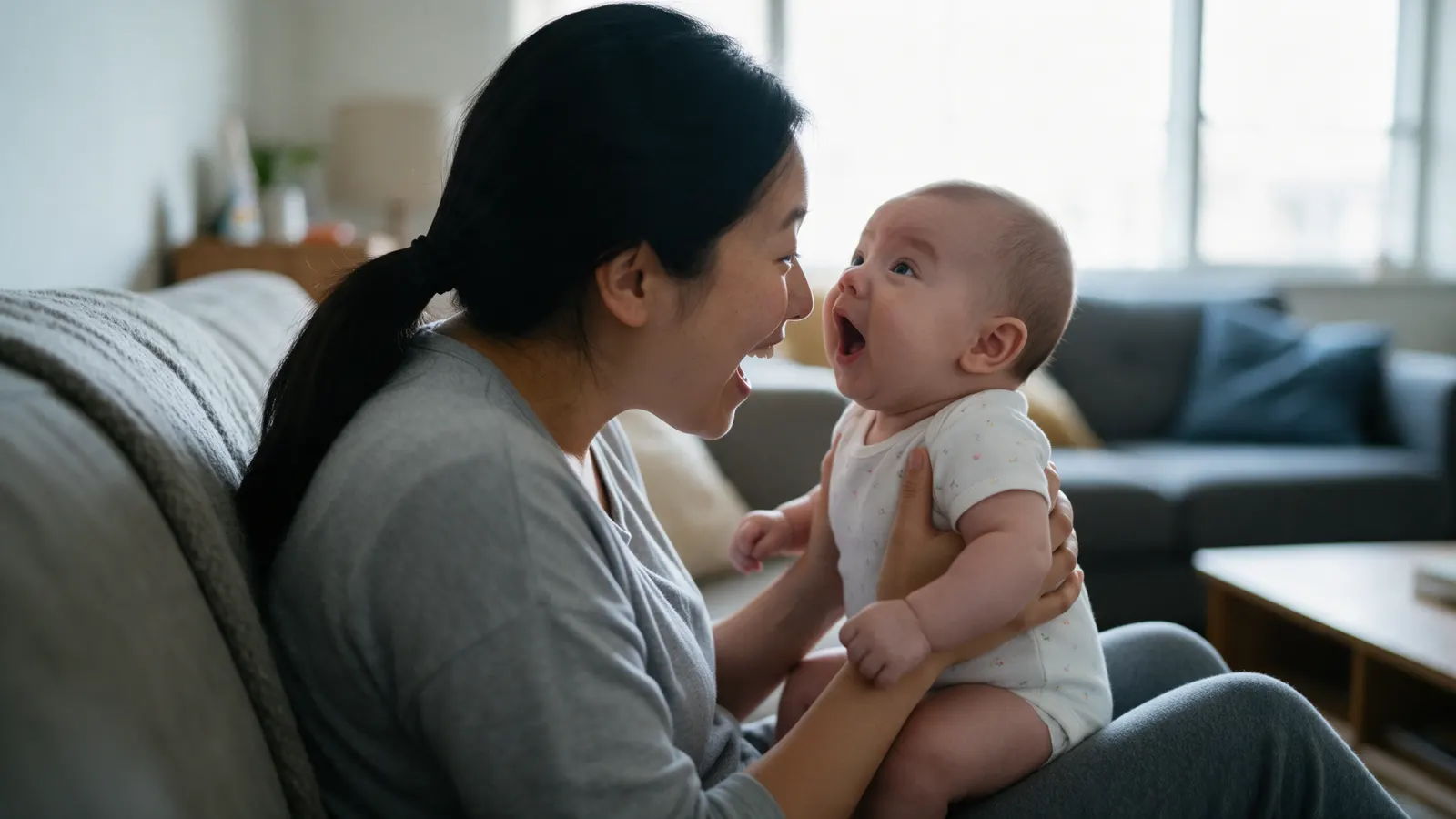
Listen for the sounds that go up at the end. That's your language, coming back at you.
Heart
Babbling often starts around 4 months, and it carries the rise and fall of the language you speak, so a string of sounds can come out like a question or a statement (AAP). By 4 months most babies coo, make sounds back when you talk, and turn toward your voice (CDC), and many amuse themselves with strange new sounds and grow more sensitive to your tone of voice (AAP). Squeals and raspberries are 6-month milestones, so if those have arrived early, enjoy them (CDC).
Head
The research is about rhythm. In a study of 40 three-month-olds, babies whose adult partner answered in a back-and-forth rhythm made more speech-like sounds than babies whose partner responded at random times (Bloom et al., 1987). Every time you answer a babble with eye contact, words, or a hug, that exchange helps build brain circuits (Harvard Center on the Developing Child). The AAP's version: when your baby lands on a sound, repeat it back, then say simple words that contain it (AAP).
Body
Their name is in the mix. In a lab, 4½-month-olds preferred listening to their own name over other names, even names with the same rhythm (Mandel et al., 1995), though looking when you call it doesn't show up on CDC's checklist until 9 months (CDC). Say it often (CDC). And keep the talking real: CDC limits screens to video calls with loved ones before age 2 (CDC), and the AAP says babies under 18 months learn best from real-world interactions (Munzer, AAP).
Try today
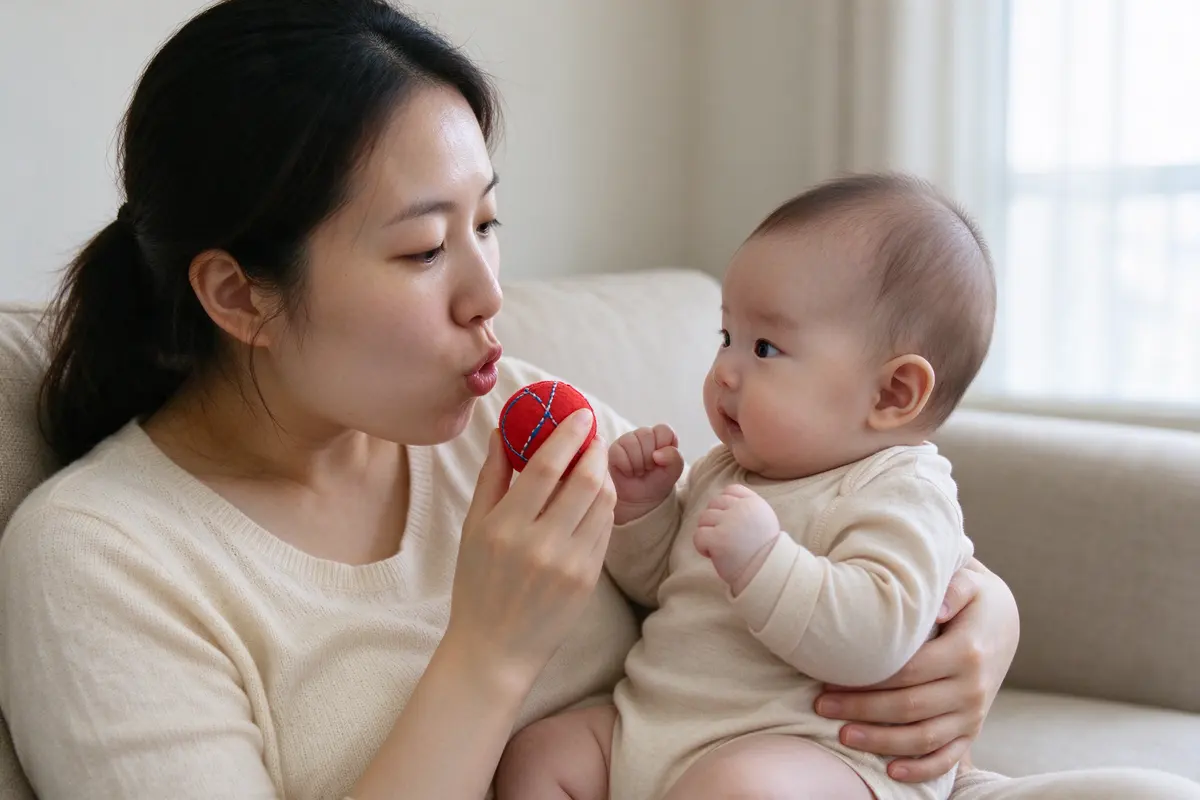
Copy, then add a word
Time: 2 to 5 minutes, during a calm, alert stretch · Sound copycat in the guide
Wait for a sound. Don't start the conversation; let them.
Copy it back, with a smile, and pause.
Add a word that holds the sound: "Bah? Bah! Ball. Bottle. Baa, baa, black sheep" (AAP).
Pause again and say, "Your turn." Count how many turns you keep going.
Make it work:The turns matter more than the words (Bloom et al., 1987). If they look away, the conversation is over for now.
Watch for
Normal
growls, squeals, and raspberries that show up one day and vanish for a week; squeals and raspberries are 6-month milestones (CDC).
Bring it up
if your baby doesn't coo, make sounds back to you, or turn toward your voice (CDC).
Normal
a frown when your voice goes sharp; they're newly sensitive to tone (AAP).
Call your pediatrician right away
if your baby cries nonstop, or cries when touched or moved (AAP).
Normal
a quiet day after a noisy one.
Bring it up
if your baby has lost skills they used to have (CDC).
For you
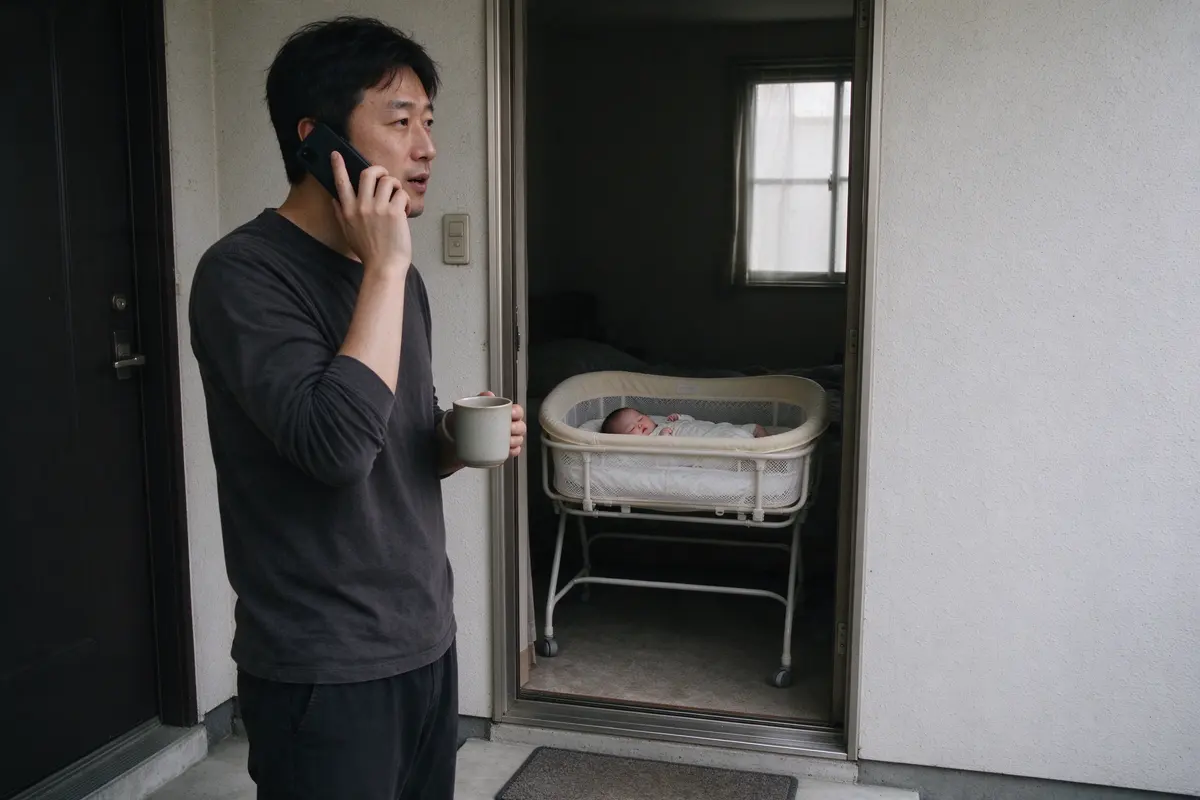
Your tone counts. Around 4 months babies grow more sensitive to the tone of your voice (AAP), which means they hear the music before the words. The words can be anything: the grocery list, the thing you're worried about, a complaint about the laundry. Say them warmly and the baby gets a conversation out of it. Save the sharp edges for an adult who can answer back, today if you can; a phone call counts.
If you're the partner: you're the second instrument. Your voice, your copying, your turn.
Sources
- American Academy of Pediatrics. "Language Development: 4 to 7 Months." HealthyChildren.org, 2009. https://www.healthychildren.org/English/ages-stages/baby/Pages/Language-Development-4-to-7-Months.aspx
- Centers for Disease Control and Prevention. "Milestones by 4 Months." Learn the Signs. Act Early., 2026. https://www.cdc.gov/act-early/milestones/4-months.html
- American Academy of Pediatrics. "Hearing & Making Sounds: Your Baby's Milestones." HealthyChildren.org, 2021. https://www.healthychildren.org/English/ages-stages/baby/Pages/Hearing-and-Making-Sounds.aspx
- Centers for Disease Control and Prevention. "Milestones by 6 Months." Learn the Signs. Act Early., 2026. https://www.cdc.gov/act-early/milestones/6-months.html
- Bloom K, Russell A, Wassenberg K. "Turn taking affects the quality of infant vocalizations." Journal of Child Language, 1987. https://doi.org/10.1017/s0305000900012897
- Center on the Developing Child at Harvard University. "Serve and Return." 2026. https://developingchild.harvard.edu/key-concept/serve-and-return/
- Mandel DR, Jusczyk PW, Pisoni DB. "Infants' recognition of the sound patterns of their own names." Psychological Science, 1995. https://pubmed.ncbi.nlm.nih.gov/25152566/
- Centers for Disease Control and Prevention. "Milestones by 9 Months." Learn the Signs. Act Early., 2026. https://www.cdc.gov/act-early/milestones/9-months.html
- Munzer T. "Helping Kids Thrive in a Digital World: AAP Policy Explained." HealthyChildren.org, 2026. https://www.healthychildren.org/English/family-life/Media/Pages/helping-kids-thrive-in-a-digital-world-AAP-policy-explained.aspx
- American Academy of Pediatrics. "Fever" (symptom checker). HealthyChildren.org, 2026. https://www.healthychildren.org/English/tips-tools/symptom-checker/Pages/symptomviewer.aspx?symptom=Fever
This guide is general education that summarizes published research and guidance from groups like the American Academy of Pediatrics, the CDC, and the WHO. It isn’t medical advice, and every child develops on their own timeline. Your pediatrician knows your child; if something feels wrong, call them. In an emergency, call 911.
Get each day’s note the morning it applies
Add your baby to a free Chorevia household with their date of birth, and every morning for 300 days the day’s note arrives in the app and by email: what’s developing, one thing to try, what to watch for, and a word for you.
Create your household